
What Separates the Three Classes
Algae are divided into Chlorophyceae, Phaeophyceae and Rhodophyceae on four things:
- Major pigments
- Stored food
- Cell wall
- Flagella - number and position of insertion
(Habitat is usually listed alongside, though it overlaps between the classes.)
That four-part scheme is the answer to "what is the basis of classification of algae?" - and every row of the comparison table at the end of this section is asked somewhere.
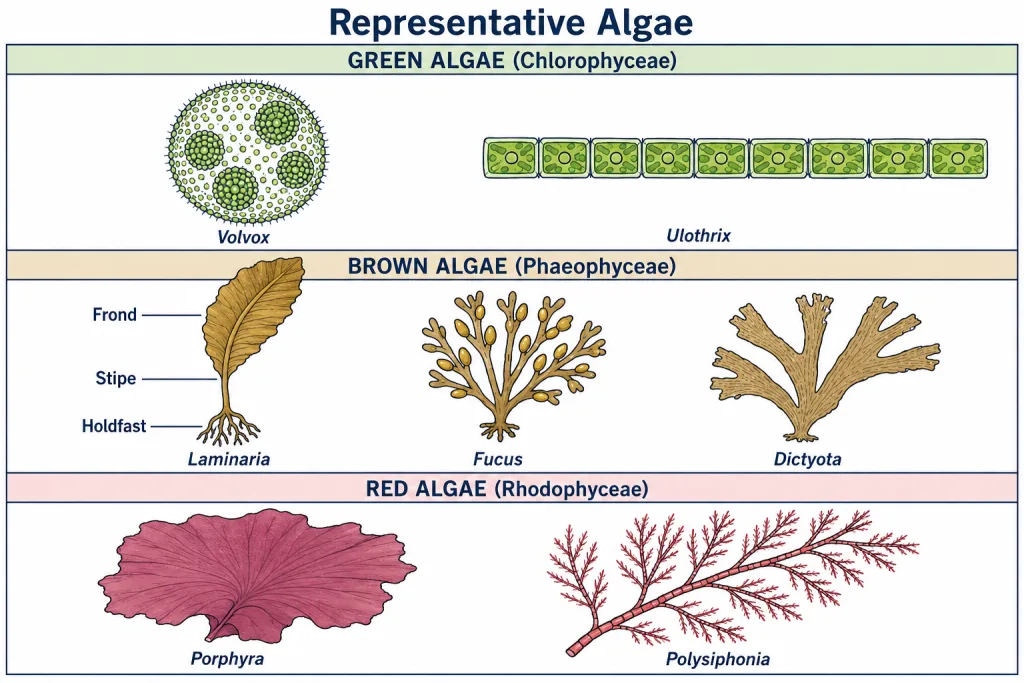
Chlorophyceae - the Green Algae
Body: may be unicellular, colonial or filamentous.
Colour and pigments: usually grass green, due to the dominance of chlorophyll a and b. The pigments are localised in definite chloroplasts.
Chloroplast shapes - a favourite recall list. They may be:
discoid - plate-like - reticulate - cup-shaped - spiral - ribbon-shaped
Pyrenoids: most members have one or more storage bodies called pyrenoids located in the chloroplasts. Pyrenoids contain protein besides starch. Some algae may also store food in the form of oil droplets.
Cell wall: rigid, with an inner layer of cellulose and an outer layer of pectose.
Reproduction
- Vegetative: usually by fragmentation.
- Asexual: by flagellated zoospores produced in zoosporangia.
- Sexual: shows considerable variation in the type and formation of sex cells - it may be isogamous, anisogamous or oogamous.
Common members: Chlamydomonas, Volvox, Ulothrix, Spirogyra and Chara.
[NEET Important] Two details are asked more than the rest: pyrenoids contain protein besides starch (not starch alone), and the two-layered wall - cellulose inside, pectose outside. Also note that green and brown algae both show all three types of sexual reproduction, while red algae are oogamous only.
Phaeophyceae - the Brown Algae
Habitat: found primarily in marine habitats.
Size and form: great variation - from simple branched filamentous forms (Ectocarpus) to profusely branched kelps, which may reach a height of 100 metres.
Pigments: chlorophyll a and c, carotenoids and xanthophylls. The colour varies from olive green to various shades of brown, depending on the amount of the xanthophyll pigment fucoxanthin present.
Stored food: complex carbohydrates - laminarin or mannitol.
Cell wall: cellulosic, usually covered on the outside by a gelatinous coating of algin.
Protoplast: contains, besides plastids, a centrally located vacuole and a nucleus.
Body plan - three named parts, and this is the only algal class with them:
| Part | What it is |
|---|---|
| Holdfast | Attaches the plant body to the substratum |
| Stipe | The stalk |
| Frond | The leaf-like photosynthetic organ |
Reproduction
- Vegetative: by fragmentation.
- Asexual: in most brown algae by biflagellate zoospores that are pear-shaped and have two unequal laterally attached flagella.
- Sexual: may be isogamous, anisogamous or oogamous. Union of gametes may take place in water or within the oogonium (in oogamous species). The gametes are pyriform (pear-shaped) and bear two laterally attached flagella.
Common forms: Ectocarpus, Dictyota, Laminaria, Sargassum and Fucus.
[NEET Important] Fucoxanthin is the pigment that sets the brown colour - a one-word answer that appears every year in some form. And the flagellar description is precise: two, unequal, laterally attached - contrast the green algae's equal, apical flagella.
Rhodophyceae - the Red Algae
Why red: because of the predominance of the red pigment r-phycoerythrin in their body.
Habitat: the majority are marine, with greater concentrations in the warmer areas. They occur both in well-lighted regions close to the surface of water and at great depths in oceans where relatively little light penetrates.
Body: the red thalli of most red algae are multicellular, and some have complex body organisation.
Stored food: floridean starch, which is very similar to amylopectin and glycogen in structure.
Reproduction
- Vegetative: usually by fragmentation.
- Asexual: by non-motile spores.
- Sexual: by non-motile gametes; reproduction is oogamous and accompanied by complex post-fertilisation developments.
Common members: Polysiphonia, Porphyra, Gracilaria and Gelidium.
[NEET Important] Red algae are the only class with no flagella at all - spores non-motile, gametes non-motile. That single fact answers a whole family of questions. Their ability to live at great depths follows from phycoerythrin absorbing the blue-green light that penetrates deepest.
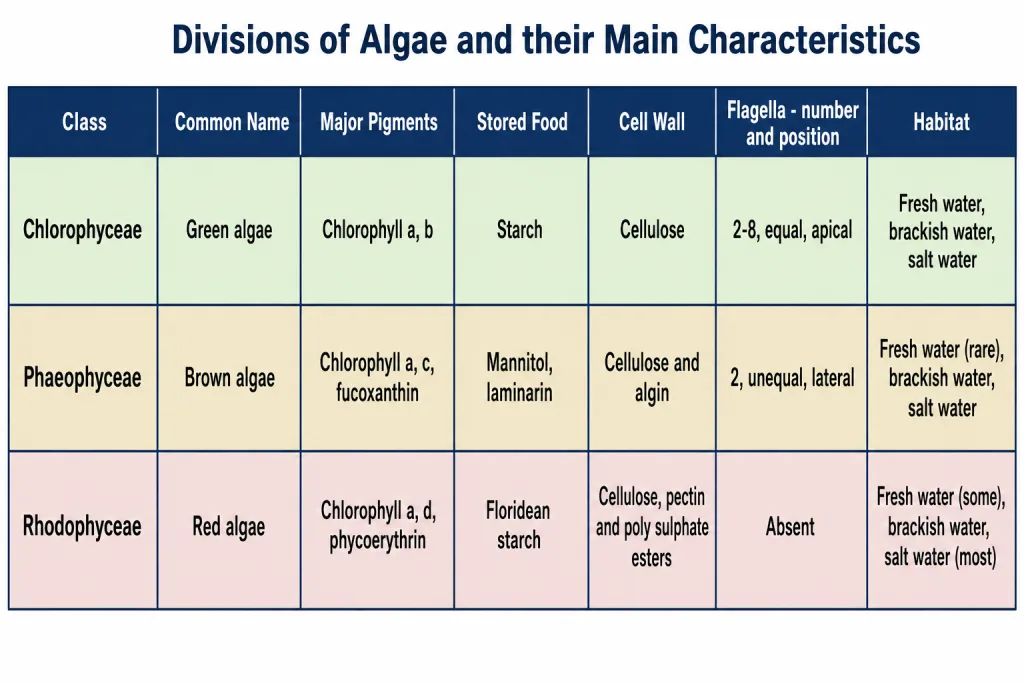
The Comparison Table
This is the table to reproduce from memory. Learn it by row, not by class, because that is how match-the-column questions are built.
| Chlorophyceae | Phaeophyceae | Rhodophyceae | |
|---|---|---|---|
| Common name | Green algae | Brown algae | Red algae |
| Major pigments | Chlorophyll a, b | Chlorophyll a, c, fucoxanthin | Chlorophyll a, d, phycoerythrin |
| Stored food | Starch | Mannitol, laminarin | Floridean starch |
| Cell wall | Cellulose | Cellulose and algin | Cellulose, pectin and poly sulphate esters |
| Flagella - number and position | 2-8, equal, apical | 2, unequal, lateral | Absent |
| Habitat | Fresh water, brackish water, salt water | Fresh water (rare), brackish water, salt water | Fresh water (some), brackish water, salt water (most) |
Three things to lock in from the table:
- Chlorophyll a is present in all three. The second pigment is the discriminator - b, c, d in that order, green to brown to red. That alphabetical run is the easiest way to remember it.
- Flagella: equal and apical in green, unequal and lateral in brown, absent in red.
- Brown algae are only rarely fresh water; most red algae are salt water.
Quick Recap
- Basis of classification: major pigments, stored food, cell wall, and flagellar number and position of insertion.
- Chlorophyceae (green): unicellular, colonial or filamentous; grass green from chlorophyll a and b in definite chloroplasts that may be discoid, plate-like, reticulate, cup-shaped, spiral or ribbon-shaped; pyrenoids contain protein besides starch; wall of inner cellulose and outer pectose; zoospores in zoosporangia; sexual reproduction isogamous, anisogamous or oogamous. Chlamydomonas, Volvox, Ulothrix, Spirogyra, Chara.
- Phaeophyceae (brown): primarily marine; from filamentous Ectocarpus to kelps up to 100 metres; chlorophyll a and c, carotenoids, xanthophylls, colour set by fucoxanthin; food stored as laminarin or mannitol; cellulosic wall coated with algin; body of holdfast, stipe and frond; pear-shaped biflagellate zoospores with two unequal lateral flagella; pyriform gametes with two lateral flagella; union of gametes in water or within the oogonium. Ectocarpus, Dictyota, Laminaria, Sargassum, Fucus.
- Rhodophyceae (red): red from r-phycoerythrin; majority marine, commonest in warmer areas, growing near the surface and at great depths; multicellular thalli, some with complex body organisation; floridean starch, similar to amylopectin and glycogen; non-motile spores and gametes; oogamous with complex post-fertilisation developments. Polysiphonia, Porphyra, Gracilaria, Gelidium.
Solved Examples
Question 1
Q. What is the basis of classification of algae?
Answer. You split algae into Chlorophyceae, Phaeophyceae and Rhodophyceae using four things - major pigments, stored food, cell wall composition, and the number and position of insertion of flagella.
Question 2
Q. Which pigment gives brown algae their colour?
Answer. The xanthophyll pigment fucoxanthin.
Question 3
Q. Name the stored food of red algae.
Answer. Floridean starch, which is very similar to amylopectin and glycogen in structure.
Question 4
Q. Name the three parts of a brown algal plant body.
Answer. Holdfast (attaches to the substratum), stipe (the stalk) and frond (the leaf-like photosynthetic organ).
Question 5
Q. Which algal class has no flagella?
Answer. Rhodophyceae - the red algae. Their spores and gametes are both non-motile.
Question 6
Q. An alga stores mannitol, has a cellulosic wall coated with algin, and bears two unequal lateral flagella. Name its class and one genus.
Answer. Class: Phaeophyceae, the brown algae. Each clue matches: mannitol or laminarin is their stored food, the wall is cellulose plus algin, and the flagella are two, unequal and laterally attached.
Genus: any of Ectocarpus, Dictyota, Laminaria, Sargassum, Fucus.
Question 7
Q. Differentiate red algae and brown algae.
Answer.
| Red algae (Rhodophyceae) | Brown algae (Phaeophyceae) | |
|---|---|---|
| Major pigments | Chlorophyll a, d and r-phycoerythrin | Chlorophyll a, c and fucoxanthin |
| Stored food | Floridean starch | Mannitol, laminarin |
| Cell wall | Cellulose, pectin and poly sulphate esters | Cellulose and algin |
| Flagella | Absent | Two, unequal, lateral |
| Habitat | Mostly salt water, warmer areas, including great depths | Primarily marine; fresh water rare |
| Sexual reproduction | Oogamous, with complex post-fertilisation development | Isogamous, anisogamous or oogamous |
| Examples | Polysiphonia, Porphyra, Gracilaria, Gelidium | Ectocarpus, Dictyota, Laminaria, Sargassum, Fucus |
Question 8
Q. What are pyrenoids and what do they contain?
Answer. Pyrenoids are storage bodies located in the chloroplasts of most members of Chlorophyceae. They contain protein besides starch. Some green algae also store food as oil droplets.
Question 9
Q. Describe the cell wall of green algae.
Answer. Green algae usually have a rigid cell wall made of an inner layer of cellulose and an outer layer of pectose.
Question 10
Q. List the chloroplast shapes found in green algae.
Answer. Discoid, plate-like, reticulate, cup-shaped, spiral and ribbon-shaped, varying between species.
Question 11
Q. State the major pigments of all three algal classes in order.
Answer. Chlorophyceae: chlorophyll a, b. Phaeophyceae: chlorophyll a, c, plus fucoxanthin. Rhodophyceae: chlorophyll a, d, plus phycoerythrin.
Note the pattern: chlorophyll a is common to all three, and the second chlorophyll runs b, c, d from green through brown to red.
Question 12
Q. Red algae grow both near the surface and at great depths in the ocean. Explain how their pigment makes this possible.
Answer. Red algae carry the red pigment r-phycoerythrin on top of chlorophyll a and d. Water soaks up the longer red wavelengths first, so deep down the light that is left is mostly blue-green. Phycoerythrin absorbs in exactly that blue-green range and passes the energy on to chlorophyll, so red algae can still photosynthesise where light is scarce and the reddish wavelengths have already been filtered out. That is why you find them at great depths in oceans where relatively little light penetrates, and also in well-lighted regions close to the surface.
Question 13
Q. Green algae show all three types of sexual reproduction while red algae show only one. Comment on what this says about the two classes.
Answer. In Chlorophyceae, sexual reproduction shows considerable variation in the type and formation of sex cells and may be isogamous, anisogamous or oogamous. So in this one class you can still see the whole series, from equal gametes all the way to a large egg plus a small sperm.
In Rhodophyceae, sexual reproduction is oogamous only, and it is accompanied by complex post-fertilisation developments. Their gametes are also non-motile, so fertilisation depends on water currents carrying the male gamete to the female - nothing swims across.
So one class has kept the full range of ancestral conditions, while the other has settled on the most specialised one and built up what happens after fertilisation.
Question 14
Q. Three unlabelled algal samples are analysed. Sample A: chlorophyll a and b, starch, cellulose wall, four equal apical flagella. Sample B: no flagella at all, floridean starch. Sample C: pear-shaped zoospores with two unequal lateral flagella, wall coated with a gelatinous substance. Identify each and name one genus for each.
Answer.
- Sample A: Chlorophyceae (green algae). Chlorophyll a and b, starch, a cellulose wall and 2-8 equal apical flagella are all diagnostic. Genus: Chlamydomonas, Volvox, Ulothrix, Spirogyra or Chara.
- Sample B: Rhodophyceae (red algae). The complete absence of flagella settles it on its own, and floridean starch confirms it. Genus: Polysiphonia, Porphyra, Gracilaria or Gelidium.
- Sample C: Phaeophyceae (brown algae). The giveaway is pear-shaped biflagellate zoospores with two unequal laterally attached flagella, plus a cellulosic wall coated with a gelatinous layer of algin. Genus: Ectocarpus, Dictyota, Laminaria, Sargassum or Fucus.
Takeaway: Flagella alone separate all three classes - equal and apical, unequal and lateral, absent. When a question gives you flagellar data, you rarely need anything else.