
The Group and Its Significance
Pteridophytes include horsetails and ferns.
Uses: they are used for medicinal purposes and as soil-binders, and are frequently grown as ornamentals.
And the evolutionary headline, which is the single most quoted line about the group:
Evolutionarily, they are the first terrestrial plants to possess vascular tissues - xylem and phloem.
Habitat: found in cool, damp, shady places, though some may flourish well in sandy-soil conditions.
[NEET Important] "First terrestrial plants with vascular tissue" is worth memorising in that exact form - both terrestrial and vascular matter, and the tissues are xylem and phloem.
The Sporophyte - a Reversal from Bryophytes
In bryophytes the dominant phase is the gametophyte. In pteridophytes the position flips:
The main plant body is a sporophyte, differentiated into true root, stem and leaves. These organs possess well-differentiated vascular tissues.
That is the first time in the chapter that true organs appear.
Leaves come in two sizes, and the terms are examinable:
| Term | Meaning | Example |
|---|---|---|
| Microphylls | Small leaves | Selaginella |
| Macrophylls | Large leaves | Ferns |
Sporangia and sporophylls
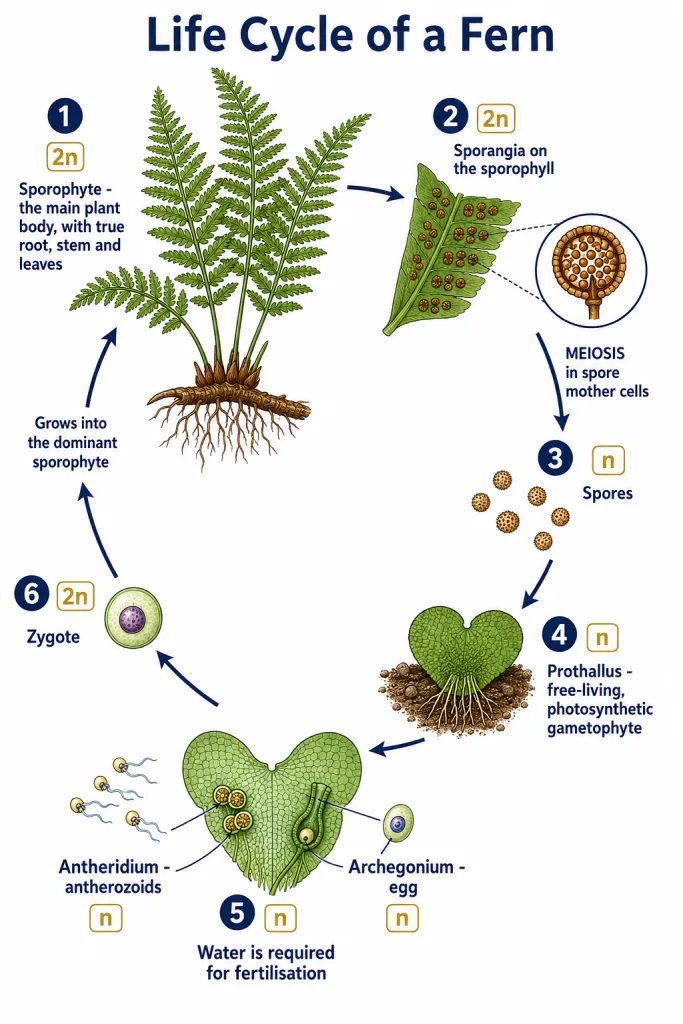
- The sporophytes bear sporangia that are subtended by leaf-like appendages called sporophylls.
- In some cases sporophylls may form distinct compact structures called strobili or cones - as in Selaginella and Equisetum.
- The sporangia produce spores by meiosis in spore mother cells.
The Gametophyte - the Prothallus
The spores germinate into the gametophyte, and its description is dense with examinable adjectives:
The spores germinate to give rise to inconspicuous, small but multicellular, free-living, mostly photosynthetic thalloid gametophytes called prothallus.
These gametophytes require cool, damp, shady places to grow.
And here is the consequence that questions love:
Because of this specific restricted requirement and the need for water for fertilisation, the spread of living pteridophytes is limited and restricted to narrow geographical regions.
Sex organs and fertilisation
- The gametophytes bear male and female sex organs called antheridia and archegonia respectively.
- Water is required for transfer of antherozoids - the male gametes released from the antheridia - to the mouth of the archegonium.
- Fusion of the male gamete with the egg present in the archegonium results in the formation of the zygote.
- The zygote thereafter produces a multicellular well-differentiated sporophyte, which is the dominant phase.
[NEET Important] Note the contrast with bryophytes, where the sporophyte is dependent. Here the prothallus is free-living and the sporophyte is dominant - both phases can stand alone, and the sporophyte is the bigger of the two.
Homospory, Heterospory and the Seed Habit
In the majority of pteridophytes all the spores are of similar kinds; such plants are called homosporous.
Genera like Selaginella and Salvinia, which produce two kinds of spores - macro (large) and micro (small) spores - are known as heterosporous.
What follows from heterospory is the important part:
- The megaspores and microspores germinate and give rise to female and male gametophytes respectively.
- The female gametophytes in these plants are retained on the parent sporophytes for variable periods.
- The development of the zygotes into young embryos takes place within the female gametophytes.
This event is a precursor to the seed habit, considered an important step in evolution.
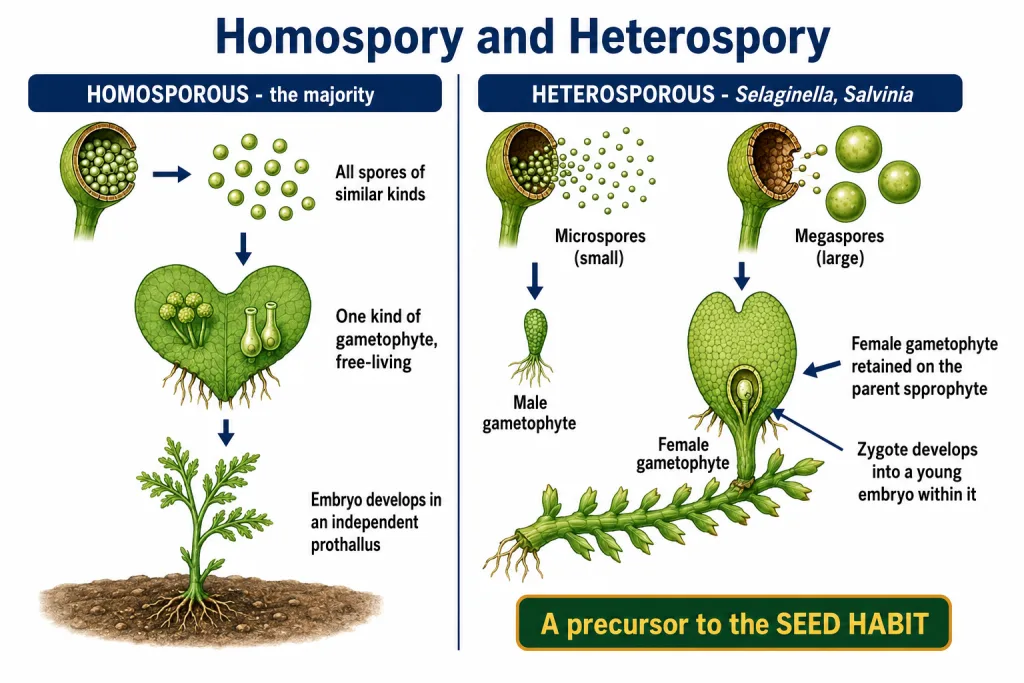
[NEET Important] The two heterosporous genera are Selaginella and Salvinia - remember them as a pair, since a question naming one usually expects the other. And the significance of heterospory is not the two spore sizes themselves but what they permit: the female gametophyte staying on the parent sporophyte while the embryo develops inside it, which is the precursor to the seed habit.
The Four Classes
| Class | Genera |
|---|---|
| Psilopsida | Psilotum |
| Lycopsida | Selaginella, Lycopodium |
| Sphenopsida | Equisetum |
| Pteropsida | Dryopteris, Pteris, Adiantum |
Cross-links worth noting:
- Selaginella (Lycopsida) is both a microphyllous genus and one of the two heterosporous ones, and it forms strobili.
- Equisetum (Sphenopsida) is the horsetail, and it also forms strobili.
- Salvinia is the other heterosporous genus.
- The Pteropsida genera - Dryopteris, Pteris, Adiantum - are the ferns, with macrophylls.
[NEET Important] A memory line for the class order: Psilopsida, Lycopsida, Sphenopsida, Pteropsida - and the single-genus classes are the first and third, Psilotum and Equisetum.
Ploidy Through the Pteridophyte Life Cycle
| Structure | Ploidy |
|---|---|
| Main plant body (sporophyte) - root, stem, leaves | 2n |
| Sporangium wall, sporophyll | 2n |
| Spore mother cell | 2n |
| Spores | n |
| Prothallus (gametophyte) | n |
| Antheridium, archegonium, antherozoid, egg | n |
| Zygote | 2n |
Where does reduction division occur? In the sporangium, in the spore mother cells, producing haploid spores.
Compare with bryophytes: meiosis happens in the sporophyte in both, but in bryophytes that sporophyte is small and dependent, while here it is the plant.
Quick Recap
- Pteridophytes = horsetails and ferns; used medicinally, as soil-binders and as ornamentals; found in cool, damp, shady places, some in sandy soil.
- First terrestrial plants to possess vascular tissues - xylem and phloem.
- Main plant body is the sporophyte, differentiated into true root, stem and leaves with well-differentiated vascular tissues.
- Leaves are microphylls (small, Selaginella) or macrophylls (large, ferns).
- Sporangia are subtended by sporophylls, which may form compact strobili or cones (Selaginella, Equisetum). Spores are produced by meiosis in spore mother cells.
- The gametophyte is the prothallus - inconspicuous, small but multicellular, free-living, mostly photosynthetic, thalloid - needing cool, damp, shady places.
- That requirement, plus the need for water for fertilisation, limits the spread of pteridophytes to narrow geographical regions.
- Prothallus bears antheridia and archegonia; water carries antherozoids to the mouth of the archegonium; the zygote builds the dominant sporophyte.
- Homosporous: all spores similar - the majority. Heterosporous: macro and micro spores - Selaginella and Salvinia.
- In heterosporous forms the female gametophyte is retained on the parent sporophyte and the zygote develops into a young embryo within it - a precursor to the seed habit.
- Four classes: Psilopsida (Psilotum), Lycopsida (Selaginella, Lycopodium), Sphenopsida (Equisetum), Pteropsida (Dryopteris, Pteris, Adiantum).
Solved Examples
Question 1
Q. Why are pteridophytes evolutionarily important?
Answer. They are the first terrestrial plants to possess vascular tissues - xylem and phloem.
Question 2
Q. What is the dominant phase in a pteridophyte, and how is it organised?
Answer. The sporophyte, differentiated into true root, stem and leaves, whose organs possess well-differentiated vascular tissues.
Question 3
Q. Name the gametophyte of a pteridophyte.
Answer. The prothallus.
Question 4
Q. What are sporophylls?
Answer. Leaf-like appendages that subtend the sporangia. In some cases they form compact structures called strobili or cones.
Question 5
Q. Name the two heterosporous genera.
Answer. Selaginella and Salvinia.
Question 6
Q. Describe the prothallus fully.
Answer. A spore germinates and gives you the prothallus - an inconspicuous, small but multicellular, free-living, mostly photosynthetic, thalloid gametophyte. It requires cool, damp, shady places to grow, and it bears the antheridia and archegonia.
Question 7
Q. Why is the spread of living pteridophytes limited to narrow geographical regions?
Answer. For two reasons together:
- The gametophyte has a specific restricted requirement - it needs cool, damp, shady places to grow.
- They also have a need for water for fertilisation, because water is required to transfer the antherozoids to the mouth of the archegonium.
Question 8
Q. Distinguish microphylls from macrophylls with examples.
Answer. Microphylls are the small leaves found in pteridophytes such as Selaginella. Macrophylls are the large leaves found in ferns.
Question 9
Q. Differentiate homosporous and heterosporous pteridophytes.
Answer.
| Homosporous | Heterosporous | |
|---|---|---|
| Spores | All spores are of similar kinds | Two kinds - macro (large) and micro (small) spores |
| Gametophytes | One kind, typically bearing both sex organs | Megaspores give female gametophytes, microspores give male gametophytes |
| Retention | Gametophyte free-living and independent | Female gametophyte retained on the parent sporophyte for variable periods |
| Embryo development | In an independent prothallus | Within the female gametophyte, on the parent plant |
| Occurrence | The majority of pteridophytes | Selaginella and Salvinia |
| Significance | - | Precursor to the seed habit |
Question 10
Q. State the ploidy of a prothallus cell of a fern, a spore mother cell, and the zygote of a fern.
Answer.
| Structure | Ploidy | Why |
|---|---|---|
| Prothallus cell | n | The prothallus is the gametophyte, formed from a haploid spore |
| Spore mother cell | 2n | It lies in the sporangium on the diploid sporophyte, and it is the cell that undergoes meiosis |
| Zygote | 2n | Formed by fusion of the haploid male gamete and the haploid egg |
Question 11
Q. Name the four classes of pteridophytes with one genus each.
Answer. Psilopsida - Psilotum; Lycopsida - Selaginella or Lycopodium; Sphenopsida - Equisetum; Pteropsida - Dryopteris, Pteris or Adiantum.
Question 12
Q. What is heterospory? Comment briefly on its significance and give two examples.
Answer. In heterospory the same plant makes two kinds of spores - macro (large) megaspores and micro (small) microspores. Homosporous plants, by contrast, make spores that are all of similar kinds.
Significance. The megaspores and microspores germinate to give female and male gametophytes respectively, so the sexes are already split at the spore stage. Bigger than that, the female gametophytes are retained on the parent sporophyte for variable periods, and the development of the zygote into a young embryo takes place within the female gametophyte - on the parent plant. A young embryo, fed and protected on the parent, is basically what a seed is, so this event is a precursor to the seed habit and is considered an important step in evolution.
Examples. Selaginella and Salvinia.
Question 13
Q. Compare the position of the gametophyte and the sporophyte in bryophytes and pteridophytes.
Answer.
| Bryophytes | Pteridophytes | |
|---|---|---|
| Dominant phase | Gametophyte | Sporophyte |
| Gametophyte | The main plant body, haploid, photosynthetic | The prothallus - inconspicuous, small, free-living, mostly photosynthetic |
| Sporophyte | Not free-living; attached to the gametophyte and derives nourishment from it | The main plant body, with true root, stem and leaves and vascular tissue |
| Independence | Only the gametophyte is independent | Both phases are free-living |
The pattern: the two groups have swapped which phase dominates, and pteridophytes have freed the sporophyte from dependence. Both still need water for fertilisation - neither group escapes that.
Question 14
Q. Trace, step by step, why heterospory rather than vascular tissue is called the precursor to the seed.
Answer. Vascular tissue solved a transport problem - it let a plant body stand up and move water and food, which is why pteridophytes could become the first terrestrial plants with xylem and phloem. It did nothing about reproduction, and pteridophytes still need water for fertilisation.
Heterospory went after reproduction instead, in three steps:
- Two spore sizes appear - macro and micro - so the megaspore carries a food reserve and the microspore stays small and numerous.
- Because the megaspore is large and provisioned, the female gametophyte can be retained on the parent sporophyte rather than being cast out to fend for itself.
- With the female gametophyte on the parent, the zygote develops into a young embryo within it - an embryo, its food supply, and the parent's protection all in one package.
A seed is exactly that package, released. So heterospory, not vascular tissue, is the precursor to the seed habit, and that is why Selaginella and Salvinia get singled out among pteridophytes.