
Same Syllabus. A Different Exam.
The Important Questions and Answers section worked this chapter the way a textbook does - define, compare, describe. NEET does not ask you to describe anything. It hands you one line, four options and about half a minute, and it wants the right one.
So this section covers the same syllabus with a different question in mind: not "can you write this out?" but "can you recognise it instantly and eliminate the other three?"
The marking is what forces the change. A correct answer is +4 and a wrong one is -1, so a guess you are not sure of costs you a mark and, worse, costs you the time you spent on it. Plant Kingdom is a pure-recall chapter with exactly one piece of reasoning in it - ploidy - and that reasoning is a single question you ask yourself. Everything else is a name, a pigment or a stored food.
Key Point: Nothing here has to be worked out except ploidy, and ploidy is one question: is this cell part of the gametophyte or part of the sporophyte? If a question from this chapter is taking you more than forty seconds, you are giving back the marks the chapter was supposed to hand you.
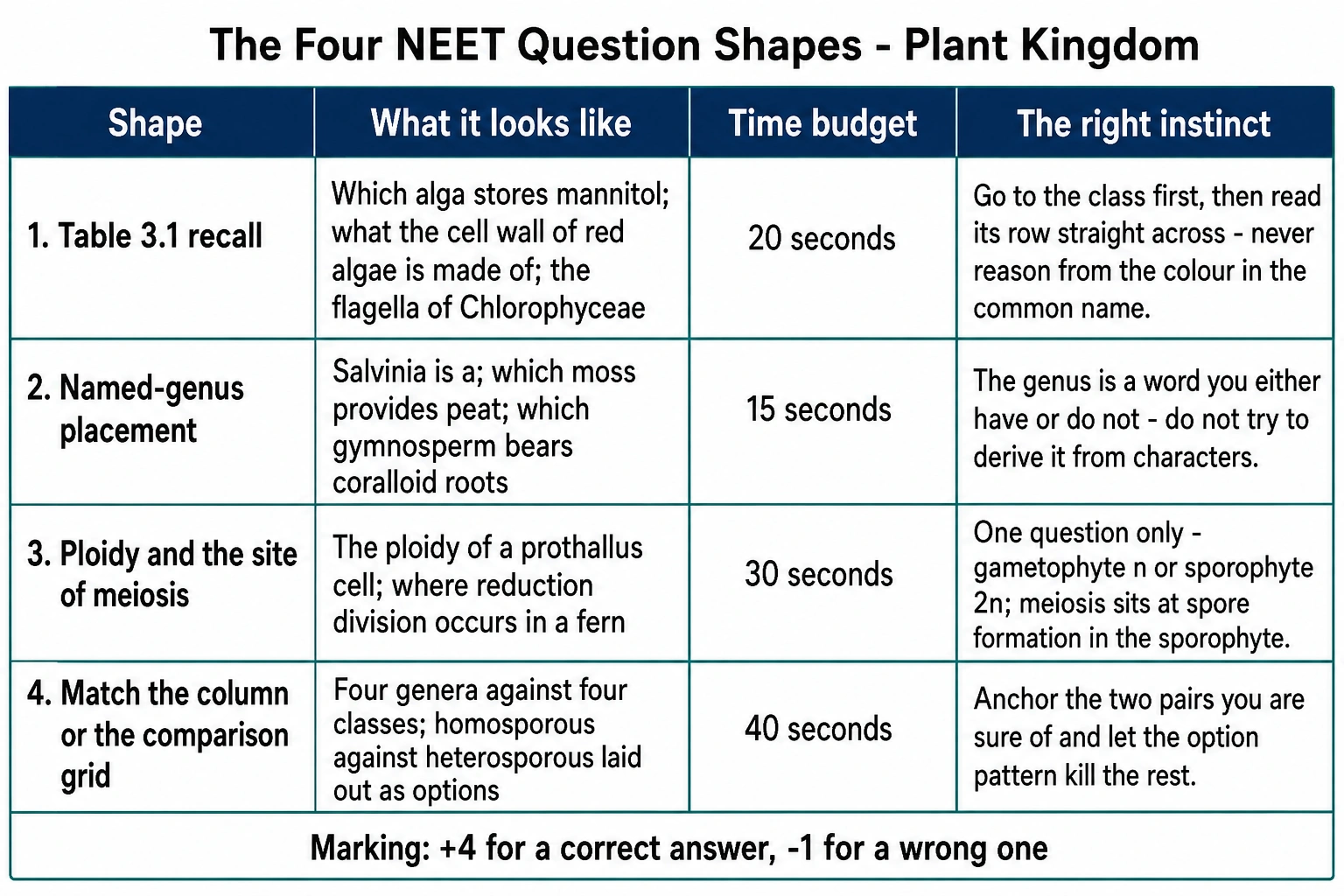
The four shapes, and what each should cost you
| Shape | What it looks like | Budget | The right instinct |
|---|---|---|---|
| 1. Table 3.1 recall | "Which alga stores mannitol?" "What is the cell wall of red algae made of?" "Flagella in Chlorophyceae?" | 20 seconds | Go to the class first, then read its row straight across. Never reason from the colour in the common name. |
| 2. Named-genus placement | "Salvinia is a?" "Which moss gives peat?" "Which gymnosperm bears coralloid roots?" | 15 seconds | The genus is a word you either have or do not. Do not try to derive it from characters - take the guess or leave it. |
| 3. Ploidy and the site of meiosis | "Ploidy of a prothallus cell." "Where does reduction division occur in a fern?" | 30 seconds | One question only - gametophyte (n) or sporophyte (2n)? Meiosis sits at spore formation, in the sporophyte. |
| 4. Match the column or the comparison grid | Four genera against four classes; homosporous against heterosporous laid out as options | 40 seconds | Anchor the two pairs you are sure of. The option pattern then kills the rest for you. |
What this section repeats, and what it does not
It does not re-explain the chapter. It gives you Table 3.1 as a grid you can read in either direction, the genus lists as pairs, ploidy as one rule, and the confusable pairs every wrong option is built from - and then drills them at speed.
Table 3.1, Rebuilt as a Recognition Grid
More NEET questions come out of this one table than out of any other page of the chapter. Learn it as three rows you can recite, and then learn it backwards, because backwards is how it is actually asked.
| Chlorophyceae (green) | Phaeophyceae (brown) | Rhodophyceae (red) | |
|---|---|---|---|
| Major pigments | Chlorophyll a, b | Chlorophyll a, c, fucoxanthin | Chlorophyll a, d, r-phycoerythrin |
| Stored food | Starch | Mannitol, laminarin | Floridean starch |
| Cell wall | Cellulose inside, pectose outside | Cellulose and algin | Cellulose, pectin and poly sulphate esters |
| Flagella | 2 to 8, equal, apical | 2, unequal, lateral | Absent |
| Habitat | Fresh, brackish and salt water | Mostly marine | Mostly marine, warmer areas |
| Genera | Chlamydomonas, Volvox, Ulothrix, Spirogyra, Chara | Ectocarpus, Dictyota, Laminaria, Sargassum, Fucus | Polysiphonia, Porphyra, Gracilaria, Gelidium |
The same table read backwards
This is the version NEET uses. One clue, one class, no thinking.
| The clue you are handed | The class it can only be |
|---|---|
| Mannitol or laminarin | Phaeophyceae |
| Floridean starch | Rhodophyceae |
| Starch stored in pyrenoids | Chlorophyceae |
| No flagella at any stage | Rhodophyceae |
| Two unequal lateral flagella | Phaeophyceae |
| Two to eight equal apical flagella | Chlorophyceae |
| Holdfast, stipe and frond | Phaeophyceae |
| Chlorophyll d | Rhodophyceae |
| Chlorophyll b | Chlorophyceae |
| Algin in the wall | Phaeophyceae |
| Poly sulphate esters in the wall | Rhodophyceae |
| r-phycoerythrin | Rhodophyceae |
| Fucoxanthin | Phaeophyceae |
Three numbers and four products it sets on their own
The numbers. Kelps reach 100 metres. About 70 species of marine algae are used as food. Algae carry out at least half of the total carbon dioxide fixation on earth.
The products. Algin - brown algae. Carrageen - red algae. Agar - Gelidium and Gracilaria, used to grow microbes and in ice-creams and jellies. Chlorella - a protein-rich food supplement used even by space travellers.
[NEET Important] Chlorophyll a is in all three classes. The letter that separates them is the second one - b for green, c for brown, d for red. Almost every pigment distractor in this chapter is made by swapping exactly that letter, so read the second letter and nothing else.
The Named Genera, Learnt as Pairs
A genus here is worth a whole question, and there is no way to derive one. Learn each as a pair - the genus and its single distinguishing tag - and the matching items become free marks.
Algae
| Genus | The tag that goes with it |
|---|---|
| Chlamydomonas | Green, unicellular |
| Volvox | Green, colonial; oogamous |
| Ulothrix | Green, filamentous; isogamy with flagellated gametes |
| Spirogyra | Green, filamentous; isogamy with non-motile gametes |
| Chara | Green alga |
| Ectocarpus | Brown, simple branched filamentous |
| Dictyota | Brown |
| Laminaria, Sargassum | Brown; among the food species, along with Porphyra |
| Fucus | Brown; oogamous; the alga with a diplontic life cycle |
| Porphyra | Red; food |
| Polysiphonia | Red |
| Gelidium, Gracilaria | Red; the source of agar |
| Chlorella | Unicellular, protein-rich food supplement |
Bryophytes
| Genus | The tag |
|---|---|
| Marchantia | Liverwort; thalloid and dorsiventral; gemmae in gemma cups |
| Funaria | Moss |
| Polytrichum | Moss |
| Sphagnum | Moss; the source of peat |
Pteridophytes - four classes, and the genera in each
| Class | Genera |
|---|---|
| Psilopsida | Psilotum |
| Lycopsida | Selaginella, Lycopodium |
| Sphenopsida | Equisetum |
| Pteropsida | Dryopteris, Pteris, Adiantum |
Two more to keep beside that list. Selaginella and Salvinia are the heterosporous genera. Selaginella and Equisetum are the genera whose sporophylls form strobili or cones. Selaginella has microphylls; ferns have macrophylls.
Gymnosperms and angiosperms
| Genus | The tag |
|---|---|
| Cycas | Unbranched stem; pinnate leaves persisting a few years; coralloid roots with nitrogen-fixing cyanobacteria; male cones and megasporophylls on different trees |
| Pinus | Branched stem; mycorrhiza; male and female cones on the same tree |
| Cedrus | Branched stem |
| Sequoia | The giant redwood, one of the tallest tree species |
| Ginkgo | A gymnosperm |
| Wolffia | The smallest angiosperm |
| Eucalyptus | Tall angiosperm trees, over 100 metres |
Isogamy, anisogamy and oogamy - defined by size, remembered by genus
| Type | What decides it | Genera |
|---|---|---|
| Isogamy | The two fusing gametes are similar in size; they may be flagellated or non-flagellated and non-motile | Ulothrix (flagellated), Spirogyra (non-motile) |
| Anisogamy | The two fusing gametes are dissimilar in size | Eudorina |
| Oogamy | A large, non-motile female gamete fuses with a smaller, motile male gamete | Volvox, Fucus |
[NEET Important] Isogamy is decided by size, not by motility. Ulothrix has swimming isogametes and Spirogyra has non-motile ones, and both are isogamous. The standing distractor is "isogamy means both gametes are motile" - it is false, and it is offered every year.
Ploidy and the Position of Meiosis - The Idea That Pays Most
This is the only place in the chapter where you have to think, and the thinking is one question long.
The one question. Does the cell belong to the gametophyte or to the sporophyte? Gametophyte is n. Sporophyte is 2n. There is a single exception in the whole chapter, and it is the primary endosperm nucleus of an angiosperm at 3n, because a male gamete fuses there with two polar nuclei.
The one rule about meiosis. In land plants, meiosis happens in the sporophyte, at spore formation - never in the gametophyte. Gametes come from mitosis in a body that is already haploid. Two algal exceptions: the haplontic cycle, where the zygote is the only diploid cell and so meiosis is zygotic, and the diplontic alga Fucus, where meiosis sits at gamete formation.
All five groups on one line each
| Group | Dominant phase | Life cycle | Where meiosis happens | Gametophyte free-living? |
|---|---|---|---|---|
| Algae (Volvox, Spirogyra, Chlamydomonas) | Gametophyte, n | Haplontic | In the zygote | Yes |
| Bryophytes (liverwort, moss) | Gametophyte, n | Haplo-diplontic | In the capsule of the sporophyte | Yes - and the sporophyte is the dependent one |
| Pteridophytes (fern) | Sporophyte, 2n | Haplo-diplontic | In spore mother cells inside the sporangium | Yes - the free-living prothallus |
| Gymnosperms | Sporophyte, 2n | Diplontic | In the microsporangium and the megasporangium | No - both stay inside the sporangia on the sporophyte |
| Angiosperms | Sporophyte, 2n | Diplontic | In the anther and in the ovule | No |
The ploidy list, as a lookup
| Structure | Ploidy | Because |
|---|---|---|
| Protonemal cell of a moss | n | Gametophyte |
| Leaf cell of a moss | n | The leafy stage is the gametophyte |
| Gemma cell in Marchantia | n | Formed by mitosis on a haploid thallus |
| Ovum of a liverwort | n | A gamete |
| Prothallus cell of a fern | n | The prothallus is the gametophyte |
| Spore of any group | n | The first cell of the gametophytic generation |
| Pollen grain | n | The reduced male gametophyte |
| Zygote of a fern | 2n | Product of two haploid gametes |
| Meristem cell of a monocot | 2n | Sporophyte plant body |
| Spore mother cell, nucellus, ovule tissue | 2n | Sporophyte |
| Primary endosperm nucleus in a dicot | 3n | One male gamete plus two polar nuclei |
The three traps set on this material
- The dependent phase swapped. "In bryophytes the gametophyte depends on the sporophyte." It is the other way round - the sporophyte is not free-living and draws nourishment from the gametophyte.
- Same pattern, different dominance. Bryophytes and pteridophytes are both haplo-diplontic. An option saying they differ in life-cycle pattern is wrong; they differ only in which phase dominates.
- Meiosis moved to gamete formation. In every land plant, meiosis is at spore formation. An option putting it at gamete formation in a moss or a fern is a giveaway.
[NEET Important] If you get one line from this section into the exam hall, make it this: spore = n, gamete = n, zygote = 2n, endosperm = 3n, and meiosis sits between the sporophyte and the spore.
Homospory Against Heterospory, and the Confusable Pairs
The comparison that carries the seed habit
| Homosporous | Heterosporous | |
|---|---|---|
| Spores | All of similar kinds | Macro (large) megaspores and micro (small) microspores |
| Gametophytes | One kind | Megaspore to female, microspore to male |
| Female gametophyte | Shed and free-living | Retained on the parent sporophyte for variable periods |
| Embryo | Develops in an independent prothallus | Develops within the female gametophyte, on the parent |
| Who | The majority of pteridophytes | Selaginella, Salvinia; and all seed plants |
| Why it matters | - | Precursor to the seed habit, an important step in evolution |
The line that gets quoted. Heterospory is a precursor to the seed habit because the embryo is already being fed and protected on the parent plant - which is most of what a seed is.
The confusable pairs, and the distractors built from them
Every wrong option in this chapter comes out of one of these rows. Learn the separator and you are reading options rather than puzzling over them.
| Pair | The separator |
|---|---|
| Isogamy against anisogamy | Similar size against dissimilar size; motility decides neither |
| Anisogamy against oogamy | Anisogamy is only about size; oogamy needs a large non-motile female and a small motile male |
| Liverwort against moss | Liverwort gametophyte is thalloid and dorsiventral with gemma cups; the moss gametophyte runs protonema, then leafy stage |
| Gemmae against spores | Gemmae are multicellular asexual buds made by mitosis; spores come from meiosis |
| Bryophyte against pteridophyte | Bryophytes have no vascular tissue and no true roots, stem or leaves; pteridophytes are the first terrestrial plants with xylem and phloem |
| Microphyll against macrophyll | Small leaves, as in Selaginella, against large leaves, as in ferns |
| Sporophyll against strobilus | A sporophyll is the leaf-like appendage subtending a sporangium; a strobilus or cone is a compact group of sporophylls |
| Microspore against pollen grain | The microspore is a spore; the pollen grain is the reduced male gametophyte it becomes |
| Prothallus against protonema | Prothallus is the fern gametophyte; protonema is the first stage of the moss gametophyte |
| Mycorrhiza against coralloid roots | Fungal association in Pinus against nitrogen-fixing cyanobacteria in Cycas |
| Gymnosperm against angiosperm | Ovules not enclosed by any ovary wall, seeds naked against ovules in flowers, seeds enclosed in fruits |
| Archegonium against embryo sac | Bryophytes, pteridophytes and gymnosperms have archegonia; angiosperms do not |
The four distractor patterns
- The swapped letter. Chlorophyll c given to red algae, chlorophyll d to brown. Read the second letter and stop.
- The swapped dependence. The bryophyte gametophyte made to depend on the sporophyte. Ask which one is not free-living - it is the sporophyte.
- The extra group. Angiosperms slipped into the list of groups bearing archegonia. The list stops at gymnosperms.
- The relocated meiosis. Reduction division placed at gamete formation, or in the gametophyte. It is at spore formation, in the sporophyte.
[NEET Important] When two options both look right, the difference is nearly always one noun - spore against gamete, gametophyte against sporophyte, microspore against pollen grain, sporophyll against strobilus. Find that noun first instead of rereading the whole option.
Solved Examples at NEET Pace
Each item names the shortcut it uses, because the shortcut is the point.
Question 1
Q. An alga has two unequal laterally attached flagella and stores food as laminarin. Name its class and one genus.
Answer. Phaeophyceae, the brown algae. Genus: any of Ectocarpus, Dictyota, Laminaria, Sargassum or Fucus.
Shortcut: read Table 3.1 backwards. Unequal lateral flagella appear in only one row, and laminarin appears in the same row, so the two clues confirm each other and you never touch pigments at all.
Question 2
Q. Give the ploidy of each in under thirty seconds: prothallus cell of a fern, gemma cell of Marchantia, primary endosperm nucleus of a dicot, zygote of a fern, protonemal cell of a moss.
Answer. n, n, 3n, 2n, n.
Shortcut: ask one question of each - gametophyte or sporophyte? Prothallus, gemma and protonema are all gametophyte, so n. The zygote is the first cell of the sporophyte, so 2n. The primary endosperm nucleus is the only 3n thing in the chapter, because a male gamete fuses there with two polar nuclei.
Question 3
Q. Where does reduction division take place in a moss, a fern and a gymnosperm?
Answer. Moss - in the capsule of the sporophyte. Fern - in the spore mother cells inside the sporangium. Gymnosperm - in the microsporangium and the megasporangium.
Shortcut: the site changes name from group to group, but the moment never does. It is always spore formation, in the sporophyte. Answer the "when" first and the "where" follows.
Question 4
Q. Match: (a) Psilotum (b) Selaginella (c) Equisetum (d) Pteris against (i) Sphenopsida (ii) Pteropsida (iii) Psilopsida (iv) Lycopsida.
Answer. (a) - (iii), (b) - (iv), (c) - (i), (d) - (ii).
Shortcut: anchor the two that name themselves. Psilotum goes with Psilopsida and Equisetum with Sphenopsida because Equisetum is the horsetail. That fixes two pairs, and Selaginella in Lycopsida settles the rest.
Question 5
Q. An option reads: "Rhodophyceae possess chlorophyll a and c." Accept or reject.
Answer. Reject. Rhodophyceae have chlorophyll a and d with r-phycoerythrin. Chlorophyll c belongs to Phaeophyceae.
Shortcut: chlorophyll a is in all three classes and tells you nothing, so cover it and read the second letter alone - b green, c brown, d red.
Question 6
Q. Ulothrix has flagellated gametes and Spirogyra has non-motile ones, yet both are called isogamous. Which option is being set up as the trap?
Answer. The trap option is the one that makes isogamy require motile gametes. Isogamy is decided only by the two gametes being similar in size. Motility enters the definitions only at oogamy, where a large non-motile female gamete fuses with a smaller motile male gamete, as in Volvox and Fucus.
Shortcut: for these three terms read the word size first. Size decides isogamy and anisogamy; only oogamy adds motility.
Question 7
Q. Answer each in under fifteen seconds. (i) Which moss provides peat? (ii) Which gymnosperm bears coralloid roots? (iii) Agar comes from which two genera? (iv) Name one of the tallest tree species among gymnosperms. (v) Name the smallest angiosperm.
Answer.
- (i) Sphagnum.
- (ii) Cycas.
- (iii) Gelidium and Gracilaria.
- (iv) Sequoia, the giant redwood.
- (v) Wolffia.
Shortcut: these are one-word items with no derivation behind them. If a name does not arrive in five seconds it is not going to arrive at all, so leave it and take the next question.
Question 8
Q. An option reads: "In heterosporous pteridophytes the female gametophyte is shed from the parent and develops independently." Accept or reject.
Answer. Reject. The female gametophytes are retained on the parent sporophytes for variable periods, and the zygote develops into a young embryo within the female gametophyte, on the parent. That retention is exactly why heterospory is called a precursor to the seed habit.
Shortcut: in this chapter, whenever an option says a structure becomes more independent as you go up the plant kingdom, suspect it. The trend runs the other way - gametophytes become less independent, until in gymnosperms neither gametophyte lives freely at all.
A Drill Before You Move On
Decide each one before you read the verdict. Aim for twenty-five seconds each.
Question 9
Q. An option reads: "In gymnosperms both gametophytes are free-living, as in pteridophytes." Accept or reject.
Answer. Reject. In gymnosperms the male and female gametophytes do not have an independent free-living existence; they remain within the sporangia retained on the sporophytes. Only the pteridophyte gametophyte, the prothallus, is free-living.
Shortcut: run the independence trend downwards - bryophyte gametophyte independent, pteridophyte prothallus independent, gymnosperm gametophytes not independent. One direction, no exceptions.
Question 10
Q. Assertion: bryophytes and pteridophytes have the same life-cycle pattern. Reason: in both, the gametophyte is the dominant phase. Judge each.
Answer. The assertion is true and the reason is false. Both are haplo-diplontic, with two multicellular phases. But the dominant phase differs - gametophyte in bryophytes, sporophyte in pteridophytes.
Shortcut: in assertion-reason items on this chapter, the assertion is usually about the pattern and the reason about the dominant phase. They are two separate facts, so judge them separately instead of letting one drag the other along.
Question 11
Q. Which of these groups does NOT bear archegonia: bryophytes, pteridophytes, gymnosperms, angiosperms?
Answer. Angiosperms. The other three all bear archegonia. In angiosperms the female gametophyte is the embryo sac, and no archegonium is formed.
Shortcut: the archegonium list is three groups long and stops at gymnosperms. Any option that stretches it to four is wrong, and any option that trims it to two has dropped gymnosperms.
Question 12
Q. Three options are offered for the male gametophyte of a gymnosperm: the microspore, the pollen grain, the male gamete. Which is right?
Answer. The pollen grain. The microspore is a spore, the immediate haploid product of meiosis in the microsporangium. When it divides it gives a male gametophytic generation highly reduced and confined to a limited number of cells, and this reduced gametophyte is the pollen grain. The male gametes are what the pollen tube finally discharges.
Shortcut: three words, three stages, in order - spore, then gametophyte, then gamete. The question is only asking which stage the name belongs to.
Question 13
Q. Arrange in the order in which they first appear in the plant kingdom: naked seed, vascular tissue, enclosed seed, heterospory.
Answer. Vascular tissue, heterospory, naked seed, enclosed seed.
- Vascular tissue - pteridophytes, the first terrestrial plants with xylem and phloem.
- Heterospory - inside pteridophytes, in Selaginella and Salvinia.
- Naked seed - gymnosperms, ovules not enclosed by any ovary wall.
- Enclosed seed - angiosperms, seeds enclosed in fruits.
Shortcut: sequence questions in this chapter follow the order of the chapter itself. Read the option against the group order - algae, bryophytes, pteridophytes, gymnosperms, angiosperms - and it settles in a few seconds.