
The Name and the Defining Character
Gymnos means naked; sperma means seeds.
Gymnosperms are plants in which the ovules are not enclosed by any ovary wall and remain exposed, both before and after fertilisation. The seeds that develop post-fertilisation are not covered - that is, they are naked.
Two details in that definition get tested:
- The ovules are exposed both before and after fertilisation - not just at one stage.
- What is missing is the ovary wall. Angiosperms have it, which is why their seeds end up enclosed in fruits.
Habit: gymnosperms include medium-sized trees or tall trees and shrubs. The giant redwood tree Sequoia is one of the tallest tree species.
Roots, Stems and Leaves
Roots
- Generally tap roots.
- In some genera the roots have a fungal association in the form of mycorrhiza - Pinus.
- In some others, small specialised roots called coralloid roots are associated with nitrogen-fixing cyanobacteria - Cycas.
Stems
- Unbranched in Cycas.
- Branched in Pinus and Cedrus.
Leaves
- May be simple or compound. In Cycas the pinnate leaves persist for a few years.
- The leaves in gymnosperms are well-adapted to withstand extremes of temperature, humidity and wind.
- In conifers, the needle-like leaves reduce the surface area.
- Their thick cuticle and sunken stomata also help to reduce water loss.
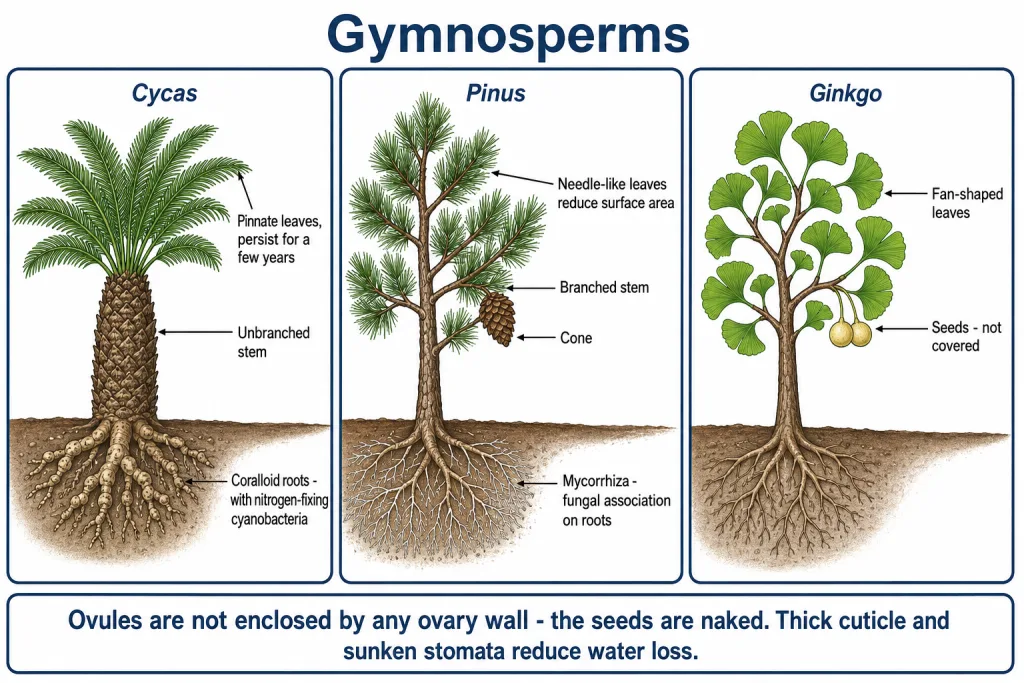
[NEET Important] Two root associations, two genera, and they are swapped constantly in options: mycorrhiza - Pinus; coralloid roots with nitrogen-fixing cyanobacteria - Cycas. And three separate xerophytic adaptations of the leaf: needle shape reducing surface area, thick cuticle, sunken stomata.
Heterospory and the Strobili
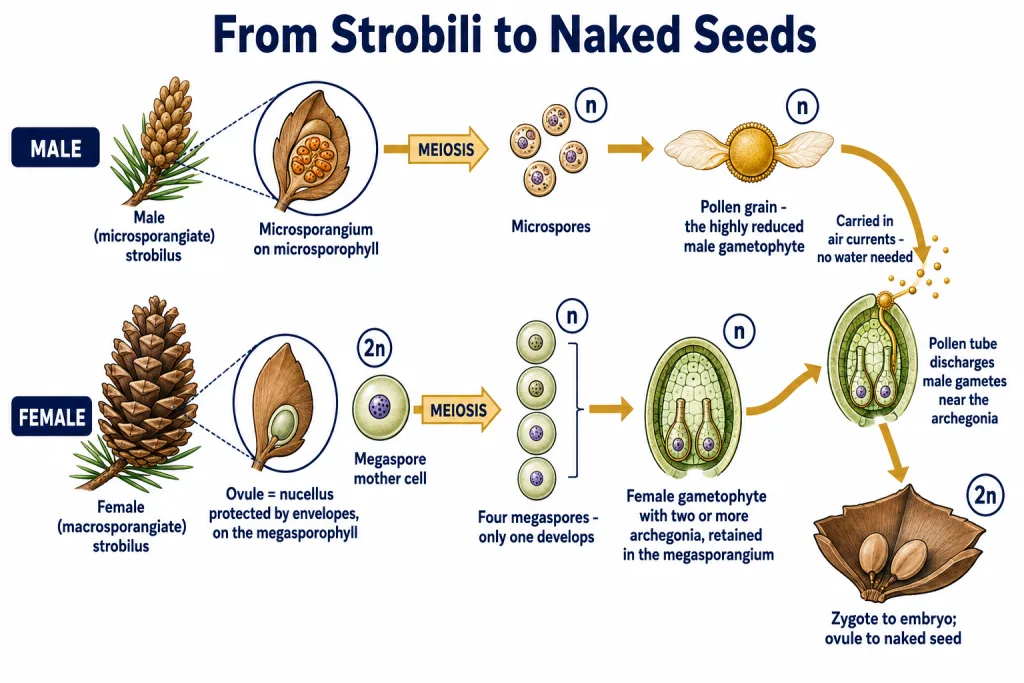
The gymnosperms are heterosporous; they produce haploid microspores and megaspores.
The two kinds of spores are produced within sporangia that are borne on sporophylls, which are arranged spirally along an axis to form lax or compact strobili or cones.
Two kinds of strobili, and the naming is precise:
| Strobilus | Bears | Also called |
|---|---|---|
| Male | Microsporophylls and microsporangia | Microsporangiate |
| Female | Megasporophylls with ovules or megasporangia | Macrosporangiate |
Where the two cones sit:
- Both on the same tree in Pinus.
- On different trees in Cycas - male cones and megasporophylls are borne on different trees.
[NEET Important] Pinus same tree, Cycas different trees. This is the standard pairing, and it sits alongside the root pairing above, so the two genera are worth learning as a contrasted pair throughout.
The Male Gametophyte - the Pollen Grain
The microspores develop into a male gametophytic generation which is highly reduced and is confined to only a limited number of cells. This reduced gametophyte is called a pollen grain.
The development of pollen grains takes place within the microsporangia.
So the pollen grain is the male gametophyte - not a gamete, and not a spore. That distinction is asked directly.
The Ovule and the Female Gametophyte
The sequence is worth following carefully, because ploidy questions are built on every step.
- The megaspore mother cell is differentiated from one of the cells of the nucellus.
- The nucellus is protected by envelopes, and the composite structure is called an ovule.
- The ovules are borne on megasporophylls, which may be clustered to form the female cones.
- The megaspore mother cell divides meiotically to form four megaspores.
- One of the megaspores, enclosed within the megasporangium, develops into a multicellular female gametophyte that bears two or more archegonia, the female sex organs.
- The multicellular female gametophyte is also retained within the megasporangium.
[NEET Important] Note the numbers: the megaspore mother cell gives four megaspores, of which one develops; and the female gametophyte bears two or more archegonia. Both figures are asked.
Dependent Gametophytes, Pollination and Seed
Here is the line that separates gymnosperms from every group before them:
Unlike bryophytes and pteridophytes, in gymnosperms the male and the female gametophytes do not have an independent free-living existence. They remain within the sporangia retained on the sporophytes.
Then the sequence to fertilisation:
- The pollen grain is released from the microsporangium.
- They are carried in air currents and come in contact with the opening of the ovules borne on megasporophylls.
- The pollen tube carrying the male gametes grows towards the archegonia in the ovules and discharges its contents near the mouth of the archegonia.
- Following fertilisation, the zygote develops into an embryo and the ovules into seeds.
- These seeds are not covered.
[NEET Important] Notice what has disappeared: no water is needed for fertilisation. Air currents carry the pollen and a pollen tube delivers the male gametes. That is why gymnosperms escape the geographical restriction that limits pteridophytes - and it is a favourite comparison question.
Ploidy Through the Gymnosperm Life Cycle
| Structure | Ploidy |
|---|---|
| Plant body (sporophyte), roots, stem, leaves | 2n |
| Sporophylls, strobili, nucellus, ovule integuments | 2n |
| Megaspore mother cell | 2n |
| Microspores and megaspores | n |
| Pollen grain (male gametophyte) | n |
| Female gametophyte, archegonia, egg | n |
| Male gametes | n |
| Zygote | 2n |
| Embryo | 2n |
Where does reduction division occur? In the microsporangium and the megasporangium - in the microspore mother cells and the megaspore mother cell - giving haploid microspores and megaspores.
Quick Recap
- Gymnos = naked, sperma = seeds. Ovules are not enclosed by any ovary wall and remain exposed both before and after fertilisation; the seeds that develop are naked.
- Medium-sized to tall trees and shrubs; Sequoia, the giant redwood, is one of the tallest tree species.
- Roots generally tap roots; mycorrhiza in Pinus; coralloid roots with nitrogen-fixing cyanobacteria in Cycas.
- Stems unbranched in Cycas, branched in Pinus and Cedrus.
- Leaves simple or compound; pinnate and persistent for a few years in Cycas; adapted to extremes of temperature, humidity and wind; needle-like conifer leaves reduce surface area, and thick cuticle and sunken stomata reduce water loss.
- Heterosporous - haploid microspores and megaspores in sporangia on sporophylls arranged spirally to form lax or compact strobili or cones.
- Male (microsporangiate) strobili bear microsporophylls and microsporangia; female (macrosporangiate) strobili bear megasporophylls with ovules or megasporangia. Same tree in Pinus, different trees in Cycas.
- The microspore develops into a highly reduced male gametophyte of limited cells - the pollen grain, developing within the microsporangium.
- Megaspore mother cell differentiates from a cell of the nucellus; nucellus + protective envelopes = the ovule; the mother cell divides meiotically into four megaspores, of which one develops into a multicellular female gametophyte bearing two or more archegonia, retained within the megasporangium.
- Neither gametophyte has an independent free-living existence - both remain within the sporangia retained on the sporophytes.
- Pollen released from the microsporangium, carried in air currents to the opening of the ovules; the pollen tube grows towards the archegonia and discharges the male gametes near their mouth; the zygote becomes an embryo and the ovule becomes an uncovered seed.
Solved Examples
Question 1
Q. What does the word gymnosperm mean?
Answer. From gymnos, meaning naked, and sperma, meaning seeds - naked-seeded plants.
Question 2
Q. Which gymnosperm is one of the tallest tree species?
Answer. The giant redwood tree Sequoia.
Question 3
Q. Which gymnosperm has coralloid roots, and what are they associated with?
Answer. Cycas. The coralloid roots are associated with nitrogen-fixing cyanobacteria.
Question 4
Q. In which gymnosperm do roots show mycorrhiza?
Answer. Pinus.
Question 5
Q. What is the reduced male gametophyte of a gymnosperm called?
Answer. The pollen grain.
Question 6
Q. How are gymnosperm leaves adapted to harsh conditions?
Answer. They are well-adapted to withstand extremes of temperature, humidity and wind. In conifers, the needle-like leaves reduce the surface area, and their thick cuticle and sunken stomata also help to reduce water loss.
Question 7
Q. Distinguish male and female strobili.
Answer.
- Male strobili, also called microsporangiate, bear microsporophylls and microsporangia.
- Female strobili, also called macrosporangiate, bear megasporophylls with ovules or megasporangia.
Both may be on the same tree as in Pinus, or on different trees as in Cycas.
Question 8
Q. What is an ovule in a gymnosperm?
Answer. It is the nucellus protected by envelopes - the nucellus plus its protective coverings, taken as one structure. The megaspore mother cell differentiates from one of the cells of the nucellus, and the ovules are borne on megasporophylls, which may sit clustered into female cones.
Question 9
Q. A megaspore mother cell divides meiotically. How many megaspores result, how many develop further, and into what?
Answer. Four megaspores are formed. One of them, enclosed within the megasporangium, develops into a multicellular female gametophyte bearing two or more archegonia. The other three do not develop. The female gametophyte is retained within the megasporangium.
Question 10
Q. How do gymnosperm gametophytes differ from those of bryophytes and pteridophytes?
Answer. In bryophytes the gametophyte is the free-living main plant, and in pteridophytes the prothallus is a small but free-living gametophyte. In gymnosperms, the male and the female gametophytes do not have an independent free-living existence - they remain within the sporangia retained on the sporophytes.
Question 11
Q. Describe the events from pollen release to seed formation.
Answer.
- The pollen grain is released from the microsporangium.
- It is carried in air currents and comes in contact with the opening of the ovules borne on megasporophylls.
- The pollen tube carrying the male gametes grows towards the archegonia in the ovules and discharges its contents near the mouth of the archegonia.
- Following fertilisation, the zygote develops into an embryo and the ovules into seeds, which are not covered.
Question 12
Q. Describe the important characteristics of gymnosperms.
Answer.
- Naked seeds. The ovules are not enclosed by any ovary wall and remain exposed both before and after fertilisation, so the seeds that develop are not covered.
- Habit. Medium-sized to tall trees and shrubs, including the giant redwood Sequoia, one of the tallest tree species.
- Roots. Generally tap roots; mycorrhizal fungal association in Pinus; coralloid roots with nitrogen-fixing cyanobacteria in Cycas.
- Stems and leaves. Unbranched in Cycas, branched in Pinus and Cedrus; leaves simple or compound, pinnate and persisting a few years in Cycas, well-adapted to extremes of temperature, humidity and wind, with needle-like conifer leaves, a thick cuticle and sunken stomata reducing water loss.
- Heterospory. They produce haploid microspores and megaspores in sporangia borne on sporophylls arranged spirally to form strobili or cones - microsporangiate male and macrosporangiate female, on the same tree in Pinus and on different trees in Cycas.
- Reduced gametophytes. The microspore becomes a highly reduced pollen grain; one of the four megaspores becomes a multicellular female gametophyte with two or more archegonia. Neither gametophyte lives independently - both stay within the sporangia on the sporophyte.
- Fertilisation without water. Pollen is carried by air currents to the ovule, and a pollen tube delivers the male gametes to the archegonia. The zygote becomes an embryo and the ovule an uncovered seed.
Takeaway: Answer this as numbered headings. Seven points, one line each, is a full 5-mark answer.
Question 13
Q. Both gymnosperms and angiosperms bear seeds. Why are they classified separately?
Answer. Because the seed is naked in one and enclosed in the other, and behind that difference sits a whole structure that one group has and the other does not.
- In gymnosperms the ovules are not enclosed by any ovary wall and remain exposed both before and after fertilisation, so the seeds that develop are naked. The ovules sit on megasporophylls, which may be clustered into female cones.
- In angiosperms the pollen grains and ovules are developed in specialised structures called flowers, and after fertilisation the seeds are enclosed in fruits - because there is an ovary whose wall becomes the fruit.
So the split rests on the presence of a flower and a closed ovary, not just on having seeds. Seeds make them both seed plants, and the covering makes them two different groups.
Question 14
Q. Pteridophytes are restricted to narrow geographical regions but gymnosperms are not. Explain the two changes that made the difference.
Answer.
Change 1 - the gametophyte no longer lives on its own. In pteridophytes the gametophyte is a free-living prothallus that requires cool, damp, shady places to grow, so the plant can only complete its life cycle where such places exist. In gymnosperms the male and female gametophytes do not have an independent free-living existence; they remain within the sporangia retained on the sporophytes, sheltered and nourished by the parent plant.
Change 2 - fertilisation no longer needs water. In pteridophytes water is required for transfer of antherozoids to the mouth of the archegonium. In gymnosperms the pollen grain is carried in air currents to the opening of the ovule, and a pollen tube grows to the archegonium and discharges the male gametes near its mouth - no external water at any point.
Together these two changes free gymnosperms from damp habitats, and that is why their leaves can afford to be built for extremes of temperature, humidity and wind.