
What Is Still a Plant, and What Is Not
The previous chapter left Plantae as one of Whittaker's five kingdoms. This chapter goes inside it - but the first job is to fix the boundary, because it has moved.
Excluded from Plantae now:
- Fungi
- Members of Monera and Protista that have cell walls
Earlier schemes placed all of these inside the plant kingdom, on the single ground that they had walls. They are out.
[NEET Important] One consequence gets asked directly: cyanobacteria, also called blue-green algae, are not 'algae' any more. They are prokaryotes, and prokaryotes belong to Monera. The name is a leftover from the older scheme.
What remains in Plantae, and what this chapter covers:
Algae - Bryophytes - Pteridophytes - Gymnosperms - Angiosperms
Artificial Systems
The earliest systems of classification used only gross superficial morphological characters - habit, colour, number and shape of leaves and the like. They rested mainly on:
- vegetative characters, or
- the structure of the androecium - the system given by Linnaeus.
Two things were wrong with them, and both are examinable:
- They separated closely related species, because they were based on only a few characteristics.
- They gave equal weightage to vegetative and sexual characteristics. This is not acceptable, because vegetative characters are more easily affected by the environment - so two plants can look alike vegetatively without being related, and two relatives can look different because they grew in different places.
[NEET Important] Linnaeus is the name attached to the androecium-based artificial system. The same person gave binomial nomenclature in Chapter 1 - do not let the two associations blur.
Natural Systems
Against the artificial systems, natural classification systems developed. These were based on natural affinities among the organisms, and they consider not only the external features but also internal features:
- ultrastructure
- anatomy
- embryology
- phytochemistry
Such a classification for flowering plants was given by George Bentham and Joseph Dalton Hooker.
[NEET Important] Bentham and Hooker - natural system - flowering plants. All three parts of that association are asked, most often as a match-the-column entry.
Phylogenetic Systems
At present, phylogenetic classification systems based on evolutionary relationships between the various organisms are acceptable.
The assumption behind them: organisms belonging to the same taxa have a common ancestor.
Information from many other sources is now used to resolve difficulties in classification, and these become more important when there is no supporting fossil evidence. Three such aids are named:
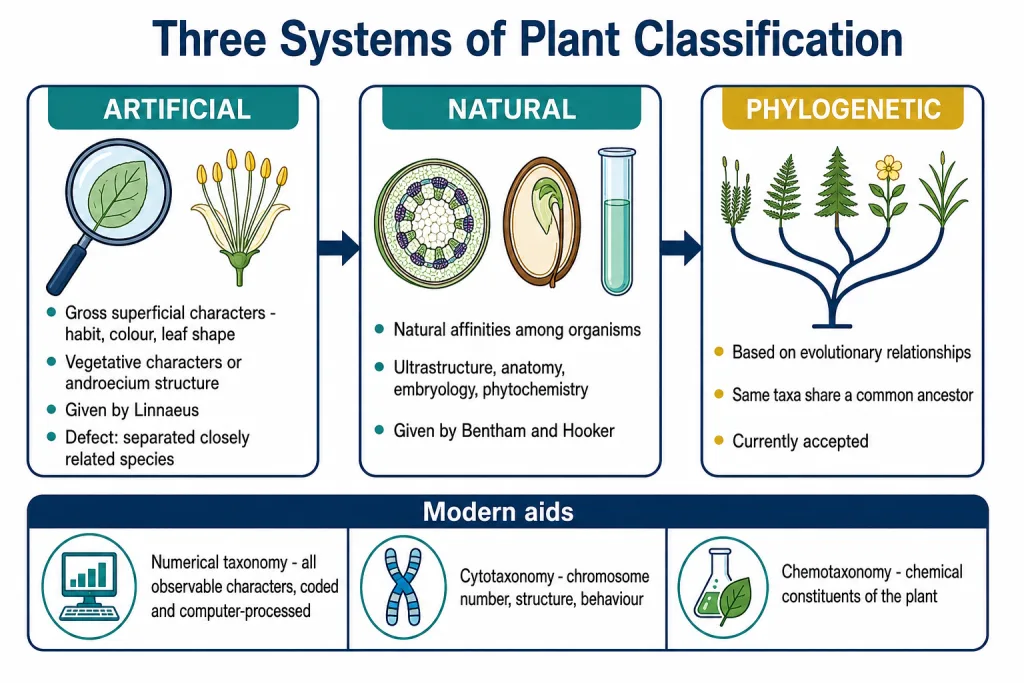
The Three Modern Aids
Numerical Taxonomy
- Now easily carried out using computers.
- Based on all observable characteristics.
- Numbers and codes are assigned to all the characters and the data are then processed.
- The advantage: each character is given equal importance, and at the same time hundreds of characters can be considered.
Cytotaxonomy
- Based on cytological information - chromosome number, structure and behaviour.
Chemotaxonomy
- Uses the chemical constituents of the plant to resolve confusions.
| Aid | Based on |
|---|---|
| Numerical taxonomy | All observable characters, coded numerically and computer-processed |
| Cytotaxonomy | Chromosome number, structure and behaviour |
| Chemotaxonomy | Chemical constituents of the plant |
[NEET Important] Notice the contrast that makes numerical taxonomy interesting: the artificial systems failed partly because they weighted a few characters unevenly, while numerical taxonomy deliberately gives every character equal importance and handles hundreds of them at once.
The Three Systems Side by Side
| Artificial | Natural | Phylogenetic | |
|---|---|---|---|
| Based on | Gross superficial morphological characters - habit, colour, number and shape of leaves | Natural affinities among organisms | Evolutionary relationships |
| Characters used | Mainly vegetative, or androecium structure | External and internal - ultrastructure, anatomy, embryology, phytochemistry | All available evidence, plus numerical, cyto- and chemotaxonomy |
| Key weakness / assumption | Separated closely related species; wrongly weighted vegetative characters equally with sexual ones | - | Assumes members of a taxon share a common ancestor |
| Associated names | Linnaeus | Bentham and Hooker | Currently accepted approach |
Quick Recap
- Fungi and the walled members of Monera and Protista are no longer in Plantae; cyanobacteria are not algae any more.
- Plantae as covered here: algae, bryophytes, pteridophytes, gymnosperms, angiosperms.
- Artificial systems used gross superficial morphological characters (habit, colour, number and shape of leaves), resting on vegetative characters or on androecium structure (Linnaeus). They separated closely related species and wrongly gave vegetative and sexual characters equal weightage, though vegetative characters are more easily affected by environment.
- Natural systems rest on natural affinities and use ultrastructure, anatomy, embryology and phytochemistry; the flowering-plant scheme is that of George Bentham and Joseph Dalton Hooker.
- Phylogenetic systems are currently accepted and are based on evolutionary relationships, assuming common ancestry within a taxon.
- Numerical taxonomy - all observable characters coded as numbers and processed by computer, each character given equal importance, hundreds considered at once.
- Cytotaxonomy - chromosome number, structure and behaviour. Chemotaxonomy - chemical constituents.
Solved Examples
Question 1
Q. Name the five groups of plants dealt with under Plantae in this chapter.
Answer. Algae, bryophytes, pteridophytes, gymnosperms and angiosperms.
Question 2
Q. Why are cyanobacteria no longer regarded as algae?
Answer. Because the walled members of Monera have been excluded from Plantae. Cyanobacteria are prokaryotes, so they sit in Monera. People still call them blue-green algae out of habit, but for classification they are not algae.
Question 3
Q. Which classification system is currently accepted, and what does it assume?
Answer. The phylogenetic system, based on evolutionary relationships. It assumes that organisms belonging to the same taxa have a common ancestor.
Question 4
Q. Who gave the natural system of classification for flowering plants?
Answer. George Bentham and Joseph Dalton Hooker.
Question 5
Q. State two defects of artificial systems of classification.
Answer.
- They went on only a few characteristics, so they separated closely related species.
- They gave equal weightage to vegetative and sexual characteristics. That will not do, because vegetative characters are more easily affected by the environment, so they are a poor guide to who is related to whom.
Question 6
Q. Distinguish natural from artificial systems of classification.
Answer.
- Artificial: goes by gross superficial morphological characters such as habit, colour, number and shape of leaves. It mostly uses vegetative characters or the androecium structure.
- Natural: goes by natural affinities among organisms, and looks at not only external features but also internal ones - ultrastructure, anatomy, embryology and phytochemistry.
Question 7
Q. What is numerical taxonomy and what are its two advantages?
Answer. Numerical taxonomy works from all observable characteristics. You give numbers and codes to all the characters and then process the data, which computers make easy now.
Its two advantages:
- Each character is given equal importance.
- Hundreds of characters can be considered at the same time.
Question 8
Q. Differentiate cytotaxonomy from chemotaxonomy.
Answer.
- Cytotaxonomy uses cytological information - chromosome number, structure and behaviour.
- Chemotaxonomy uses the chemical constituents of the plant to resolve confusions.
Question 9
Q. Why does information from sources beyond morphology become more important in some cases?
Answer. Because that extra information helps resolve difficulties in classification. It matters more when there is no supporting fossil evidence, since then you cannot read the evolutionary relationships off fossils directly.
Question 10
Q. Explain why weighting vegetative and sexual characters equally is a flaw rather than a neutral choice.
Answer. Because the two kinds of character are not equally trustworthy. Vegetative characters are more easily affected by environment - leaf shape, size, habit and colour all shift with light, water and soil. So two unrelated plants grown in similar conditions can end up looking alike, and two close relatives in different conditions can end up looking different. Sexual and reproductive structures change far less. Weight them equally and you let the environment shout down real relationship - which is exactly how artificial systems ended up separating closely related species.
Question 11
Q. Trace the logic that leads from artificial systems, through natural systems, to phylogenetic systems.
Answer.
- Artificial systems used just a few gross superficial characters, so they grouped plants by looks and split closely related species. That failure showed you need more characters, and better-chosen ones.
- Natural systems fixed this by resting on natural affinities and bringing in internal evidence - ultrastructure, anatomy, embryology, phytochemistry. Now the grouping matched real similarity, not surface resemblance.
- But similarity is not the real goal - descent is. So phylogenetic systems classify on evolutionary relationships, assuming a common ancestor for members of a taxon.
- Fossil evidence is often missing, so extra data streams came in: numerical taxonomy (all observable characters, equally weighted, computer-processed), cytotaxonomy (chromosome number, structure, behaviour) and chemotaxonomy (chemical constituents).
Takeaway: Each stage fixes the specific defect of the one before it. If you can name the defect, you can reconstruct the sequence.
Question 12
Q. Two species of a genus have very different leaf shapes but nearly identical floral anatomy, embryology and chemistry. How would an artificial system and a phylogenetic system treat them differently, and which is more likely to be right?
Answer.
- An artificial system works from gross superficial morphological characters such as shape of leaves, so it would very likely place them apart - which is exactly how artificial systems separate closely related species.
- A phylogenetic system would weigh floral anatomy, embryology and phytochemistry. Those change slowly and point to shared descent, so it would keep the two together.
The phylogenetic reading is more likely to be right, because vegetative characters such as leaf shape are more easily affected by environment, while the internal and reproductive evidence tracks common ancestry.