
Liverworts - Habitat and Body
Liverworts grow usually in moist, shady habitats:
- banks of streams
- marshy ground
- damp soil
- bark of trees
- deep in the woods
The plant body of a liverwort is thalloid, for example Marchantia. The thallus is dorsiventral and closely appressed to the substrate.
Some liverworts are leafy members, which have tiny leaf-like appendages in two rows on the stem-like structures.
[NEET Important] Two words do the work here: thalloid and dorsiventral. Both appear in the standard liverwort-versus-moss comparison, against the moss's upright slender axes with spirally arranged leaves.
Liverworts - Reproduction
Asexual reproduction takes place in two ways:
- By fragmentation of thalli.
- By the formation of specialised structures called gemmae (singular: gemma).
What gemmae are - the description is asked almost word for word:
Gemmae are green, multicellular, asexual buds, which develop in small receptacles called gemma cups located on the thalli. The gemmae become detached from the parent body and germinate to form new individuals.
Sexual reproduction: male and female sex organs are produced either on the same or on different thalli.
The sporophyte is differentiated into a foot, seta and capsule. After meiosis, spores are produced within the capsule, and these spores germinate to form free-living gametophytes.
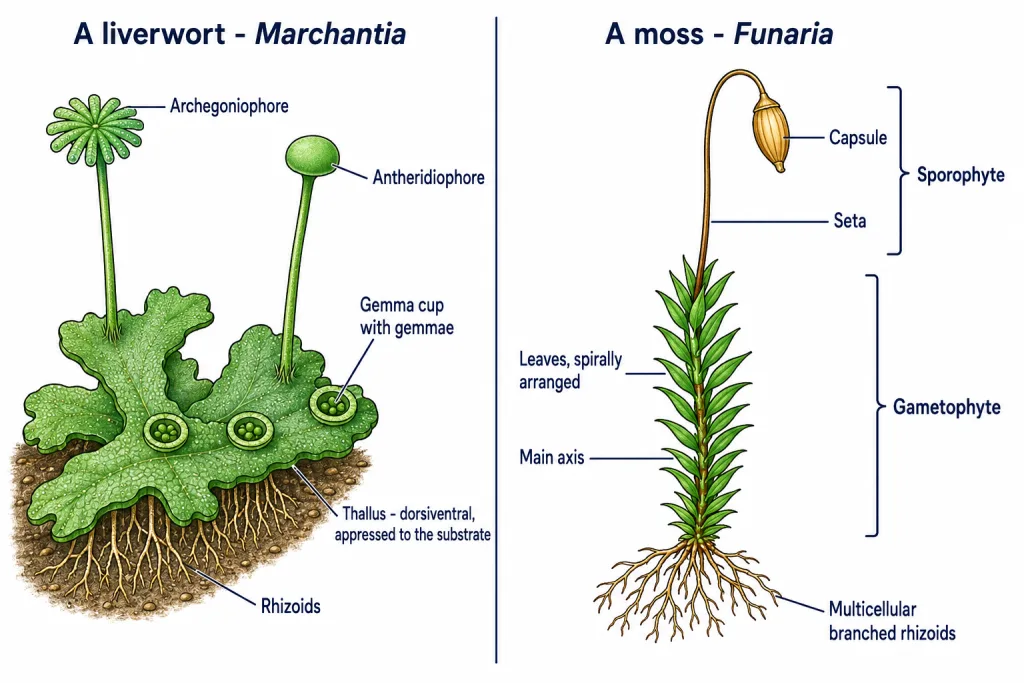
[NEET Important] Gemma cup is the receptacle; gemma is the bud inside it. A gemma is green, multicellular and asexual - three adjectives, all examinable - and it is a liverwort feature, associated with Marchantia.
Mosses - the Two Gametophyte Stages
The predominant stage of the life cycle of a moss is the gametophyte, which consists of two stages.
Stage 1 - the protonema stage
- Develops directly from a spore.
- Is creeping, green, branched and frequently filamentous.
Stage 2 - the leafy stage
- Develops from the secondary protonema as a lateral bud.
- Consists of upright, slender axes bearing spirally arranged leaves.
- Is attached to the soil through multicellular and branched rhizoids.
- This stage bears the sex organs.
[NEET Important] "Protonema" is a term the exercises ask you to explain, so learn the full description: the first stage of the moss gametophyte, developing directly from a spore, creeping, green, branched and frequently filamentous. Note also that the rhizoids of the leafy stage are multicellular and branched - a specific detail, and one that separates mosses from many liverworts.
Mosses - Reproduction
Vegetative reproduction is by fragmentation and by budding in the secondary protonema.
Sexual reproduction: the sex organs antheridia and archegonia are produced at the apex of the leafy shoots.
After fertilisation, the zygote develops into a sporophyte consisting of a foot, seta and capsule.
The sporophyte in mosses is more elaborate than that in liverworts.
The capsule contains spores. Spores are formed after meiosis. And - a detail that distinguishes the group:
The mosses have an elaborate mechanism of spore dispersal.
Common examples: Funaria*, *Polytrichum* and *Sphagnum.
Liverworts and Mosses Compared
| Liverworts | Mosses | |
|---|---|---|
| Gametophyte body | Thalloid and dorsiventral, closely appressed to the substrate; leafy members have tiny leaf-like appendages in two rows | Two stages - the protonema (creeping, green, branched, filamentous) and the leafy stage with upright slender axes and spirally arranged leaves |
| Rhizoids | Attach the thallus to the substrate | Multicellular and branched |
| Asexual reproduction | Fragmentation of thalli and gemmae formed in gemma cups | Fragmentation and budding in the secondary protonema |
| Position of sex organs | On the same or different thalli | At the apex of the leafy shoots |
| Sporophyte | Foot, seta and capsule | Foot, seta and capsule, but more elaborate |
| Spore dispersal | Spores released from the capsule after meiosis | Elaborate mechanism of spore dispersal |
| Examples | Marchantia | Funaria, Polytrichum, Sphagnum |
Both share: a dominant haploid gametophyte, multicellular antheridia and archegonia, water-dependent fertilisation, a dependent sporophyte of foot, seta and capsule, and meiosis inside the capsule producing haploid spores.
Quick Recap
Liverworts
- Grow in moist, shady habitats - banks of streams, marshy ground, damp soil, bark of trees, deep woods.
- Plant body thalloid, dorsiventral, closely appressed to the substrate (Marchantia); leafy members bear tiny leaf-like appendages in two rows.
- Asexual reproduction: fragmentation of thalli and gemmae - green, multicellular, asexual buds formed in gemma cups on the thalli, which detach and germinate into new individuals.
- Sex organs on the same or different thalli.
- Sporophyte: foot, seta and capsule; spores formed after meiosis within the capsule germinate into free-living gametophytes.
Mosses
- Gametophyte is the predominant stage and has two stages: the protonema - developing directly from a spore, creeping, green, branched, frequently filamentous - and the leafy stage, arising from the secondary protonema as a lateral bud, with upright slender axes bearing spirally arranged leaves, attached by multicellular branched rhizoids, and bearing the sex organs.
- Vegetative reproduction: fragmentation and budding in the secondary protonema.
- Antheridia and archegonia at the apex of leafy shoots; sporophyte of foot, seta and capsule, more elaborate than in liverworts; spores formed after meiosis in the capsule; elaborate mechanism of spore dispersal.
- Examples: Funaria, Polytrichum, Sphagnum.
Solved Examples
Question 1
Q. Name a thalloid liverwort.
Answer. Marchantia.
Question 2
Q. What are gemma cups?
Answer. Small receptacles located on the thalli of liverworts, in which gemmae develop.
Question 3
Q. Name the three parts of a moss sporophyte.
Answer. Foot, seta and capsule.
Question 4
Q. Give three examples of mosses.
Answer. Funaria, Polytrichum and Sphagnum.
Question 5
Q. Where are the sex organs of a moss produced?
Answer. At the apex of the leafy shoots.
Question 6
Q. Explain the term protonema with reference to a moss.
Answer. A moss begins as the protonema, the first stage of the moss gametophyte. It develops directly from a spore and is creeping, green, branched and frequently filamentous. Then the second stage, the leafy stage, develops from the secondary protonema as a lateral bud, and that is the stage carrying the sex organs.
Question 7
Q. What are gemmae? Describe them fully.
Answer. Gemmae are green, multicellular, asexual buds. They develop in small receptacles called gemma cups located on the thalli of liverworts, and later they become detached from the parent body and germinate to form new individuals. So gemmae are one route of asexual reproduction.
Question 8
Q. Differentiate between liverworts and mosses.
Answer.
| Liverworts | Mosses | |
|---|---|---|
| Gametophyte | Thalloid and dorsiventral, appressed to the substrate | Two stages - protonema and leafy stage with upright slender axes and spirally arranged leaves |
| Asexual reproduction | Fragmentation and gemmae in gemma cups | Fragmentation and budding in the secondary protonema |
| Sporophyte | Foot, seta, capsule | Foot, seta, capsule - more elaborate |
| Spore dispersal | Simple release from the capsule | Elaborate mechanism |
| Example | Marchantia | Funaria, Polytrichum, Sphagnum |
Question 9
Q. Describe vegetative reproduction in mosses.
Answer. It occurs by fragmentation and by budding in the secondary protonema.
Question 10
Q. State the ploidy of a gemma cell in Marchantia and of a leaf cell of a moss, and justify both.
Answer. Both are haploid (n).
Justification: a gemma is an asexual bud that grows on the thallus, and the liverwort thallus is the gametophyte, so it is haploid. The gemma comes off that haploid body by mitosis, so it is haploid too. Same story for a moss leaf cell - the leafy stage is part of the gametophyte, so its cells are haploid. In both plants the only diploid structures are the zygote and the sporophyte.
Question 11
Q. Both gemmae and spores produce new individuals in bryophytes. Distinguish them on origin, ploidy and the type of reproduction they represent.
Answer.
| Gemma | Spore | |
|---|---|---|
| Formed in | Gemma cups on the thallus (gametophyte) | The capsule of the sporophyte |
| Formed by | Mitosis from the haploid gametophyte | Meiosis in the sporophyte |
| Ploidy | n | n |
| Type of reproduction | Asexual - a vegetative propagule | Part of the sexual cycle, being the product of meiosis |
| Genetic outcome | Offspring identical to the parent | Offspring carry recombined genetic material |
Takeaway: Both are haploid, and both germinate into gametophytes - but one is a clone and the other is the recombination step of the life cycle. That is the distinction a question is really testing.
Question 12
Q. Why does the moss gametophyte need two stages while the liverwort manages with one body form?
Answer. The two moss stages split the work between them. The protonema is creeping, green, branched and frequently filamentous, and it develops directly from a spore. That shape is right for spreading over the substrate and establishing the colony from one spore. The leafy stage then comes up from the secondary protonema as a lateral bud, as upright slender axes bearing spirally arranged leaves held by multicellular branched rhizoids. That shape does the other job - raising the sex organs into the air at the apex of the shoots, and later holding up an elaborate sporophyte for spore dispersal.
The liverwort thallus is dorsiventral and closely appressed to the substrate, so it stays low and one flat body handles both spreading and reproduction. For spread it leans on gemma cups instead. That is also why the moss sporophyte counts as more elaborate and the moss dispersal mechanism as elaborate - height helps you release spores.