
Angiosperms - Flowers and Enclosed Seeds
Gymnosperms left the ovules naked. Angiosperms close them in.
Unlike the gymnosperms where the ovules are naked, in the angiosperms or flowering plants the pollen grains and ovules are developed in specialised structures called flowers. In angiosperms, the seeds are enclosed in fruits.
The group:
- An exceptionally large group of plants, occurring in a wide range of habitats.
- They range in size from the smallest Wolffia to tall trees of Eucalyptus (over 100 metres).
- They provide us with food, fodder, fuel, medicines and several other commercially important products.
- They are divided into two classes: the dicotyledons and the monocotyledons.
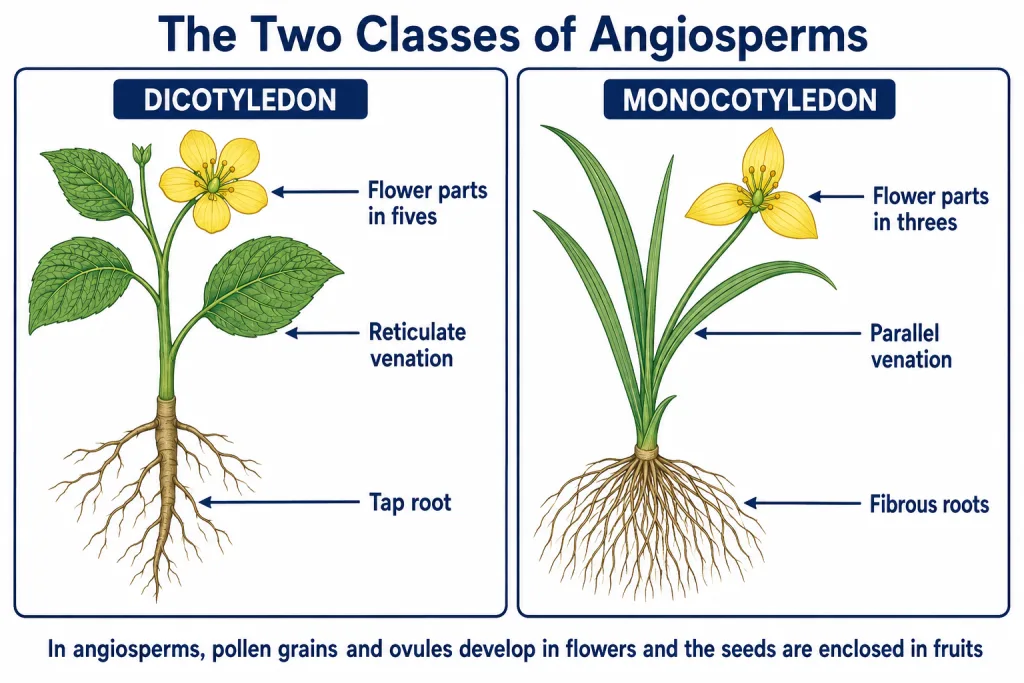
[NEET Important] The size pair - smallest Wolffia, tallest Eucalyptus over 100 metres - is asked as a straight recall item, and Eucalyptus is often set against Sequoia from the previous section. Sequoia is the tall gymnosperm; Eucalyptus the tall angiosperm.
Gymnosperms and Angiosperms Compared
This comparison is the most frequently asked in the second half of the chapter.
| Gymnosperms | Angiosperms | |
|---|---|---|
| Ovules | Not enclosed by any ovary wall; exposed before and after fertilisation | Enclosed; developed within flowers |
| Reproductive structures | Strobili or cones - microsporangiate and macrosporangiate | Flowers |
| Seeds | Naked, not covered | Enclosed in fruits |
| Size range | Medium to tall trees and shrubs; Sequoia among the tallest | Smallest Wolffia to Eucalyptus over 100 metres |
| Classes | - | Dicotyledons and monocotyledons |
The answer to "why are they classified separately if both bear seeds?" rests on this table: both are seed plants, but only angiosperms have flowers and a closed ovary whose wall becomes the fruit.
Plant Life Cycles - Where Meiosis Sits
Every group in this chapter alternates between a haploid gametophytic phase and a diploid sporophytic phase. What changes from group to group is which phase dominates and where reduction division happens. Three patterns are recognised, and the chapter's exercises assume them.
1. Haplontic
- The dominant phase is the haploid gametophyte; it is free-living and photosynthetic.
- The only diploid stage is the zygote. There is no multicellular diploid phase at all.
- The zygote itself undergoes meiosis to produce haploid spores.
- Examples: many algae - Volvox, Spirogyra, Chlamydomonas.
2. Diplontic
- The dominant phase is the diploid sporophyte.
- The gametophyte is reduced to a few cells or even to single-celled gametes.
- Meiosis occurs during gamete formation, or in the sporangia of the dominant sporophyte.
- Examples: seed plants - gymnosperms and angiosperms - and, among algae, Fucus.
3. Haplo-diplontic
- Both phases are multicellular and alternate with each other.
- Bryophytes: dominated by the gametophyte, with a dependent sporophyte.
- Pteridophytes: dominated by the sporophyte, with a free-living prothallus.
- Some algae, such as Ectocarpus and Polysiphonia, also fall here.
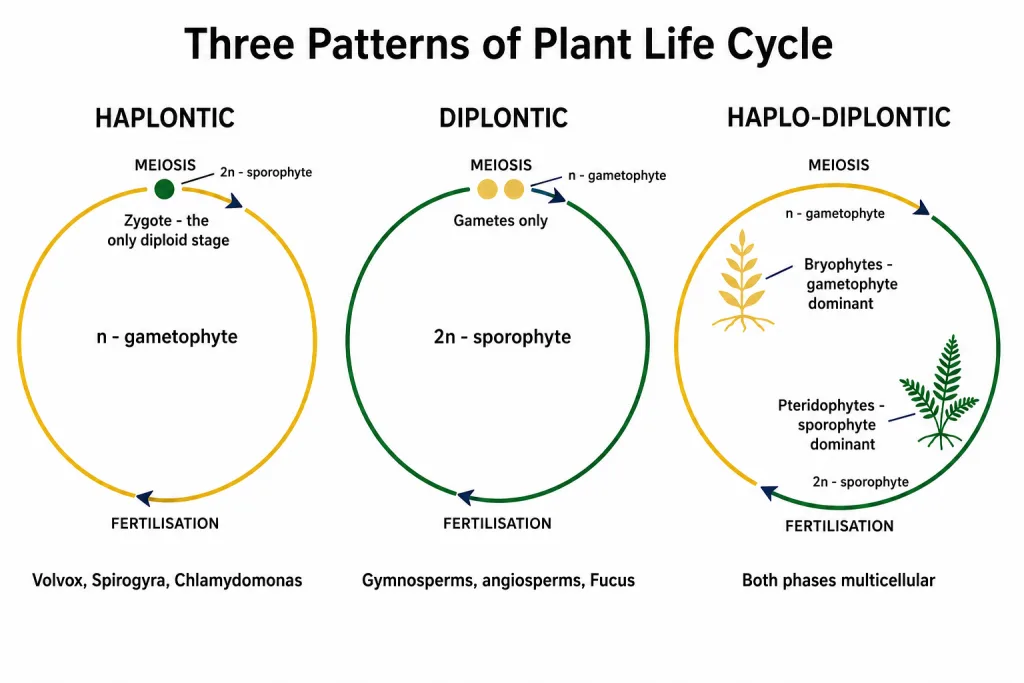
[NEET Important] The two most-missed points: in a haplontic cycle the zygote is the only diploid cell, so meiosis is zygotic; and bryophytes and pteridophytes share the same pattern - haplo-diplontic - and differ only in which multicellular phase dominates.
Reduction Division and Ploidy - the Master Table
If you learn one table from this chapter, learn this one. It answers every ploidy and life-cycle question in the exercises.
| Group | Dominant phase | Where meiosis occurs | Life-cycle pattern |
|---|---|---|---|
| Algae (many) | Gametophyte | In the zygote | Haplontic |
| Liverwort | Gametophyte | In the capsule of the sporophyte (spore mother cells) | Haplo-diplontic |
| Moss | Gametophyte | In the capsule of the sporophyte | Haplo-diplontic |
| Fern | Sporophyte | In the sporangium, in spore mother cells | Haplo-diplontic |
| Gymnosperm | Sporophyte | In the microsporangium and megasporangium | Diplontic |
| Angiosperm | Sporophyte | In the anther (microsporangium) and the ovule (megasporangium) | Diplontic |
Ploidy of some cells the exercises name:
| Cell | Ploidy |
|---|---|
| Protonemal cell of a moss | n |
| Leaf cell of a moss | n |
| Gemma cell in Marchantia | n |
| Ovum of a liverwort | n |
| Prothallus cell of a fern | n |
| Zygote of a fern | 2n |
| Meristem cell of a monocot | 2n |
| Primary endosperm nucleus in a dicot | 3n |
[NEET Important] The primary endosperm nucleus is 3n - the odd one out in that list. It arises from double fertilisation - specifically from the triple fusion half of it, where a male gamete fuses with two polar nuclei. Everything else on the list follows the simple rule: gametophyte structures are n, sporophyte structures are 2n.
The Whole Chapter as One Progression
Read down this table and the logic of the plant kingdom appears.
| Algae | Bryophytes | Pteridophytes | Gymnosperms | Angiosperms | |
|---|---|---|---|---|---|
| Body | Thalloid | Thallus-like, more differentiated; no true organs | True root, stem, leaves | True organs | True organs |
| Vascular tissue | Absent | Absent | Present - first time | Present | Present |
| Dominant phase | Usually gametophyte | Gametophyte | Sporophyte | Sporophyte | Sporophyte |
| Other phase | - | Sporophyte dependent on gametophyte | Prothallus free-living | Gametophytes not free-living | Gametophytes not free-living |
| Water for fertilisation | Required | Required | Required | Not required | Not required |
| Seeds | Absent | Absent | Absent; heterospory is a precursor | Naked | Enclosed in fruits |
Three turning points to name:
- Vascular tissue arrives with pteridophytes.
- Independence from water at fertilisation arrives with gymnosperms.
- The enclosed seed and the flower arrive with angiosperms.
Quick Recap
Angiosperms
- Pollen grains and ovules develop in flowers; seeds are enclosed in fruits.
- Exceptionally large group across a wide range of habitats; from the smallest Wolffia to tall Eucalyptus trees over 100 metres.
- Provide food, fodder, fuel, medicines and other commercially important products.
- Divided into dicotyledons and monocotyledons.
Life-cycle patterns
- Haplontic: dominant haploid gametophyte; zygote is the only diploid stage and undergoes meiosis. Volvox, Spirogyra, Chlamydomonas.
- Diplontic: dominant diploid sporophyte; gametophyte reduced. Seed plants, and Fucus.
- Haplo-diplontic: both phases multicellular - gametophyte-dominant in bryophytes, sporophyte-dominant in pteridophytes.
Where meiosis occurs
- Algae (haplontic): in the zygote.
- Liverwort and moss: in the capsule of the sporophyte.
- Fern: in the sporangium, in spore mother cells.
- Gymnosperm and angiosperm: in the microsporangium and megasporangium - in flowering plants, the anther and the ovule.
Ploidy shortcut: gametophyte structures are n, sporophyte structures are 2n, and the primary endosperm nucleus is 3n.
Solved Examples
Question 1
Q. Where do the pollen grains and ovules of an angiosperm develop?
Answer. In specialised structures called flowers.
Question 2
Q. Name the smallest and one of the tallest angiosperms.
Answer. Smallest: Wolffia. Tallest: Eucalyptus, over 100 metres.
Question 3
Q. Into which two classes are angiosperms divided?
Answer. Dicotyledons and monocotyledons.
Question 4
Q. In which life-cycle pattern is the zygote the only diploid stage?
Answer. The haplontic pattern.
Question 5
Q. Mention the ploidy of the following: protonemal cell of a moss; primary endosperm nucleus in a dicot; leaf cell of a moss; prothallus cell of a fern; gemma cell in Marchantia; meristem cell of a monocot; ovum of a liverwort; zygote of a fern.
Answer.
| Cell | Ploidy | Reason |
|---|---|---|
| Protonemal cell of a moss | n | Part of the moss gametophyte |
| Primary endosperm nucleus in a dicot | 3n | A male gamete fuses with two polar nuclei in double fertilisation |
| Leaf cell of a moss | n | The leafy stage is the gametophyte |
| Prothallus cell of a fern | n | The prothallus is the gametophyte |
| Gemma cell in Marchantia | n | Formed by mitosis on the haploid thallus |
| Meristem cell of a monocot | 2n | Part of the sporophyte plant body |
| Ovum of a liverwort | n | A gamete, produced by the gametophyte |
| Zygote of a fern | 2n | Product of fusion of two haploid gametes |
The rule: everything belonging to the gametophyte is n, everything belonging to the sporophyte is 2n, and the endosperm is the one 3n exception.
Question 6
Q. When and where does reduction division take place in the life cycle of a liverwort, a moss, a fern, a gymnosperm and an angiosperm?
Answer.
| Plant | When | Where |
|---|---|---|
| Liverwort | During spore formation | In the capsule of the sporophyte |
| Moss | During spore formation | In the capsule of the sporophyte |
| Fern | During spore formation | In the spore mother cells inside the sporangium |
| Gymnosperm | During microspore and megaspore formation | In the microsporangium and the megasporangium |
| Angiosperm | During microspore and megaspore formation | In the anther (microsporangium) and the ovule (megasporangium) |
The common thread: in every land plant - liverwort, moss, fern, gymnosperm, angiosperm - meiosis occurs in the sporophyte, at the point of spore formation, never in the gametophyte. Among algae it sits elsewhere: zygotic in the haplontic cycle, and at gamete formation in a diplontic alga such as Fucus.
Question 7
Q. Both gymnosperms and angiosperms bear seeds. Why are they classified separately?
Answer. Because of what surrounds the ovule and the seed.
- In gymnosperms the ovules are not enclosed by any ovary wall and remain exposed both before and after fertilisation, so the resulting seeds are naked. Reproductive structures are strobili or cones.
- In angiosperms the pollen grains and ovules develop in flowers, and after fertilisation the seeds are enclosed in fruits, because the ovary wall becomes the fruit.
So both are seed plants, but only angiosperms have a flower and a closed ovary. That is a difference of whole structures, not a difference of degree.
Question 8
Q. Distinguish haplontic and diplontic life cycles.
Answer.
| Haplontic | Diplontic | |
|---|---|---|
| Dominant phase | Haploid gametophyte, free-living | Diploid sporophyte |
| Other phase | Zygote only - no multicellular diploid stage | Gametophyte reduced to a few cells or to gametes |
| Meiosis | In the zygote | At spore or gamete formation in the sporophyte |
| Examples | Volvox, Spirogyra, Chlamydomonas | Gymnosperms, angiosperms, Fucus |
Question 9
Q. Bryophytes and pteridophytes share a life-cycle pattern. Name it and state how they differ within it.
Answer. Both are haplo-diplontic - both phases are multicellular. They differ in which phase dominates: in bryophytes the gametophyte dominates and the sporophyte is dependent on it; in pteridophytes the sporophyte dominates and the gametophyte is a small but free-living prothallus.
Question 10
Q. Name three groups of plants that bear archegonia, and briefly describe the life cycle of any one of them.
Answer. Bryophytes, pteridophytes and gymnosperms.
Life cycle of a moss (a bryophyte):
- A haploid spore germinates into the protonema - creeping, green, branched and frequently filamentous.
- From the secondary protonema, a lateral bud gives the leafy stage, with upright axes and spirally arranged leaves. This is the gametophyte, and it is haploid.
- At the apex of the leafy shoots it bears antheridia, producing biflagellate antherozoids, and archegonia, each producing a single egg.
- Antherozoids are released into water and reach the archegonium; one fuses with the egg to form the diploid zygote.
- The zygote does not divide meiotically at once. It builds a sporophyte of foot, seta and capsule, which is attached to the gametophyte and draws nourishment from it.
- Meiosis occurs in the capsule, producing haploid spores, which are shed by an elaborate dispersal mechanism and germinate into new protonemata.
Takeaway: For "three groups with archegonia", stop at gymnosperms. Angiosperms have no archegonia - their female gametophyte is the embryo sac.
Question 11
Q. Trace the three turning points of the plant kingdom and say what problem each solved.
Answer.
Vascular tissue, in pteridophytes. Algae and bryophytes have no xylem and phloem, so they stay small and close to moisture - bryophytes lack true roots, stem or leaves altogether. Pteridophytes, the first terrestrial plants to possess vascular tissue, gained true root, stem and leaves and could stand up and transport water. Problem solved: support and transport on land.
Freedom from water at fertilisation, in gymnosperms. Both bryophytes and pteridophytes still need water for the antherozoids to reach the archegonium, and the pteridophyte prothallus needs cool, damp, shady places - which is why their spread is restricted to narrow geographical regions. In gymnosperms the gametophytes never live independently, staying within the sporangia on the sporophyte, and pollen is carried in air currents with a pollen tube delivering the gametes. Problem solved: reproduction in dry habitats.
The flower and the enclosed seed, in angiosperms. Gymnosperm ovules are exposed before and after fertilisation and their seeds are naked. Angiosperms develop pollen grains and ovules in flowers and enclose the seeds in fruits. Problem solved: protection of the ovule and seed, plus a structure that can recruit animals for pollination and dispersal.
Question 12
Q. A cell is described as belonging to a plant, and is found to be triploid. What is it most likely to be, and why is it the only such cell in this chapter's ploidy list?
Answer. It is the primary endosperm nucleus of an angiosperm, and it is 3n.
Every other structure in the chapter follows a two-value rule: gametophyte structures are n (spores, prothallus, protonema, gemmae, gametes, archegonia) and sporophyte structures are 2n (the plant body, sporophylls, spore mother cells, the nucellus, the zygote, the embryo). Nothing in that scheme can be triploid, because every cell is either the product of meiosis or the product of one fusion of two haploid gametes.
The endosperm breaks the pattern because it comes from double fertilisation, unique to angiosperms: one male gamete fertilises the egg to give the 2n zygote, while a second fuses with two polar nuclei to give the 3n primary endosperm nucleus. That second fusion involves three nuclei - one male gamete and two polar nuclei - so it has its own name, triple fusion. Three haploid nuclei, one product - hence 3n.