
Who They Are, and the Nickname
Bryophytes include the various mosses and liverworts found commonly growing in moist shaded areas in the hills.
Bryophytes are also called amphibians of the plant kingdom because these plants can live in soil but are dependent on water for sexual reproduction.
That sentence is the answer to a guaranteed question, and both halves are needed - live in soil and depend on water for sexual reproduction. Say only one and you lose half the mark.
They usually occur in damp, humid and shaded localities, and they play an important role in plant succession on bare rocks and soil.
The Plant Body
The plant body of bryophytes is more differentiated than that of algae.
What that means in practice:
- It is thallus-like and prostrate or erect.
- It is attached to the substratum by unicellular or multicellular rhizoids.
- They lack true roots, stem or leaves.
- They may possess root-like, leaf-like or stem-like structures.
[NEET Important] Read the last two lines together - they look contradictory and are not. Bryophytes have structures that look like roots, stems and leaves but are not true organs, because true organs require vascular tissue, which arrives only in pteridophytes. Questions phrase this as "possess root-like structures but lack true roots", and expect you to accept both.
So the sequence of body organisation across the chapter runs: thalloid algae to thallus-like but more differentiated bryophytes to truly organ-differentiated pteridophytes.
The Gametophyte and Its Sex Organs
The main plant body of the bryophyte is haploid. It produces gametes, hence is called a gametophyte.
That one line drives most of the ploidy questions in this chapter: the visible moss or liverwort plant is n.
The sex organs are multicellular - a real advance on algae. There are two:
| Sex organ | Sex | Produces |
|---|---|---|
| Antheridium | Male | Biflagellate antherozoids |
| Archegonium | Female | A single egg; it is flask-shaped |
[NEET Important] Three precise details are asked: the antheridium produces biflagellate antherozoids; the archegonium is flask-shaped; and it produces a single egg - one, not several.
Fertilisation and the Dependent Sporophyte
The sequence, step by step:
- The antherozoids are released into water, where they come in contact with the archegonium.
- An antherozoid fuses with the egg to produce the zygote.
- Zygotes do not undergo reduction division immediately. Instead, they produce a multicellular body called a sporophyte.
- The sporophyte is not free-living but attached to the photosynthetic gametophyte and derives nourishment from it.
- Some cells of the sporophyte undergo reduction division (meiosis) to produce haploid spores.
- These spores germinate to produce the gametophyte.
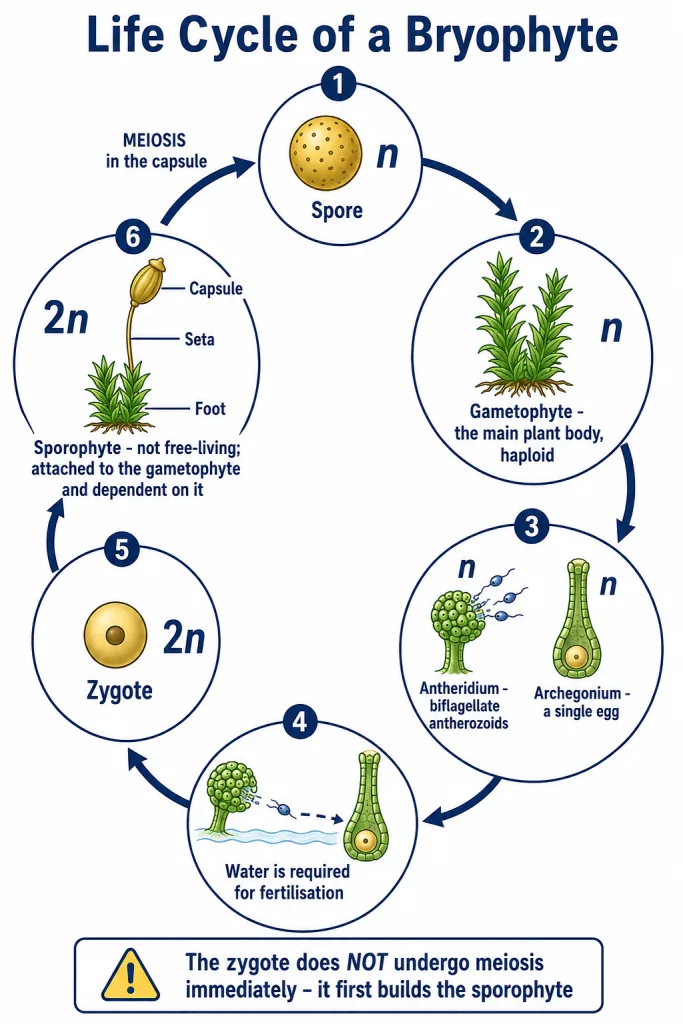
[NEET Important] Two points carry most of the marks here.
First - step 1 is why they are amphibians. Fertilisation needs water for the antherozoids to swim in.
Second - step 3 is the standard trap. The zygote does not divide meiotically straight away; it first builds a multicellular diploid sporophyte. Meiosis happens later, in some cells of that sporophyte. Get this wrong and the whole ploidy table collapses.
Ploidy Through the Bryophyte Life Cycle
| Structure | Ploidy |
|---|---|
| Main plant body (gametophyte) | n |
| Rhizoids, leaf-like structures of the gametophyte | n |
| Antheridium and archegonium (and the antherozoid and egg) | n |
| Zygote | 2n |
| Sporophyte (foot, seta, capsule) | 2n |
| Spores | n |
Where does reduction division occur? In the sporophyte - specifically in the spore mother cells inside the capsule - producing the haploid spores.
Economic and Ecological Importance
Bryophytes in general are of little economic importance, but there are exceptions worth naming.
Economic
- Some mosses provide food for herbaceous mammals, birds and other animals.
- Species of Sphagnum, a moss, provide peat, which has long been used as fuel, and as packing material for trans-shipment of living material - because of its capacity to hold water.
Ecological - this is the more heavily examined half:
- Mosses, along with lichens, are the first organisms to colonise rocks, and are therefore of great ecological importance.
- They decompose rocks, making the substrate suitable for the growth of higher plants.
- Since mosses form dense mats on the soil, they reduce the impact of falling rain and prevent soil erosion.
[NEET Important] Sphagnum - peat - fuel and packing material - water-holding capacity. That whole chain is one question. And mosses + lichens as the first colonisers of bare rock links straight back to the pioneer role of lichens from the previous chapter.
Bryophytes are divided into liverworts and mosses, taken up in the next section.
Quick Recap
- Bryophytes = mosses and liverworts, of moist shaded areas in the hills; amphibians of the plant kingdom because they live in soil but depend on water for sexual reproduction.
- Important in plant succession on bare rocks and soil; occur in damp, humid and shaded localities.
- Body more differentiated than algae: thallus-like, prostrate or erect, attached by unicellular or multicellular rhizoids; no true roots, stem or leaves, but root-like, leaf-like and stem-like structures.
- Main plant body is haploid and produces gametes - it is the gametophyte.
- Sex organs are multicellular: antheridium produces biflagellate antherozoids; flask-shaped archegonium produces a single egg.
- Antherozoids are released into water; one fuses with the egg to give the zygote.
- The zygote does not undergo reduction division immediately - it produces a multicellular sporophyte, which is not free-living, stays attached to the photosynthetic gametophyte and derives nourishment from it.
- Some cells of the sporophyte undergo meiosis to give haploid spores, which germinate into gametophytes.
- Little economic importance overall; some mosses feed herbaceous mammals and birds; Sphagnum provides peat used as fuel and as packing material for its water-holding capacity.
- Mosses and lichens are the first colonisers of rock; they decompose rock to prepare the substrate for higher plants, and their dense mats reduce the impact of falling rain and prevent soil erosion.
Solved Examples
Question 1
Q. Why are bryophytes called amphibians of the plant kingdom?
Answer. Because these plants can live in soil but are dependent on water for sexual reproduction - the antherozoids must swim through water to reach the archegonium.
Question 2
Q. Name the male and female sex organs of a bryophyte.
Answer. Male: antheridium. Female: archegonium.
Question 3
Q. What does the antheridium produce?
Answer. Biflagellate antherozoids.
Question 4
Q. Describe the archegonium in two words plus its product.
Answer. It is flask-shaped and multicellular, and it produces a single egg.
Question 5
Q. Which moss provides peat?
Answer. Sphagnum.
Question 6
Q. State the ploidy of the following in a moss: the main plant body, the antherozoid, the zygote, the sporophyte, and the spores.
Answer.
| Structure | Ploidy |
|---|---|
| Main plant body (gametophyte) | n |
| Antherozoid | n |
| Zygote | 2n |
| Sporophyte | 2n |
| Spores | n |
The rule to hold: everything from the spore up to the gametes is haploid; fertilisation makes it diploid; and it stays diploid until meiosis in the sporophyte returns it to haploid.
Question 7
Q. Why is the bryophyte sporophyte described as dependent?
Answer. Because it is not free-living. It remains attached to the photosynthetic gametophyte and derives nourishment from it. The gametophyte photosynthesises; the sporophyte does not support itself.
Question 8
Q. Where does meiosis take place in a bryophyte, and what does it produce?
Answer. In some cells of the sporophyte - the spore mother cells within the capsule. It produces haploid spores, which germinate to form the gametophyte.
Question 9
Q. How is the bryophyte plant body more differentiated than that of algae, and how is it still short of a pteridophyte?
Answer. Compared with algae: the bryophyte body is thallus-like but more differentiated. It lies prostrate or erect, it is attached by rhizoids, and it carries root-like, leaf-like and stem-like structures - the first signs of division of labour.
Compared with pteridophytes: bryophytes still lack true roots, stem and leaves. Those structures only look like organs. The true organs, with well-differentiated vascular tissue, turn up first in the pteridophytes.
Question 10
Q. State three ecological roles of mosses.
Answer.
- Mosses, along with lichens, are the first organisms to colonise rocks.
- They decompose rocks, making the substrate suitable for the growth of higher plants.
- Their dense mats on the soil reduce the impact of falling rain and prevent soil erosion.
Question 11
Q. A student writes: "In bryophytes the zygote undergoes meiosis to form spores." Correct this and explain why the error matters.
Answer. The statement is wrong. Zygotes do not undergo reduction division immediately. The zygote first produces a multicellular body called a sporophyte, and only then do some cells of that sporophyte undergo meiosis to produce haploid spores.
Why it matters: if the zygote went straight into meiosis, there would be no diploid multicellular phase at all - the life cycle would be haplontic, with the zygote as the only diploid stage. Bryophytes alternate between a dominant haploid gametophyte and a dependent multicellular diploid sporophyte, and that whole picture rests on this delay. Every ploidy question in the chapter turns on getting it right.
Question 12
Q. Explain how the two uses of Sphagnum peat both follow from one property.
Answer. The property is its capacity to hold water.
- People have burnt peat as fuel for a long time, because Sphagnum piles up in waterlogged, oxygen-poor conditions and never fully decomposes. That partly decomposed, compacted mass dries out and burns.
- It also works as packing material for trans-shipment of living material, because something that holds water keeps roots, cuttings and other living material moist on the way.
One property, two applications - which is why questions on peat usually ask for both uses in the same breath.
Question 13
Q. Bryophytes are said to be of little economic importance yet of great ecological importance. Reconcile the two claims.
Answer. They are not in conflict, because the two words measure different things.
Economically the group gives humans very little. Some mosses provide food for herbaceous mammals, birds and other animals, and Sphagnum gives us peat for fuel and packing. That is nearly the whole list, so bryophytes count as of little economic importance in general.
Ecologically they are pioneers. Mosses and lichens are the first organisms to colonise rocks; they decompose rock, making the substrate suitable for the growth of higher plants; and their dense mats reduce the impact of falling rain and prevent soil erosion. Without that first stage of plant succession on bare rocks and soil, the higher plants that do have economic value would have no soil to grow in.
Takeaway: Small direct yield, large enabling role. That is the shape of the answer a 3-mark question wants.