
Connective Tissue
Connective tissues are the most abundant and widely distributed tissues in the body of complex animals. They are named for their function - they link and support other tissues and organs of the body.
Except for blood, connective tissues secrete fibres of structural proteins, which along with the modified polysaccharides they secrete accumulate between the cells as the matrix. It is the matrix that gives each connective tissue its character.
There are three types: loose, dense and specialised.
Loose connective tissue
Cells and fibres loosely arranged in a semi-fluid ground substance.
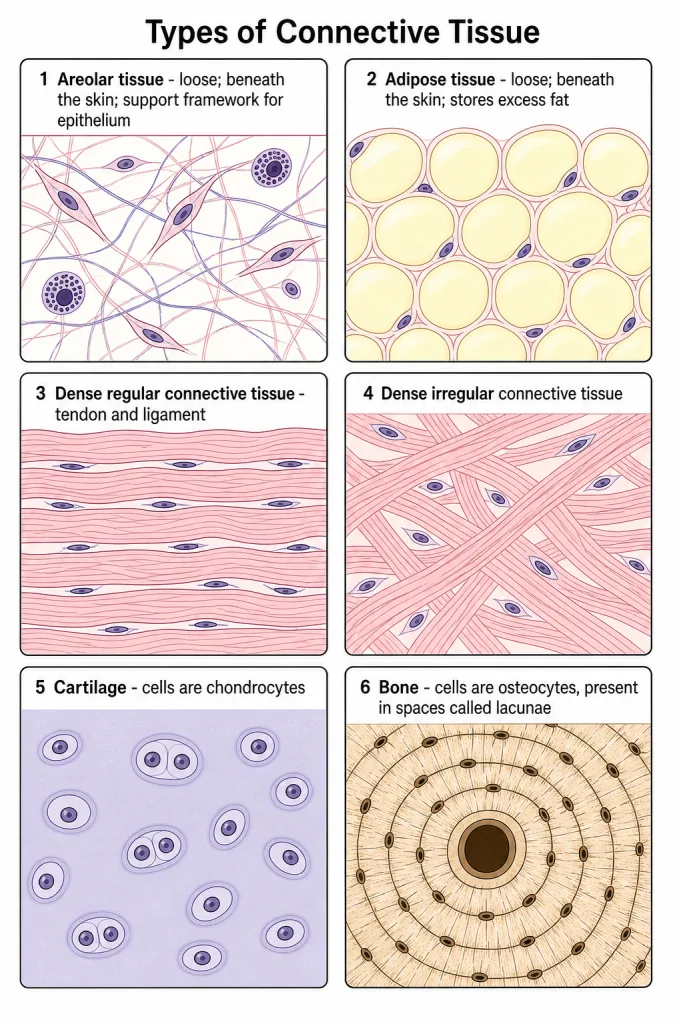
- Areolar tissue - present beneath the skin. It often serves as a support framework for epithelium, and it contains fibroblasts, which produce and secrete fibres, along with macrophages and mast cells.
- Adipose tissue - located mainly beneath the skin. Its cells are specialised to store fats. The excess of nutrients which are not used immediately is converted into fats and stored here.
Dense connective tissue
Fibres and fibroblasts compactly packed.
- Dense regular - the collagen fibres are present in rows between many parallel bundles of fibres. Tendons, which attach skeletal muscles to bones, and ligaments, which attach one bone to another, are of this kind.
- Dense irregular - fibroblasts and many fibres, mostly collagen, oriented differently. Present in the skin.
Specialised connective tissue
| Tissue | Matrix | Cells | Notes |
|---|---|---|---|
| Cartilage | Solid, pliable, and resists compression | Chondrocytes, enclosed in small cavities within the matrix | Most cartilages in vertebrate embryos are replaced by bones in adults. In adults it stays in the tip of the nose, outer ear joints, between adjacent bones of the vertebral column, limbs and hands |
| Bone | Hard and non-pliable, rich in calcium salts and collagen fibres, which give bone its strength | Osteocytes, in spaces called lacunae | Provides the structural frame to the body; supports and protects softer tissues and organs; long bones of the legs bear weight; interacts with skeletal muscles attached to them to bring about movement; bone marrow in some bones is the site of production of blood cells |
| Blood | Fluid - the plasma | RBC, WBC and platelets | The main circulating fluid, helping in the transport of various substances |
[NEET Important] Three cell names are asked directly and must not be swapped: fibroblasts in areolar tissue, chondrocytes in cartilage, osteocytes in bone, sitting in lacunae. And the tendon-ligament pair is fixed - tendon joins muscle to bone, ligament joins bone to bone. Blood is the odd one out here: it is a connective tissue with a fluid matrix and no fibres.
Muscle Tissue
Each muscle is made of many long, cylindrical fibres arranged in parallel arrays, and these fibres are composed of numerous fine fibrils called myofibrils. Muscle fibres contract, that is shorten, in response to stimulation, then relax and return to their uncontracted state in a coordinated fashion.
Three types:
| Type | Where | Striations | Control | Held together by |
|---|---|---|---|---|
| Skeletal | Closely attached to skeletal bones, in bundle form | Striated | Voluntary | A sheath of tough connective tissue enclosing several bundles of fibres |
| Smooth | Wall of internal organs - blood vessels, stomach and intestine | No striations; fibres taper at both ends | Involuntary | Cell junctions, bundled in a connective tissue sheath |
| Cardiac | Only in the heart | Striated | Involuntary | Cell junctions fuse the plasma membranes so cells stick together |
The cardiac detail that is always asked. At some fusion points there are communication junctions, the intercalated discs, and they allow the cells to contract as a unit - which is why the whole heart beats together rather than fibre by fibre.
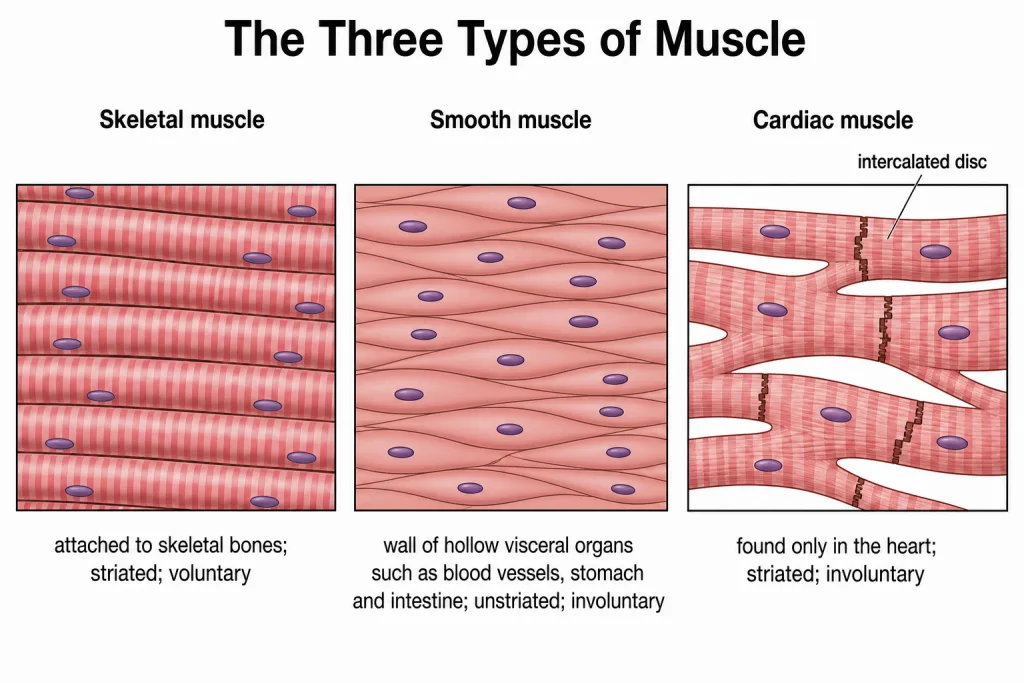
[NEET Important] Smooth muscle is also called visceral or non-striated, and it is the involuntary one in the gut and blood vessels. Cardiac muscle is found only in the heart. The intercalated disc is a communication junction - link it back to the gap junction from the previous section and it stops being a separate fact to memorise.
Neural Tissue
Neural tissue exerts the greatest control over the body's responsiveness to changing conditions.
- Neurons are the unit of the neural system, and they are excitable cells.
- Neuroglial cells constitute the rest of the neural system and they protect and support the neurons. Neuroglia make up more than one-half the volume of neural tissue in our body.
- When a neuron is suitably stimulated, an electrical disturbance is generated which swiftly travels along its plasma membrane. Arrival of the disturbance at the neuron's endings, or output zone, triggers events that may cause stimulation or inhibition of adjacent neurons and other cells.
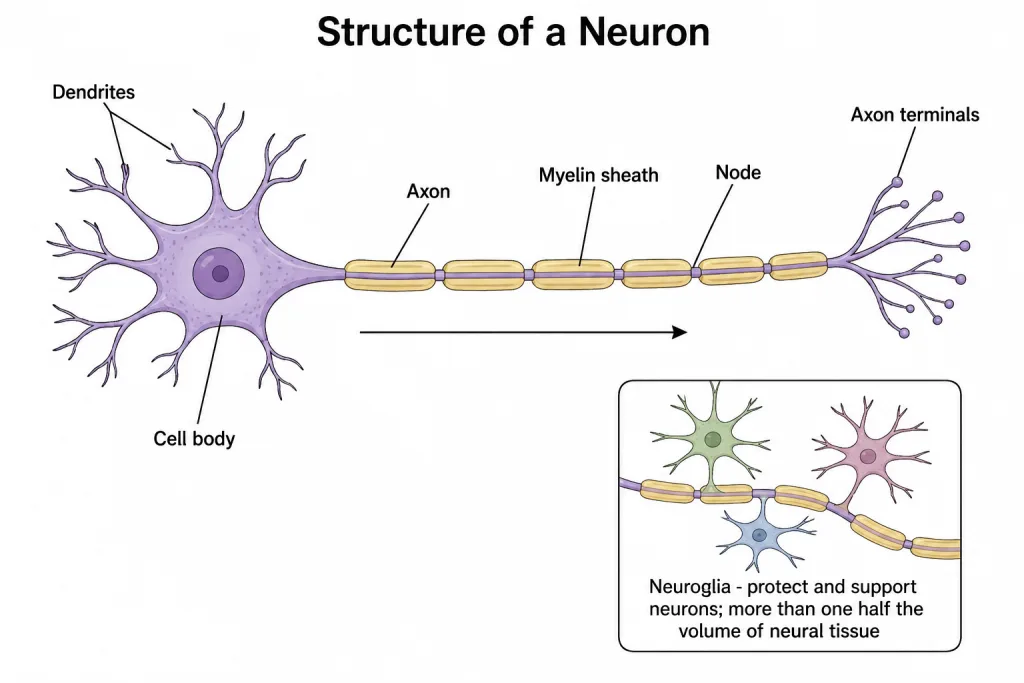
[NEET Important] The one statistic here is the one that gets set: neuroglia make up more than one-half the volume of neural tissue. Note also that the neuron is described as an excitable cell, and that the ending is called the output zone.
Quick Recap
Connective tissue - most abundant and widely distributed; links and supports other tissues and organs; secretes fibres and modified polysaccharides that make the matrix (blood is the exception - no fibres).
- Loose: areolar (beneath the skin, support framework for epithelium, with fibroblasts, macrophages, mast cells) and adipose (beneath the skin, stores fat from nutrients not used immediately).
- Dense: regular - collagen fibres in rows between parallel bundles; tendons (muscle to bone) and ligaments (bone to bone). Irregular - fibres oriented differently; in the skin.
- Specialised: cartilage (solid, pliable, resists compression; chondrocytes in cavities; tip of nose, outer ear joints, between vertebrae, limbs and hands), bone (hard, non-pliable, calcium salts and collagen; osteocytes in lacunae; bone marrow makes blood cells), blood (plasma, RBC, WBC, platelets; the main circulating fluid).
Muscle tissue - long cylindrical fibres of myofibrils; contract, then relax.
- Skeletal - attached to bones, in bundles, in a sheath of tough connective tissue.
- Smooth - fibres taper at both ends, no striations; blood vessels, stomach, intestine; involuntary.
- Cardiac - only in the heart; cell junctions fuse the plasma membranes; intercalated discs are communication junctions letting the cells contract as a unit.
Neural tissue - greatest control over responsiveness.
- Neurons - the unit, excitable.
- Neuroglia - protect and support; more than one-half the volume of neural tissue.
- Stimulation makes an electrical disturbance travel along the plasma membrane to the output zone, where it stimulates or inhibits adjacent neurons and other cells.
Solved Examples
Question 1
Q. Why are connective tissues so named, and which is the odd one out?
Answer. Because they link and support other tissues and organs of the body. Blood is the odd one - it is a connective tissue with a fluid matrix and no fibres, where every other connective tissue secretes fibres into its matrix.
Question 2
Q. Name the three types of connective tissue.
Answer. Loose, dense and specialised.
Question 3
Q. Describe areolar tissue.
Answer. A loose connective tissue beneath the skin with its cells and fibres loosely arranged in a semi-fluid ground substance. It often serves as a support framework for epithelium, and it contains fibroblasts, macrophages and mast cells.
Question 4
Q. What do fibroblasts do?
Answer. They produce and secrete fibres.
Question 5
Q. What is adipose tissue for?
Answer. Its cells are specialised to store fats. Nutrients that are in excess and not used immediately are converted into fats and stored there.
Question 6
Q. Distinguish between a tendon and a ligament.
Answer. Both are dense regular connective tissue. A tendon attaches skeletal muscles to bones; a ligament attaches one bone to another.
Question 7
Q. Where is dense irregular connective tissue found, and how is it arranged?
Answer. In the skin. It has fibroblasts and many fibres, mostly collagen, oriented differently rather than in parallel rows.
Question 8
Q. Describe the matrix and cells of cartilage, and say where it remains in an adult.
Answer. The matrix is solid, pliable, and resists compression, and the cells, the chondrocytes, sit enclosed in small cavities within it. Most cartilages in vertebrate embryos are replaced by bones in adults, but it stays in the tip of the nose, the outer ear joints, and between the adjacent bones of the vertebral column, limbs and hands.
Question 9
Q. What makes bone strong, and what are its cells and their spaces called?
Answer. A hard and non-pliable ground substance rich in calcium salts and collagen fibres. The cells are osteocytes and they lie in spaces called lacunae.
Question 10
Q. Give three jobs that bone does.
Answer. It provides the structural frame to the body; it supports and protects softer tissues and organs; and it interacts with the skeletal muscles attached to it to bring about movement. In some bones the bone marrow is the site of production of blood cells, and the long bones of the legs bear weight.
Question 11
Q. Name the three types of muscle and say where each is found.
Answer. Skeletal, closely attached to skeletal bones. Smooth, in the wall of internal organs such as blood vessels, stomach and intestine. Cardiac, only in the heart.
Question 12
Q. How would you recognise smooth muscle?
Answer. Its fibres taper at both ends and they do not show striations. Cell junctions hold them together and they are bundled in a connective tissue sheath.
Question 13
Q. What is an intercalated disc, and why does it matter?
Answer. A communication junction at some of the points where the plasma membranes of cardiac muscle cells fuse. It matters because it allows the cells to contract as a unit, so the heart beats as one rather than fibre by fibre.
Question 14
Q. What are neuroglia, and how much of the neural tissue do they make up?
Answer. The cells that constitute the rest of the neural system and protect and support the neurons. They make up more than one-half the volume of neural tissue in our body.
Question 15
Q. Describe what happens when a neuron is stimulated.
Answer. An electrical disturbance is generated which travels swiftly along the plasma membrane. When it arrives at the neuron's endings, the output zone, it triggers events that may stimulate or inhibit adjacent neurons and other cells.
Question 16
Q. A tissue has cells sitting in small cavities in a solid but pliable matrix that resists compression. Name the tissue, the cells, and one place it stays in an adult.
Answer. Cartilage, whose cells are chondrocytes. In an adult it remains in the tip of the nose, among other places.