
The Digestive System
The body cavity of a frog accommodates different organ systems - digestive, circulatory, respiratory, nervous, excretory and reproductive - with well developed structures and functions.
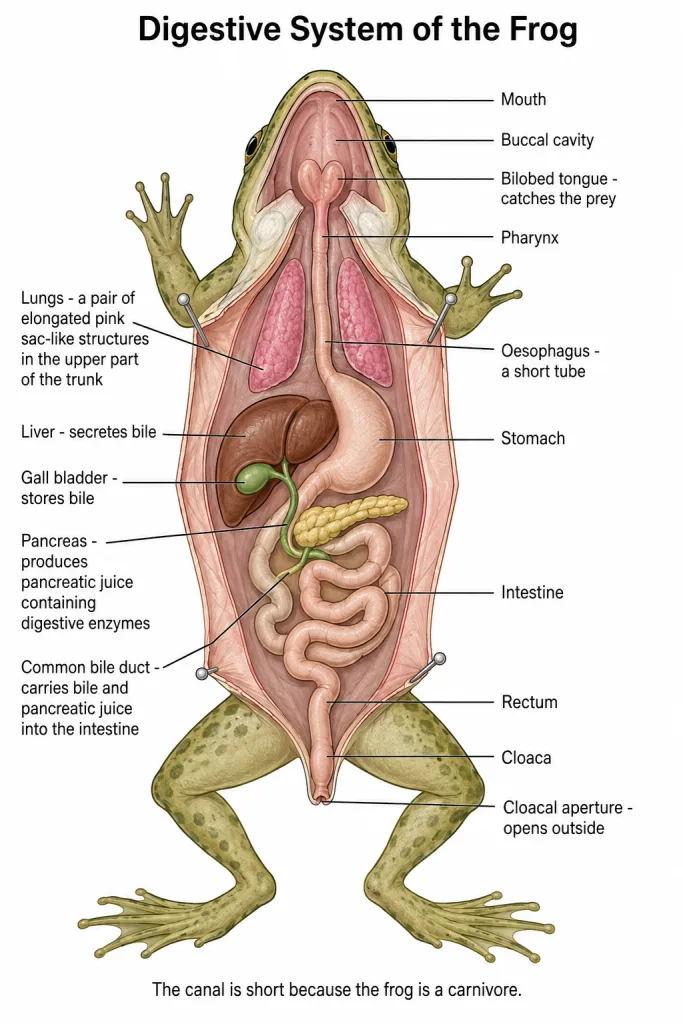
The digestive system consists of the alimentary canal and digestive glands.
The alimentary canal is short because frogs are carnivores, and hence the length of the intestine is reduced.
The path, in order: mouth - buccal cavity - pharynx - oesophagus, a short tube - stomach - intestine - rectum - and finally opens outside by the cloaca.
The glands.
- Liver secretes bile, which is stored in the gall bladder.
- Pancreas, a digestive gland, produces pancreatic juice containing digestive enzymes.
How a meal is processed.
- Food is captured by the bilobed tongue.
- Digestion takes place by the action of HCl and gastric juices secreted from the walls of the stomach.
- Partially digested food, called chyme, passes from the stomach to the first part of the small intestine, the duodenum.
- The duodenum receives bile from the gall bladder and pancreatic juices from the pancreas through a common bile duct. Bile emulsifies fat and pancreatic juices digest carbohydrates and proteins.
- Final digestion takes place in the intestine.
- Digested food is absorbed by the numerous finger-like folds in the inner wall of the intestine called villi and microvilli.
- The undigested solid waste moves into the rectum and passes out through the cloaca.
[NEET Important] Two lines here are asked as reasoning, not recall. The alimentary canal is short because the frog is a carnivore, so the intestine is reduced - herbivores need long guts, carnivores do not. And the bilobed tongue captures the prey. Note also that bile and pancreatic juice arrive together through a common bile duct.
The Respiratory System
Frogs respire on land and in the water by two different methods.
In water. The skin acts as an aquatic respiratory organ - this is cutaneous respiration. Dissolved oxygen in the water is exchanged through the skin by diffusion.
On land. The buccal cavity, skin and lungs act as the respiratory organs. Respiration by the lungs is called pulmonary respiration.
- The lungs are a pair of elongated, pink coloured sac-like structures present in the upper part of the trunk region, the thorax.
- Air enters through the nostrils into the buccal cavity and then to the lungs.
During aestivation and hibernation, gaseous exchange takes place through the skin.
| Where the frog is | Organs used | Name |
|---|---|---|
| In water | Skin | Cutaneous respiration |
| On land | Buccal cavity, skin and lungs | Lung breathing is pulmonary respiration |
| Aestivating or hibernating | Skin only | Cutaneous |
[NEET Important] Three routes, and the question is usually which ones are available where. Skin works everywhere, and it is the only route during aestivation and hibernation - which makes sense, since a buried frog cannot ventilate its lungs. The lungs are described exactly as a pair of elongated, pink, sac-like structures in the thorax.
Quick Recap
Digestive
- Alimentary canal + digestive glands; canal short because the frog is a carnivore, so the intestine is reduced.
- Mouth - buccal cavity - pharynx - oesophagus - stomach - intestine - rectum - cloaca.
- Liver secretes bile, stored in the gall bladder. Pancreas produces pancreatic juice with digestive enzymes.
- Bilobed tongue captures food; HCl and gastric juices from the stomach walls begin digestion; chyme passes to the duodenum.
- Bile and pancreatic juice reach the duodenum through a common bile duct; bile emulsifies fat, pancreatic juice digests carbohydrates and proteins.
- Final digestion in the intestine; absorption by villi and microvilli; undigested waste to the rectum and out through the cloaca.
Respiratory
- In water - skin, cutaneous respiration, dissolved oxygen exchanged by diffusion.
- On land - buccal cavity, skin and lungs; lung breathing is pulmonary respiration.
- Lungs - a pair of elongated, pink, sac-like structures in the thorax; air enters through the nostrils into the buccal cavity and then to the lungs.
- During aestivation and hibernation, exchange is through the skin.
Solved Examples
Question 1
Q. What are the two parts of the digestive system of a frog?
Answer. The alimentary canal and the digestive glands.
Question 2
Q. Why is the alimentary canal of a frog short?
Answer. Because frogs are carnivores, and the length of the intestine is therefore reduced. Meat is easier to break down than plant material, so a long gut is not needed.
Question 3
Q. Trace the path of food through a frog, in order.
Answer. Mouth, then the buccal cavity, then the oesophagus through the pharynx, then the stomach, then the intestine, then the rectum, and finally out through the cloaca.
Question 4
Q. What does the liver secrete, and where is it stored?
Answer. Bile, and it is stored in the gall bladder.
Question 5
Q. What does the pancreas produce?
Answer. Pancreatic juice, containing digestive enzymes.
Question 6
Q. How does a frog capture its food?
Answer. With its bilobed tongue.
Question 7
Q. What begins digestion in the stomach, and what is the partly digested food called?
Answer. The action of HCl and gastric juices secreted from the walls of the stomach. The partly digested food is chyme.
Question 8
Q. What reaches the duodenum, how, and what does each do?
Answer. Bile from the gall bladder and pancreatic juices from the pancreas, both through a common bile duct. Bile emulsifies fat; pancreatic juices digest carbohydrates and proteins.
Question 9
Q. How is digested food absorbed?
Answer. By the numerous finger-like folds in the inner wall of the intestine, called villi and microvilli.
Question 10
Q. Name the respiratory organs a frog uses in water and on land.
Answer. In water, the skin - cutaneous respiration. On land, the buccal cavity, skin and lungs, with lung breathing called pulmonary respiration.
Question 11
Q. Describe the lungs of a frog.
Answer. A pair of elongated, pink coloured, sac-like structures in the upper part of the trunk region, the thorax. Air enters through the nostrils into the buccal cavity and then to the lungs.
Question 12
Q. How does a frog exchange gases while hibernating, and why can it not use its lungs?
Answer. Through the skin. A hibernating frog is buried in a deep burrow and is not ventilating its buccal cavity or lungs, so cutaneous exchange is the only route left - which is possible only because the skin is highly vascularised and kept moist.
Question 13
Q. Draw and label a diagram of the digestive system of a frog.
Answer. Label, in order down the canal: mouth, buccal cavity, oesophagus, stomach, intestine, rectum, cloaca and the cloacal aperture. Then label the two glands off to the side: the liver with the gall bladder beneath it, and the pancreas lying between the stomach and the duodenum, with the common bile duct running from gall bladder and pancreas into the duodenum. This is one of the chapter-end exercises.