
Same Syllabus. A Different Exam.
The Important Questions and Answers section worked this chapter the way a written paper does - describe the structure, give the function, compare the two. NEET does not ask you to describe anything. It shows you one line about one structure and gives you four names, and you have about fifty seconds to pick.
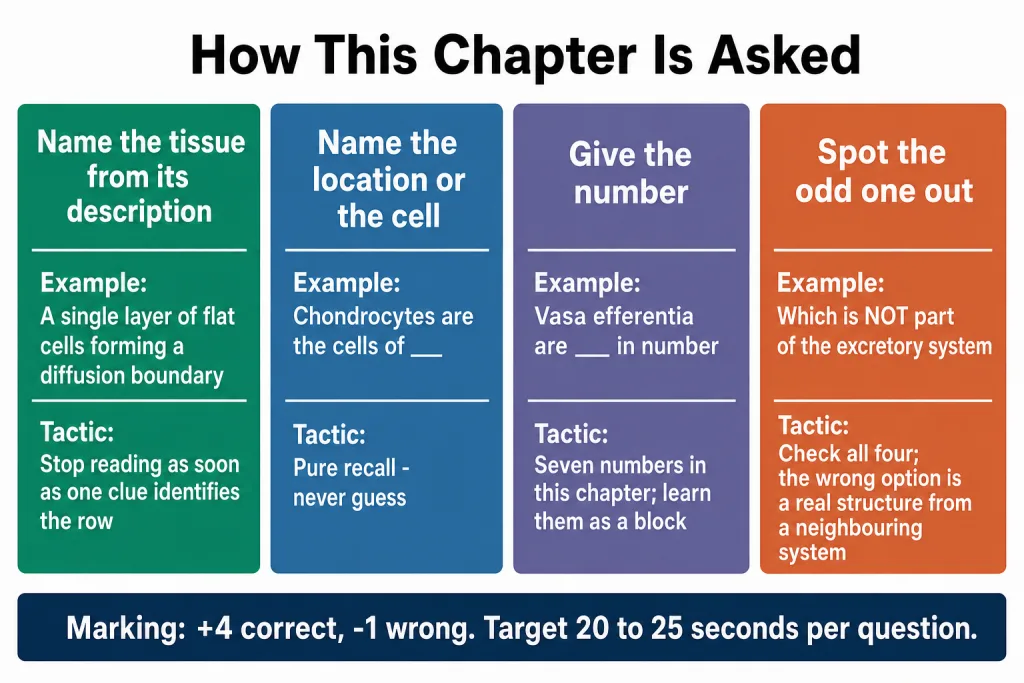
The marking is +4 for a correct answer and -1 for a wrong one. That single fact changes how you should read this chapter. In a written answer, remembering four of the five parts of a system still earns most of the marks. Here, a half-remembered fact is worth -1, which is five marks behind the person who left it blank and moved on.
The good news is that this is the most memorisable chapter in the unit. There is no mechanism to reason through and no calculation to make. Everything is a name, a number, a location or a pairing - and every one of them can be nailed down in advance.
The Four Shapes This Chapter Is Asked In
Nearly every question from this chapter is one of four shapes. Learn to recognise the shape first, because each one has its own fastest route to the answer.
Shape 1 - Name the tissue from its description. "A single layer of flat cells forming a diffusion boundary in the walls of blood vessels." You are given layer count + cell shape + location + function, and any two of those four are enough. Do not read all four; read until you are sure, then answer.
Shape 2 - Name the location or the cell. "Chondrocytes are the cells of _." These are pure recall pairs. Either you have the pair or you do not - there is no working out. Never guess on one of these; a coin-flip on a four-option question loses marks on average.
Shape 3 - The number. "The number of vasa efferentia in a frog is _." This chapter has exactly seven numbers worth memorising, listed below. They are free marks if you have them.
Shape 4 - The odd one out, or the incorrect statement. "Which of the following is NOT a component of the excretory system of a frog?" Here you must check all four, so budget the extra time. The trick is that the wrong option is almost always a real structure from a neighbouring system - a bile duct among excretory parts, a tympanum among endocrine glands.
The Tissue Grid
Most of the tissue questions in this chapter are testing one row of this grid. Read it across a row to learn one tissue and down a column to answer a "which of these is found in _" question.
| Tissue | Key structure | Where it is | What it does |
|---|---|---|---|
| Squamous epithelium | Single layer of flat cells | Walls of blood vessels, air sacs of lungs | Forms a diffusion boundary |
| Cuboidal epithelium | Single layer of cube-like cells | Ducts of glands, tubular parts of nephrons | Secretion and absorption |
| Columnar epithelium | Single layer of tall, slender cells | Lining of stomach and intestine | Secretion and absorption |
| Ciliated epithelium | Cilia on the free surface | Bronchioles, fallopian tubes | Moves particles or mucus in one direction |
| Compound epithelium | More than one layer | Dry surface of skin, buccal cavity, pharynx, ducts of glands | Protection against chemical and mechanical stress |
| Areolar | Loose, with fibroblasts and mast cells | Beneath the skin | Support framework for epithelium |
| Adipose | Cells storing fat | Beneath the skin | Stores excess fat |
| Dense regular | Fibres in a regular row | Tendons, ligaments | Muscle to bone, bone to bone |
| Cartilage | Chondrocytes | Tip of nose, between adjacent bones | Smooth, resists compression |
| Bone | Osteocytes in lacunae | Skeleton | Support, protection, muscle attachment |
| Blood | Plasma with RBC, WBC, platelets | In vessels | Fluid connective tissue; transport |
| Skeletal muscle | Striated, in bundles | Attached to bones | Voluntary movement |
| Smooth muscle | Not striated, spindle cells | Wall of hollow visceral organs | Involuntary movement |
| Cardiac muscle | Striated, with intercalated discs | Heart only | Involuntary pumping |
| Neural | Neurons and neuroglia | Nervous system | Conducts impulses; neuroglia over half the volume |
One Structure, One Address
The other half of this chapter is the frog, and the frog questions are almost all "which system does this belong to" or "where does this open". Fix each structure to one address and these become instant.
| Structure | The one address to remember |
|---|---|
| Sinus venosus | Joins the right atrium; receives blood from the vena cava |
| Conus arteriosus | Ventricle opens into it; on the ventral side |
| Hepatic portal system | Liver and intestine |
| Renal portal system | Kidney and lower parts of the body |
| Nephron | Unit of the kidney; also called uriniferous tubule |
| Ureter, male | Acts as a urinogenital duct, opens into the cloaca |
| Ureter, female | Opens into the cloaca separately from the oviduct |
| Urinary bladder | Ventral to the rectum, opens into the cloaca |
| Mesorchium | Double fold of peritoneum, holds testes to the kidney |
| Vasa efferentia | Testes to the kidney, opening into Bidder's canal |
| Bidder's canal | Inside the kidney, joins the urinogenital duct |
| Oviduct | Ovary to the cloaca, opening separately |
| Cloaca | The one exit for faecal matter, urine and sperms |
| Foramen magnum | The hole the medulla oblongata leaves through |
| Tympanum | The ear, on either side of the eyes; the only ear part seen externally |
The rule that saves the most marks here: in a male frog, the reproductive and excretory paths merge inside the kidney; in a female, they stay separate all the way to the cloaca. Almost every "male versus female" question in this chapter is that one sentence in disguise.
The Seven Numbers, and the Negatives
The numbers
Every one of these has been asked as a bare number question. There are only seven, so learn them as a block.
- 4 basic types of tissue in complex animals.
- 5 digits on the hind limb, 4 on the forelimb.
- 3 chambers in the heart - 2 atria, 1 ventricle.
- 10 pairs of cranial nerves.
- 10 to 12 vasa efferentia.
- 2500 to 3000 ova laid at a time.
- More than one half - the share of neural tissue volume that is neuroglia.
The lists the "which is NOT" questions come from
- Excretory system: kidneys, ureters, cloaca, urinary bladder. (A bile duct or an oviduct in this list is the wrong option.)
- Endocrine glands of the frog: pituitary, thyroid, parathyroid, thymus, pineal body, pancreatic islets, adrenals, gonads. (A tympanum or a nephron here is the wrong option.)
- Fore-brain: olfactory lobes, paired cerebral hemispheres, unpaired diencephalon. (Optic lobes belong to the mid-brain.)
- Hind-brain: cerebellum, medulla oblongata.
- Sense organs: sensory papillae (touch), taste buds (taste), nasal epithelium (smell), eyes (vision), tympanum with internal ears (hearing).
- Blood cells: RBC or erythrocytes, WBC or leucocytes, platelets. (Plasma is not a cell.)
The five pairs that get swapped
- Aestivation is summer, hibernation is winter.
- Tendon joins muscle to bone; ligament joins bone to bone.
- Sinus venosus goes into the atrium; conus arteriosus comes out of the ventricle.
- Hepatic portal is the liver; renal portal is the kidney.
- Chondrocytes are cartilage; osteocytes are bone.
Solved Examples at NEET Pace
Each item names the shortcut it uses, because the shortcut is the thing worth carrying into the exam hall.
Question 1
Q. A tissue forms the diffusion boundary in the air sacs of the lungs. It is (a) cuboidal epithelium (b) squamous epithelium (c) compound epithelium (d) columnar epithelium
Answer. (b) squamous epithelium. Shortcut - the word "diffusion" appears in exactly one row of the tissue grid. Squamous epithelium is a single thin layer of flat cells in the walls of blood vessels and air sacs, and it forms a diffusion boundary. Stop reading at "diffusion" and answer.
Question 2
Q. Chondrocytes and osteocytes are the cells of, respectively, (a) bone and cartilage (b) cartilage and blood (c) cartilage and bone (d) bone and blood
Answer. (c) cartilage and bone. Shortcut - "chondro" gives cartilage, "osteo" gives bone; the word roots do the work. Osteocytes are present in spaces called lacunae. The distractor here is always the same pair in reverse order, so read the order of the question before you read the options.
Question 3
Q. Which of the following is NOT a component of the excretory system of a frog? (a) urinary bladder (b) cloaca (c) common bile duct (d) ureters
Answer. (c) common bile duct. Shortcut - for a "which is NOT" question, recall the official list first, then look for the intruder. The list is kidneys, ureters, cloaca and urinary bladder. The common bile duct is real, but it belongs to the digestive system - it carries bile and pancreatic juice into the intestine.
Question 4
Q. In a male frog, the ureters (a) carry only urine (b) act as urinogenital ducts (c) open separately from the vas deferens (d) open into the urinary bladder
Answer. (b) act as urinogenital ducts. Shortcut - male means merged, female means separate. In male frogs the two ureters act as urinogenital ducts that open into the cloaca, carrying both urine and sperms. Option (a) is the female answer, offered here to catch a rushed read.
Question 5
Q. The number of pairs of cranial nerves in a frog is (a) 8 (b) 10 (c) 12 (d) 31
Answer. (b) 10. Shortcut - this is a bare number question; either you have the number or you skip it. There are ten pairs of cranial nerves arising from the brain of a frog. Option (c) is the human number, which is exactly why it is there.
Question 6
Q. Intercalated discs are found in (a) skeletal muscle (b) smooth muscle (c) cardiac muscle (d) neural tissue
Answer. (c) cardiac muscle. Shortcut - one structure, one address. Cardiac muscle is present only in the heart, and the intercalated disc is the junction at which adjoining cells meet. This is the single most reliable identifier of cardiac muscle in the whole chapter.
Question 7
Q. Which statement about the reproductive system of a frog is INCORRECT? (a) testes are attached to the kidneys by the mesorchium (b) vasa efferentia are 10 to 12 in number (c) ovaries are functionally connected to the kidneys (d) fertilisation is external
Answer. (c) ovaries are functionally connected to the kidneys. Shortcut - male merges, female stays separate; test each option against that one rule. The ovaries are situated near the kidneys and there is no functional connection with the kidneys. The other three statements are all correct as written.
Question 8
Q. The lymph of a frog differs from its blood in that lymph (a) lacks plasma (b) lacks a few proteins and RBCs (c) lacks WBCs (d) contains no water
Answer. (b) lacks a few proteins and RBCs. Shortcut - remember what lymph LACKS, not what it has; the question is always phrased as a lack. The lymph is different from blood - it lacks few proteins and RBCs. It still has plasma and white blood cells, which rules out (a) and (c).
A Drill Before You Move On
Decide each one before you read the verdict. Aim for 20 to 25 seconds per question - this chapter should be finished faster than any other in the unit, and the time you save here is time you can spend on physiology.
Mark yourself honestly. A wrong answer here is worth -1 in the hall, so treat "I think it is B" as a skip, not an answer, and go back to the grid for that row.