
The Blood Vascular System
The vascular system of the frog is well developed and of the closed type - the blood always stays inside vessels. Frogs also have a lymphatic system alongside it.
- The blood vascular system involves the heart, blood vessels and blood.
- The lymphatic system consists of lymph, lymph channels and lymph nodes.
The heart. It is a muscular structure situated in the upper part of the body cavity. It has three chambers - two atria and one ventricle - and is covered by a membrane called the pericardium.
- A triangular structure called the sinus venosus joins the right atrium. It receives blood through the major veins called vena cava.
- The ventricle opens into a sac-like conus arteriosus on the ventral side of the heart.
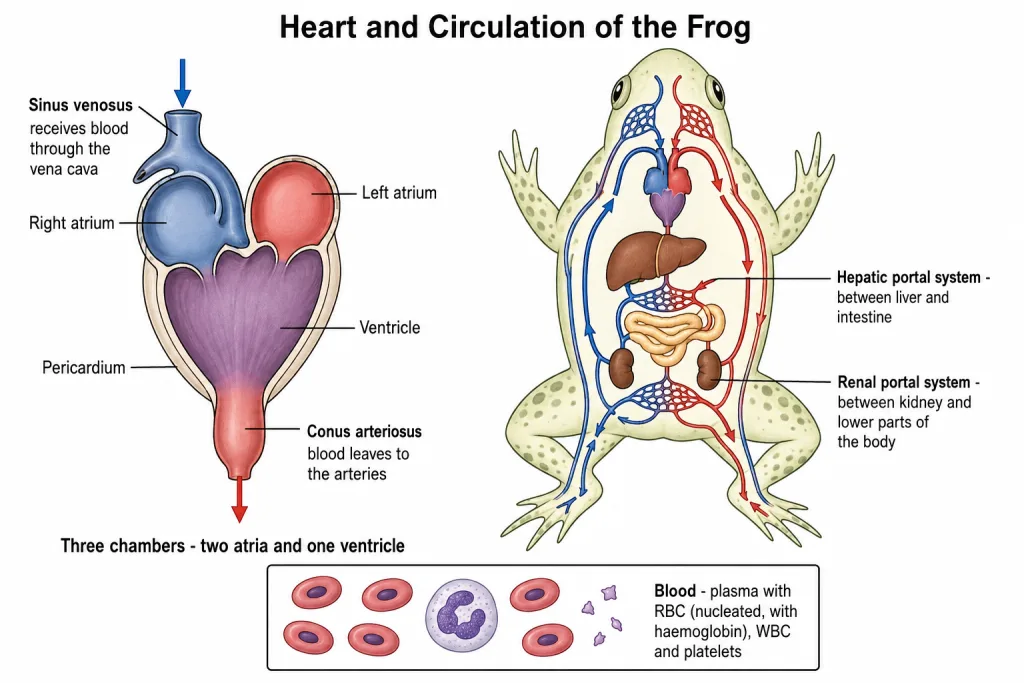
[NEET Important] Two structures are unique enough to be asked by name. Sinus venosus feeds INTO the right atrium (blood coming in), and the conus arteriosus comes OUT of the ventricle (blood going out), sitting on the ventral side. If you remember that venosus goes with veins and arteriosus goes with arteries, the direction sorts itself out.
Arteries, Veins and the Two Portal Systems
The blood from the heart is carried to all parts of the body by the arteries, which together make the arterial system. The veins collect blood from different parts of the body back to the heart and form the venous system.
Frogs have two special venous connections, called portal systems.
| Portal system | The connection it makes |
|---|---|
| Hepatic portal system | Between the liver and the intestine |
| Renal portal system | Between the kidney and the lower parts of the body |
The blood is composed of plasma and cells. The blood cells are:
- RBC (red blood cells) or erythrocytes - in a frog these are nucleated and contain the red coloured pigment haemoglobin.
- WBC (white blood cells) or leucocytes.
- Platelets.
The lymph is different from blood - it lacks a few proteins and it lacks RBCs.
The blood carries nutrients, gases and water to the respective sites during the circulation, and the circulation of blood is achieved by the pumping action of the muscular heart.
[NEET Important] Frog RBCs are nucleated - this is a favourite one-line contrast with human RBCs, which are not. And keep the two portal systems straight by their names: hepatic goes with the liver, renal goes with the kidney.
The Excretory System
The elimination of nitrogenous wastes is carried out by a well developed excretory system.
The excretory system consists of a pair of kidneys, ureters, cloaca and urinary bladder.
The kidneys are compact, dark red and bean-like structures situated a little posteriorly in the body cavity on both sides of the vertebral column. Each kidney is composed of several structural and functional units called uriniferous tubules or nephrons.
The ureters.
- In male frogs, two ureters emerge from the kidneys and act as urinogenital ducts, which open into the cloaca - the same duct carries both urine and sperms.
- In females, the ureters and the oviduct open separately into the cloaca.
The urinary bladder is thin-walled and present ventral to the rectum, and it also opens into the cloaca.
The frog excretes urea and is therefore a ureotelic animal. Excretory wastes are carried by blood into the kidney, where they are separated and excreted.
[NEET Important] The male-versus-female ureter difference is exactly what one of the chapter-end exercises asks about, so learn it as a pair: male - urinogenital duct carrying urine and sperms; female - ureter and oviduct open separately. Also fix the word ureotelic: the waste is urea, not ammonia and not uric acid.
Quick Recap
- Vascular system - well developed, closed type; frogs also have a lymphatic system (lymph, lymph channels, lymph nodes).
- Heart - three chambers: two atria and one ventricle, covered by the pericardium, in the upper part of the body cavity.
- Sinus venosus - triangular, joins the right atrium, receives blood through the vena cava.
- Conus arteriosus - sac-like, the ventricle opens into it, on the ventral side.
- Hepatic portal system - liver and intestine. Renal portal system - kidney and lower parts of the body.
- Blood = plasma + cells; cells are RBC/erythrocytes (nucleated, with haemoglobin), WBC/leucocytes and platelets.
- Lymph lacks a few proteins and lacks RBCs.
- Excretory system - a pair of kidneys, ureters, cloaca and urinary bladder.
- Kidneys - compact, dark red, bean-like, posterior, on both sides of the vertebral column; made of uriniferous tubules or nephrons.
- Male - ureters act as urinogenital ducts into the cloaca. Female - ureters and oviduct open separately.
- Urinary bladder - thin-walled, ventral to the rectum, opens into the cloaca.
- The frog excretes urea - it is ureotelic.
Solved Examples
Question 1
Q. What type of blood vascular system does the frog have, and what other circulatory system does it possess?
Answer. The frog has a well developed closed type of blood vascular system, meaning the blood stays inside vessels throughout. Alongside it the frog also has a lymphatic system, made of lymph, lymph channels and lymph nodes.
Question 2
Q. Describe the heart of a frog.
Answer. It is a muscular structure in the upper part of the body cavity, covered by a membrane called the pericardium. It has three chambers - two atria and one ventricle.
Question 3
Q. What is the sinus venosus and what does it do?
Answer. It is a triangular structure that joins the right atrium. It receives blood through the major veins called vena cava, so it is the point where returning blood enters the heart.
Question 4
Q. Where does the ventricle open, and on which side of the heart is that structure?
Answer. The ventricle opens into a sac-like conus arteriosus, which lies on the ventral side of the heart.
Question 5
Q. Distinguish between the arterial system and the venous system in a frog.
Answer. The arterial system carries blood from the heart to all parts of the body through the arteries. The venous system collects blood from different parts of the body back to the heart through the veins.
Question 6
Q. Name the two portal systems of the frog and state what each connects.
Answer. The hepatic portal system is a special venous connection between the liver and the intestine. The renal portal system is a special venous connection between the kidney and the lower parts of the body.
Question 7
Q. What is the blood of a frog made of?
Answer. It is made of plasma and blood cells. The cells are RBC (red blood cells) or erythrocytes, WBC (white blood cells) or leucocytes, and platelets.
Question 8
Q. Give one clear difference between the RBCs of a frog and those of a human being.
Answer. Frog RBCs are nucleated - they keep their nucleus - and they contain the red coloured pigment haemoglobin. Human mature RBCs do not have a nucleus.
Question 9
Q. How is lymph different from blood?
Answer. Lymph lacks a few proteins and it lacks RBCs. Otherwise it is a body fluid like blood and moves through lymph channels and lymph nodes.
Question 10
Q. What does the blood carry, and what drives its circulation?
Answer. The blood carries nutrients, gases and water to the respective sites during circulation, and the circulation is achieved by the pumping action of the muscular heart.
Question 11
Q. List the parts of the excretory system of a frog.
Answer. A pair of kidneys, the ureters, the cloaca and the urinary bladder.
Question 12
Q. Describe the kidneys of a frog and name their functional unit.
Answer. They are compact, dark red and bean-like structures placed a little posteriorly in the body cavity, on both sides of the vertebral column. Each kidney is made of several structural and functional units called uriniferous tubules or nephrons.
Question 13
Q. Mention the function of the ureters in frog. This is one of the chapter-end exercises.
Answer. The ureters carry urine away from the kidneys to the cloaca, from where it leaves the body. In male frogs the two ureters also act as urinogenital ducts - the same duct carries both urine and sperms into the cloaca. In female frogs the ureters and the oviduct open separately into the cloaca, so there the ureter carries urine only.
Question 14
Q. Where is the urinary bladder of a frog situated, and where does it open?
Answer. It is thin-walled and lies ventral to the rectum, and it opens into the cloaca.
Question 15
Q. What is meant by saying the frog is ureotelic?
Answer. It means the frog excretes urea as its main nitrogenous waste. The waste is carried by blood into the kidney, where it is separated and excreted.