
Control and Coordination
The system for control and coordination is highly evolved in the frog. It includes both the neural system and the endocrine glands.
The chemical coordination of the various organs of the body is achieved by hormones, which are secreted by the endocrine glands.
The prominent endocrine glands found in the frog are the pituitary, thyroid, parathyroid, thymus, pineal body, pancreatic islets, adrenals and gonads.
The nervous system is organised into three parts.
| Part | What it is made of |
|---|---|
| Central nervous system | Brain and spinal cord |
| Peripheral nervous system | Cranial and spinal nerves |
| Autonomic nervous system | Sympathetic and parasympathetic |
There are ten pairs of cranial nerves arising from the brain.
[NEET Important] Two numbers and one list carry this block: ten pairs of cranial nerves, the three divisions of the nervous system, and the eight endocrine glands. Note that the frog has ten pairs of cranial nerves - a mammal has twelve, and swapping the two is the usual trap.
The Brain
The brain is enclosed in a bony structure called the brain box, or cranium. The brain is divided into fore-brain, mid-brain and hind-brain.
- Fore-brain includes the olfactory lobes, the paired cerebral hemispheres and the unpaired diencephalon.
- Mid-brain is characterised by a pair of optic lobes.
- Hind-brain consists of the cerebellum and medulla oblongata.
The medulla oblongata passes out through the foramen magnum and continues into the spinal cord, which is enclosed in the vertebral column.
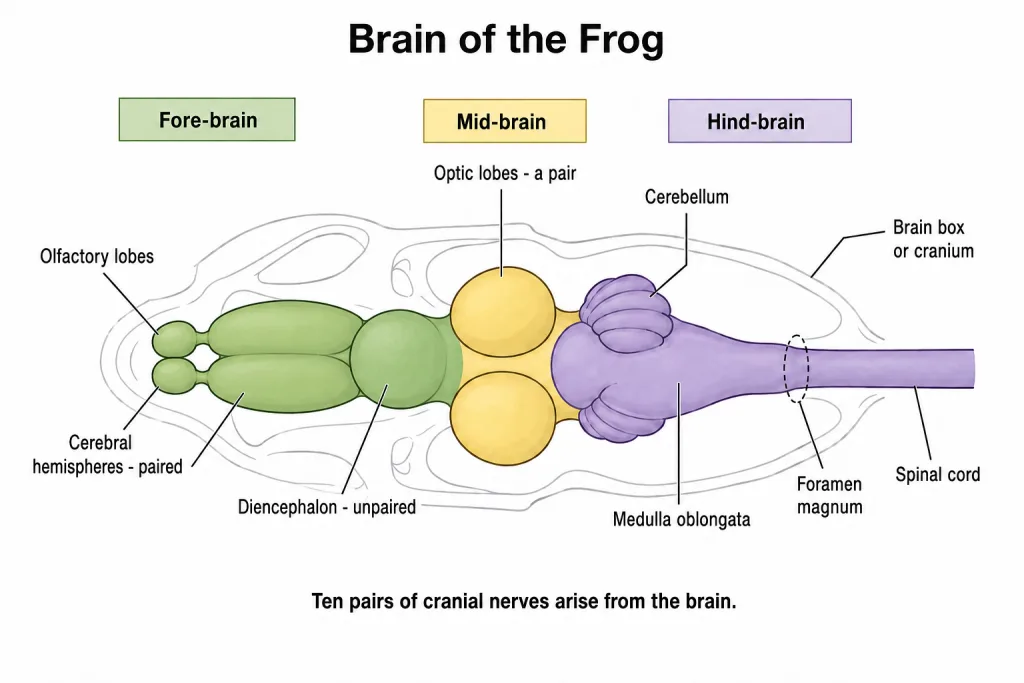
[NEET Important] Learn the three divisions with the paired-versus-unpaired detail attached: cerebral hemispheres are paired, the diencephalon is unpaired, and the optic lobes are a pair. The exit route is also asked as a one-liner - medulla oblongata leaves through the foramen magnum and becomes the spinal cord.
The Sense Organs
The frog has different types of sense organs, one for each kind of stimulus.
| Sense | Organ in the frog |
|---|---|
| Touch | Sensory papillae |
| Taste | Taste buds |
| Smell | Nasal epithelium |
| Vision | Eyes |
| Hearing | Tympanum with internal ears |
Out of these, the eyes and the internal ears are well-organised structures, and the rest are only cellular aggregations around nerve endings.
The eyes are a pair of spherical structures situated in the orbit in the skull. They are simple eyes, possessing only one unit.
The ear. An external ear is absent in frogs and only the tympanum can be seen externally. The ear is an organ of hearing as well as of balancing, that is equilibrium.
[NEET Important] Two contrasts get set here. Only the eyes and the internal ears are well organised - touch, taste and smell organs are just cellular aggregations around nerve endings. And the frog's eye is a simple eye with one unit, unlike the compound eye of an insect.
Quick Recap
- Control and coordination uses both the neural system and the endocrine glands; hormones from endocrine glands do the chemical coordination.
- Endocrine glands of the frog - pituitary, thyroid, parathyroid, thymus, pineal body, pancreatic islets, adrenals and gonads.
- Nervous system - central (brain and spinal cord), peripheral (cranial and spinal nerves), autonomic (sympathetic and parasympathetic).
- Ten pairs of cranial nerves arise from the brain.
- Brain box, or cranium, encloses the brain; brain is fore-brain, mid-brain and hind-brain.
- Fore-brain - olfactory lobes, paired cerebral hemispheres, unpaired diencephalon. Mid-brain - a pair of optic lobes. Hind-brain - cerebellum and medulla oblongata.
- Medulla oblongata passes out through the foramen magnum and continues into the spinal cord, which is enclosed in the vertebral column.
- Sense organs - touch (sensory papillae), taste (taste buds), smell (nasal epithelium), vision (eyes), hearing (tympanum with internal ears).
- Only the eyes and internal ears are well organised; the rest are cellular aggregations around nerve endings.
- Eyes - a pair of spherical structures in the orbit of the skull, simple eyes with one unit.
- External ear absent - only the tympanum is seen externally; the ear does hearing and balancing (equilibrium).
Solved Examples
Question 1
Q. Which two systems together carry out control and coordination in a frog?
Answer. The neural system and the endocrine glands. The endocrine glands secrete hormones, which handle the chemical coordination of the various organs of the body.
Question 2
Q. Name the prominent endocrine glands found in a frog.
Answer. Pituitary, thyroid, parathyroid, thymus, pineal body, pancreatic islets, adrenals and gonads.
Question 3
Q. How is the nervous system of a frog organised?
Answer. Into three parts - a central nervous system (brain and spinal cord), a peripheral nervous system (cranial and spinal nerves) and an autonomic nervous system (sympathetic and parasympathetic).
Question 4
Q. How many pairs of cranial nerves arise from the brain of a frog?
Answer. Ten pairs.
Question 5
Q. What is the brain of a frog enclosed in?
Answer. In a bony structure called the brain box, or cranium.
Question 6
Q. Name the three divisions of the frog brain and the parts of each.
Answer. Fore-brain - olfactory lobes, paired cerebral hemispheres and the unpaired diencephalon. Mid-brain - a pair of optic lobes. Hind-brain - cerebellum and medulla oblongata.
Question 7
Q. Which part of the brain is characterised by a pair of optic lobes?
Answer. The mid-brain.
Question 8
Q. Trace the route by which the brain continues into the spinal cord.
Answer. The medulla oblongata passes out through the foramen magnum and continues into the spinal cord, which is enclosed in the vertebral column.
Question 9
Q. Name the sense organs of a frog for touch, taste and smell.
Answer. Touch - sensory papillae. Taste - taste buds. Smell - nasal epithelium.
Question 10
Q. Which sense organs of the frog are well organised, and what are the rest?
Answer. Only the eyes and the internal ears are well-organised structures. The rest are cellular aggregations around nerve endings.
Question 11
Q. Describe the eyes of a frog.
Answer. They are a pair of spherical structures situated in the orbit in the skull, and they are simple eyes, possessing only one unit.
Question 12
Q. Does a frog have an external ear? What is seen from outside?
Answer. An external ear is absent in frogs. Only the tympanum can be seen externally.
Question 13
Q. State the two functions of the frog's ear.
Answer. It is an organ of hearing and also an organ of balancing, that is equilibrium.