
The Chapter in One Read
Cells, tissues, organs and organ systems split up the work in a way that ensures the survival of the body as a whole, and in doing so they exhibit division of labour. A tissue is a group of cells along with intercellular substances performing one or more functions in the body, and all complex animals are built from only four basic types - epithelial, connective, muscular and neural.
Epithelia are sheet-like tissues lining the body's surface and its cavities, ducts and tubes. They have one free surface facing a body fluid or the outside environment, and their cells are structurally and functionally connected at junctions.
The Indian bullfrog, Rana tigrina, is the common frog found in India. Its body is covered by skin, in which mucous glands are present; the skin is highly vascularised and helps in respiration in water and on land. The body is divisible into head and trunk, with no neck and no tail. Respiration is through the skin and through the lungs on land. The circulatory system is closed with single circulation, and the RBCs are nucleated. The nervous system is organised into central, peripheral and autonomic parts. The organs of excretion are the kidneys and the urinogenital ducts, which open into the cloaca. Fertilisation is external and development involves a tadpole that undergoes metamorphosis.
Master Quick Recap
Levels of organisation
- Cell - tissue - organ - organ system. Division of labour at every level.
- A tissue = a group of cells + intercellular substances doing one or more functions.
- Four basic tissues: epithelial, connective, muscular, neural.
Epithelial tissue
- Simple - one layer. Squamous (flat; blood vessel walls, air sacs; diffusion boundary), cuboidal (cube-like; ducts of glands, tubular parts of nephrons; secretion and absorption), columnar (tall and slender; stomach and intestine lining; secretion and absorption).
- Ciliated - cilia on the free surface; moves particles or mucus in a specific direction.
- Glandular - unicellular (goblet cells) or multicellular (salivary gland); exocrine secrete through ducts (mucus, saliva, earwax, oil, milk, digestive enzymes), endocrine are ductless and pour hormones into the blood.
- Compound - more than one layer; dry surface of the skin, moist surface of the buccal cavity, pharynx, ducts of most glands; main function protection, limited secretion and absorption.
- Junctions - tight (stops leaking), adhering (cements cells), gap (rapid transfer of ions and molecules).
Connective tissue
- Loose - areolar (beneath the skin, support framework for epithelium), adipose (stores excess fat).
- Dense - regular (tendon: muscle to bone; ligament: bone to bone), irregular.
- Specialised - cartilage (chondrocytes), bone (osteocytes in lacunae), blood (fluid connective tissue: plasma, RBC, WBC, platelets).
Muscular tissue
- Skeletal - attached to bones, striated, voluntary, cells in bundles.
- Smooth - wall of hollow visceral organs, unstriated, involuntary, spindle-shaped.
- Cardiac - heart only, striated, involuntary, intercalated discs.
Neural tissue
- Neurons conduct impulses; neuroglia support and protect them and are more than half the volume of neural tissue.
The frog
- Rana tigrina, class Amphibia, phylum Chordata; poikilotherm; mimicry; aestivation (summer), hibernation (winter).
- Skin - smooth, slippery, moist, dorsal olive green with dark spots, ventral pale yellow; never drinks water, absorbs it through the skin.
- Body - head and trunk, no neck, no tail; nostrils, nictitating membrane, tympanum; five hind digits, four fore digits, webbed.
- Male only - vocal sacs and a copulatory pad on the first digit of the forelimb.
- Digestion - mouth - buccal cavity - pharynx - oesophagus - stomach - intestine - rectum - cloaca; liver secretes bile stored in the gall bladder; pancreas makes pancreatic juice; canal short because carnivore.
- Respiration - cutaneous in water and during aestivation and hibernation, pulmonary on land.
- Circulation - closed, plus a lymphatic system; three-chambered heart in a pericardium; sinus venosus into the right atrium from the vena cava; conus arteriosus out of the ventricle, ventral; hepatic portal (liver-intestine) and renal portal (kidney-lower body); RBCs nucleated; lymph lacks a few proteins and RBCs.
- Excretion - kidneys, ureters, cloaca, urinary bladder; nephrons or uriniferous tubules; male ureter = urinogenital duct, female ureter and oviduct open separately; bladder ventral to the rectum; ureotelic.
- Coordination - neural system + endocrine glands; ten pairs of cranial nerves; brain box or cranium; fore-brain (olfactory lobes, paired cerebral hemispheres, unpaired diencephalon), mid-brain (a pair of optic lobes), hind-brain (cerebellum, medulla oblongata); medulla leaves by the foramen magnum.
- Sense organs - sensory papillae (touch), taste buds, nasal epithelium (smell), eyes (simple, one unit), tympanum with internal ears (hearing and equilibrium); only eyes and internal ears are well organised.
- Reproduction - testes held by the mesorchium; 10 to 12 vasa efferentia into Bidder's canal and the urinogenital duct; ovaries near the kidneys with no functional connection; oviducts open separately; 2500 to 3000 ova; external fertilisation in water; tadpole; metamorphosis.
- Importance - eat insects and protect crops; an important link in the food chain and food web; muscular legs eaten as food in some countries.
The Frog's Systems, Side by Side
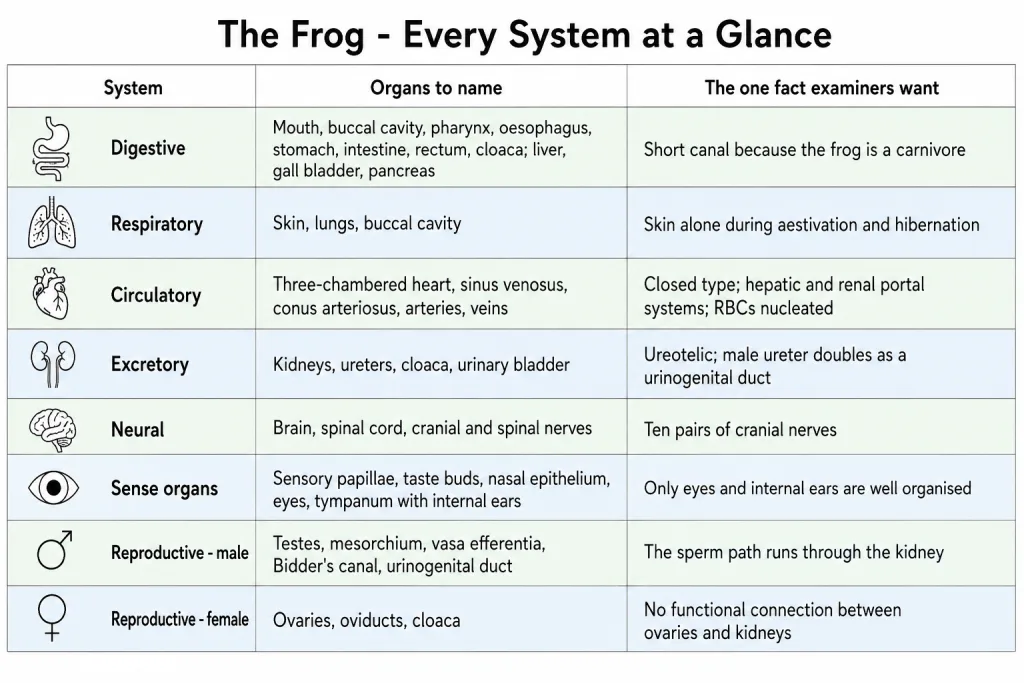
| System | The organs to name | The one fact examiners want |
|---|---|---|
| Digestive | Mouth, buccal cavity, pharynx, oesophagus, stomach, intestine, rectum, cloaca; liver, gall bladder, pancreas | Short canal because the frog is a carnivore |
| Respiratory | Skin; lungs; buccal cavity | Skin alone during aestivation and hibernation |
| Circulatory | Three-chambered heart, sinus venosus, conus arteriosus, arteries, veins | Closed type, with hepatic and renal portal systems; RBCs nucleated |
| Excretory | Kidneys, ureters, cloaca, urinary bladder | Ureotelic; male ureter doubles as a urinogenital duct |
| Neural | Brain, spinal cord, cranial and spinal nerves, sympathetic and parasympathetic | Ten pairs of cranial nerves |
| Sense organs | Sensory papillae, taste buds, nasal epithelium, eyes, tympanum with internal ears | Only eyes and internal ears are well organised |
| Reproductive, male | Testes, mesorchium, vasa efferentia, Bidder's canal, urinogenital duct, cloaca | The sperm path runs through the kidney |
| Reproductive, female | Ovaries, oviducts, cloaca | No functional connection between ovaries and kidneys |
The Six Comparisons Worth Memorising
- Simple against compound epithelium - one layer, lining and absorbing against many layers, protecting.
- Exocrine against endocrine gland - through ducts against ductless, hormones into blood.
- Tendon against ligament - muscle to bone against bone to bone.
- Skeletal, smooth and cardiac muscle - striated and voluntary, unstriated and involuntary, striated and involuntary with intercalated discs.
- Cutaneous against pulmonary respiration - through the moist skin, in water and during dormancy against through the lungs, on land.
- Male against female frog urinogenital arrangement - ureter doubles as a urinogenital duct against ureter and oviduct opening separately.
Writing the Chapter-End Exercises Well
Class 11 has no board paper, but the two chapter-end exercises are still the best short test of whether you actually know this chapter, and both have appeared in school and entrance tests in slightly different words.
For the digestive-system diagram, a labelled drawing scores on the labels, not the artwork. Put the canal down the middle in order - mouth, buccal cavity, pharynx, oesophagus, stomach, intestine, rectum, cloaca, cloacal aperture - and hang the liver, gall bladder and pancreas off it at the side, joined by their ducts. Add the bilobed tongue and one line saying the canal is short because the frog is a carnivore. A diagram with nine correct labels beats a beautiful one with five.
For the function of the ureters, do not stop at "carry urine". The answer that scores in full has three parts: the ureters carry urine from the kidneys to the cloaca; in the male they act as urinogenital ducts carrying both urine and sperms; in the female the ureters and the oviduct open separately, so the ureter carries urine only.
The general habit both exercises reward: give the name, the location and the function in that order for every structure. Most marks lost in this chapter are lost by naming a structure correctly and then not saying what it does.
NEET Strategy
What the paper asks. One structure, one feature, one location - with a distractor pulled from the neighbouring system. There is nothing here to work out, so speed comes from certainty, not from technique.
The marking is +4 and -1. On a pure-recall question, a guess between two options loses marks on average. If you do not have the pair, skip it and bank the time for physiology.
Budget. Aim for 20 to 25 seconds per question in this chapter. It should be the fastest chapter in the unit, and the two or three minutes you save are worth more spent elsewhere.
The four shapes, in the order they are easiest. Give the number questions first - they are instant if you know them. Then the name the location or the cell pairs. Then name the tissue from its description, where you can stop reading as soon as one clue identifies the row. Leave the "which is NOT" questions for last, since they force you to check all four options.
Read the direction word before the options. "Respectively", "NOT" and "INCORRECT" are the three words that turn a known fact into a lost mark. Underline them as you read.
The Mistakes That Cost the Most Marks
- Aestivation and hibernation swapped. Aestivation is summer, hibernation is winter.
- Tendon and ligament swapped. Tendon joins muscle to bone; ligament joins bone to bone.
- Sinus venosus and conus arteriosus swapped. Venosus goes with veins - into the right atrium. Arteriosus goes with arteries - out of the ventricle.
- Hepatic and renal portal systems swapped. Hepatic is the liver; renal is the kidney.
- Chondrocytes and osteocytes swapped, especially in a question that says "respectively".
- Human numbers given for the frog. The frog has ten pairs of cranial nerves and a three-chambered heart, not twelve and four.
- Digit counts reversed. Five behind, four in front.
- Saying the frog drinks water. The frog never drinks water - it absorbs water through the skin.
- Forgetting that the ovaries have no functional connection with the kidneys, while the testes do drain through them.
- Naming a structure and stopping. In a written answer, the function is usually worth as much as the name.
A Short Revision Plan
First pass - forty minutes. Read sections 1 to 7 straight through without stopping to memorise. You are building the map: two tissue sections, then the frog system by system.
Second pass - one hour. Work the Important Questions and Answers section, tier by tier, writing the answers rather than reading them. Then read your answer against the one given and mark only the words you missed.
Third pass - thirty minutes. Learn the tissue grid and the one structure, one address table from the NEET Corner. These two tables carry most of the recall load in this chapter.
Fourth pass - forty minutes. Sit the 40 NEET-Pattern Practice Questions under time, then revisit only the rows of the two tables that your wrong answers came from.
The night before. Read the Master Quick Recap and the six comparisons once. Nothing else. This chapter rewards a clean, recent pass more than a long one.