
The Frog - Where It Lives and How It Copes
Frogs can live both on land and in freshwater and belong to class Amphibia of phylum Chordata. The most common species of frog found in India is Rana tigrina.
- They do not have a constant body temperature - their body temperature varies with the temperature of the environment. Such animals are cold blooded, or poikilotherms.
- They can change colour to hide themselves from their enemies, which is camouflage. This protective coloration is called mimicry.
- Frogs are not seen during peak summer and winter. They take shelter in deep burrows to protect themselves from extreme heat and cold - summer sleep is aestivation and winter sleep is hibernation.
[NEET Important] Four terms come straight out of this paragraph and all four get asked: poikilotherm, mimicry, aestivation and hibernation. Keep the season attached - aestivation is summer, hibernation is winter - because a swapped pair is the standard distractor.
Morphology
The skin. It is smooth and slippery due to the presence of mucus and is always maintained in a moist condition. The dorsal side is generally olive green with dark irregular spots, and the ventral side is uniformly pale yellow. The frog never drinks water but absorbs it through the skin.
The body. It is divisible into head and trunk. A neck and tail are absent.
- Above the mouth is a pair of nostrils.
- Eyes are bulged and covered by a nictitating membrane that protects them while in water.
- On either side of the eyes a membranous tympanum, the ear, receives sound signals.
- The forelimbs and hind limbs help in swimming, walking, leaping and burrowing.
- The hind limbs end in five digits and are larger and more muscular than the forelimbs, which end in four digits.
- Feet have webbed digits that help in swimming.
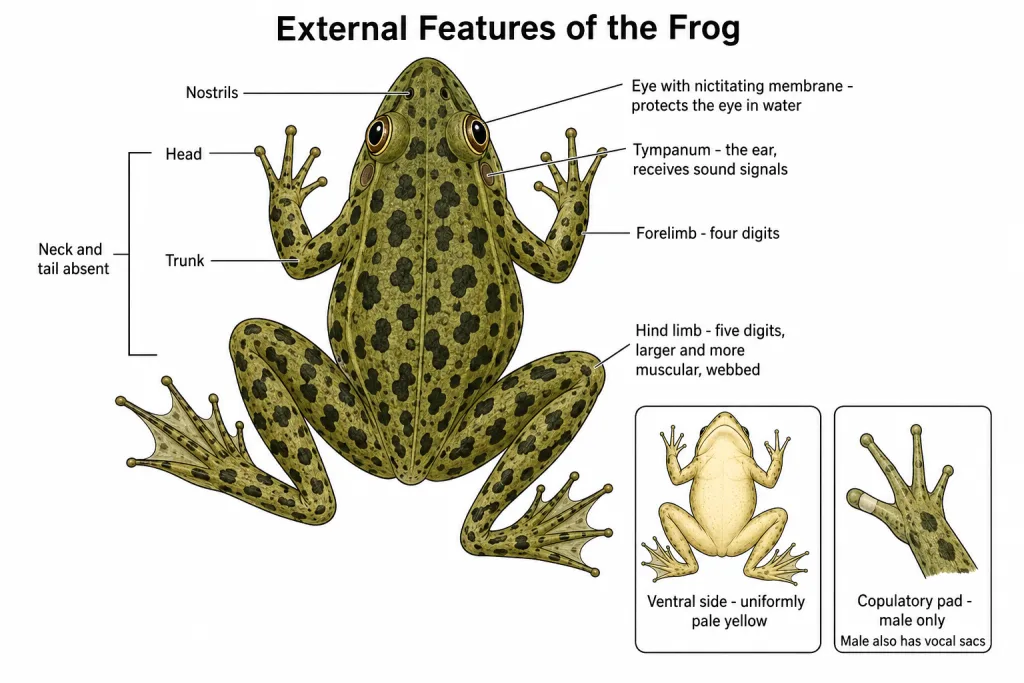
Sexual dimorphism. Frogs exhibit sexual dimorphism. Male frogs can be distinguished by the presence of sound-producing vocal sacs and also a copulatory pad on the first digit of the forelimbs, both of which are absent in female frogs.
| Feature | The fact to hold |
|---|---|
| Body divisions | Head and trunk only - no neck, no tail |
| Hind limbs | Five digits, larger and more muscular, webbed |
| Forelimbs | Four digits |
| Eye covering | Nictitating membrane - protects the eye in water |
| Ear | Tympanum, on either side of the eyes |
| Male only | Vocal sacs and a copulatory pad on the first digit of the forelimb |
[NEET Important] The digit count is the single most-set fact in this section: five behind, four in front. And the frog never drinks water - it absorbs water through the skin, which is also why the skin must stay moist.
Quick Recap
- Rana tigrina - the common Indian frog; class Amphibia, phylum Chordata; lives on land and in freshwater.
- Poikilotherm - body temperature varies with the environment.
- Mimicry - the protective coloration that lets the frog change colour to hide from enemies; camouflage.
- Aestivation - summer sleep. Hibernation - winter sleep. Both spent in deep burrows.
- Skin - smooth and slippery with mucus, always moist; dorsal olive green with dark irregular spots, ventral uniformly pale yellow; the frog never drinks water but absorbs it through the skin.
- Body - head and trunk; no neck, no tail.
- Nostrils above the mouth; eyes bulged, with a nictitating membrane; tympanum on either side of the eyes.
- Hind limbs - five digits, larger and muscular, webbed. Forelimbs - four digits. Both help in swimming, walking, leaping and burrowing.
- Sexual dimorphism - the male has vocal sacs and a copulatory pad on the first digit of the forelimb.
Solved Examples
Question 1
Q. Give the scientific name of the common Indian frog and place it in its class and phylum.
Answer. Rana tigrina, of class Amphibia, phylum Chordata.
Question 2
Q. What is a poikilotherm?
Answer. An animal that does not have a constant body temperature - its body temperature varies with the temperature of the environment. Frogs are cold blooded in exactly this sense.
Question 3
Q. What is mimicry in a frog, and what is it for?
Answer. The frog can change its colour to hide itself from its enemies, which is camouflage, and that protective coloration is called mimicry.
Question 4
Q. Distinguish between aestivation and hibernation.
Answer. Aestivation is summer sleep and hibernation is winter sleep. In both the frog takes shelter in deep burrows to protect itself from extreme heat or cold.
Question 5
Q. Describe the skin of a frog.
Answer. It is smooth and slippery because of mucus and is always kept moist. The dorsal side is olive green with dark irregular spots and the ventral side is uniformly pale yellow.
Question 6
Q. How does a frog take in water?
Answer. It never drinks water. It absorbs water through the skin.
Question 7
Q. Into what parts is the body of a frog divided, and what is missing?
Answer. Into head and trunk. A neck and a tail are absent.
Question 8
Q. What is the nictitating membrane for?
Answer. It covers the bulged eyes and protects them while the frog is in water.
Question 9
Q. How many digits do the hind limbs and forelimbs have, and how do they differ?
Answer. Hind limbs end in five digits; forelimbs end in four. The hind limbs are larger and more muscular, and the feet have webbed digits that help in swimming.
Question 10
Q. Name the four things the limbs of a frog are used for.
Answer. Swimming, walking, leaping and burrowing.
Question 11
Q. How can you tell a male frog from a female?
Answer. By sexual dimorphism. The male has sound-producing vocal sacs and a copulatory pad on the first digit of its forelimbs; both are absent in the female.
Question 12
Q. A frog is found buried in a deep burrow in December. Name the state it is in and the reason for it.
Answer. Hibernation, the winter sleep. It has taken shelter in the burrow to protect itself from the extreme cold, because as a poikilotherm its own body temperature would otherwise follow the temperature outside.