
Read This First
In unicellular organisms all functions like digestion, respiration and reproduction are performed by a single cell. In the complex body of multicellular animals the same basic functions are carried out by different groups of cells in a well organised manner.
- A group of similar cells along with intercellular substances performing a specific function is a tissue.
- All complex animals consist of only four basic types of tissues. These are organised in specific proportion and pattern to form an organ like stomach, lung, heart and kidney.
- When two or more organs perform a common function by their physical or chemical interaction, they together form an organ system - the digestive system, the respiratory system and so on.
- Cells, tissues, organs and organ systems split up the work in a way that exhibits division of labour and contribute to the survival of the body as a whole.
This section and the next define those four tissues. The chapter that follows names them constantly - it says that the heart consists of all the four types of tissues, epithelial, connective, muscular and neural - without stopping to explain any of them, and the chapter summary defines a tissue and describes epithelia in detail. So these two sections are not optional background. Read them first, and the frog reads easily.
Epithelial Tissue
Epithelia are sheet-like tissues lining the body's surface and its cavities, ducts and tubes. An epithelium always has one free surface facing a body fluid or the outside environment, and its cells are structurally and functionally connected at junctions.
There are two types: simple and compound.
Simple epithelium
A single layer of cells, forming the lining of body cavities, ducts and tubes. Three forms, named by cell shape:
| Form | The cells | Where | What it does |
|---|---|---|---|
| Squamous | A single thin layer of flattened cells with irregular boundaries | Walls of blood vessels and air sacs of the lungs | Diffusion across a boundary |
| Cuboidal | A single layer of cube-like cells | Ducts of glands and tubular parts of the nephrons in the kidney | Secretion and absorption |
| Columnar | A single layer of tall, slender cells with their nuclei at the base | Lining of the stomach and intestine | Secretion and absorption |
Ciliated epithelium. When the columnar or cuboidal cells bear cilia on their free surface they are ciliated epithelium. Their job is to move particles or mucus in a specific direction, and they line the inner surface of hollow organs such as the bronchioles and the fallopian tubes.
Glandular epithelium. Some columnar or cuboidal cells become specialised for secretion.
- Unicellular - the goblet cells of the alimentary canal.
- Multicellular - the salivary gland.
- Sorted by how the secretion is delivered: exocrine glands have ducts and secrete mucus, saliva, earwax, oil, milk and digestive enzymes; endocrine glands have no ducts, and their products, called hormones, are secreted directly into the fluid bathing the gland.
Compound epithelium
Made of two or more cell layers. It has a limited role in secretion and absorption; its main function is to give protection against chemical and mechanical stresses. It covers the dry surface of the skin, the moist surface of the buccal cavity and pharynx, and the inner lining of the ducts of the salivary glands and pancreatic ducts.
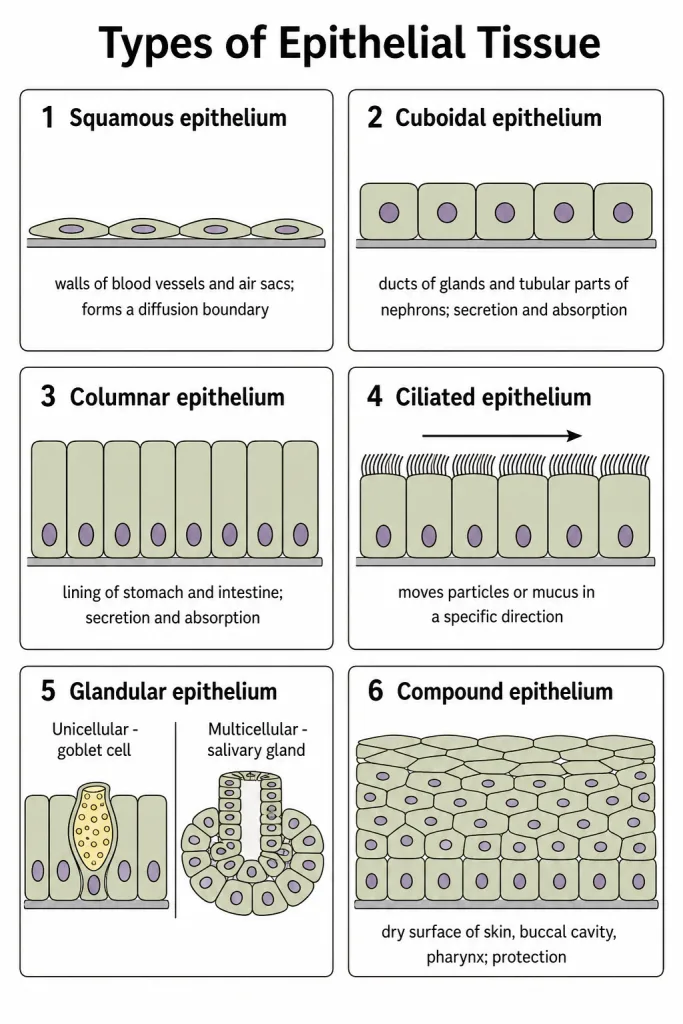
[NEET Important] The location is what gets asked, not the shape. Squamous - blood vessels and alveoli. Cuboidal - gland ducts and nephron tubules. Columnar - stomach and intestine. Ciliated - bronchioles and fallopian tubes. Compound - skin, buccal cavity, pharynx, gland ducts. And the gland split is a two-line answer: exocrine has ducts, endocrine has none and makes hormones.
Cell Junctions
The cells of an epithelium are held together with little intercellular material, and three types of cell junction do the work. All three appear in the epithelial and some other tissues.
| Junction | What it does |
|---|---|
| Tight junctions | Help to stop substances from leaking across a tissue |
| Adhering junctions | Perform cementing to keep neighbouring cells together |
| Gap junctions | Facilitate the cells to communicate with each other by connecting the cytoplasm of adjoining cells, for the rapid transfer of ions, small molecules and sometimes big molecules |
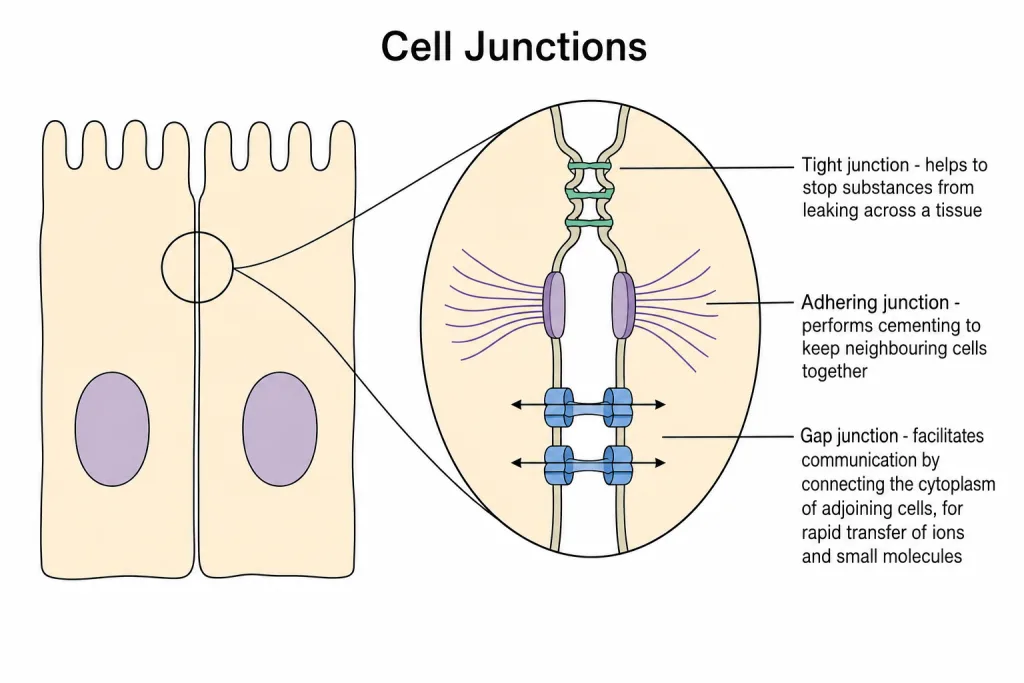
[NEET Important] Learn these as three verbs - tight stops leaking, adhering cements, gap communicates. The gap junction is the one that gets a longer answer, because it works by connecting the cytoplasm of adjoining cells, and that is what lets cardiac muscle contract as a unit later in this chapter.
Quick Recap
- Unicellular - one cell does everything. Multicellular - groups of cells divide the work.
- Tissue - a group of similar cells with intercellular substances performing a specific function.
- Four basic tissues in all complex animals: epithelial, connective, muscular, neural.
- Organ - tissues in specific proportion and pattern. Organ system - two or more organs performing a common function by physical or chemical interaction.
Epithelium - one free surface, cells connected at junctions.
- Simple - one layer. Squamous (flattened; blood vessels, air sacs; diffusion), cuboidal (cube-like; gland ducts, nephron tubules; secretion and absorption), columnar (tall, slender, nuclei at the base; stomach and intestine; secretion and absorption).
- Ciliated - columnar or cuboidal with cilia; move particles or mucus in a specific direction; bronchioles and fallopian tubes.
- Glandular - unicellular (goblet cells) or multicellular (salivary gland); exocrine with ducts, endocrine with none, secreting hormones.
- Compound - two or more layers; protection against chemical and mechanical stresses; skin, buccal cavity, pharynx, gland ducts.
Cell junctions - tight (stop leaking), adhering (cement), gap (communicate by connecting cytoplasm).
Solved Examples
Question 1
Q. Define a tissue.
Answer. A group of similar cells along with intercellular substances that performs a specific function.
Question 2
Q. Name the four basic types of tissue in complex animals.
Answer. Epithelial, connective, muscular and neural.
Question 3
Q. What makes an organ system, as opposed to an organ?
Answer. An organ is tissues organised in specific proportion and pattern. An organ system is two or more organs performing a common function by their physical or chemical interaction - the digestive system, for instance.
Question 4
Q. What is the one structural feature every epithelium has?
Answer. One free surface, facing either a body fluid or the outside environment.
Question 5
Q. Where is squamous epithelium found, and what is it for?
Answer. In the walls of blood vessels and the air sacs of the lungs. Its thin flattened cells suit its job, which is diffusion.
Question 6
Q. Which epithelium lines the tubular parts of the nephrons, and what does it do?
Answer. Cuboidal epithelium, and it handles secretion and absorption. It also lines the ducts of glands.
Question 7
Q. How would you recognise columnar epithelium under a microscope?
Answer. A single layer of tall, slender cells with the nuclei sitting at the base. It lines the stomach and intestine.
Question 8
Q. What are ciliated epithelia for, and where are they?
Answer. They move particles or mucus in a specific direction. You find them on the inner surface of hollow organs such as the bronchioles and the fallopian tubes.
Question 9
Q. Distinguish between exocrine and endocrine glands.
Answer. Exocrine glands have ducts and pour out mucus, saliva, earwax, oil, milk and digestive enzymes. Endocrine glands have no ducts; their products are hormones, secreted directly into the fluid bathing the gland.
Question 10
Q. Give one unicellular and one multicellular gland.
Answer. Goblet cells of the alimentary canal are unicellular; the salivary gland is multicellular.
Question 11
Q. What is compound epithelium for, and where is it found?
Answer. It is made of two or more cell layers and its main job is protection against chemical and mechanical stresses. It has only a limited role in secretion and absorption. It covers the dry surface of the skin, the moist surface of the buccal cavity and pharynx, and the inner lining of the ducts of the salivary glands and pancreatic ducts.
Question 12
Q. Name the three cell junctions and say what each one does.
Answer. Tight junctions stop substances from leaking across a tissue. Adhering junctions cement neighbouring cells together. Gap junctions let cells communicate by connecting the cytoplasm of adjoining cells, allowing the rapid transfer of ions, small molecules and sometimes big molecules.
Question 13
Q. A tissue is one cell thick, its cells are flattened with irregular boundaries, and it forms a wall across which gases pass. Name it and give one location.
Answer. Simple squamous epithelium. The air sacs of the lungs fit exactly - a thin single layer is what makes diffusion possible.
Question 14
Q. Why is the epithelium of the skin compound rather than simple?
Answer. Because the skin's job there is protection against chemical and mechanical stresses, and two or more layers survive that far better than one. A simple epithelium is built for diffusion, secretion and absorption, which is not what a dry outer surface needs.