
The Male Reproductive System
Frogs have well organised male and female reproductive systems.
The male reproductive organs consist of a pair of yellowish ovoid testes, which are found adhered to the upper part of the kidneys by a double fold of peritoneum called the mesorchium.
The path a sperm takes:
- Vasa efferentia are 10 to 12 in number and arise from the testes.
- They enter the kidneys on their side and open into Bidder's canal.
- Finally it communicates with the urinogenital duct that comes out of the kidneys and opens into the cloaca.
The cloaca is a small, median chamber that is used to pass faecal matter, urine and sperms to the exterior.
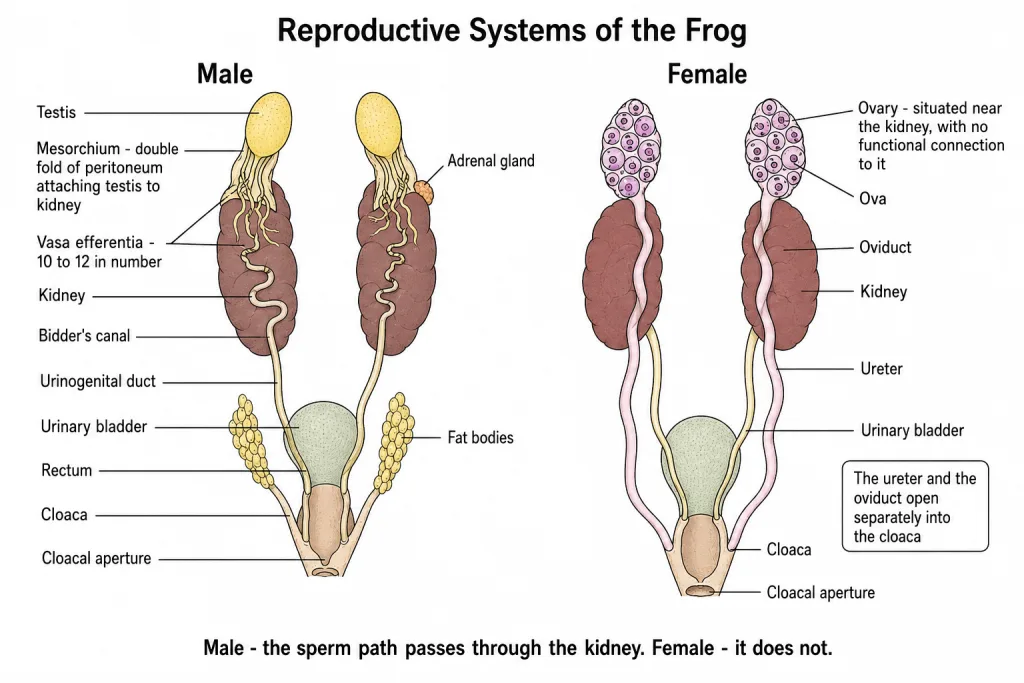
[NEET Important] Three names in one sentence get asked over and over: mesorchium (the double fold of peritoneum holding the testes to the kidney), vasa efferentia (10 to 12 in number) and Bidder's canal. And remember what makes the cloaca special - one chamber for faecal matter, urine and sperms.
The Female Reproductive System and Development
The female reproductive organs include a pair of ovaries.
- The ovaries are situated near the kidneys, and there is no functional connection with the kidneys - a clear contrast with the male, where the testes drain through the kidneys.
- A pair of oviducts arising from the ovaries opens into the cloaca separately.
A mature female can lay 2500 to 3000 ova at a time.
Fertilisation is external and takes place in water. Development involves a larval stage called the tadpole, and the tadpole undergoes metamorphosis to form the adult.
[NEET Important] The contrast between the two systems is the whole point of this block. Male - testes attached to the kidneys by the mesorchium, sperm passes through the kidney into the urinogenital duct. Female - ovaries near the kidneys but with no functional connection, and the oviduct opens into the cloaca separately. Also hold the numbers: 2500 to 3000 ova, external fertilisation, tadpole, metamorphosis.
Why the Frog Matters
Frogs are beneficial for mankind because they eat insects and protect the crop.
Frogs maintain ecological balance because these serve as an important link of the food chain and food web in the ecosystem.
In some countries the muscular legs of the frog are used as food by man.
[NEET Important] This short block is a ready-made two-mark answer. Give the three points in order - insect control and crop protection, an important link in the food chain and food web, and frog legs eaten as food in some countries.
Quick Recap
- Male organs - a pair of yellowish ovoid testes, adhered to the upper part of the kidneys by a double fold of peritoneum called the mesorchium.
- Vasa efferentia - 10 to 12 in number, arise from the testes, enter the kidneys and open into Bidder's canal.
- Bidder's canal communicates with the urinogenital duct, which comes out of the kidneys and opens into the cloaca.
- Cloaca - a small, median chamber passing out faecal matter, urine and sperms.
- Female organs - a pair of ovaries near the kidneys, with no functional connection to them.
- A pair of oviducts arises from the ovaries and opens into the cloaca separately.
- A mature female lays 2500 to 3000 ova at a time.
- Fertilisation is external, in water. Development involves a tadpole larva, which undergoes metamorphosis into the adult.
- Importance - frogs eat insects and protect crops, maintain ecological balance as a link in the food chain and food web, and their muscular legs are eaten as food in some countries.
Solved Examples
Question 1
Q. Describe the testes of a frog and how they are held in place.
Answer. They are a pair of yellowish ovoid testes, adhered to the upper part of the kidneys by a double fold of peritoneum called the mesorchium.
Question 2
Q. What are vasa efferentia and how many are there?
Answer. They are the ducts that arise from the testes, 10 to 12 in number. They enter the kidneys on their side and open into Bidder's canal.
Question 3
Q. Trace the path of sperms from the testis to the exterior in a male frog.
Answer. Testes - vasa efferentia - kidney - Bidder's canal - urinogenital duct, which comes out of the kidneys - cloaca - outside.
Question 4
Q. What is the cloaca and what passes through it?
Answer. It is a small, median chamber that is used to pass faecal matter, urine and sperms to the exterior.
Question 5
Q. Where are the ovaries of a frog situated, and are they connected to the kidneys?
Answer. They are situated near the kidneys, but there is no functional connection with the kidneys. This is unlike the male, where the sperm duct passes through the kidney.
Question 6
Q. How do the oviducts of a frog open?
Answer. A pair of oviducts arises from the ovaries and opens into the cloaca separately - separately from the ureters.
Question 7
Q. How many ova can a mature female frog lay at a time?
Answer. 2500 to 3000 ova at a time.
Question 8
Q. What kind of fertilisation takes place in frogs, and where?
Answer. Fertilisation is external and takes place in water.
Question 9
Q. Describe the development of a frog after fertilisation.
Answer. Development involves a larval stage called the tadpole. The tadpole undergoes metamorphosis to form the adult frog.
Question 10
Q. Why are frogs said to be beneficial for mankind?
Answer. Because they eat insects and protect the crop. They also maintain ecological balance, since they serve as an important link of the food chain and food web in the ecosystem. Besides this, in some countries the muscular legs of the frog are used as food by man.
Question 11
Q. Compare the way the male and the female reproductive systems of a frog relate to the kidneys.
Answer. In the male, the testes are attached to the upper part of the kidneys by the mesorchium, and the sperms actually pass through the kidney by way of the vasa efferentia and Bidder's canal into the urinogenital duct. In the female, the ovaries are only situated near the kidneys with no functional connection, and the oviducts open into the cloaca separately.