
How to Use This Section
You have finished the theory. Sections 1 to 5 taught you units, significant figures, arithmetic with them, dimensional formulae and dimensional analysis, and each carried a dozen worked examples of its own. This section is different: it is one long problem set, 35 fully worked examples in an easy to medium to hard progression, and it deliberately mixes the topics up the way a real exam does.
Here is the thing about this chapter — nobody loses marks because the physics is hard. They lose marks because they converted to with a factor of instead of , or wrote 2.34 kg when the rule demanded 2.3 kg, or forgot that is not . The only cure is volume. So work these.
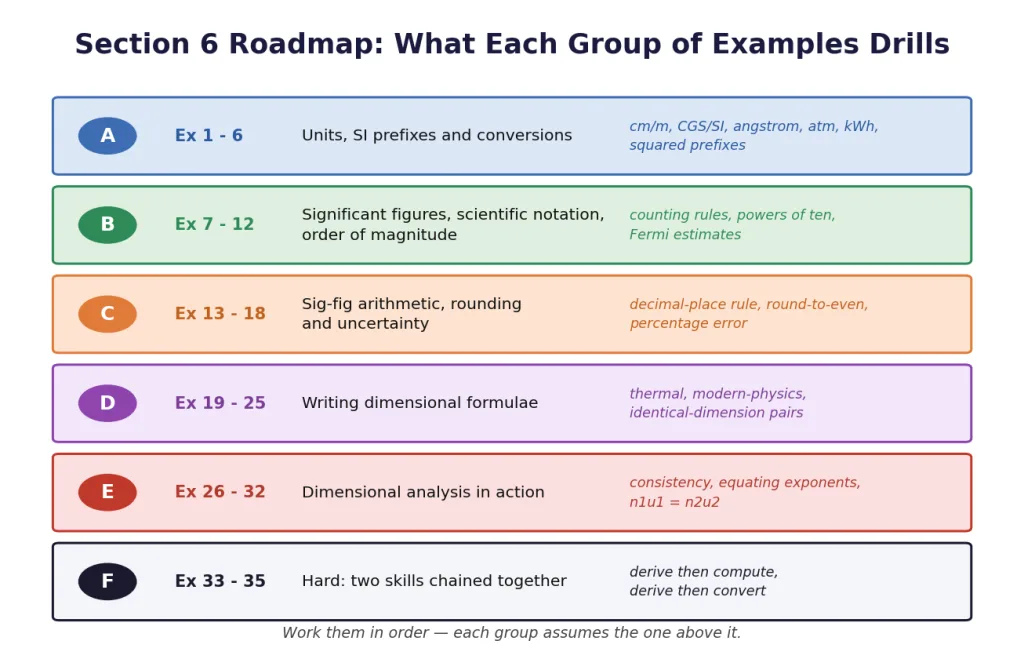
The working method
- Cover the solution. Genuinely attempt the example first, on paper, with a pen. Reading a solution feels like learning and is not.
- Compare your steps, not just your answer. If you got the right number by a longer route, note the shorter one.
- Read the Takeaway. Every example ends with one. That line is the transferable part; the numbers are disposable.
A last piece of advice before you start. Write the units at every line, not only at the end. Half the errors in this chapter announce themselves the moment you carry the units through, because you end up with an answer in when you wanted a joule and you catch it instantly.
Solved Examples
Example 1: Fill in the blanks
(a) The volume of a cube of side 1 cm is equal to ….. (b) The surface area of a solid cylinder of radius 2.0 cm and height 10.0 cm is equal to ….. (c) A vehicle moving with a speed of 18 km h covers ….. m in 1 s (d) The relative density of lead is 11.3. Its density is ….. g cm or ….. kg m.
Solution:
- (a) Convert the side first, then cube it. m, so
- (b) A solid cylinder has two flat circular ends plus the curved side, so the total surface area is .
- Substituting cm and cm:
- Now convert. , so .
- The data (2.0 and 10.0) carries 2 significant figures, so
- (c) . In 1 s it therefore covers 5 m.
- (d) Relative density is a pure ratio: density of the substance divided by the density of water. Since water is , the density in is numerically the relative density, i.e. .
- Convert: , so
Final Answer: (a) (b) (c) 5 m (d) or .
Takeaway: The single most common error in this whole chapter lives in part (a). A prefix inside a squared or cubed bracket gets squared or cubed too: is , not . Part (d) is the other trap — relative density is dimensionless, and only becomes a density when you attach the density of water to it.
Example 2: Conversion of units
Fill in the blanks by suitable conversion of units: (a) (b) ly (c) (d)
Solution:
- (a) Replace each unit by its equivalent and multiply the numbers out:
- (b) One light year is the distance light travels in one year, m. Inverting,
- (c) Here the time unit is squared, and this is where signs go wrong. Write each replacement separately: km, and h, so .
- Therefore
- (d) First simplify the unit of . Since ,
- Now convert (a factor ) and (a factor , because a gram is smaller so there are fewer of the new unit in the denominator sense — safest is to write ):
Final Answer: (a) (b) (c) (d) .
Takeaway: Never convert a compound unit in one mental leap. Break it into single units, write each replacement in brackets with its own power, and only then multiply the powers of ten. Part (d) also shows a habit worth keeping: simplify the unit before you convert it. Turning into first makes the conversion a two-line job instead of a five-line one.
Example 3: The very small units — angstrom and fermi
(a) The wavelength of yellow sodium light is 5893 Å. Express it in m, in nm and in m. (b) The radius of a gold nucleus is about 6.9 fermi. Express it in m and in Å. (c) Roughly how many times bigger is an atom than the nucleus inside it, taking the atom as 1 Å across and the nucleus as 1.2 fermi?
Solution:
- Recall the two definitions. 1 Å m (angstrom, the atomic-scale unit) and 1 fermi m (also written fm, the nuclear-scale unit).
- (a) In metres: m.
- In nanometres: m, so nm.
- In micrometres: m, so m.
- (b) m. In angstrom: Å.
- (c) Take the ratio directly, in metres:
Final Answer: (a) m 589.3 nm 0.5893 m. (b) m Å. (c) About times, i.e. roughly .
Takeaway: Learn the ladder 1 Å fermi and 1 nm 10 Å and you will never have to think about these again. Part (c) is worth remembering as a fact: the atom is about times the nucleus, which is why almost all of an atom is empty space.
Example 4: Pressure in four different units
(a) Show that . (b) Standard atmospheric pressure is Pa. Express it in dyne cm and in bar. (c) A normal systolic blood pressure reading is "120 mm of Hg". Convert it to pascal. Take and .
Solution:
- (a) dyne and . Therefore
- (b) Using the factor just proved,
- The bar is defined as Pa exactly, so
- (c) "120 mm of Hg" is not a pressure unit in disguise — it means the pressure at the base of a mercury column 120 mm high, .
- Convert the height to SI first: m. Then
- The data has 2 significant figures (120), so Pa kPa.
Final Answer: (a) . (b) bar. (c) About Pa.
Takeaway: Two things to bank. First, the conversion factor (many students guess wrongly as by multiplying instead of dividing). Second, [NEET Important] any pressure quoted as a column height must go through — the mm is a length, not a pressure.
Example 5: The units of energy you actually meet
(a) Your electricity bill charges you per "unit", which is 1 kilowatt-hour. Express 1 kWh in joules. (b) A 2.0 kW geyser runs for 3.0 hours. How many units does it consume, and how much energy is that in joules? (c) Express 1 joule in erg and in electronvolt, given J.
Solution:
- (a) A kilowatt-hour is a power multiplied by a time, so it is an energy. Convert both factors to SI:
- (b) Energy consumed kWh, i.e. 6.0 units.
- In joules: J.
- (c) In CGS the unit of energy is the erg, and erg (this is just from Example 2a).
- In electronvolt:
Final Answer: (a) J (b) 6.0 units J (c) erg eV.
Takeaway: The joule is a hopeless unit for both ends of the scale, which is why physics keeps the eV for atoms and the kWh for kettles. All three are the same dimension — only the size differs. [JEE Tip] J and erg are worth memorising outright.
Example 6: When the prefix gets squared or cubed
Express in SI base units: (a) in (b) in (c) in (d) a length of m in nm and in Å (e) a density of in .
Solution:
- The one rule that governs (a) to (c): the prefix belongs to the unit before the power is applied, so the power hits the prefix too. Always rewrite the prefixed unit in brackets.
- (a) .
- (b) .
- (c) .
- (d) nm, and Å.
- (e) Numerator and denominator separately: .
Final Answer: (a) (b) (c) (d) 45 nm 450 Å (e) (this is aluminium).
Takeaway: Notice that and both come out as — pure coincidence, and exactly the kind of thing you will get wrong if you memorise answers instead of the method. Bracket the prefixed unit, apply the power, then multiply. [Board Important] The universal shortcut: to go from to , multiply by . Every time.
Example 7: Counting significant figures — a fresh drill
State the number of significant figures in each: (i) 0.05070 kg (ii) m (iii) 1200 s (iv) 1200.0 s (v) 30.00 mL (vi) 0.0001 m (vii) N.
Solution:
- (i) 0.05070 kg. The leading zeros (before the 5) are not significant — they only place the decimal point. The sandwiched zero is significant, and the trailing zero after a decimal point is significant. Digits counted: 5, 0, 7, 0 4.
- (ii) m. In scientific notation only the mantissa is counted; the power of ten never contributes. Digits: 5, 0 2.
- (iii) 1200 s. Trailing zeros in a number without a decimal point are not significant. Digits: 1, 2 2.
- (iv) 1200.0 s. The decimal point is now present, so every trailing zero counts. Digits: 1, 2, 0, 0, 0 5.
- (v) 30.00 mL. Sandwiched zero plus two trailing zeros after a decimal point, all significant 4.
- (vi) 0.0001 m. All four zeros are leading zeros. Only the 1 survives 1.
- (vii) N. Mantissa only: 3, 0, 8, 0, 0 5.
Final Answer: (i) 4 (ii) 2 (iii) 2 (iv) 5 (v) 4 (vi) 1 (vii) 5.
Takeaway: Compare (iii) and (iv). Adding a single decimal point took the count from 2 to 5 without changing the value at all — that is how much information the notation carries. [JEE Tip] If a number in an exam is written as 1200 with no decimal point and no scientific notation, treat it as 2 significant figures unless the question tells you otherwise.
Example 8: Into and out of scientific notation
(a) Write the astronomical unit, 149600000 km, in scientific notation, and then round it to 3 significant figures. (b) The charge on an electron is 0.00000000000000000016 C. Write it in scientific notation. (c) The speed of light is 299792458 m s. Write it to 3 significant figures. (d) Avogadro's number is 602200000000000000000000 per mole. Write it in scientific notation.
Solution:
- The recipe. Move the decimal point until exactly one non-zero digit sits to its left. Moving it places left gives ; moving it places right gives .
- (a) 149600000 km. The decimal is currently after the final zero; move it 8 places left: That is 4 significant figures. To 3 significant figures the digit dropped is 6, which is more than 5, so the 9 rounds up to 10 and carries: km.
- (b) Move the decimal 19 places right: C — 2 significant figures.
- (c) . To 3 figures, the digit dropped is 7, so 9 rounds up and carries again: .
- (d) Move the decimal 23 places left: — 4 significant figures.
Final Answer: (a) km, i.e. km to 3 s.f. (b) C (c) (d) .
Takeaway: Parts (a) and (c) both hide a carry. Rounding and requires the trailing zeros to be written, because dropping them would falsely claim fewer significant figures. [Board Important] Writing when the question asked for 3 significant figures is a mark lost — it says 1 significant figure.
Example 9: The volume of a mole of atoms
The unit of length convenient on the atomic scale is known as an angstrom, 1 Å m. The size of a hydrogen atom is about 0.5 Å. What is the total atomic volume in of one mole of hydrogen atoms?
Solution:
- Read "size" carefully. The size of the atom is given as 0.5 Å, and the standard reading is that this is the radius. So 0.5 Å m m.
- Volume of one atom, treating it as a sphere:
- Cube the bracket first: .
- Multiply by :
- Scale up to a mole. One mole contains atoms, and Avogadro's number is a defined (exact) quantity here:
- Multiply mantissas and add exponents: , and , giving .
- The data ("about 0.5 Å") carries 1 significant figure, so honestly this is .
Final Answer: , i.e. about (roughly 0.3 mL).
Takeaway: A mole of hydrogen atoms, packed solid, would fit in a third of a millilitre. Hold on to that number — the next example uses it to make a point about gases. [NEET Important] The cubing step is where marks vanish: , not 0.5, and , not .
Example 10: Why a gas is mostly nothing
One mole of an ideal gas at STP occupies 22.4 L (the molar volume). What is the ratio of molar volume to the atomic volume of a mole of hydrogen? Take the size of a hydrogen molecule to be about 1 Å. Why is this ratio so large?
Solution:
- Molar volume in SI. , so
- Atomic (molecular) volume. "Size about 1 Å" means a diameter of 1 Å, so the radius is 0.5 Å m — exactly the figure from Example 9. Therefore
- Take the ratio:
- Divide the mantissas, subtract the exponents: and , so the ratio is .
- Why so large? In a gas the molecules are far apart compared with their own size. The inter-molecular separation is roughly the cube root of the volume per molecule, which is about times the molecular diameter. So a gas is essentially empty space with occasional molecules in it, which is exactly why gases are compressible and liquids are not.
Final Answer: The ratio is about , i.e. of order . It is large because in the gaseous state the inter-molecular separation is roughly 40 times the size of a molecule.
Takeaway: This is a numerical answer that carries real physics. [NEET Important] The examiner's favourite follow-up is "estimate the mean free path" or "why is a liquid nearly incompressible" — both are answered by the same fact: in a liquid the molecules are already touching, in a gas they are to volumes apart.
Example 11: A Fermi estimate — the air in your classroom
Estimate, to the nearest order of magnitude, (a) the mass of air in a classroom measuring roughly 5 m 4 m 3 m, and (b) the number of gas molecules in it. Take the density of air as and the molar volume as 22.4 L.
Solution:
- (a) Volume of the room: .
- Mass: kg.
- Order of magnitude. Write it as kg. Since the mantissa , we round the power up: the order of magnitude is kg.
- (b) Number of moles. Using the molar volume ,
- Number of molecules:
- Order of magnitude. The mantissa , so the power stays: the order of magnitude is .
Final Answer: (a) About 72 kg, order of magnitude kg. (b) About molecules, order of magnitude .
Takeaway: Most students guess "a few kilograms" for the air in a room and are out by a factor of 20 — the air above you weighs about as much as you do. Note also the two different rounding decisions in steps 3 and 6: order of magnitude uses the rule round the power up if the mantissa exceeds 5, and 7.2 does while 1.61 does not.
Example 12: The density of the Sun
The Sun is a hot plasma with an inner core above K and a surface at about 6000 K, so no substance in it can be a solid or a liquid. In what range do you expect the mass density of the Sun to lie — that of solids and liquids, or that of gases? Check your guess: mass of the Sun kg, radius m.
Solution:
- The guess. Since the Sun is entirely gaseous (a plasma), the instinctive guess is a gas-like density, around .
- Volume of the Sun, treating it as a sphere:
- Cube first: and , so .
- Multiply by :
- Density:
- To 2 significant figures (the data has 2), .
- Compare. Water is and air is about . The Sun's mean density is 1.4 times that of water and about a thousand times that of air.
Final Answer: — the range of solids and liquids, not gases. The initial guess is wrong.
Takeaway: The resolution of the paradox is gravity. The Sun's enormous mass compresses its interior so hard that the plasma reaches liquid-like densities even at K, and the core is far denser than this average. [Board Important] This is a favourite two-mark reasoning question: the phase (gas/plasma) and the density are set by different things — temperature decides the phase, pressure decides the density.
Example 13: The grocer, the box and the gold
The mass of a box measured by a grocer's balance is 2.30 kg. Two gold pieces of masses 20.15 g and 20.17 g are added to the box. What is (a) the total mass of the box, and (b) the difference in the masses of the pieces, to correct significant figures?
Solution:
- (a) Put everything in one unit first. kg and kg.
- Add:
- Apply the addition rule — the result keeps as many decimal places as the term with the fewest. Counting decimal places: 2.30 has 2, the gold pieces have 5 each. The least is 2.
- Rounding 2.34032 to 2 decimal places: the first digit dropped is 0, which is less than 5, so the preceding digit is unchanged. Total mass kg.
- (b) Difference: g. Both have 2 decimal places, so the answer keeps 2 decimal places: g.
- Notice what subtraction did to the precision. Both inputs had 4 significant figures; the difference has just 1.
Final Answer: (a) 2.34 kg (b) 0.02 g (1 significant figure).
Takeaway: [Board Important] Some solution keys quote the answer to (a) as 2.3 kg, reading the grocer's balance as trustworthy only to 0.1 kg. Follow the printed data: 2.30 kg states 2 decimal places, so the decimal-place rule gives 2.34 kg. The deeper lesson is part (b) — adding a tiny precise number to a big rough one gains you nothing, and subtracting two nearly equal numbers destroys significant figures wholesale.
Example 14: Rounding off, including the awkward cases
Round off as instructed: (i) 3.765 to 3 s.f. (ii) 3.755 to 3 s.f. (iii) 0.04653 to 2 s.f. (iv) 87.65 to 3 s.f. (v) 1.2345 to 4 s.f. (vi) 9.996 to 3 s.f.
Solution:
- Look only at the first digit you are about to drop. More than 5, round up. Less than 5, leave alone. Exactly 5 with nothing after it, use the round-to-even convention.
- (i) 3.765 3 s.f. The dropped digit is exactly 5, and the preceding digit 6 is even, so the 5 is simply dropped: 3.76.
- (ii) 3.755 3 s.f. The dropped digit is exactly 5, but the preceding digit 5 is odd, so it is raised by 1: 3.76.
- (iii) 0.04653 2 s.f. The two significant digits are 4 and 6. The part being dropped is "53", which is more than 5, so the 6 rounds up: 0.047.
- (iv) 87.65 3 s.f. Dropped digit is exactly 5, preceding digit 6 is even, so drop it: 87.6.
- (v) 1.2345 4 s.f. Dropped digit is exactly 5, preceding digit 4 is even, so drop it: 1.234.
- (vi) 9.996 3 s.f. Dropped digit 6 is more than 5, so 9 rounds up, which carries all the way: . Write it as 10.0, keeping the trailing zero so that it still shows 3 significant figures.
Final Answer: (i) 3.76 (ii) 3.76 (iii) 0.047 (iv) 87.6 (v) 1.234 (vi) 10.0.
Takeaway: Parts (i) and (ii) land on the same answer from opposite sides — that is the whole point of the round-to-even convention, and the fastest way to remember it. [JEE Tip] Part (iii) is the trap: the round-to-even rule applies only when the dropped part is exactly 5 with nothing after it. "53" is more than 5, so you round up normally. And never write part (vi) as "10" — that would claim 2 significant figures.
Example 15: The projector
The photograph of a house occupies an area of on a 35 mm slide. The slide is projected onto a screen, and the area of the house on the screen is . What is the linear magnification of the projector-screen arrangement?
Solution:
- Distinguish the two magnifications. If the linear magnification is , every length is multiplied by , so every area is multiplied by . That is the key relation:
- Put both areas in the same unit. Working in : , so
- Form the ratio:
- Take the square root:
- Significant figures. Both areas are given to 3 significant figures, and the operations are division and a square root, so the answer keeps 3: .
- The "35 mm slide" in the question is a red herring — it names the film format and plays no part in the calculation.
Final Answer: The linear magnification is about 94.1.
Takeaway: Areas scale as the square of the linear magnification. Students who divide by and stop get 8857 and call it the magnification — off by a factor of 94. [JEE Tip] The same square-and-cube logic runs through the whole chapter: lengths , areas , volumes .
Example 16: The thickness of a human hair
A student measures the thickness of a human hair by looking at it through a microscope of magnification 100. He makes 20 observations and finds that the average width of the hair in the field of view of the microscope is 3.5 mm. What is the estimate on the thickness of the hair?
Solution:
- What magnification means. The microscope makes the hair appear 100 times wider than it really is:
- Invert it:
- In SI: m.
- Significant figures. The magnification 100 is an exact number (a counted specification, not a measurement), so it has infinite significant figures and does not limit the answer. Only 3.5 mm counts, with 2 significant figures, so the answer keeps 2: m.
- Why 20 observations? Averaging many readings reduces the random error in the mean. It does not change the method, only the reliability of the 3.5 mm.
Final Answer: The thickness of the hair is about , i.e. roughly 35 m.
Takeaway: [Board Important] The magnification 100 is exact, which is why the answer still has 2 significant figures and not 1. This is the same principle as dividing by the number of oscillations when you find a time period — a counted number never degrades your precision.
Example 17: Percentage error in a resistance
In an experiment the potential difference across a resistor is measured as V and the current through it as A. Find the resistance and the percentage error in it, and quote the result properly.
Solution:
- Central value. By Ohm's law,
- Percentage error in each measurement:
- Combine. For a quotient the percentage errors add (they never subtract, no matter that the quantity is being divided):
- Absolute error:
- Quote it. The absolute error is rounded to one significant figure, and the central value is then rounded to the same decimal place:
Final Answer: with a percentage error of , quoted as .
Takeaway: [JEE/NEET] For or , the relative errors add. The instinct to subtract for a division is wrong — errors do not cancel, they accumulate, because you must plan for the worst case. Also note step 5: an error is quoted to one significant figure, and the answer is then matched to it.
Example 18: Error in a kinetic energy
A body of mass kg is moving with speed . Find its kinetic energy and the percentage error in it.
Solution:
- Central value.
- Percentage errors in the inputs:
- Apply the power rule. For , the relative errors add with their exponents as weights: The factor is a pure number and contributes nothing.
- Substitute:
- Absolute error: J, so J.
Final Answer: J with a percentage error of , i.e. J.
Takeaway: The speed and the mass were each measured to the same , yet the speed contributes twice as much error, because it enters squared. [JEE Tip] When a question asks "which quantity should be measured most carefully?", the answer is always the one with the largest exponent, not the one with the largest value.
Example 19: Dimensional formulae of thermal quantities
Write the dimensional formulae of (i) heat , (ii) specific heat capacity , (iii) latent heat , (iv) coefficient of thermal conductivity , (v) the universal gas constant , and (vi) Boltzmann's constant .
Solution:
- (i) Heat. Heat is energy in transit, so it has exactly the dimensions of energy:
- (ii) Specific heat capacity. From , we get :
- (iii) Latent heat. From , so — no temperature appears, because a phase change happens at constant temperature:
- (iv) Thermal conductivity. From the conduction equation , rearranged as :
- (v) Gas constant. From , so . Note that , which is an energy — as it must be:
- (vi) Boltzmann's constant. , and carries the dimension , so dividing removes the mole:
Final Answer: , , , , , .
Takeaway: Every one of these is "energy divided by something". Once you see that, the whole family is one step of division away from . [JEE Tip] Two traps here: latent heat has no in it (constant temperature), and exactly — specific heat and latent heat differ by one power of temperature and nothing else.
Example 20: Dimensional formulae of modern-physics constants
Find the dimensional formulae of (i) Planck's constant , (ii) Stefan's constant , (iii) Wien's constant , (iv) the Rydberg constant . Then (v) use your answer to (i) to check the de Broglie relation .
Solution:
- (i) Planck's constant. The defining relation is , so . Frequency has :
- (ii) Stefan's constant. Stefan's law says the energy radiated per unit area per unit time is , so :
- (iii) Wien's constant. Wien's displacement law is , a wavelength times a temperature:
- (iv) Rydberg constant. It appears as . The bracket is a pure number, so has the dimensions of a reciprocal wavelength:
- (v) Check de Broglie. Momentum has , so which is indeed a length. The relation is dimensionally consistent.
Final Answer: , , , , and checks out.
Takeaway: You do not need to understand Stefan's law or the Rydberg formula to get their dimensions — you only need the defining equation and the courage to divide. [JEE Tip] is the same as angular momentum, which is not a coincidence: is an angular momentum, and that fact is worth two marks in any "identical dimensions" question.
Example 21: Which of these share dimensions?
From the list below, group together every quantity that has the same dimensional formula: work, torque, impulse, linear momentum, pressure, energy density, angular momentum, Planck's constant, frequency, velocity gradient, gravitational potential, latent heat, surface tension, spring constant.
Solution:
- Work down the list writing each formula. Do not try to spot pairs by intuition; compute, then sort.
- Work . Torque the same, .
- Impulse . Momentum .
- Pressure . Energy density .
- Angular momentum , and from Example 20.
- Frequency . Velocity gradient .
- Gravitational potential , and latent heat .
- Surface tension , and spring constant .
Final Answer:
| Group | Members | Dimensional formula |
|---|---|---|
| 1 | work, torque | |
| 2 | impulse, linear momentum | |
| 3 | pressure, energy density | |
| 4 | angular momentum, Planck's constant | |
| 5 | frequency, velocity gradient | |
| 6 | gravitational potential, latent heat | |
| 7 | surface tension, spring constant |
Takeaway: [NEET Important] These seven pairs cover almost every "which pair has the same dimensions" question ever set. Learn them as pairs, not as fourteen separate formulae. And remember what identical dimensions do not mean: work and torque have the same dimensions but are completely different physical quantities — one is a scalar, one is a vector, and you cannot add them.
Example 22: Dimensions from the van der Waals equation
The van der Waals equation for one mole of a real gas is where is pressure and is volume. Find the dimensional formulae of the constants and .
Solution:
- Use the principle of homogeneity on the brackets. Only quantities with the same dimensions can be added or subtracted, so each bracket must be dimensionally uniform.
- The second bracket first, because it is easier. requires So is a volume — physically, the volume actually occupied by the molecules themselves.
- The first bracket. requires
- Solve for :
- Collect the powers of length: . Therefore
Final Answer: and .
Takeaway: You never needed to know any thermodynamics. The homogeneity principle alone tells you that anything added to a pressure is a pressure and anything subtracted from a volume is a volume. [JEE Tip] This is the single most reliable technique in the chapter: find the term you already know, and force everything added to it to match.
Example 23: Finding the dimensions of unknown constants
(a) A force varies with time as . Find the dimensional formulae of , , and . (b) The pressure of a gas is given by , where is time and is distance. Find , and .
Solution:
- (a) The arguments first. The argument of any trigonometric function must be a pure number — you cannot take the sine of 3 seconds. So , giving and by the same argument .
- The coefficients. Since and are pure numbers, has the dimensions of alone. And that sum must equal a force:
- (b) The numerator. is a subtraction, so must have the dimensions of :
- Solve for . Rearranging, , so
- Dividing: the mass power is , the length power is , the time power is . Therefore
- The ratio: which, incidentally, is the dimension of surface tension.
Final Answer: (a) , . (b) , , .
Takeaway: Two rules solve every problem of this type, and you apply them in this order: (1) the argument of , , , or is always dimensionless; (2) anything added to or subtracted from a quantity shares its dimensions. Only after those do you go looking for the unknown by rearranging. [JEE Tip] Watch the sign in step 5 — dividing by adds 2 to the time exponent.
Example 24: Reading a dimensional formula backwards
Name at least one physical quantity having each of these dimensional formulae, and justify it: (i) (ii) (iii) (iv) (v) .
Solution:
- The technique. Do not guess. Look at the power of first — it is almost always 1, 0 or , and it tells you whether the quantity is "per unit mass" (power 0 or ) or an ordinary extensive quantity (power 1). Then use the time power to tell you how many divisions by time have happened.
- (i) — coefficient of viscosity . Check from :
- (ii) — frequency, and equally angular velocity, velocity gradient, angular frequency or a radioactive decay constant. All are "something per unit time" where the something is dimensionless.
- (iii) — power. This is energy per unit time:
- (iv) — pressure, and equally stress, Young's modulus, bulk modulus, modulus of rigidity or energy density. This formula is shared by more named quantities than any other in the syllabus.
- (v) — electric potential (or potential difference, or emf). The gives it away as electrical; and , so
Final Answer: (i) viscosity (ii) frequency / angular velocity / velocity gradient / decay constant (iii) power (iv) pressure / stress / Young's modulus / energy density (v) electric potential.
Takeaway: A dimensional formula never identifies a quantity uniquely — parts (ii) and (iv) each have four or more legitimate answers. [NEET Important] When a question says "the dimensional formula represents", check the options for all of pressure, stress and modulus; the intended answer is whichever one appears.
Example 25: Two dimensionless (and one not) checks
(a) Show that the Reynolds number is dimensionless, where is density, speed, a diameter and the coefficient of viscosity. (b) Show that has the dimensions of a speed. Take and .
Solution:
- (a) Numerator:
- Collect: mass power 1, length power , time power . So .
- Denominator: from Example 24.
- Divide: every exponent cancels, so The Reynolds number is dimensionless, which is exactly why the same critical value of about 2000 separates laminar from turbulent flow for water in a pipe and for air over a wing.
- (b) Multiply the two permittivity and permeability formulae:
- Add exponents one base at a time: : . : . : . : . So .
- Take the inverse square root. Halving every exponent and changing the sign:
Final Answer: (a) , dimensionless. (b) has dimensions , i.e. a speed.
Takeaway: Part (b) is one of the most beautiful results in physics compressed into three lines of exponent arithmetic — that combination is the speed of light, , and Maxwell discovered light was an electromagnetic wave essentially by noticing this. [JEE Tip] Taking a root of a dimensional formula just halves every exponent. Practise it until it is automatic.
Example 26: Where does belong?
A famous relation in physics relates the moving mass of a particle to its rest mass , its speed and the speed of light . A boy recalls the relation almost correctly but forgets where to put the constant . He writes Guess where to put the missing .
Solution:
- Test the equation as written. Look at the bracket . The 1 is a pure number, and .
- A pure number is being subtracted from a quantity with dimensions . That violates the principle of homogeneity outright, so the equation as written is wrong.
- Diagnose the fix. For the subtraction to be legal, must be made dimensionless. Since the only other quantity available is , and is itself a speed with , the obvious repair is to divide by :
- Check the rest of the equation. The denominator is now dimensionless, so on both sides. Consistent.
- Therefore the correct relation is
Final Answer: The belongs in the denominator of the bracket, as : .
Takeaway: This is dimensional analysis doing something genuinely useful — repairing a half-remembered formula. [Board Important] The giveaway is always the same: a pure number (here, the 1) being added to or subtracted from something with dimensions. Whatever you insert must cancel those dimensions exactly.
Example 27: Four consistency checks
Check each of these for dimensional consistency, and say what is wrong where the check fails. (i) The speed of sound in a gas, . (ii) The fundamental frequency of a stretched string, , where is the tension and the mass per unit length. (iii) A wave, . (iv) The pressure at a depth in a liquid, .
Solution:
- (i) Inside the root: Taking the square root halves the exponents: , a speed. Consistent.
- (ii) Note that is a linear density, . Inside the root:
- Square root gives ; dividing by (the 2 is a pure number) gives , a frequency. Consistent.
- (iii) The whole bracket is the argument of a sine, so it must be dimensionless. Inside it, has and has — the subtraction is legal. Dividing by , which is also , makes the whole thing a pure number. And is a pure number. Consistent.
- (iv) Collecting: mass 1, length , time . So the right side is , while the left side is a pressure, . They differ by . Inconsistent — the correct relation is , with to the first power.
Final Answer: (i), (ii) and (iii) are dimensionally consistent. (iv) is wrong; it should be .
Takeaway: Part (ii) contains the trap most students fall into: is mass per unit length, , not mass per unit volume. Read the definition, never the symbol. [JEE Tip] In part (iv) the mismatch was exactly one power of length — that is the signature of an index typed wrongly, and it tells you where to look for the fix.
Example 28: Deducing the frequency of a stretched string
The fundamental frequency of a vibrating string is thought to depend on the length of the string, the tension in it, and the mass per unit length . Derive the relation by the method of dimensions.
Solution:
- Assume a power-law relation — this is the only form the method can handle: where is a dimensionless constant.
- Write every dimensional formula. , , , .
- Substitute:
- Collect the exponents on the right:
- Equate exponents, one base at a time:
- :
- :
- :
- Solve. From the time equation, . From the mass equation, . From the length equation, .
- Reassemble:
- Check against the known result. Experiment (and the wave theory you meet in Chapter 14) gives , so .
Final Answer: , with supplied by experiment.
Takeaway: Three base quantities give you exactly three equations, so the method pins down exactly three exponents — no more. [Board Important] Always end with the sentence "where is a dimensionless constant that cannot be found by this method". It is worth a mark, and it is honest.
Example 29: The time period of a satellite
The period of revolution of a satellite in a circular orbit depends on the orbital radius , the mass of the planet, and the gravitational constant . Derive the relation.
Solution:
- Assume: .
- Dimensional formulae. , , , and from ,
- Substitute:
- Equate exponents:
- :
- :
- :
- Reassemble:
- Verify dimensionally: , whose square root is . Correct.
Final Answer: , and the exact theory gives , so .
Takeaway: Look at what fell out: . That is Kepler's third law, obtained from nothing but exponent arithmetic. [JEE Tip] Start with the base that appears in only one quantity — here appears only in , so the time equation gives you instantly and the rest unravels.
Example 30: The vibration frequency of a liquid drop
A liquid drop held together by surface tension can oscillate. Its frequency is expected to depend on the density of the liquid, the radius of the drop, and the surface tension . Find the relation.
Solution:
- Assume: .
- Dimensional formulae. , , , and surface tension is force per unit length:
- Substitute and collect:
- Equate exponents:
- :
- :
- :
- Reassemble:
- Sanity check the physics. A bigger drop should wobble more slowly, and indeed falls with . A more strongly bound liquid (larger ) should wobble faster, and indeed .
Final Answer: , where is a dimensionless constant.
Takeaway: Always run the sanity check in step 6 — you can catch a sign error in the exponents in five seconds by asking "should this go up or down when I make the drop bigger?" [JEE Tip] Note that is essentially the mass of the drop, so the result is really — exactly the structure of a spring-mass oscillator, with playing the role of a stiffness.
Example 31: A unit of length in which
A new unit of length is chosen such that the speed of light in vacuum is unity. What is the distance between the Sun and the Earth in terms of the new unit, if light takes 8 min and 20 s to cover this distance?
Solution:
- Decode "the speed of light is unity". It means new-length-unit per second. Since the time unit is still the second, one new unit of length must be the distance light travels in one second:
- Convert the given time to seconds:
- Distance in SI:
- Convert to the new unit:
- The one-line route. Since , the equation becomes simply numerically. The distance is therefore numerically equal to the travel time: 500.
Final Answer: The Sun-Earth distance is 500 new units of length.
Takeaway: This is exactly how the light year, light minute and light second work, and why astronomers use them. [JEE Tip] Setting a fundamental constant to 1 is a standard trick in advanced physics (relativity uses , quantum gravity uses ). The payoff is visible in step 5: an entire equation collapses to "distance = time". Note also that the answer 500 has no unit attached in the usual sense — it is 500 of the new units.
Example 32: Young's modulus in a brand-new system
The Young's modulus of steel is in SI. (a) Express it in . (b) Find its numerical value in a system in which the unit of mass is 10 kg, the unit of length is 10 m, and the unit of time is 10 s.
Solution:
- Get the dimensional formula first — everything else follows from it. Young's modulus is stress over strain, and strain is dimensionless, so has the dimensions of stress, i.e. of pressure:
- (a) Using from Example 4:
- (b) Set up . The working form is
- List the ratios. System 1 is SI, so kg, m, s. System 2 has kg, m, s. Every ratio is therefore .
- Substitute with the exponents from step 1:
- Evaluate the powers of ten: , , . Their product is .
- Therefore
Final Answer: (a) . (b) The numerical value is in the new system.
Takeaway: The numerical value went up even though the new units are all bigger. That is not a mistake — the negative exponents on and flip the effect, and they outweigh the single positive exponent on . [JEE Tip] Never reason about "bigger unit means smaller number" for a compound quantity. Write the exponents down, substitute, and let the algebra decide.
Example 33 (Hard): Derive the speed of sound, then test it against reality
Newton assumed the speed of sound in a gas depends only on the pressure and the density of the gas. (a) Derive the relation by dimensional analysis. (b) Compute for air at STP, taking Pa and , and give the answer to the correct number of significant figures. (c) The measured speed of sound in air at C is . Comment on the discrepancy.
Solution:
- (a) Assume .
- Dimensional formulae: , , .
- Substitute and collect:
- Equate exponents:
- :
- :
- : check that it is consistent —
- Therefore . Newton took .
- (b) Substitute the numbers:
- Take the square root:
- Significant figures. The data carries 3 significant figures, so
- (c) The discrepancy. Newton's value is 280 against a measured 332, which is about low — far too big to blame on measurement error. The ratio is
- Laplace's correction supplies the missing physics: sound compressions are adiabatic, not isothermal, so must be replaced by where for air. That multiplies by — which matches the ratio 1.187 almost exactly, and gives .
Final Answer: (a) . (b) . (c) The value is about too low; the missing dimensionless factor is , and agrees with experiment.
Takeaway: This is the honest picture of what dimensional analysis can and cannot do, in one problem. It got the structure exactly right — and no experiment was needed for that. But is dimensionless, so the method was blind to it, and the answer came out wrong. [JEE Tip] When a dimensionally derived formula misses experiment by a modest factor like 1.2 or 2, suspect a missing dimensionless constant, not a missing variable.
Example 34 (Hard): From the dimensional formula to a change of system
The coefficient of viscosity in the CGS system is measured in poise, where 1 poise . (a) Derive from Newton's law of viscous flow . (b) Using , convert 1 poise into the SI unit . (c) The viscosity of glycerine is about 15 poise. Express it in SI, and state the percentage error in the SI value if the poise value is known to poise.
Solution:
- (a) Rearrange the defining equation: .
- The velocity gradient is . Therefore
- Collect: mass , length , time . So
- (b) Set up the conversion. System 1 is CGS ( g, cm, s), system 2 is SI ( kg, m, s), and .
- The ratios: , , .
- Substitute:
- Therefore 1 poise . (Check the unit name: , which matches exactly.)
- (c) Convert glycerine: .
- Percentage error. A change of units is a multiplication by an exact conversion factor, so it cannot change the relative error at all:
- The same applies to the SI value: , so .
Final Answer: (a) . (b) 1 poise . (c) with a percentage error of , i.e. .
Takeaway: Step 9 is the point of the whole example. A unit conversion never changes the percentage error, because you are multiplying by an exact number with infinite significant figures. Students routinely "recalculate" the error after converting and get it wrong. [JEE/NEET] The same logic says a unit change cannot change the number of significant figures either — a fact you first met in Section 2.
Example 35 (Hard): Building a length out of , and
Nature provides three fundamental constants: Planck's constant , the speed of light , and the gravitational constant . (a) Show that a unique combination of these three has the dimensions of length. (b) Compute it, taking , and , and give its order of magnitude.
Solution:
- (a) Assume .
- The three dimensional formulae:
- Substitute and collect exponents:
- Equate, one base at a time:
- :
- :
- :
- Solve. From the mass equation, . Substituting into the time equation: , so . Substituting both into the length equation:
- Hence and , and the combination is Since the three equations had a unique solution, this combination is unique (up to a dimensionless factor).
- (b) Numerator: .
- Denominator: .
- Divide:
- Square root. Make the exponent even before you take the root: , so
- Order of magnitude. The mantissa , so the power stands: the order of magnitude is m.
Final Answer: (a) . (b) m, of order m. This is the Planck length.
Takeaway: Three constants, three base dimensions, one unique answer — and the number that comes out is about times smaller than a proton, the scale at which quantum mechanics and gravity must finally be combined. [JEE Tip] Step 10 is a technique worth stealing: to square-root a power of ten, first shift the mantissa so the exponent is even. is not a real power of ten you can write down, but is trivial.