
What a Measurement Really Is
Physics is an experimental science, so sooner or later every idea has to face a measuring instrument. But here is the thing students often skip past: a measurement is never just a number.
If a friend says "the table is 4.5", you learn nothing. 4.5 what? Metres? Feet? Hand-spans? The number only becomes information once it is compared against an agreed reference standard — and that standard is called a unit.
Key Point (Definition): Measurement of a physical quantity means comparing it with a certain basic, arbitrarily chosen, internationally accepted reference standard called a unit. The result is expressed as a number (the numerical measure) accompanied by a unit.
So: length = 4.5 m. Number = 4.5, unit = metre.
The number and the unit are inversely related
Change the unit and the number must change to compensate, because the physical quantity itself has not changed:
The same table is 4.5 m or 450 cm or 4500 mm. The unit got 100 times smaller, so the number got 100 times bigger. This little relation, written as , is the whole basis of unit conversion — you will meet it again as a formal tool in Section 5.
[JEE Tip] Whenever an answer "looks" too big or too small, check whether you multiplied when you should have divided. Bigger unit → smaller number, always.
Base quantities and derived quantities
There are hundreds of physical quantities, but we do not need hundreds of independent units, because the quantities are related to one another. Physicists pick a small set of quantities as independent and build everything else out of them.
- Base (fundamental) quantities — chosen by convention, treated as independent of each other. Their units are base units.
- Derived quantities — everything else, defined in terms of the base quantities. Their units are derived units, built by multiplying and dividing base units.
For instance, speed is length divided by time, so its unit is — no new standard needed. Force is mass times acceleration, so its unit is .
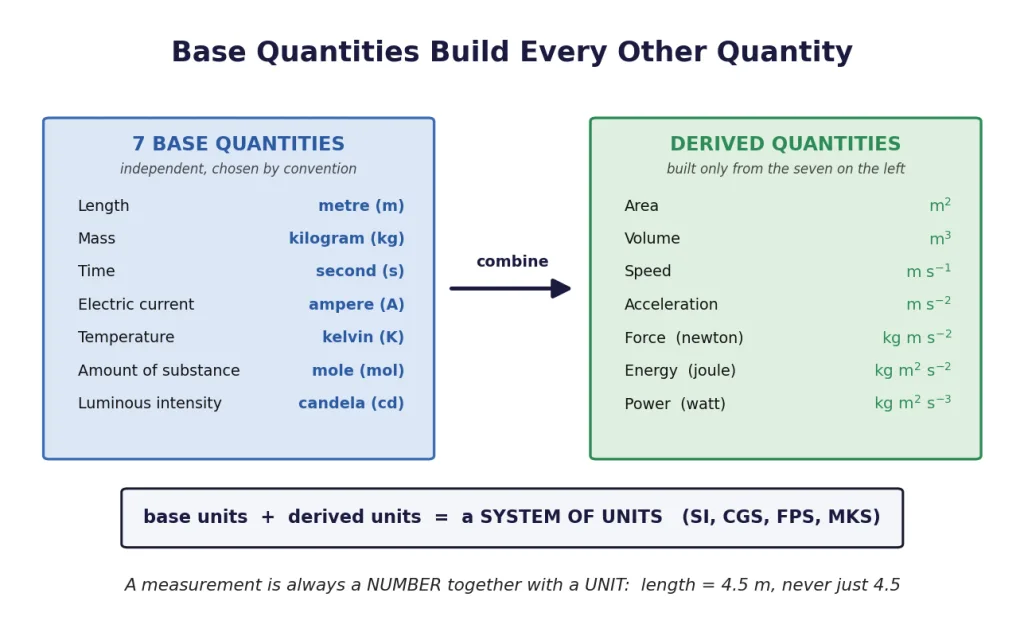
Key Point: A complete set of units — the base units plus all the derived units built from them — is called a system of units.
From CGS, FPS and MKS to SI
Before international agreement, different countries measured in different systems. Three were in wide use, and they differed only in which standards they picked for length, mass and time:
| System | Length | Mass | Time |
|---|---|---|---|
| CGS | centimetre | gram | second |
| FPS (British) | foot | pound | second |
| MKS | metre | kilogram | second |
Notice all three agree on the second — but a physicist in Kolkata quoting grams and a physicist in London quoting pounds had to convert before they could even compare results. That is a lot of wasted effort and a lot of avoidable mistakes.
Enter SI
The system now accepted internationally is the Système International d'Unités (French for International System of Units), abbreviated SI. Its standard scheme of symbols, units and abbreviations was developed by the Bureau International des Poids et Mesures (BIPM) in 1971, and was revised by the General Conference on Weights and Measures in November 2018 — the revision that redefined every base unit in terms of fundamental constants of nature.
SI won for two very practical reasons:
- It is decimal. Conversions inside SI are just shifts of the decimal point — no "12 inches to a foot, 3 feet to a yard" arithmetic.
- It is coherent. Derived units come out of base units with no stray conversion factors: exactly, and exactly.
Key Point: SI is an extension of MKS (metre-kilogram-second), widened to seven base units so that electricity, heat, chemistry and light are covered too.
[JEE/NEET] "Which system does SI extend?" and "In which year was the SI revised?" are direct one-mark recall questions. MKS, and November 2018.
The Seven SI Base Units
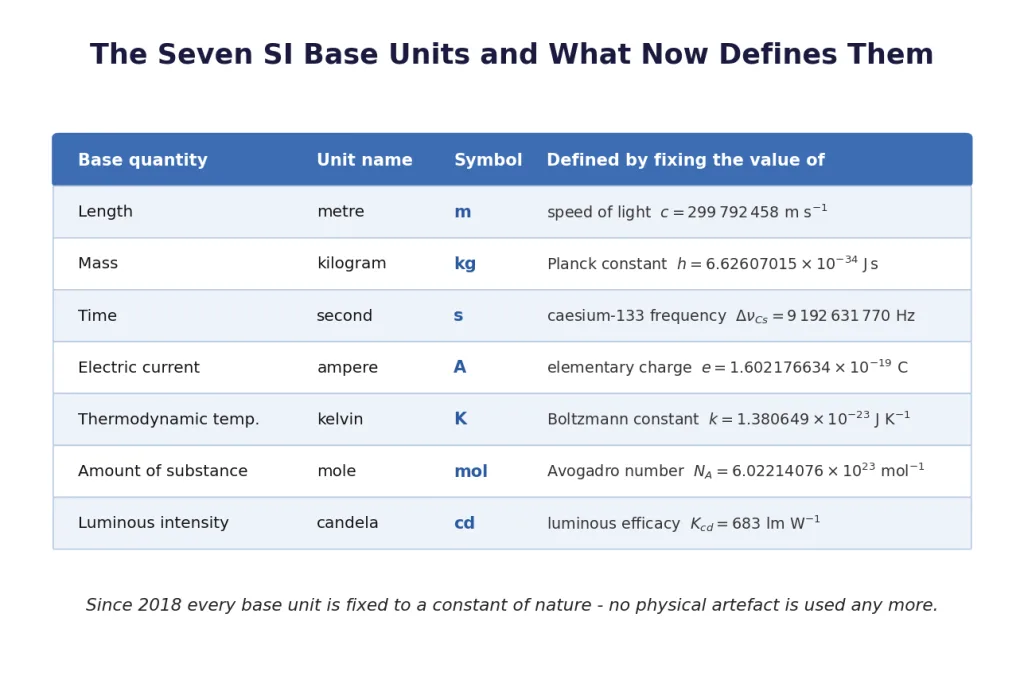
SI rests on seven base units. Learn the quantity, the unit name and the symbol — those are examinable. The full definitions are given below so you can see the modern logic, but the numerical values need not be memorised.
What changed in 2018 — and why it matters
Until 2019, the kilogram was defined by a physical object: a platinum-iridium cylinder kept in a vault near Paris. If that cylinder gained a fingerprint's worth of mass, the world's definition of "kilogram" drifted with it. Uncomfortable.
The 2018 revision fixed that by defining every base unit through a constant of nature — quantities that are the same in Delhi, on the Moon and in a distant galaxy:
- the metre through the speed of light ,
- the kilogram through the Planck constant ,
- the second through the caesium-133 hyperfine frequency ,
- the ampere through the elementary charge ,
- the kelvin through the Boltzmann constant ,
- the mole through the Avogadro number ,
- the candela through the luminous efficacy .
Key Point: No SI base unit depends on a man-made artefact any more. The definitions can be reproduced in any well-equipped laboratory in the world.
A caution about the mole
When you use the mole, the elementary entities must be specified — atoms, molecules, ions, electrons, or any specified group of particles. "One mole of oxygen" is ambiguous; "one mole of molecules" is not.
[NEET Important] One mole contains exactly elementary entities. This exact-by-definition value is shared with your Chemistry syllabus — the same number, the same definition.
[JEE Tip] The kilogram is the only base unit that already carries a prefix. That is why multiples of mass are formed on the gram: kg is written 1 mg, never "1 μkg".
Plane Angle, Solid Angle and Derived Units
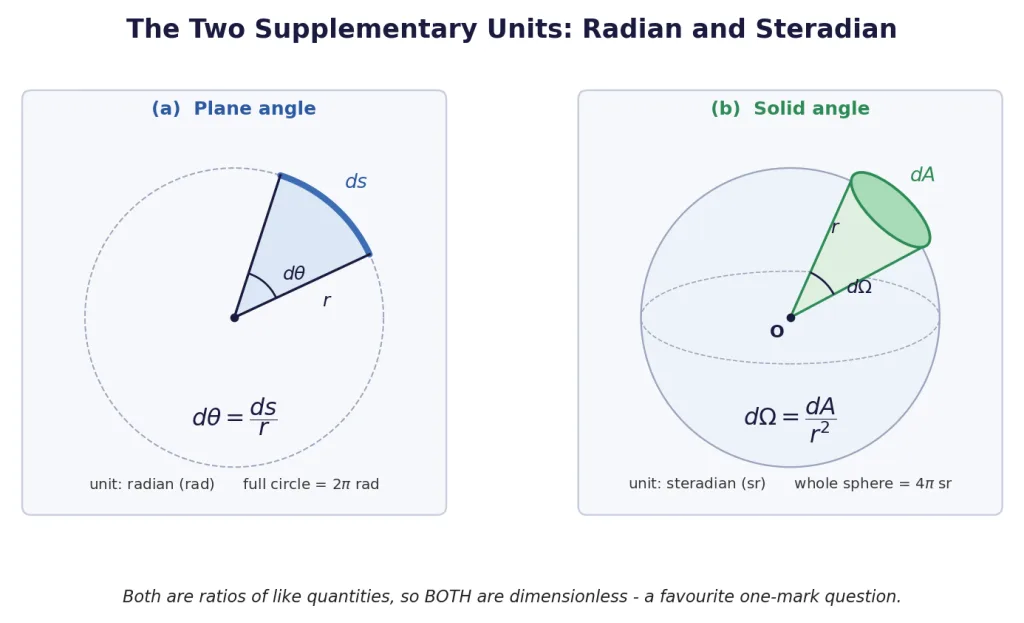
Besides the seven base units, SI defines two more units for angles. They sit slightly apart because they are ratios of two like quantities, and so are dimensionless.
Plane angle
the ratio of the arc length to the radius . Unit: radian (rad). A full circle is rad, so
Finer subdivisions: (minutes of arc) and (seconds of arc), giving rad and rad.
Solid angle
the ratio of the intercepted area on a sphere to the square of its radius, measured at the apex at the centre. Unit: steradian (sr). Since a full sphere has surface area ,
Key Point: Both radian and steradian are dimensionless — they are (length/length) and (area/area) respectively. This is why , and can only ever take dimensionless arguments, a fact that becomes a weapon in Section 5.
Derived units with special names
Many derived units are used so often that they were given names of their own, almost always after a scientist:
| Quantity | Special name | In base units |
|---|---|---|
| Force | newton (N) | |
| Work, energy | joule (J) | |
| Power | watt (W) | |
| Pressure, stress | pascal (Pa) | |
| Frequency | hertz (Hz) | |
| Charge | coulomb (C) | |
| Potential difference | volt (V) | |
| Resistance | ohm () |
[JEE Tip] Being able to unpack a special name back into base units — "express the volt in base units" — is a standing favourite, and it is exactly the skill Section 4 formalises as the dimensional formula.
SI Prefixes and Units Retained Outside SI
The diameter of a hydrogen atom is 0.000000000106 m. The distance to the Sun is 149600000000 m. Writing physics like that is unbearable, so SI supplies prefixes that stand for powers of ten.
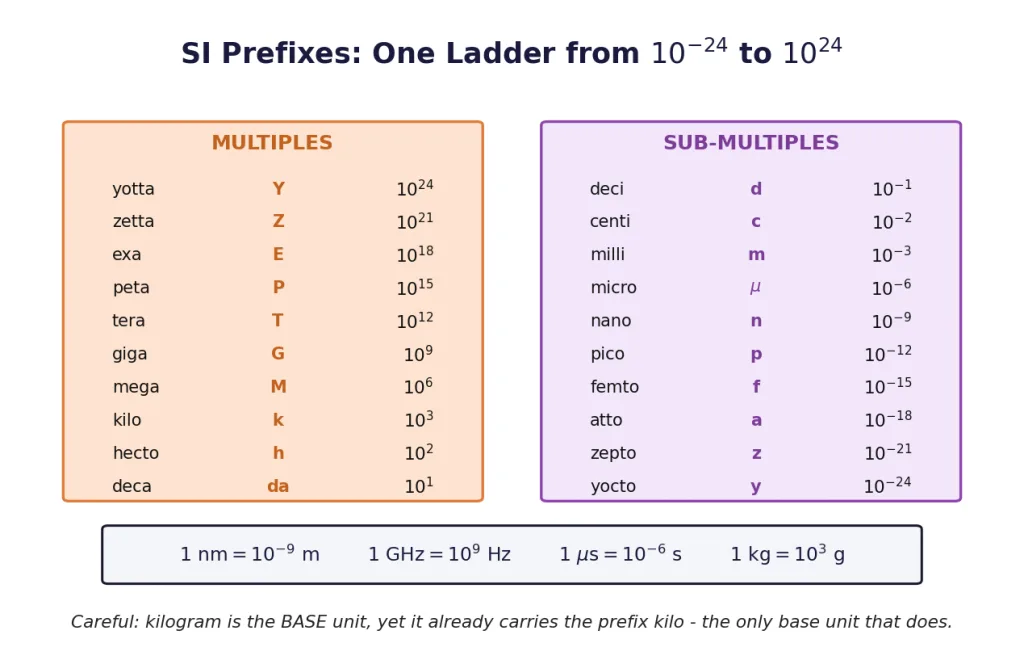
A prefix attaches directly to the unit symbol with no space and no full stop: 1 nm, 5 GHz, 250 mL.
Units retained for general use though outside SI
Some non-SI units are too convenient — or too entrenched — to abandon, so they are officially retained:
| Unit | Symbol | Value in SI |
|---|---|---|
| minute | min | 60 s |
| hour | h | 3600 s |
| day | d | 86400 s |
| year | y | s |
| degree (angle) | ° | rad |
| litre | L | |
| tonne | t | kg |
| quintal | q | 100 kg |
| carat | c | 200 mg |
| bar | bar | Pa |
| standard atmosphere | atm | Pa |
| hectare | ha | |
| barn | b | |
| curie | Ci |
Practical units worth memorising
These are not SI, but physics problems lean on them constantly:
| Unit | Value |
|---|---|
| angstrom (Å) | m |
| fermi (f) | m |
| astronomical unit (AU) | m (mean Earth-Sun distance) |
| light year (ly) | m (distance light travels in 1 year) |
| parsec (pc) | m ly |
| unified atomic mass unit (u) | kg |
[JEE/NEET] A light year is a unit of distance, not time — the classic trap in a one-mark question. Same for the parsec.
Writing Units Correctly — the Rules Examiners Check
These conventions look fussy, but board papers do award and deduct marks on them.
1. Unit symbols are never pluralised. ✓ 10 kg, 25 N ✗ 10 kgs, 25 Ns
2. No full stop after a symbol (unless it ends a sentence). ✓ 5 m ✗ 5 m.
3. Units named after a scientist: the full name is lowercase, the symbol is capitalised. ✓ newton → N, joule → J, watt → W, kelvin → K, pascal → Pa, hertz → Hz ✗ Newton, Joule, Watt (as unit names)
4. Leave a space between the number and the symbol. ✓ 10 kg, 20 °C ✗ 10kg Exception: the degree symbol for angles takes no space — 30°, not 30 °.
5. Use only one solidus (slash) in a compound unit. ✓ or J/(kg K) ✗ J/kg/K
6. Compound prefixes are not allowed. ✓ 1 nm ✗ 1 mμm
7. For mass, prefixes go on the gram, since kg already carries one. ✓ 1 mg ✗ 1 μkg
8. Symbols of prefixes attach with no space: 1 GHz, not 1 G Hz.
Key Point (Board): "Write any four rules for writing SI units" is a standard 2-mark question. Learn four of the eight above cold and you never lose those marks.
A quick self-check
Which of these are written correctly? 5 Kg · 5 kg · 20 secs · 20 s · 3 Newtons · 3 N · 10 m/s/s · 10 m s⁻²
Only the second of each pair is right — and now you can say exactly which rule the other one broke.
Solved Examples
Example 1: Why the unit cannot be dropped
A student writes "the length of the lab bench is 2.5". (i) What is wrong? (ii) If the length is 2.5 m, express it in cm and mm. (iii) What happens to the numerical value as the unit gets smaller?
Solution:
- The fault: a measurement is a number and a unit. Without the unit, 2.5 could mean 2.5 m, 2.5 cm or 2.5 feet — the statement carries no information.
- Convert: 1 m = 100 cm, so 2.5 m = 250 cm. And 1 m = 1000 mm, so 2.5 m = 2500 mm.
- Pattern: the unit shrank by 100 (m → cm) and the number grew by 100. This is , i.e. .
Final Answer: 2.5 m = 250 cm = 2500 mm.
Takeaway: Bigger unit → smaller number. Use this as a sanity check on every conversion you ever do.
Example 2: Base or derived?
Classify as base or derived: (i) mass (ii) volume (iii) electric current (iv) pressure (v) luminous intensity (vi) frequency.
Solution:
- Base: mass (kg), electric current (A), luminous intensity (cd) — these are three of the chosen seven.
- Derived: volume , unit ; pressure force/area, unit (pascal); frequency time, unit (hertz).
Final Answer: (i), (iii), (v) base; (ii), (iv), (vi) derived.
Takeaway: If you can write the quantity as a formula built from length, mass, time, current, temperature, amount or luminous intensity, it is derived.
Example 3: Spot the mistakes in unit writing
Find and correct the error in each: (i) 25 Kg (ii) 10 secs (iii) a force of 5 Newtons (iv) 8 m/s/s (v) 1 mμm (vi) 3 μkg.
Solution:
- (i) 25 kg — the symbol for kilo is a lowercase k; capital K is the kelvin.
- (ii) 10 s — symbols are never pluralised and take no full stop.
- (iii) a force of 5 N, or "5 newtons" — the unit name is lowercase; only the symbol is capitalised.
- (iv) — at most one solidus is allowed; two slashes are ambiguous.
- (v) 1 nm — compound prefixes are forbidden; , which is nano.
- (vi) 3 mg — mass prefixes attach to the gram: kg g 3 mg.
Takeaway: Six rules, six marks. Examiners love this exact question because it takes them ten seconds to mark.
Example 4: Prefix arithmetic
Express: (i) 5 μm in m and in nm (ii) 2.4 GHz in Hz (iii) 750 mg in kg (iv) 0.0000000045 m using a suitable prefix.
Solution:
- (i) micro , so 5 μm m. Since nano , , i.e. 5000 nm.
- (ii) giga , so 2.4 GHz Hz.
- (iii) 750 mg g g kg.
- (iv) m 4.5 nm.
Takeaway: Convert the prefix to its power of ten first, do the arithmetic in scientific notation, then re-attach a prefix at the end. Never try to shift decimal points in your head across nine places.
Example 5: How many seconds in a year?
Taking 1 year days, express one year in seconds.
Solution:
- Chain the conversions: .
- Seconds per day: s.
- Multiply: s.
- Round sensibly: s.
Final Answer: s.
Takeaway: Worth memorising as "about seconds" — a famous physicist's mnemonic that is accurate to under 0.5%.
Example 6: Unpack the special names
Express (i) the newton (ii) the joule (iii) the watt (iv) the pascal in SI base units.
Solution:
- (i) Newton: , so .
- (ii) Joule: , so .
- (iii) Watt: , so .
- (iv) Pascal: , so .
Takeaway: Always start from the defining equation. Every special name collapses into base units in one or two steps — and this is exactly the machinery of dimensional formulae in Section 4.
Example 7: Degrees, minutes, seconds and radians
Convert (i) to radians (ii) 1 radian to degrees (iii) (one arcminute) to radians.
Solution:
- Base relation: rad, so rad rad.
- (i) rad (which is ).
- (ii) — approximately .
- (iii) rad. (And rad.)
Takeaway: Keep the three numbers rad, rad, rad in your formula memory. Astronomy problems run on them.
Example 8: Angular size gives you real size
The Moon subtends an angle of at the Earth. The Earth-Moon distance is m. Find the diameter of the Moon.
Solution:
- Formula: for a small angle, arc chord, so with in radians.
- Convert the angle: rad.
- Apply: m.
Final Answer: m, i.e. about 3570 km.
Takeaway: The single most common error here is feeding degrees or arcseconds into . The formula demands radians — because that is the only angle unit defined as a pure ratio.
Example 9: Solid angles
Find the solid angle subtended at the centre by (i) the whole sphere (ii) a hemisphere (iii) a patch of area on a sphere of radius 10 cm.
Solution:
- Formula: .
- (i) , so sr sr.
- (ii) Half of that: sr sr.
- (iii) sr.
Takeaway: In (iii) the centimetres cancel, so no conversion to metres was needed — a direct consequence of the solid angle being dimensionless.
Example 10: Volume and capacity conversions
Express (i) in (ii) 1 litre in (iii) 250 mL in .
Solution:
- (i) , so .
- (ii) .
- (iii) .
Takeaway: When a unit is raised to a power, the conversion factor is raised to the same power. Forgetting to cube the 100 in part (i) is the single most common conversion mistake in all of Class 11.
Example 11: Density across systems
The density of mercury is . Express it in .
Solution:
- Replace each unit: kg and .
- Substitute: .
- State: .
Final Answer: .
Takeaway: The CGS-to-SI density factor is always . Water: . Use it to check your answer instantly.
Example 12: Astronomical distance units
(i) Show that 1 parsec light years. (ii) Express 1 light year in astronomical units. Take m, m, m.
Solution:
- (i) Divide: . Hence ly. ∎
- (ii) Divide: .
- State: AU.
Takeaway: Light year and parsec measure distance, not time — an examiner's favourite trap. Ranking to remember: AU < light year < parsec.