
Same Syllabus. Completely Different Exam.
Section 7 just took you through errors and dimensions the JEE way — derive the propagation rules, chain three concepts together, watch out for the adversarial fourth option. If you have read it, you already know more physics than this section will ask of you.
So why a separate NEET Corner? Because NEET does not test the same skill.
JEE gives you a hard question and enough time to think. NEET gives you an easy question and almost no time at all. The Physics paper is 45 questions, and in a 180-minute exam split across three subjects, those 45 questions deserve roughly 45 minutes. That is 60 seconds each — and mechanics, thermodynamics and electricity will eat far more than their share. Which means the two or three questions that come from Units and Measurement have to be answered in well under a minute each, correctly, so that you can bank the time.
Key Point: NEET rewards instant recall and clean elimination, not cleverness. A Units and Measurement question you solve in 25 seconds is worth exactly the same 4 marks as a mechanics question you fight for 4 minutes. This chapter is the cheapest scoring on the paper — provided you never let one of its questions run long.
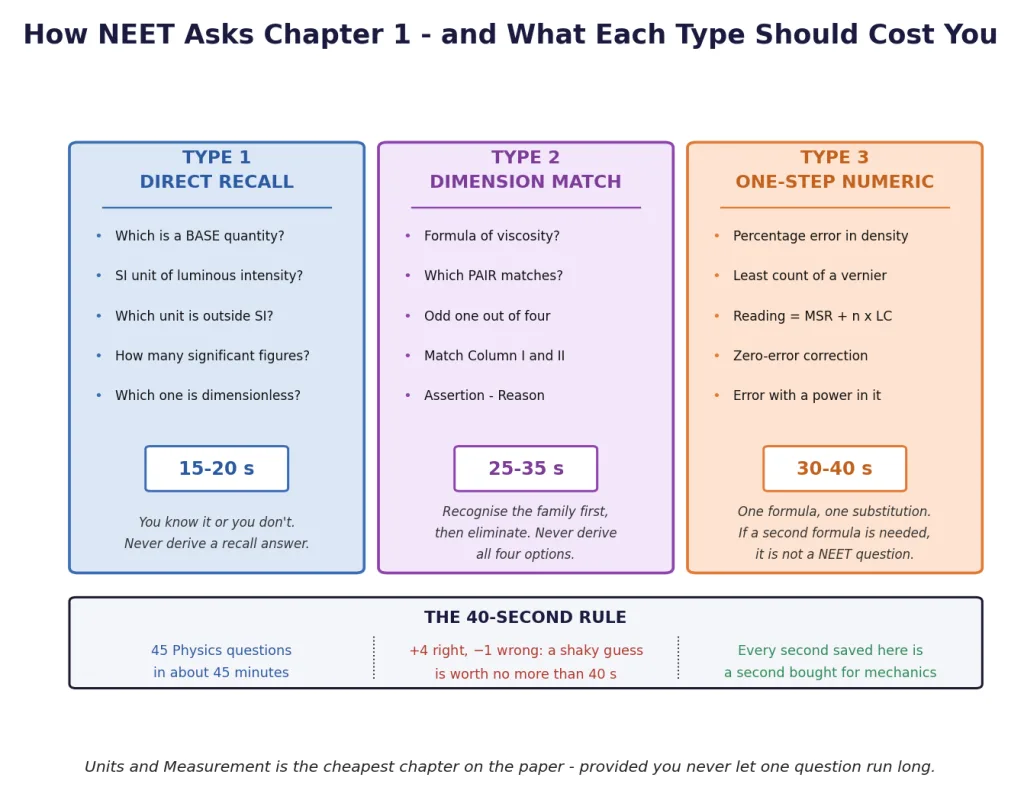
The three types, and what each should cost you
Almost every NEET question from this chapter is one of three things.
| Type | What it looks like | Your budget | The right instinct |
|---|---|---|---|
| 1. Direct recall | "Which of the following is a base quantity?" "The SI unit of luminous intensity is…" "Number of significant figures in 0.06900" | 15-20 s | You either know it or you don't. Never derive a recall answer. |
| 2. Dimension match | Dimensional formula of a quantity, identical-dimension pairs, odd-one-out, column matching, assertion-reason | 25-35 s | Recognise the family, then eliminate. Do not work out all four options. |
| 3. One-step numeric | Percentage error, least count, vernier or screw-gauge reading, zero-error correction | 30-40 s | One formula, one substitution. |
[Important] Here is a diagnostic worth internalising: if a Units and Measurement question needs a second formula, you have misread it. NEET does not build error budgets across four measured quantities the way JEE Advanced does. It gives you percentage errors and a formula with visible powers, and asks you to add them up.
The +4 / arithmetic
Every right answer is 4 marks, every wrong one costs 1, and a blank is 0. So the real question on a doubtful item is not "can I get this?" but "can I get this in 40 seconds?" If two options survive your elimination and 40 seconds have gone, take the better of the two and move on — a 50-50 guess has a positive expected value of marks. What you must never do is spend three minutes rescuing one mark's worth of doubt.
What this section does and does not repeat
We will not re-derive the error-combination rules (Section 7 does that properly) or re-teach how to count significant figures (Section 2) or how to build a dimensional formula from a defining equation (Section 4). What you get here instead is the material reorganised for recognition speed: lookup tables built for matching, the two NEET-only question formats drilled properly, and the distractor patterns that decide whether you get the mark.
The One-Liners NEET Asks Almost Verbatim
This block is pure recall ammunition. Read it as flashcards, not as prose. Every item here has appeared as a complete NEET question by itself.
Base quantity or derived quantity?
The single most common one-liner in the chapter. There are exactly seven base quantities. Everything else in physics — every single thing — is derived.
| Base quantity | SI unit | Symbol | Defined via the fixed value of |
|---|---|---|---|
| Length | metre | m | speed of light |
| Mass | kilogram | kg | Planck constant |
| Time | second | s | caesium frequency |
| Electric current | ampere | A | elementary charge |
| Thermodynamic temperature | kelvin | K | Boltzmann constant |
| Amount of substance | mole | mol | Avogadro constant |
| Luminous intensity | candela | cd | luminous efficacy |
Key Point: Learn the seven, and the complement takes care of itself. Force, weight, energy, work, pressure, area, volume, velocity, acceleration, momentum, charge, frequency, density and power are all DERIVED. A question that offers you three derived quantities and one base quantity is answered by recognition alone.
[Important] Two favourite traps. Weight is a force, so it is derived — only mass is base. And electric charge is derived (from current and time); it is current that is base. The right-hand column above is also a question in its own right: "The kilogram is now defined in terms of which physical constant?" — the Planck constant.
Radian and steradian
Key Point: Plane angle is measured in the radian (rad), solid angle in the steradian (sr). Both are ratios of like quantities, so both are dimensionless. They are not base units.
Angle is the classic "dimensionless quantity that still has a unit". Do not let dimensionless and unitless blur together.
Units retained for general use though outside SI
This is a table NEET treats as its own question. These are not SI units, but you are allowed to keep using them:
Key Point: minute, hour, day, degree of arc, litre, tonne, quintal, carat, bar, standard atmosphere, hectare, barn, curie.
The question is usually the other way round: "Which of the following is not an SI unit?" with newton, joule, pascal and litre on offer. The answer is the one that feels most everyday.
Practical units worth knowing cold
| Unit | Value | Measures |
|---|---|---|
| 1 angstrom (Å) | m | atomic sizes |
| 1 fermi | m | nuclear sizes |
| 1 barn | m | nuclear cross-section (an area) |
| 1 astronomical unit (AU) | m | Earth-Sun distance |
| 1 light year | m | a distance, never a time |
| 1 parsec | m light years | a distance |
| 1 unified atomic mass unit (u) | kg | atomic masses |
[Important] "Light year is a unit of time" is the oldest distractor in the book, and it still catches people at speed. So is offering the barn as a unit of length when it is an area. Parsec is the largest of the astronomical distance units listed here.
Significant figures, compressed to one card
Section 2 taught these properly. Here they are as a lookup:
| Rule | Example | Count |
|---|---|---|
| All non-zero digits count | 287.5 | 4 |
| Zeros between non-zero digits count | 2.308 | 4 |
| Leading zeros in a number less than 1 never count | 0.0025 | 2 |
| Trailing zeros without a decimal point do not count | 2300 | 2 |
| Trailing zeros with a decimal point do count | 4.700 | 4 |
| Both rules at once | 0.06900 | 4 |
Key Point: A change of units cannot change the number of significant figures. 2.308 cm, 0.02308 m and 23.08 mm all have four. And in arithmetic: multiplication and division keep the least number of significant figures; addition and subtraction keep the least number of decimal places (Section 3).
The dimensionless list
Key Point: Strain, angle, solid angle, refractive index, relative density (specific gravity), Poisson's ratio, coefficient of friction, dielectric constant, and every pure number are dimensionless. So is any ratio of two quantities of the same kind.
Notice why each one is dimensionless: it is a ratio of two things of the same type. Strain is length over length, refractive index is speed over speed, relative density is density over density. That reasoning gets you the answer even for a quantity you have never met.
Rapid Dimensional-Formula Matching
NEET asks about dimensions constantly, and almost never asks you to derive one. It asks you to recognise one. So stop treating each dimensional formula as a calculation and start treating it as a face you know.
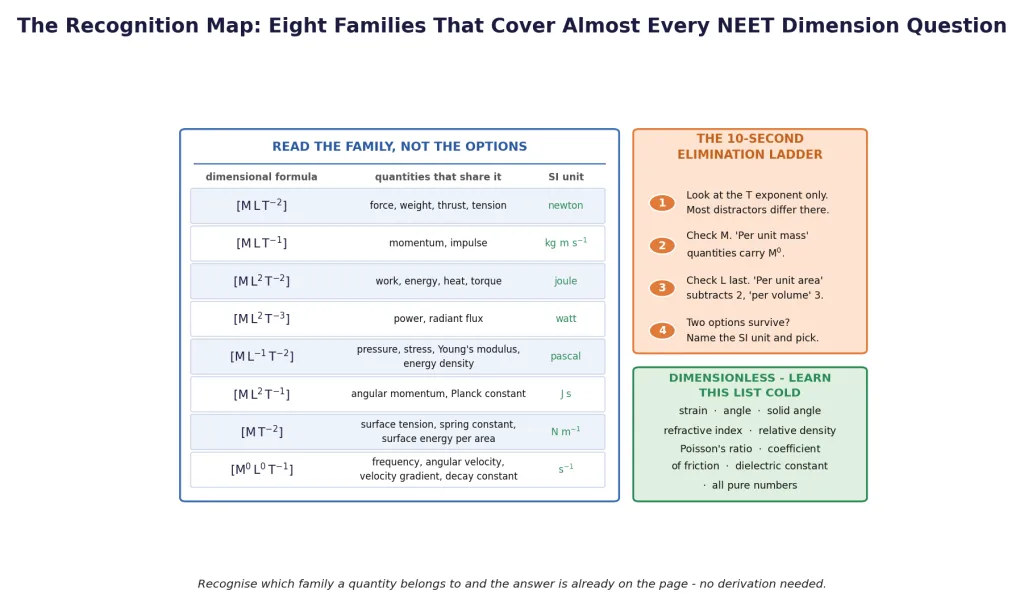
The recognition table
Organised by family — quantities on the same row share a dimensional formula, which is exactly how the questions are built.
| Dimensional formula | Quantities that share it | SI unit | Spot it by |
|---|---|---|---|
| force, weight, thrust, tension, momentum per unit time | newton | it is a push or a pull | |
| linear momentum, impulse | kg m s | mass times a speed | |
| work, energy, heat, torque, moment of force | joule | measured in joules | |
| power, radiant flux, rate of doing work | watt | energy per second | |
| pressure, stress, Young's modulus, bulk modulus, energy density | pascal | force per unit area | |
| angular momentum, Planck constant | J s | energy times a time | |
| surface tension, spring constant, surface energy per unit area | N m | force per unit length | |
| frequency, angular velocity, velocity gradient, decay constant | s | "per second" of anything | |
| coefficient of viscosity | Pa s | the odd one out, learn it alone | |
| gravitational constant | N m kg | the only common | |
| latent heat, gravitational potential, (speed) | J kg | energy per unit mass | |
| specific heat capacity | J kg K | latent heat, per kelvin | |
| heat capacity, entropy, Boltzmann constant | J K | energy per kelvin | |
| thermal conductivity | W m K | rare, but examinable |
Key Point: The three families that account for most questions are work-energy-torque , pressure-stress-modulus and impulse-momentum . Know those three cold and you have already covered the majority of the dimension questions NEET has ever asked.
The 10-second elimination ladder
Faced with four dimensional formulae and one quantity, do this instead of deriving:
- Look at the exponent of T first. Most distractors are built by changing it. Ask only "how many times is this divided by time?" Velocity once, acceleration twice, power three times.
- Then check M. If the quantity is per unit mass — latent heat, specific heat, gravitational potential — the mass exponent must be zero. If it is a constant like , expect a negative power of M.
- Then check L, last. "Per unit length" subtracts 1, "per unit area" subtracts 2, "per unit volume" subtracts 3, and multiplying by a length adds 1.
- If two options survive, name the SI unit and see which one it matches.
The "per unit" arithmetic
This is the fastest single trick in the block, because it converts an unfamiliar quantity into a familiar one plus a correction.
| You are asked for | Start from | Then |
|---|---|---|
| energy density | energy | divide by volume: subtract 3 from L |
| surface energy per unit area | energy | subtract 2 from L |
| latent heat (energy per unit mass) | energy | subtract 1 from M |
| pressure gradient | pressure | divide by length |
| power (work per unit time) | work | subtract 1 from T |
How the odd-one-out question is really built
"Which of the following does not have the same dimensions as the others?" is not four derivations. Three of the options are one family, and the fourth is a near neighbour that differs in exactly one exponent. Find the family from the two you are surest about, then check the remaining two against it.
[Important] The near-neighbour pairs the examiners reuse:
- surface tension vs force — differ by one power of L
- work vs power — differ by one power of T
- momentum vs Planck constant — differ by one power of L
- latent heat vs specific heat — differ by one power of K
- pressure vs force — differ by two powers of L
Key Point: Identical dimensions never mean identical physics. Work and torque share and are different quantities; so do energy and heat. If a question asks which quantities have the same dimensions, it is asking about the formula, not the meaning.
Assertion-Reason: The Format, Then the Drill
Here is a format a JEE-trained student has probably never practised, and NEET uses it every year. You are given two statements — an Assertion (A) and a Reason (R) — and asked how they relate.
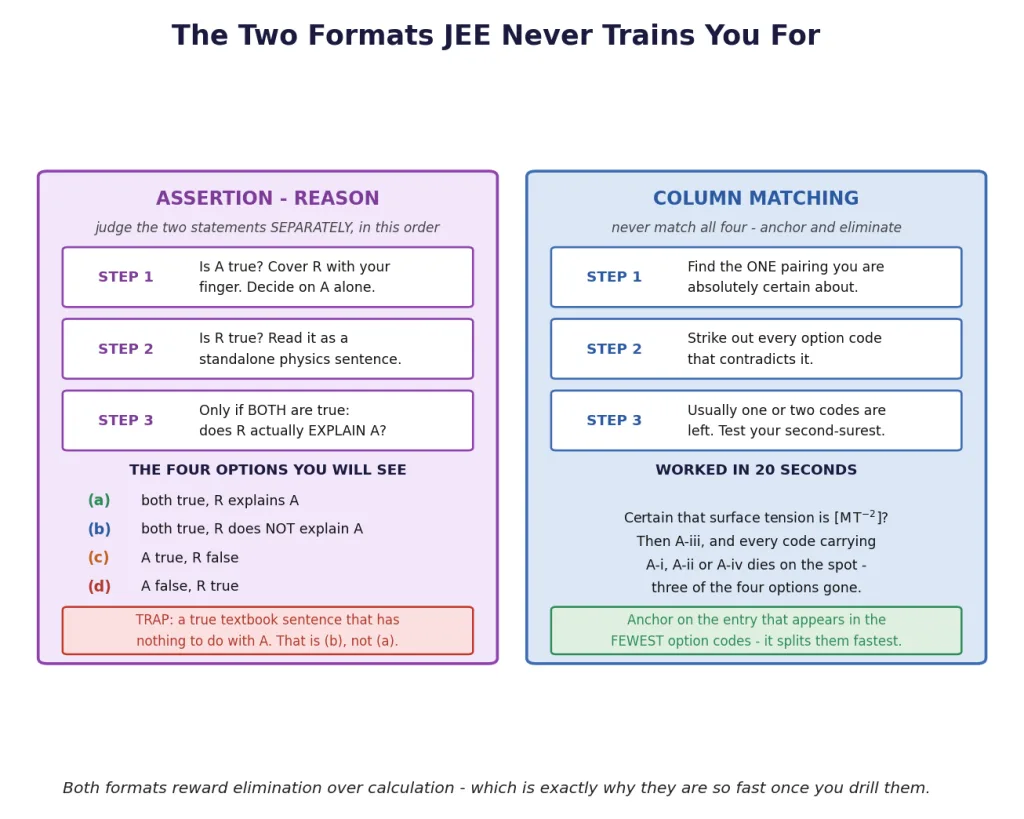
The four options you will see
Key Point:
(a) Both A and R are true, and R is the correct explanation of A.
(b) Both A and R are true, but R is NOT the correct explanation of A.
(c) A is true but R is false.
(d) A is false but R is true.(Some papers swap (d) for "both A and R are false" — read the instruction line once before you start, then never again.)
The three-step attack
The whole format collapses if you do this in order and refuse to shortcut it.
- Judge A on its own. Physically cover R with your finger. Is the assertion, as a standalone sentence, true? Decide before you have read a word of R — otherwise R's confident tone will talk you into agreeing with a false assertion.
- Judge R on its own. Is the reason a true statement of physics? Not "does it support A" — just, is it true?
- Only if both are true, ask the third question: does R actually explain A? Not "are they both about the same topic" — does R supply the cause of A?
Two of the four options are already decided by steps 1 and 2 alone. Step 3 only ever separates (a) from (b).
The traps, in order of how often they work
- The true-but-irrelevant reason. R is a perfectly correct sentence, but it has nothing to do with A. Both statements read as familiar and true, so the hand reaches for (a). The answer is (b). This is the single most common way marks are lost in this format.
- The swapped definition. A says "precision tells you how close a reading is to the true value" — which is the definition of accuracy. Familiar words, wrong pairing. Watch for accuracy/precision, systematic/random, absolute/relative.
- The converse. R states the reverse implication of A. "All squares are rectangles" as a reason for "all rectangles are squares" — true statement, wrong direction.
- The over-general reason. R is true in most cases but A is asking about the exception, or vice versa.
Drill: five items, decide before you read the verdict
1. A: Radian is a dimensionless quantity. R: A plane angle is defined as the ratio of arc length to radius, and both are lengths.
2. A: Systematic errors cannot be reduced by taking a large number of readings and averaging them. R: Systematic errors occur in one direction only, either always positive or always negative.
3. A: The absolute error in a measurement has the same unit as the measured quantity. R: The relative error is a dimensionless quantity.
4. A: A measurement can be precise without being accurate. R: Precision is a measure of how close the measured value is to the true value.
5. A: The number of significant figures in 2.308 cm changes when the length is expressed in metres. R: A change of units cannot change the number of significant figures in a measurement.
| # | A | R | Does R explain A? | Answer |
|---|---|---|---|---|
| 1 | true | true | yes — being a ratio of two lengths is the reason it is dimensionless | (a) |
| 2 | true | true | yes — a one-directional bias is exactly what averaging cannot remove | (a) |
| 3 | true | true | no — R is a true sentence about a different quantity | (b) |
| 4 | true | false — that is the definition of accuracy | — | (c) |
| 5 | false — 2.308 cm and 0.02308 m both have four | true | — | (d) |
Item 3 is the trap in its purest form: both sentences are straight out of Section 7, both are true, and they are about absolute error and relative error respectively — two different quantities. Item 5 is worth noticing for the opposite reason: R is the sentence that proves A false, which is a favourite construction for option (d).
[Important] When you genuinely cannot separate (a) from (b), pick (a) only if you can say out loud, in one sentence, why R causes A. If the best you can manage is "they're both true and both about errors", the answer is (b).
Column Matching: Anchor and Eliminate
The other NEET-specific format. Column I gives you four items, Column II gives four or five, and the options are codes like "A-iii, B-i, C-iv, D-ii".
The trap is built into the shape of the question: it looks like four questions for the price of one, so students dutifully work out all four pairings and burn two minutes. You should almost never do that.
The method: anchor, eliminate, confirm
- Find your anchor. Scan Column I for the one entry you are absolutely certain about. Not the first one — the surest one.
- Kill every code that contradicts the anchor. Usually two or three of the four options die immediately.
- Take your second-surest pairing and apply it to whatever survives. That is almost always enough.
- Only if two codes still stand, check a third pairing. You will rarely get this far.
Key Point: You are not matching four items. You are eliminating four codes. The fastest anchor is the pairing whose entry appears in the fewest option codes, because it splits the options most unevenly.
Worked demonstration
Match Column I with Column II.
| Column I | Column II |
|---|---|
| (A) Surface tension | (i) |
| (B) Coefficient of viscosity | (ii) |
| (C) Pressure | (iii) |
| (D) Angular momentum | (iv) |
Codes:
| A | B | C | D | |
|---|---|---|---|---|
| 1 | i | iii | iv | ii |
| 2 | iii | i | iv | ii |
| 3 | iii | i | ii | iv |
| 4 | iv | i | iii | ii |
The 20-second run. Pressure is force per unit area, so C must be , which is (iv). Codes 3 and 4 pair C with (ii) and (iii) — both dead. Two codes left, and they differ only in A: is surface tension (i) or (iii)? Surface tension is force per unit length, , which is (iii). Code 1 dies. Answer: code 2.
Notice what you never did: you never worked out the coefficient of viscosity or angular momentum at all. Two facts you were certain about killed three options.
The extras that make column matching fiddly
- Column II sometimes has five entries. One is a decoy that matches nothing. Do not panic when an entry goes unused — that is the design.
- One Column II entry may match two Column I entries (work and torque, for instance). Read whether the question says "one-to-one".
- Check the direction. Some papers put the dimensional formula in Column I and the quantity in Column II. Read the code labels, not your assumption.
[Important] If you have no anchor at all — every pairing feels shaky — do not start deriving. Look for the Column II entry that appears least often across the codes and test only that one. It is the cheapest single test available, and it usually halves the options.
A second drill, run it yourself
Column I: (A) 1 light year (B) 1 parsec (C) 1 barn (D) 1 angstrom Column II: (i) m (ii) m (iii) m (iv) m
Your anchor should be C, because the barn is the only area in the list and (i) is the only entry with square metres. That one observation fixes C-i without any recall of astronomical distances at all. The rest: A-iii, B-iv, D-ii.
Key Point: The best anchor is often not the fact you know best — it is the fact that is structurally unique. An area among lengths, a negative power among positives, a per-kelvin among the rest. Look for the odd shape first.
Single-Step Error Propagation
Section 7 derived the combination rules from scratch. You do not need the derivation in the exam hall — you need the formula and the discipline to substitute into it without thinking.
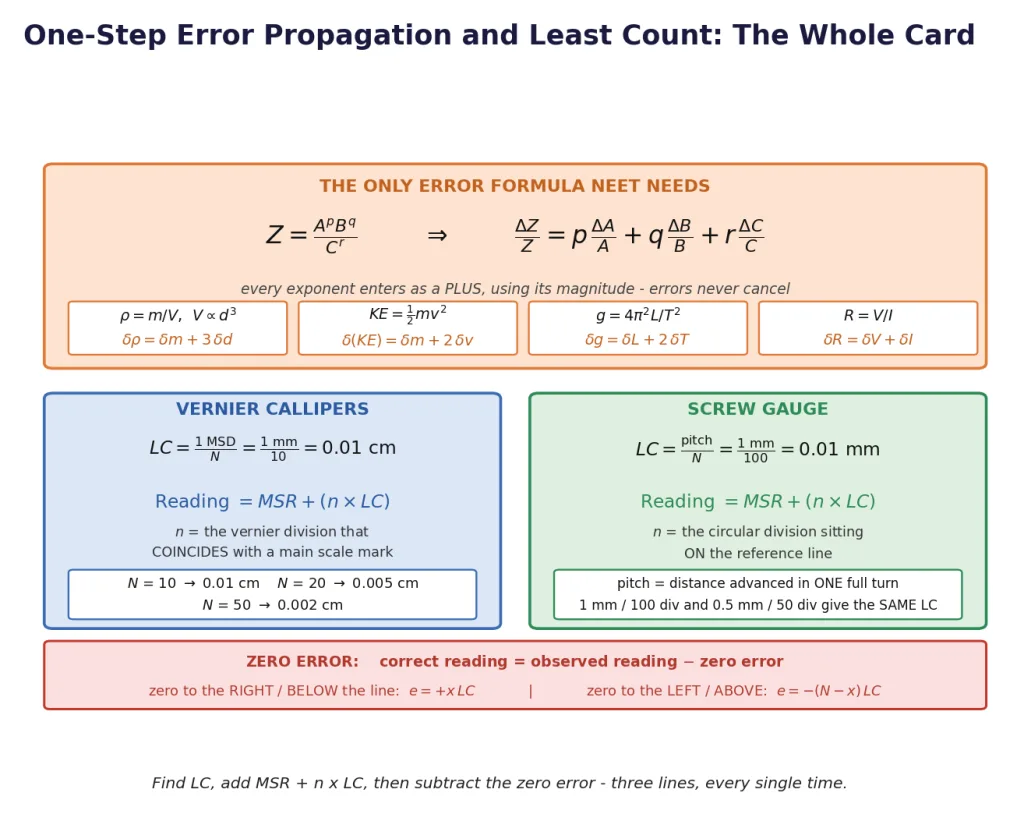
The one formula
Key Point: If then the maximum relative error is Every exponent enters as a plus, using its magnitude, whether the quantity sat in the numerator or the denominator.
And the three rules it contains, in one line each:
| Operation | What adds |
|---|---|
| or | the absolute errors add: |
| or | the percentage errors add |
| the percentage error is multiplied by |
Key Point: Errors never subtract. Not for a difference, not for a quotient. You are quoting a worst case, so everything piles up.
Work in percentages, not fractions
This is the actual speed trick. If the question hands you percentage errors, never convert to fractions and back — just multiply each percentage by its exponent and add. The answer comes out in percent directly.
The six shapes NEET reuses
Memorise these and most numerical error questions become a single line of arithmetic.
| Quantity | Formula | Error rule |
|---|---|---|
| Density from mass and diameter | ||
| Kinetic energy | ||
| from a pendulum | ||
| Resistance from Ohm's law | ||
| Area of a circle | ||
| Volume of a sphere |
Notice that , , and contribute nothing. Pure numbers are known exactly; they have no error to contribute.
When the question gives readings instead of percentages
Two conventions cover everything NEET asks:
Key Point (1): If an instrument is named but no uncertainty is given, the intended is the least count. A length of 2.50 cm on a vernier of least count 0.01 cm carries cm, so .
Key Point (2): For repeated readings, mean absolute error — take the magnitudes before averaging, or everything cancels to zero.
The exact-number rule that shows up in every pendulum question
If you time oscillations and write , the count is an exact number with no error whatsoever. So
The cancels completely. Timing 50 oscillations instead of 1 divides the relative error in by 50, which is precisely why lab manuals ask you to.
The four distractor patterns in error questions
[Important] Every wrong option in an error question is generated by one of these mistakes, which means you can often spot the right answer by spotting the errors:
- The exponent was ignored. For density from mass (2%) and diameter (1%), the correct 5% sits alongside a tempting 3% — that is , with the cube forgotten.
- The errors were subtracted. A quotient invites . There will be an option for it.
- Absolute and relative got mixed. An answer in the right units but the wrong kind of error.
- A factor of 100 went missing. 0.05 offered against 5%.
If you compute an answer and it is not among the options, check the exponent first. That is where it went, nine times out of ten.
Vernier, Screw Gauge, and the Final Speed Checklist
These two instruments are worth a guaranteed mark, because the question is always the same question. Three lines, every time.
The three-line recipe
Key Point:
Line 1 — least count. Line 2 — the reading. Line 3 — the correction.
For a vernier, is the vernier division that coincides with a main scale mark. For a screw gauge, is the circular division sitting on the reference line. And pitch is the distance the spindle advances in one complete rotation — if it moves 1 mm in two full turns, the pitch is 0.5 mm.
The least count values worth recognising on sight
| Instrument | Setup | Least count |
|---|---|---|
| Vernier | 1 mm main division, 10 vernier divisions | 0.1 mm cm |
| Vernier | 1 mm main division, 20 vernier divisions | 0.05 mm cm |
| Vernier | 1 mm main division, 50 vernier divisions | 0.02 mm cm |
| Screw gauge | pitch 1 mm, 100 circular divisions | 0.01 mm cm |
| Screw gauge | pitch 0.5 mm, 50 circular divisions | 0.01 mm |
| Screw gauge | pitch 1 mm, 50 circular divisions | 0.02 mm |
| Screw gauge | pitch 0.5 mm, 100 circular divisions | 0.005 mm |
Look at rows 4 and 5: halving the pitch and halving the number of divisions leaves the least count unchanged. That comparison is itself a NEET question.
Zero error, and the one sign rule people get wrong
Key Point: With the jaws closed (or the spindle touching the anvil):
- zero of the moving scale to the right (vernier) or below the reference line (screw gauge), -th division coinciding:
- zero to the left (vernier) or above the line (screw gauge), -th division coinciding:
Then correct = observed e, always. A positive zero error is subtracted; a negative zero error is effectively added back.
That is where the marks go. For a negative zero error you count backwards — if the 96th of 100 divisions is on the line, the error is , not .
The distractor patterns for instrument questions
[Important] Four traps, and they are all arithmetic rather than physics:
- The decimal slip. 0.1 mm offered against 0.01 mm. Write the unit down every time.
- Centimetres against millimetres. The same number appears twice in the options with different units. Decide which unit the question wants before you compute.
- The zero error added instead of subtracted. If the correct answer is , then will be sitting right there.
- The omission. For a negative zero error, the option built on instead of is always present.
The complete distractor checklist for this chapter
Run your eye down this before the exam. Every one of these is an option that exists purely to catch a hurried student.
| Topic | The trap |
|---|---|
| Base vs derived | offering weight or charge as a base quantity |
| Practical units | light year as a unit of time; barn as a unit of length |
| Dimensionless | confusing dimensionless with unitless (angle has a unit) |
| Significant figures | trailing zeros with and without a decimal point |
| Dimensions | one exponent flipped, usually on T |
| Same-dimension pairs | surface tension paired with force |
| Error propagation | the exponent forgotten; errors subtracted |
| Pendulum | treating the count in as uncertain |
| Least count | decimal slip, or cm against mm |
| Zero error | added instead of subtracted; omitted |
Finishing in under 40 seconds: the checklist
- Classify the question in 3 seconds. Recall, dimension match, or one-step numeric?
- If recall: answer or move on. Do not reason your way to a definition.
- If dimensions: read the T exponent across the options first. Eliminate, then confirm with the SI unit.
- If numeric: write the formula with its powers visible, then substitute percentages directly.
- If assertion-reason: judge A alone, then R alone. Only then ask whether R explains A.
- If column matching: anchor on your surest (or structurally unique) pairing and kill codes.
- At 40 seconds, stop. Two survivors and no clarity means guess between them and move — the expected value is positive and the clock is worth more than the mark.
Key Point: Everything in this chapter is recall or one substitution. If you are on your third line of working, you have wandered into the JEE version of the question. Go back and read it again — NEET almost certainly asked something simpler.
Solved Examples
These are worked at NEET pace. Each one names the shortcut it uses, because the shortcut is the point.
Example 1: The rapid-recall round
Answer each in under 15 seconds. (i) Which of these is a base quantity — force, weight, luminous intensity, pressure? (ii) The SI unit of solid angle. (iii) Which of these is retained for general use though outside SI — newton, litre, pascal, watt? (iv) The kilogram is defined by fixing the value of which constant? (v) Is a light year a unit of time or distance? (vi) Which is larger, a parsec or a light year?
Solution:
- (i) The seven base quantities are length, mass, time, electric current, thermodynamic temperature, amount of substance and luminous intensity. Force and pressure are derived; weight is a force, so it is derived too. Answer: luminous intensity.
- (ii) Plane angle is measured in the radian, solid angle in the steradian (sr). Both are dimensionless.
- (iii) Newton, pascal and watt are all SI derived units with special names. The litre is retained for general use but is not SI.
- (iv) The Planck constant , fixed at J s. (Metre ; second caesium frequency; ampere ; kelvin ; mole ; candela .)
- (v) Distance. It is the distance light travels in one year, m.
- (vi) A parsec, at m, which is about 3.26 light years.
Final Answer: (i) luminous intensity (ii) steradian (iii) litre (iv) Planck constant (v) distance (vi) parsec.
Takeaway: Not one of these needed a calculation, and none of them should have taken more than a few seconds. This is exactly the type that funds the rest of your paper — six questions in the time one mechanics problem would take.
Example 2: Significant figures at speed
State the number of significant figures in (i) 0.06900, (ii) 2.308, (iii) 2300, (iv) 4.700, (v) . Then: a rectangular sheet measures 4.234 m by 1.005 m — to how many significant figures should its area be quoted?
Solution:
- (i) 0.06900 — leading zeros never count, trailing zeros after a decimal point do: the significant digits are 6, 9, 0, 0. Four.
- (ii) 2.308 — a sandwiched zero always counts. Four.
- (iii) 2300 — trailing zeros with no decimal point do not count. Two.
- (iv) 4.700 — trailing zeros with a decimal point do count. Four.
- (v) — in scientific notation only the base number matters, and it has three. This is exactly why 2300 is ambiguous and scientific notation is not.
- The area. Multiplication keeps the least number of significant figures among the inputs: 4.234 has 4, and 1.005 has 4 (sandwiched zeros count). So the area is quoted to four significant figures.
Final Answer: 4, 4, 2, 4, 3 significant figures; the area to 4 significant figures.
Takeaway: Every one of these is decided by a single rule, and the rule is chosen by looking at where the zeros sit relative to the decimal point. Nothing here is arithmetic.
Example 3: Which one is dimensionless?
Which of the following has dimensions? Strain, relative density, coefficient of friction, momentum, refractive index, Poisson's ratio, angle. And which of that list is dimensionless yet still carries a unit?
Solution:
- Apply the ratio test. Every dimensionless quantity in this chapter is a ratio of two quantities of the same kind:
- strain change in length / original length length over length
- relative density density of substance / density of water
- coefficient of friction friction force / normal force
- refractive index speed in vacuum / speed in medium
- Poisson's ratio lateral strain / longitudinal strain
- angle arc / radius
- The exception. Momentum is mass times velocity, . It is not a ratio of like quantities, and it is the only quantity in the list with dimensions.
- Dimensionless but with a unit. Angle. It is a pure ratio, hence dimensionless, but it is still measured in radians (and solid angle in steradians).
Final Answer: Only momentum has dimensions. Angle is dimensionless yet has a unit.
Takeaway: You never need to memorise the dimensionless list if you can spot the ratio. "Is this one thing divided by another thing of the same kind?" answers the question for quantities you have never even met.
Example 4: Dimensional formula by elimination
The dimensional formula of the coefficient of viscosity is: (1) (2) (3) (4)
Solution:
- Recall, do not derive. Viscosity is the one common mechanical quantity that lives alone in its family, at . Its SI unit is the pascal second (Pa s) — and pressure time is exactly .
- If recall fails, eliminate. Option (4) has , which would make viscosity independent of mass — impossible for a quantity defined through a force. Gone. Option (3) is the pressure family, and viscosity is emphatically not a pressure. Gone. Between (1) and (2), the L exponent decides: viscosity is defined by , so
- Confirm by unit. Pa s matches .
Final Answer: Option (1), .
Takeaway: Two options died on inspection — one for an impossible , one for belonging to the wrong family — before any derivation started. That is what the elimination ladder buys you.
Example 5: The identical-dimensions question
Which of the following pairs does not have the same dimensional formula? (1) impulse and momentum (2) work and torque (3) surface tension and force (4) pressure and stress
Solution:
- Check the pairs you are surest of first.
- Impulse , and momentum . Same.
- Work distance , torque force perpendicular distance . Same (different physics, identical formula).
- Stress is force per unit area, which is the definition of pressure. Same.
- That leaves the answer, but verify it. Surface tension is force per unit length:
Final Answer: Option (3) — surface tension and force differ by one power of length.
Takeaway: Three of the four pairs are famous identical-dimension pairs you should recognise instantly. The question is really asking "do you know that surface tension is force per unit length, not per unit area or per unit anything else?"
Example 6: A column-matching question, run properly
Match Column I with Column II and choose the correct code.
| Column I | Column II |
|---|---|
| (A) Planck constant | (i) |
| (B) Latent heat | (ii) |
| (C) Young's modulus | (iii) |
| (D) Power | (iv) |
Codes: (1) A-ii, B-iii, C-i, D-iv (2) A-ii, B-i, C-iii, D-iv (3) A-iv, B-iii, C-i, D-ii (4) A-i, B-iii, C-ii, D-iv
Solution:
- Pick the structurally unique anchor. Entry (iii) is the only one with — a quantity independent of mass. In Column I the only "per unit mass" quantity is latent heat (energy per kilogram), so B-iii. That already kills code (2), which pairs B with (i).
- Second anchor: power. Power is energy per second, so it carries the largest negative power of T. That is (iv), giving D-iv. Code (3) pairs D with (ii) — dead.
- Two codes left, (1) and (4), differing only in A and C. The Planck constant comes from , so So A-ii, and code (4) dies. Young's modulus is a stress, hence (i), which confirms code (1).
Final Answer: Code (1) — A-ii, B-iii, C-i, D-iv.
Takeaway: The anchor was not the fact I knew best — it was the structurally unique entry, the only in Column II. Look for the odd shape before you look for the familiar name.
Example 7: Three assertion-reason items
For each pair choose: (a) both true, R explains A; (b) both true, R does not explain A; (c) A true, R false; (d) A false, R true.
(I) A: Random errors can be reduced by taking a large number of observations and averaging them. R: Random errors are random with respect to both sign and size, so they tend to cancel on averaging.
(II) A: The percentage error in the volume of a sphere is three times the percentage error in its radius. R: The relative error in a quantity raised to the power is times the relative error in the quantity.
(III) A: A screw gauge with 200 divisions on its circular scale is necessarily more accurate than one with 100 divisions. R: The least count of a screw gauge is the pitch divided by the number of circular scale divisions.
Solution:
- (I) Step 1 — is A true? Yes; this is the standard remedy for random error. Step 2 — is R true? Yes; randomness in sign is precisely why deviations cancel. Step 3 — does R explain A? Yes, directly and causally. Answer (a).
- (II) Step 1 — is A true? , so . True. Step 2 — is R true? Yes, that is Rule 4. Step 3 — does R explain A? Yes; A is the special case of the general rule in R. Answer (a).
- (III) Step 1 — is A true? No. More divisions raise the precision (a smaller least count), not the accuracy. Accuracy is limited by zero error, backlash, calibration and the deformation of the object under the spindle — none of which extra divisions fix. Step 2 — is R true? Yes, that is the definition of least count. So A is false and R is true: answer (d).
Final Answer: (I) (a), (II) (a), (III) (d).
Takeaway: Item (III) is the format at its most characteristic. R is a flawless textbook sentence, and it is related to A — which is exactly what tempts you into (a) or (b) without ever testing whether A itself is true. Judge A first, always.
Example 8: Percentage error in kinetic energy
The mass of a body is measured with 2% error and its speed with 3% error. What is the maximum percentage error in the calculated kinetic energy?
Solution:
- Write the formula with its powers visible. The is a pure number and contributes nothing.
- Apply the propagation rule, exponents as multipliers.
- Substitute the percentages directly.
Final Answer: 8%.
Takeaway: One line of arithmetic, and the whole question is the exponent 2 on the velocity. The distractor to watch for is 5%, which is what you get by adding and forgetting the square. If you see your answer missing from the options, the exponent is where it went.
Example 9: Percentage error in resistance
In an experiment the potential difference across a resistor is measured as V and the current through it as A. Find the resistance and the percentage error in it.
Solution:
- The resistance itself.
- Percentage error in each measurement.
- A quotient: the percentage errors ADD.
Final Answer: with a percentage error of 7%, i.e. .
Takeaway: Division does not subtract errors. The option built on will always be offered, and it is always wrong. Worst case means everything adds, every time.
Example 10: Accuracy of from a pendulum
The length of a simple pendulum is measured as 25.0 cm with a scale of least count 0.1 cm. The time for 50 oscillations is 100 s, measured with a stopwatch of resolution 1 s. Find the percentage error in the calculated value of .
Solution:
- Make the subject and expose the powers. From ,
- The length term. The uncertainty is the least count, 0.1 cm:
- The time term. Here is the only subtlety. with oscillations, and is an exact counted number with no error, so it cancels:
- Combine, remembering the square on .
Final Answer: The percentage error in is 2.4%.
Takeaway: Counting 50 oscillations rather than 1 divided the relative error in by 50 — the single most valuable habit in the practical syllabus. Even after that, the time term still supplies 2 of the 2.4 percentage points, because is squared.
Example 11: Vernier callipers with a negative zero error
A vernier calliper has a main scale graduated in millimetres and 10 vernier divisions that span 9 main scale divisions. With the jaws closed, the vernier zero lies to the left of the main scale zero and the 8th vernier division coincides with a main scale mark. While measuring a rod, the main scale reads 3.1 cm and the 4th vernier division coincides. Find the correct length of the rod.
Solution:
- Line 1 — least count. With vernier divisions and 1 MSD mm,
- Line 2 — the observed reading. The 4th vernier division coincides, so :
- Line 3 — the zero error. The vernier zero is to the left, so the zero error is negative and you count backwards from :
- Correct the reading.
Final Answer: The correct length is 3.16 cm.
Takeaway: Two traps in one question. The zero error is cm, not cm — count backwards for a negative error. And subtracting a negative adds, so the corrected length is larger than the observed one. Both wrong answers will be sitting in the options.
Example 12: Screw gauge, and a 40-second finish
The pitch of a screw gauge is 1 mm and its circular scale has 100 divisions. When the spindle touches the anvil, the 96th division of the circular scale lies on the reference line and the zero of the circular scale is above it. While measuring a wire, the main scale reads 2 mm and the 45th division is on the reference line. Find (a) the least count, (b) the corrected diameter, and (c) the percentage error in the diameter.
Solution:
- (a) Least count.
- (b) Observed reading.
- The zero error. The circular scale zero is above the reference line, so the error is negative and counted backwards:
- (c) Percentage error. The uncertainty in a single reading is the least count:
Final Answer: mm, corrected diameter mm, percentage error about 0.4%.
Takeaway: Notice the shape of the whole thing: three short lines, then one division. Part (c) is also a warning for anything built on this diameter — the cross-sectional area goes as , so its percentage error would be . Get the three lines automatic and this entire topic becomes free marks at 30 seconds a question.