
The Seven Dimensions of the Physical World
Section 1 gave you the seven SI base quantities and their units. This section takes the same seven and uses them for something far more powerful: describing the nature of any physical quantity in the universe.
Here is the thing. A quantity has two separate identities. There is how much of it there is — the number and the unit, which Sections 1 to 3 handled. And there is what kind of thing it is — is it a length? a length divided by a time? a mass times a length squared divided by a time squared? That second identity is what we call its dimensions.
Key Point: The nature of a physical quantity is described by its dimensions. All the physical quantities represented by derived units can be expressed in terms of some combination of seven fundamental or base quantities. We call these base quantities the seven dimensions of the physical world, and we denote them with square brackets
[ ].
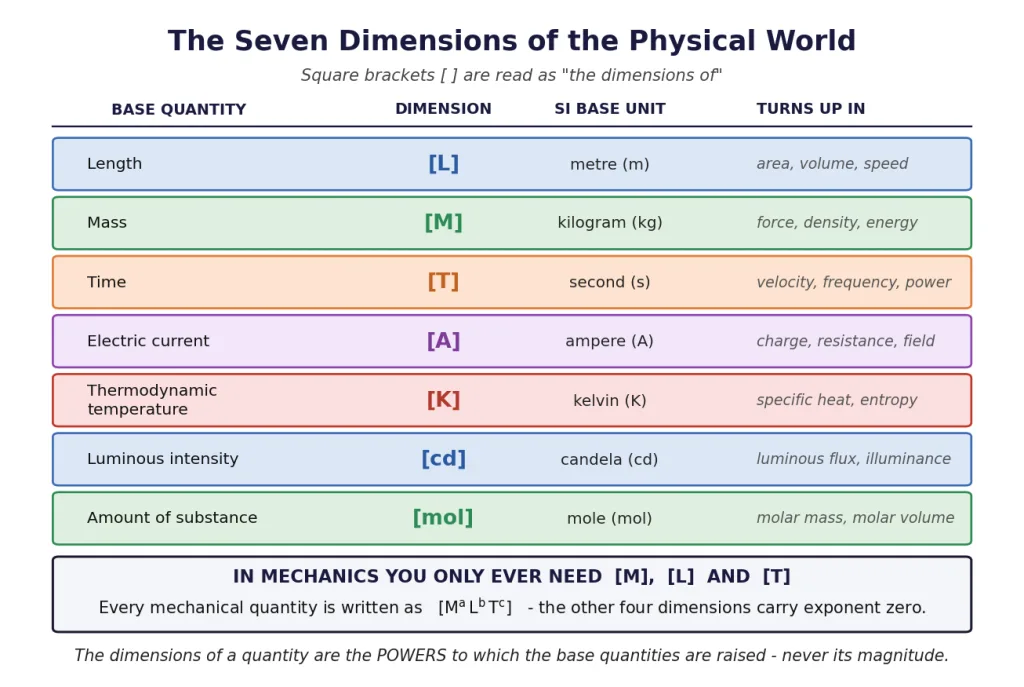
The notation you must get right from day one
Length has the dimension , mass , time , electric current , thermodynamic temperature , luminous intensity and amount of substance .
Key Point: Putting square brackets
[ ]around a quantity means "the dimensions of" that quantity. So is not the force. is read aloud as "the dimensions of force".
That sounds like a small distinction. It is not. Half the mistakes students make later come from silently treating as if it were a velocity you can plug numbers into. It is not a number at all — it is a statement about what kind of quantity is.
Magnitude is deliberately thrown away
This is the point that surprises people, so it is worth stating plainly.
Key Point: In this type of representation, the magnitudes are not considered. It is the quality of the type of the physical quantity that enters.
So a change in velocity, an initial velocity, an average velocity, a final velocity and a speed are all equivalent in this context. Every one of them is a length divided by a time, so every one of them has dimensions , written .
A snail crawling at 0.001 m/s and a photon travelling at m/s have exactly the same dimensions. Dimensions do not care how fast. They care what fast is.
In mechanics, three is all you need
[Board Important] Every quantity in mechanics — the whole of Class 11 kinematics, laws of motion, work-energy, gravitation, rotation, fluids and oscillations — can be written using only , and . The other four dimensions sit there with exponent zero.
That is why almost every dimensional formula you will meet this year has the shape
Your entire job is to find the three numbers , and . turns up only when you reach current electricity, only in thermodynamics, and and almost never in Class 11 problems. Section 7 (JEE Corner) picks up the electrical and thermal ones.
Dimensions Are Powers, Not Sizes
Now for the definition that everything else hangs on. Read it slowly.
Key Point: The dimensions of a physical quantity are the powers (or exponents) to which the base quantities are raised to represent that quantity.
So when someone says "the dimensions of force", the answer is not a size, not a unit, not a number of metres. The answer is a set of exponents.
Worked from first principles: volume
The volume occupied by an object is the product of its length, breadth and height — that is, three lengths. So
Volume is completely independent of mass and of time. Doubling the mass of a box does not change its volume; waiting an hour does not change it either. We record this by saying that volume possesses:
- zero dimension in mass, written
- zero dimension in time, written
- three dimensions in length, written
Put them together and the complete statement is
Why bother writing and when anything to the power zero is 1? Because it is a claim, and a useful one. It says: "I have checked mass and time, and volume genuinely has nothing to do with either." Leaving them out looks like you forgot to check. Boards write the zeros, so write them.
Worked from first principles: force
Force is the product of mass and acceleration:
Replacing each word by its dimension:
Read that out loud: force has one dimension in mass, one dimension in length, and minus two dimensions in time. Three exponents: , , . That is the whole content of the statement.
Reading a dimensional formula aloud
Get into this habit — it makes errors visible.
| Written | Read as | Exponents |
|---|---|---|
| zero in mass, three in length, zero in time | ||
| one in mass, one in length, minus two in time | ||
| one in mass, minus three in length, zero in time | ||
| zero in everything — dimensionless |
[JEE Tip] When an exam option list differs only in a sign — versus , say — you are being tested on exactly one thing: did you divide or multiply by that length? Slow down at the division step.
Dimensional Formula and Dimensional Equation — Two Different Things
Students use these two terms as if they were the same. Exams do not. Here is the distinction.
Key Point (Definition 1): The expression which shows how and which of the base quantities represent the dimensions of a physical quantity is called the dimensional formula of that quantity.
Key Point (Definition 2): An equation obtained by equating a physical quantity with its dimensional formula is called the dimensional equation of the quantity.
So the dimensional formula is the expression on the right. The dimensional equation is the whole statement, with an equals sign in it.
| Quantity | Dimensional formula | Dimensional equation |
|---|---|---|
| Volume | ||
| Speed or velocity | ||
| Force | ||
| Mass density |
[Board Important] Those four are the standard examples, and "write the dimensional equations of volume, speed, force and mass density" is a question that has been asked verbatim. Note also that the dimensional formula of acceleration is .
The one-line test
If it has an equals sign and a quantity in brackets on the left, it is a dimensional equation. If it is just the bracketed bundle of powers, it is a dimensional formula.
Where the dimensional equation comes from
Key Point: The dimensional equation can be obtained from the equation representing the relations between the physical quantities.
Which is exactly the skill of the next block. Every dimensional formula in this chapter was obtained by taking a defining equation and stripping it down to its base quantities. Nobody memorised them first — they derived them, and then the frequent ones stuck.
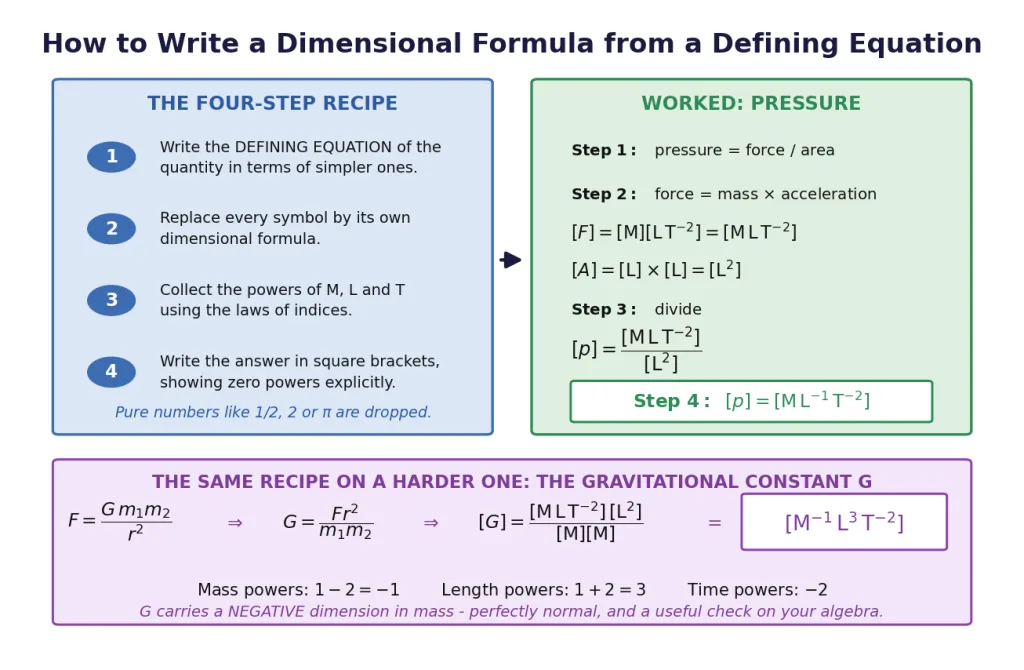
The Four-Step Recipe: From a Defining Equation to a Dimensional Formula
This is the single most useful procedure in the chapter. Everything in Section 5 assumes you can do it without thinking, so let's make it mechanical.
Key Point — the procedure:
- Write the defining equation of the quantity in terms of quantities you already know.
- Replace every symbol by its own dimensional formula.
- Collect the powers of , and using the ordinary laws of indices.
- Write the answer in square brackets, showing the zero powers explicitly.
Rule zero: throw away every pure number
Numerical factors carry no dimensions at all. The in , the 2 in , the itself, the 4 in — all of them vanish in step 2.
The never appears again. This is why kinetic energy, potential energy and work all land on the identical formula .
Build a ladder, don't leap
The reason force felt easy and viscosity feels hard is not difficulty — it is distance from the base quantities. Derive in order, and each step is one line:
| Step | Defining equation | Substitution | Result |
|---|---|---|---|
| Velocity | |||
| Acceleration | |||
| Force | |||
| Work | |||
| Power |
Five quantities, five one-line steps, no memorising. Once force is in your hands, the rest of mechanics falls out of it.
The trap: use the DEFINING equation, not a special case
[JEE Tip] To find the dimensions of energy, do not reach for or if a plainer route exists — and never reach for a formula that only holds in a special case. Use a relation that defines the quantity in general.
The classic casualty is the gravitational constant . Students try to remember its value, in SI units, and read the dimensions off the unit. That works, but it is slower and more error-prone than four lines of algebra:
Mass: . Length: . Time: . [JEE/NEET] A negative power of mass is perfectly legal and is a strong hint you have done the algebra right — sits in the denominator of nothing you can build out of masses alone.
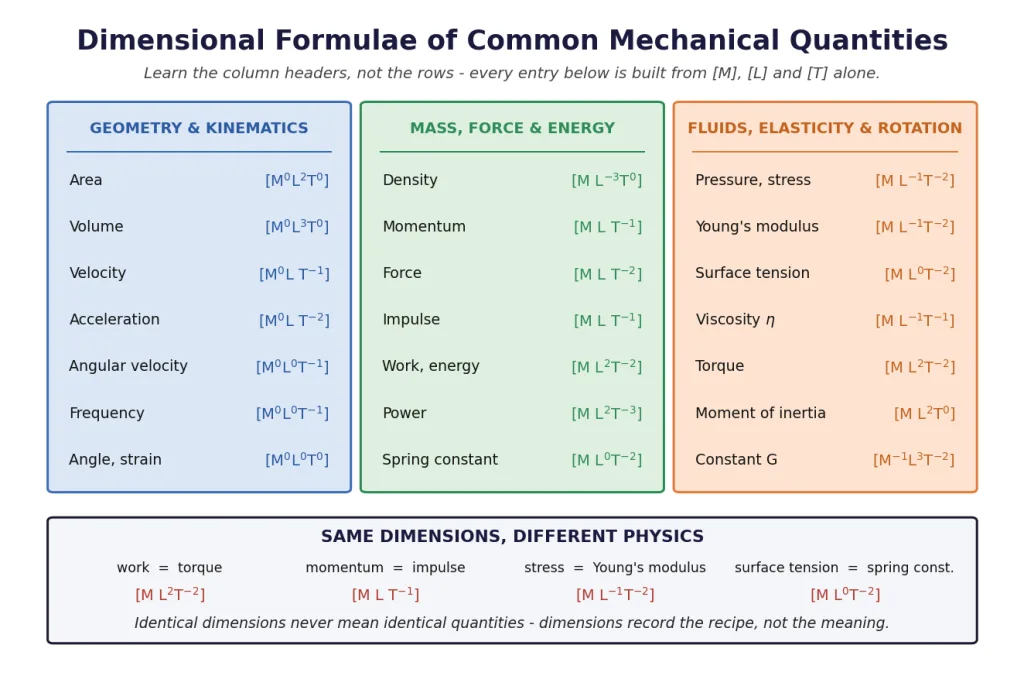
The Ready-Reference Table
Here is the table to come back to. Every row below was derived from the defining equation in the second column — read the second column and you can reconstruct the third from scratch, which is what you should practise doing.
| Quantity | Defining relation | Dimensional formula | SI unit |
|---|---|---|---|
| Area | length breadth | ||
| Volume | length breadth height | ||
| Density | |||
| Velocity, speed | |||
| Acceleration | |||
| Linear momentum | |||
| Force | newton (N) | ||
| Impulse | |||
| Work, energy | joule (J) | ||
| Power | watt (W) | ||
| Pressure, stress | pascal (Pa) | ||
| Surface tension | |||
| Coefficient of viscosity | |||
| Gravitational constant | |||
| Spring constant | |||
| Angular velocity | |||
| Torque | |||
| Moment of inertia | |||
| Frequency | hertz (Hz) | ||
| Strain | none | ||
| Young's modulus |
Same dimensions, different physics
Scan that table for repeats and a pattern jumps out:
| These share a formula | Common dimensional formula |
|---|---|
| work, energy, torque, heat | |
| momentum, impulse | |
| pressure, stress, Young's modulus, energy density | |
| surface tension, spring constant, force gradient | |
| frequency, angular velocity, velocity gradient, decay constant |
Key Point: Identical dimensions do not mean identical quantities. Work is a scalar; torque is a vector. A dimensional formula records the recipe a quantity is built from, not what it means. Two dishes made from the same ingredients are still two dishes.
[JEE/NEET] "Which of the following pairs has the same dimensions?" is one of the highest-frequency question types in the entire chapter — it has appeared in JEE Main and NEET repeatedly. The five rows above cover the overwhelming majority of them. Learn the groups, not twenty separate rows.
Dimensionless Quantities, and Constants of Both Kinds
Some quantities come out of the recipe with every exponent equal to zero. Their dimensional formula is , and we call them dimensionless.
They are almost always built as a ratio of two quantities of the same kind, so the dimensions cancel top and bottom.
| Dimensionless quantity | Built as | Why it cancels |
|---|---|---|
| Plane angle | ||
| Strain | ||
| Refractive index | ||
| Relative density (specific gravity) | ||
| Coefficient of friction | ||
| Solid angle |
Dimensionless does not mean unitless
Here is a distinction that catches out a lot of students, and it is a favourite of assertion-reason questions.
Key Point: A dimensionless quantity may still have a unit. Plane angle is dimensionless yet is measured in radians; solid angle is dimensionless yet is measured in steradians. Strain, refractive index and relative density, on the other hand, have no unit at all.
Both radian and steradian are the SI units you met in Section 1 as the supplementary units — and now you can see why they were described there as dimensionless. An angle of 1.5 rad has a unit but no dimensions.
[NEET Important] So there are three possibilities, and all three exist:
- has dimensions and a unit — force, energy, pressure (the vast majority)
- no dimensions but has a unit — plane angle (radian), solid angle (steradian)
- no dimensions and no unit — strain, refractive index, relative density, coefficient of friction
There is no fourth box: nothing has dimensions but no unit.
Constants come in two kinds too
The word "constant" hides two completely different animals.
Key Point: A dimensional constant has a fixed numerical value and a non-zero dimensional formula. A dimensionless constant is a pure number, with dimensional formula .
| Dimensional constants | Dimensional formula |
|---|---|
| Gravitational constant | |
| Planck's constant | |
| Speed of light in vacuum |
| Dimensionless constants |
|---|
| , , |
| the in |
| pure counting numbers: 1, 2, 3, 60 |
[JEE Tip] This gives you the complete four-way classification examiners like to test:
| Has dimensions | Dimensionless | |
|---|---|---|
| Variable | force, velocity, energy | strain, angle, refractive index |
| Constant | , , | , , 2, |
The reason this matters is coming next. A dimensionless constant has every exponent zero, which makes it completely invisible to the dimensional method: dimensions can tell you which quantities a formula is built from, but never the pure number sitting out in front of them.
Working with that blind spot — and the three big things dimensions let you do in spite of it — is what Section 5: Dimensional Analysis and its Applications is about. Get comfortable writing dimensional formulae first; everything there is built on this one skill.
Solved Examples
Example 1: Volume and area from first principles
Write the dimensional formulae of (i) area and (ii) volume, showing the zero powers explicitly.
Solution:
- Defining relation for area: area = length breadth = two lengths.
- .
- Area is independent of mass and time, so both carry exponent zero: .
- Volume: volume = length breadth height = three lengths.
- , again with nothing from mass or time.
Final Answer: and .
Takeaway: Volume has three dimensions in length and zero dimension in mass and time. That is the phrasing to use, and writing the zeros shows the examiner you checked all three base quantities.
Example 2: Force, one exponent at a time
Derive the dimensional formula of force and state how many dimensions it has in each base quantity.
Solution:
- Defining equation: (Newton's second law).
- Dimensions of mass: .
- Dimensions of acceleration: acceleration is a change of velocity per unit time, and velocity is a length per unit time, so .
- Multiply: .
Final Answer: — one dimension in mass, one in length and minus two in time.
Takeaway: Force is the gateway quantity of mechanics. Once you have in your head, work, power, pressure, surface tension, viscosity and are each one algebraic step away.
Example 3: Four dimensional equations
Write the dimensional equations of volume, speed, force and mass density.
Solution:
- Volume: three lengths, no mass, no time → .
- Speed: a distance divided by a time → .
- Force: mass acceleration → .
- Mass density: , so .
Final Answer: , , , .
Takeaway: These four are asked in exactly this form. Notice all four are dimensional equations — each has a bracketed quantity, an equals sign, and a dimensional formula.
Example 4: Momentum and impulse — why they must agree
Find the dimensional formulae of linear momentum and of impulse, and explain the result.
Solution:
- Momentum: , so .
- Impulse: , so .
- Compare: the time exponents are , matching momentum exactly.
Final Answer: Both are .
Takeaway: This is not a coincidence — the impulse-momentum theorem says impulse equals change in momentum, and quantities that can be equated must share dimensions. Whenever a physical law connects two quantities with an equals sign, their dimensions are forced to agree.
Example 5: The work-energy-power ladder
Derive the dimensional formulae of work, kinetic energy, potential energy and power.
Solution:
- Work: → .
- Kinetic energy: . The is a pure number and is dropped: .
- Potential energy: → .
- Power: → .
Final Answer: Work, kinetic energy and potential energy all have ; power has .
Takeaway: Every form of energy shares one dimensional formula. That is the dimensional fingerprint of the whole work-energy chapter, and it is why energy can be converted freely between forms.
Example 6: Pressure, stress and Young's modulus
Find the dimensional formulae of pressure and of Young's modulus.
Solution:
- Pressure: .
- Subtract length exponents: , giving .
- Stress is also force per unit area, so stress has the same formula, .
- Young's modulus: . Strain is a ratio of two lengths, so .
- Dividing by a dimensionless quantity changes nothing: .
Final Answer: Pressure, stress and Young's modulus all have .
Takeaway: Dividing by a dimensionless quantity never changes a dimensional formula. That single fact explains why Young's modulus is measured in pascals even though it is a modulus and not a pressure.
Example 7: Surface tension and spring constant
Show that surface tension and the spring constant have the same dimensional formula.
Solution:
- Surface tension is force per unit length: .
- , since for length.
- Spring constant comes from Hooke's law , so .
- .
Final Answer: Both are , often written simply as .
Takeaway: Two quantities from completely unrelated chapters — fluids and oscillations — share a formula because both are "a force divided by a length". Their SI units agree too: both are .
Example 8: Coefficient of viscosity
Newton's law of viscous flow is , where is area and is the velocity gradient. Find .
Solution:
- Rearrange to isolate the unknown: .
- Velocity gradient is a velocity divided by a length: .
- Substitute everything: .
- Collect length: . Collect time: . Mass stays at 1.
Final Answer: .
Takeaway: The velocity gradient reducing to a pure is the whole trick here. Note how close this is to pressure, — they differ by exactly one power of time, which is why the SI unit of viscosity is the pascal second.
Example 9: The gravitational constant
Obtain the dimensional formula of the universal gravitational constant .
Solution:
- Defining equation: .
- Make the subject: .
- Substitute: .
- Mass: . Length: . Time: .
Final Answer: , consistent with its SI unit .
Takeaway: is the standard example of a dimensional constant — a fixed number that nevertheless carries dimensions. The negative power of mass is not an error; it is what lets cancel the two masses in the numerator.
Example 10: Rotational quantities
Find the dimensional formulae of angular velocity, torque and moment of inertia.
Solution:
- Angular velocity: . Angle is dimensionless, , so .
- Torque: . The sine of an angle is a pure number, so .
- Moment of inertia: , so .
Final Answer: , , .
Takeaway: Angular velocity has the same dimensional formula as frequency, and torque the same as work — both because an angle contributes nothing. [JEE Tip] Torque and work are the most-asked "same dimensions" pair in the chapter.
Example 11: Reading dimensions backwards
A physical quantity has the dimensional formula . Name two quantities that fit, and check them.
Solution:
- Try angular momentum: , so . It fits.
- Try Planck's constant: from we get , so . It fits too.
- Cross-check by a different route: angular momentum can also be written , giving — the same answer from a different defining equation.
Final Answer: Angular momentum and Planck's constant both have .
Takeaway: Deriving a formula by two independent routes is the best self-check there is. And this particular match is not accidental — it is why is often quoted in units of and why angular momentum in quantum mechanics comes in multiples of .
Example 12: Sorting the dimensionless from the dimensional
Classify each of the following as a dimensional variable, dimensionless variable, dimensional constant or dimensionless constant: (i) velocity (ii) refractive index (iii) (iv) (v) strain (vi) speed of light in vacuum.
Solution:
- Velocity: varies from case to case and has → dimensional variable.
- Refractive index: varies with the medium, but is a ratio of two speeds, so → dimensionless variable.
- : the same everywhere in the universe, and → dimensional constant.
- : a fixed pure number → dimensionless constant.
- Strain: varies with the load, and is a length over a length → dimensionless variable.
- Speed of light: fixed at m/s, with → dimensional constant.
Final Answer: (i) dimensional variable (ii) dimensionless variable (iii) dimensional constant (iv) dimensionless constant (v) dimensionless variable (vi) dimensional constant.
Takeaway: Two independent questions, asked together: does it change? decides variable versus constant, and does the recipe cancel? decides dimensional versus dimensionless. [NEET Important] Remember that a dimensionless quantity may still carry a unit — the radian is the standard example.