
The Principle of Homogeneity of Dimensions
Section 4 taught you to write a dimensional formula. This section teaches you what to do with one — and it turns out you can do three genuinely powerful things.
All three rest on a single idea, and it is almost embarrassingly simple.
Key Point: Only those physical quantities can be added or subtracted which have the same dimensions. This is called the principle of homogeneity of dimensions.
Think of it this way. You cannot add 3 apples to 5 rupees and get 8 of anything. In exactly the same way, you cannot add a velocity to a force, and you cannot subtract an electric current from a thermodynamic temperature. The operation is not hard — it is meaningless.
The two halves of the principle
The principle has a second half that students often forget, and it is the half that does the real work.
Key Point: Physical quantities represented by symbols on both sides of a mathematical equation must have the same dimensions. So in any correct physical equation:
- every term that is added or subtracted must carry the same dimensions, and
- the left-hand side and right-hand side must carry the same dimensions.
Break either half and the equation is wrong. No exceptions, no special cases, no "but the numbers work out".
Dimensions cancel like algebraic symbols
Here is the mechanical rule that makes all the manipulation legal.
Key Point: When magnitudes of two or more physical quantities are multiplied, their units should be treated in the same manner as ordinary algebraic symbols. We can cancel identical units in the numerator and denominator. The same is true for the dimensions of a physical quantity.
So behaves exactly like the letter in an algebra problem. , and , for precisely the same reason that . There is nothing to memorise here beyond the laws of indices you already know.
[Board Important] This is also why a dimensional check is better than a unit check. A test of consistency of dimensions tells us no more and no less than a test of consistency of units — but it has the advantage that we need not commit ourselves to a particular choice of units, and we need not worry about conversions among multiples and sub-multiples.
The three applications — your roadmap for this section
| Application | What you are given | What you get out |
|---|---|---|
| 1. Checking dimensional consistency | A complete equation | A verdict: definitely wrong, or possibly right |
| 2. Deducing a relation | Which quantities a result depends on (at most three) | The formula, up to a pure number |
| 3. Converting between systems | A value in one system of units | The same value in another system |
Notice what each application costs you. Application 1 gives you certainty only when the answer is "wrong". Application 2 gives you everything except the constant out front. Application 3 is the only one of the three that gives you an exact, complete answer — which is why it is the one that shows up in numerical questions.
We take them in that order, then finish with the four things dimensional analysis genuinely cannot do.
Application 1 — Checking the Dimensional Consistency of an Equation
This is the everyday use. You have derived an equation, or half-remembered one in an exam, and you want a fast, cheap check before you trust it.
Key Point: If the dimensions of all the terms are not the same, the equation is wrong. Dimensions are customarily used as a preliminary test of the consistency of an equation, when there is some doubt about its correctness.
The worked check, term by term
Take the standard kinematics equation for a body starting at position with initial velocity at and moving with uniform acceleration :
There are four things to check — the left-hand side, and each of the three terms being added on the right. Take them one at a time and never skip one.
Every term on the right-hand side has the same dimension, namely that of length, which is the same as the dimension of the left-hand side. Hence this equation is a dimensionally correct equation.
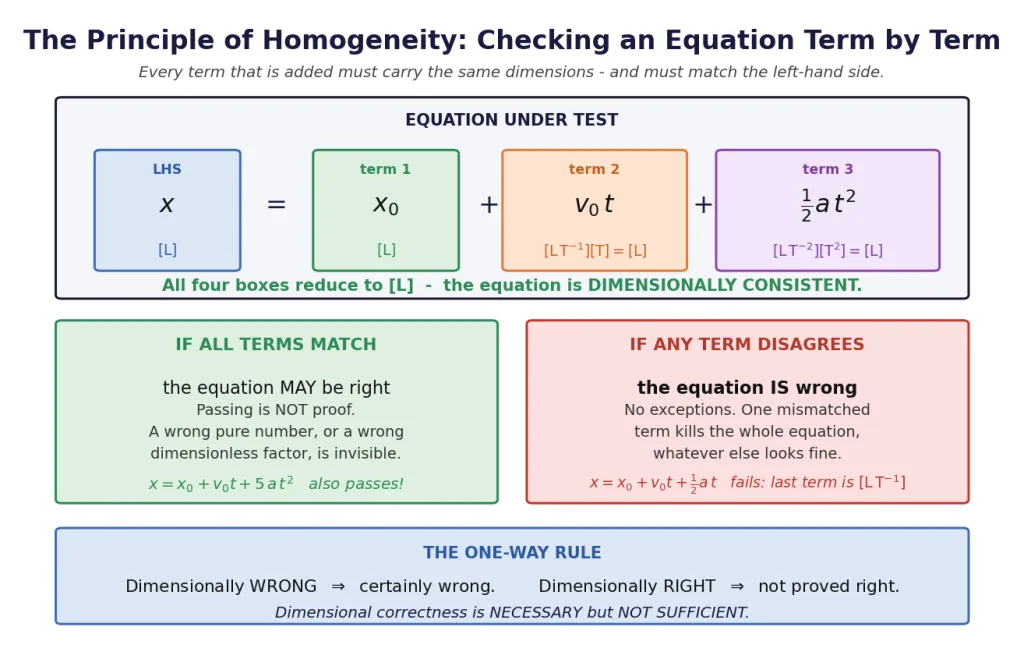
Two details in that working are worth pausing on, because both are marks:
- The vanished. It is a pure number, so it has dimensional formula and contributes nothing. (Section 4, rule zero.)
- contributed , not . Whatever power a symbol carries in the equation, its dimension carries the same power.
Necessary, but not sufficient — the most important sentence in this section
Now the warning. Read it twice, because it is the single most examined idea here.
Key Point: If an equation fails this consistency test, it is proved wrong. But if it passes, it is not proved right. A dimensionally correct equation need not be an exact (correct) equation, but a dimensionally wrong (inconsistent) equation must be wrong.
Why the asymmetry? Because the test is blind to anything dimensionless. Look at these three:
| Equation | Dimensionally? | Physically? |
|---|---|---|
| consistent | correct | |
| consistent | wrong — bad numerical factor | |
| consistent | wrong — still just a pure number | |
| inconsistent | wrong, and dimensions caught it |
The first three are dimensionally indistinguishable. The method simply cannot see the difference between , 5 and — all of them are .
Key Point (the one-way rule): Dimensionally wrong certainly wrong. Dimensionally right not yet proved right. Dimensional correctness is a necessary condition for an equation to be right, but not a sufficient one.
[JEE Tip] Assertion-reason questions live on exactly this asymmetry. "Assertion: a dimensionally correct equation is always physically correct." That assertion is false, every single time. Its converse — "a dimensionally incorrect equation is always physically incorrect" — is true, every single time.
[NEET Important] In a hurry, the check is still worth doing, because it is fast and it catches the errors you actually make: a dropped power of , a stray division by , a where a belonged. It will not catch a wrong sign or a wrong number, so it is a filter, not a proof.
Application 2 — Deducing a Relation Among Physical Quantities
This is the application that feels like magic the first time you see it. You do not solve any differential equation, you do no experiment — you simply write down which quantities the answer can depend on, and the algebra hands you the formula.
Key Point: The method of dimensions can sometimes be used to deduce a relation among physical quantities. For this we should know the dependence of the physical quantity on other quantities (up to three physical quantities or linearly independent variables) and consider it as a product type of dependence.
Read the two conditions in that sentence carefully, because they are the whole fine print:
- You must already know which quantities matter. Dimensions will not tell you that — physical insight or the question does.
- The dependence must be a product of powers, at most three quantities. Sums do not work, and a fourth quantity breaks the method (we will see why in the limitations block).
The five-step procedure
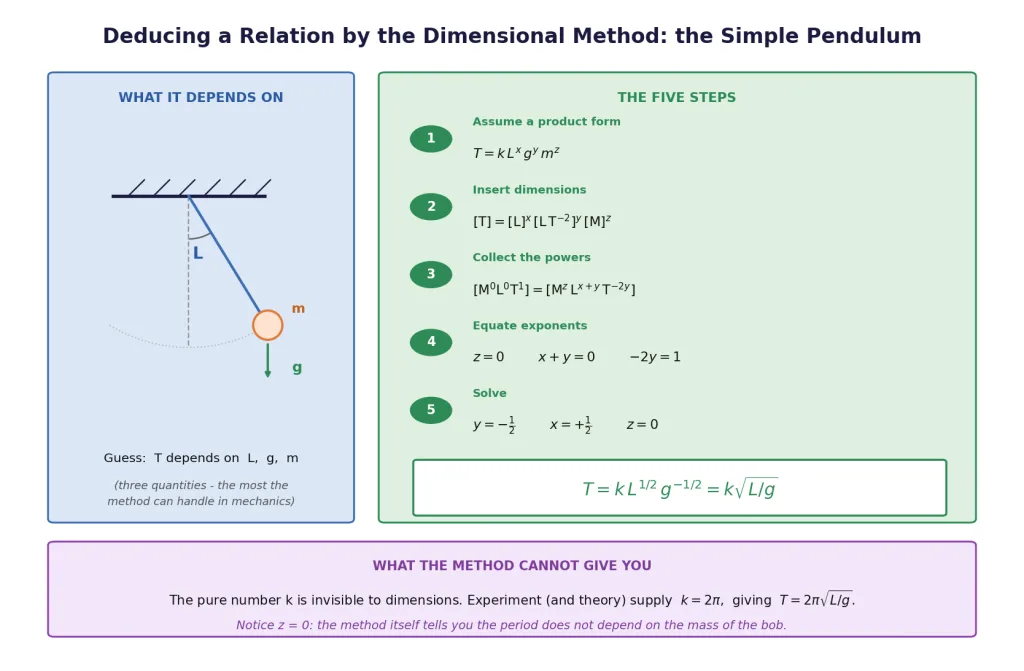
Key Point — the recipe:
- Assume a product form. If depends on , and , write , where is a dimensionless constant and , , are the unknown exponents.
- Replace every symbol by its dimensional formula, including the left-hand side.
- Collect the powers of , and on the right using the laws of indices.
- Equate the exponent of , of and of separately. Three base quantities give you exactly three equations.
- Solve for , , and substitute back.
Three unknowns, three equations. That is the arithmetic reason the method caps out at three quantities in mechanics.
Why must be dimensionless
Step 1 puts out in front and declares it a pure number. That is not laziness — it is forced. If carried dimensions of its own, those dimensions would have to be built from , and too, and they would simply merge into the exponents , , you are already solving for. Anything dimensional is inside the powers; everything left over is a pure number.
And a pure number is invisible to this method. So the honest statement of what you get is:
Key Point: The dimensional method gives you the correct combination of quantities and the correct powers, but never the dimensionless constant: the value of the constant cannot be obtained by the method of dimensions.
For the simple pendulum the method delivers , and only experiment (or the full theory of simple harmonic motion in Chapter 13) tells you that .
Reading the zeros — a free bonus
[JEE/NEET] When an exponent comes out zero, the method has told you something real: that quantity does not appear at all. In the pendulum, for the mass of the bob. That is a genuine physical prediction — the period of a simple pendulum is independent of the mass of the bob — and dimensional analysis found it in one line, before you touched an experiment.
Do not skip past a zero exponent as if it were a non-answer. It is often the most interesting number on the page.
Application 3 — Converting a Quantity from One System of Units to Another
You already met the seed of this in Section 1: the same table is 4.5 m or 450 cm, and the relation captured the idea that a smaller unit needs a bigger number. Here that loose intuition becomes a formal tool, because dimensions tell you exactly how the unit changes when you change all three base units at once.
The idea in one sentence
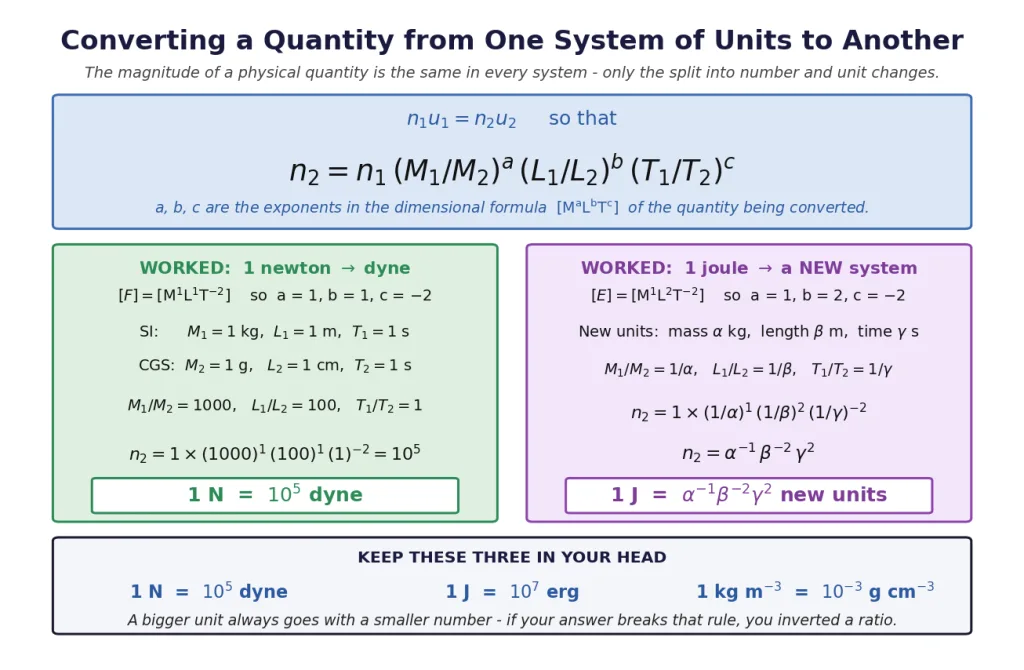
The magnitude of a physical quantity does not depend on the system of units you describe it in. A table is a table. Only the split into "number" and "unit" changes.
where is the numerical value in the first system whose unit is , and is the numerical value in the second system whose unit is . Rearranged, : the number is inversely proportional to the size of the unit.
Turning that into a working formula
Now bring dimensions in. Suppose the quantity has dimensional formula . Then its unit is built as out of whatever base units the system uses, so
Key Point (the conversion formula): where are the base units of the old system, those of the new system, and , , are the exponents in the dimensional formula of the quantity.
The four-step drill
Key Point — the procedure:
- Write the dimensional formula of the quantity and read off , , .
- List the base units of the old system () and the new one (), expressed in a common unit so the ratios are pure numbers.
- Substitute into .
- Sanity-check the direction: a smaller new unit must give a bigger new number.
The classic SI-to-CGS results
Since 1 kg = 1000 g and 1 m = 100 cm, the two most-asked conversions fall out immediately:
| Quantity | Dimensional formula | Conversion | Result |
|---|---|---|---|
| Force | 1 N = dyne | ||
| Energy, work | 1 J = erg | ||
| Power | 1 W = erg per second |
[Board Important] Memorise 1 N = dyne and 1 J = erg. They are quoted constantly, and both are two lines of this formula if you ever forget them.
Watch the direction of every ratio
[JEE Tip] The single most common error in this entire topic is inverting a ratio. The formula wants — old over new — not the other way round. Here is the check that never fails:
Key Point: Bigger unit smaller number. If you convert from a large unit to a small one and your number gets smaller, you have flipped a ratio. Go back and flip it.
Going from the kilogram to the gram, the unit shrank by a factor of 1000, so the number must grow by a factor of 1000. That is why , sitting in the numerator.
The Limitations of Dimensional Analysis
The method is powerful, but it is not a substitute for physics. Bluntly, the method of dimensions can only test the dimensional validity, but not the exact relationship between physical quantities in any equation.
Here are the four limitations you must be able to state, with the reason for each.
Limitation 1 — it cannot find dimensionless constants
Key Point: Dimensionless constants cannot be obtained by this method.
The pendulum is the standard illustration. Dimensions give and stop dead. The factor has to come from experiment or from a full derivation. Likewise the in Stokes' law, the in , the in the volume of a sphere and the in the escape velocity are all invisible.
As the pendulum working shows: it does not matter if some number multiplies the right side of this formula, because that does not affect its dimensions.
Limitation 2 — it fails for relations that are sums of terms
The method assumes a product of powers. So it can never produce
because those are sums of several terms, not single products. You can check such an equation with dimensions (Application 1), but you can never derive it (Application 2). Keep the two applications apart in your head.
Limitation 3 — it cannot handle trigonometric, logarithmic or exponential functions
Key Point: The arguments of special functions, such as the trigonometric, logarithmic and exponential functions, must be dimensionless.
A quantity like , or cannot be built by multiplying powers of , and , so the method simply has nothing to say about a formula such as beyond the amplitude in front.
But look what the same restriction hands you for free. Since the argument must be dimensionless:
| In this expression | The argument | Forces |
|---|---|---|
| , and | ||
| and | ||
| the two volumes must be the same kind of quantity |
[JEE/NEET] "Find the dimensions of / / / in the following expression" is one of the highest-yield question types in the chapter, and it is always solved by this one rule: set the argument's dimensions to . What looks like a limitation is, in practice, a shortcut.
Limitation 4 — it breaks down beyond three quantities
In mechanics you can write only three equations — one each for the exponents of , and . So you can solve for at most three unknown exponents.
If a quantity genuinely depends on four or more others, you have four unknowns and three equations: the system is underdetermined and the method gives an incomplete answer. (Outside mechanics you get a little more room, because and add equations of their own — but the principle is the same.)
And one more: it cannot tell two quantities apart
Key Point: The method does not distinguish between physical quantities having the same dimensions.
Work and torque are both ; momentum and impulse are both . If a derivation lands on , dimensions cannot tell you whether you have found an energy or a torque. Only the physics can.
Summary card
| Dimensional analysis can | Dimensional analysis cannot |
|---|---|
| prove an equation wrong | prove an equation right |
| find the powers in a product relation | find the dimensionless constant |
| convert between systems of units exactly | derive an equation that is a sum of terms |
| fix the dimensions of , , from a function's argument | handle , or themselves |
| handle up to three quantities in mechanics | handle four or more |
| — | tell work from torque |
Solved Examples
Example 1: Checking
Let us consider an equation , where is the mass of the body, its velocity, is the acceleration due to gravity and is the height. Check whether this equation is dimensionally correct.
Solution:
- Left-hand side. The is a pure number and is dropped. So .
- Squaring the bracket: .
- Therefore LHS .
- Right-hand side. .
- Collect the length powers, : RHS .
- Compare. LHS RHS.
Final Answer: The dimensions of LHS and RHS are the same, , and hence the equation is dimensionally correct.
Takeaway: Both sides are an energy — this is just the statement that kinetic energy converts into potential energy. Note the wording of the conclusion: dimensionally correct. We have not proved the is right; dimensions cannot see it.
Example 2: Ruling out formulae for kinetic energy
The SI unit of energy is ; that of speed is and of acceleration is . Which of the formulae for kinetic energy given below can you rule out on the basis of dimensional arguments ( stands for the mass of the body)?
(a) (b) (c) (d) (e)
Solution:
- Target. Kinetic energy must have the dimensions of energy, .
- (a) . Does not match — ruled out.
- (b) . Matches.
- (c) — that is a force, not an energy. Ruled out.
- (d) , since is a pure number. Matches.
- (e) This adds , which is , to , which is . Two quantities of different dimensions have been added, so the expression has no proper dimensions at all. Ruled out.
Final Answer: Formulae (a), (c) and (e) are ruled out. Dimensional arguments cannot decide between (b) and (d); for that one must turn to the actual definition of kinetic energy. The correct formula is (b).
Takeaway: This is the cleanest demonstration that dimensional correctness is necessary but not sufficient. (b) and (d) differ only by a dimensionless factor, and no amount of dimensional analysis will ever separate them. [JEE Tip] Option (e) is the one students miss — an expression containing an illegal sum is rejected outright, before you even compare it with the target.
Example 3: Consistency of the kinematic equations
Check the dimensional consistency of (i) and (ii) .
Solution:
- (i) LHS: .
- First term on RHS: — matches.
- Second term: the 2 is a pure number, so — matches.
- All three agree, so equation (i) is dimensionally consistent.
- (ii) LHS: .
- First term: — matches.
- Second term: — this is a velocity, not a length.
- A length is being added to a velocity, which the principle of homogeneity forbids.
Final Answer: (i) is dimensionally consistent; (ii) is dimensionally wrong — the last term should be .
Takeaway: One mismatched term condemns the whole equation, no matter how respectable the other terms look. This is exactly the error a dimensional check is best at catching: a dropped power of .
Example 4: Finding unknown dimensions by homogeneity
The distance covered by a particle is given by , where is time. Find the dimensional formulae of , , and .
Solution:
- The governing idea: every term added on the right must have the same dimensions as , which is a distance, .
- Term : .
- Term : , so .
- Term : , so .
- Term : , so .
Final Answer: , , , .
Takeaway: came out as a velocity and as an acceleration — which is exactly what they are, since this is a Taylor-style expansion of position in time. [JEE/NEET] Whenever a question hands you a polynomial in with lettered coefficients, this is the entire solution: divide the left-hand side's dimensions by the power of .
Example 5: The argument of a function must be dimensionless
The displacement of a wave is , where is time and is distance. Find the dimensional formulae of , and . Also find in .
Solution:
- The rule: the argument of a sine, a logarithm or an exponential must be dimensionless, .
- The whole argument is dimensionless, and by homogeneity so is each of its terms separately.
- From : , so .
- From : , so .
- Amplitude : is itself a pure number, so . Since is a displacement, .
- Decay constant: in the exponent must be dimensionless, so .
Final Answer: , , and .
Takeaway: is an angular frequency and a decay constant — physically unrelated, dimensionally identical, both . That is limitation 5 in action. [NEET Important] The step students skip is number 5: the function itself is dimensionless, so whatever sits in front of it inherits the dimensions of the left-hand side.
Example 6: The simple pendulum
Consider a simple pendulum having a bob attached to a string, that oscillates under the action of the force of gravity. Suppose that the period of oscillation of the simple pendulum depends on its length , mass of the bob and acceleration due to gravity . Derive the expression for its time period using the method of dimensions.
Solution:
- Assume a product dependence: , where is a dimensionless constant and , , are the exponents.
- Insert dimensions on both sides: .
- Collect the powers on the right: .
- Equate the exponents of each base quantity separately:
- length:
- time:
- mass:
- Solve: from the time equation ; substituting into the length equation, ; and .
- Substitute back: , that is .
Final Answer: . The value of the constant cannot be obtained by the method of dimensions; actually , so that .
Takeaway: Two results for the price of one. The formula itself, and the fact that — the period does not depend on the mass of the bob. That second result is real physics, delivered by three lines of algebra. [Board Important] This derivation is asked almost verbatim; reproduce all six steps, including the sentence about .
Example 7: Stokes' law by the dimensional method
The viscous force on a small sphere moving slowly through a fluid depends on the coefficient of viscosity of the fluid, the radius of the sphere and its velocity . Derive the relation. Given .
Solution:
- Assume a product form: , with a dimensionless constant.
- Insert dimensions: .
- Collect powers on the right: .
- Equate exponents:
- mass:
- time:
- length:
- Solve: from mass, . Substituting into the time equation, , so . Substituting both into the length equation, , so .
- Substitute back: .
Final Answer: , and experiment gives , so — Stokes' law.
Takeaway: Solve the equations in the order that gives you a free answer first — mass gave immediately, which unlocked time, which unlocked length. [JEE Tip] Never hunt for the ; it is a dimensionless constant and is structurally invisible to this method.
Example 8: Time period of a spring-mass system
The time period of a mass oscillating on a spring of force constant depends only on and . Find the relation. Given .
Solution:
- Assume: , with dimensionless.
- Insert dimensions: .
- Collect: .
- Equate exponents: mass gives ; time gives .
- Solve: and therefore .
- Substitute back: , and in fact .
Final Answer: .
Takeaway: Compare with the pendulum. There the mass exponent came out zero; here it comes out . The dimensional method itself tells you that a spring's period does depend on the mass while a pendulum's does not — a distinction worth remembering for Chapter 13.
Example 9: Escape velocity
The escape velocity of a body from a planet depends on the gravitational constant , the mass of the planet and its radius . Derive the relation, given .
Solution:
- Assume: .
- Insert dimensions: .
- Collect: .
- Equate exponents:
- time: , so
- mass: , so
- length: , so
- Substitute back: .
Final Answer: , with the true value of the constant being , giving .
Takeaway: Once again the method nails the combination exactly and misses only the factor . [JEE/NEET] Start from whichever equation has a single unknown — here the time equation gave outright, and everything else followed.
Example 10: Converting 1 newton into dyne, and 1 joule into erg
Show that 1 newton dyne and 1 joule erg.
Solution:
- Force first. Dimensional formula: , so , , .
- The two systems. SI: kg, m, s. CGS: g, cm, s.
- The ratios: , , .
- Substitute with : .
- Energy next. , so , , .
- Substitute: .
Final Answer: 1 N dyne and 1 J erg.
Takeaway: The only difference between the two calculations is the exponent on the length ratio — 1 for force, 2 for energy. [Board Important] Both results should be instant recall, but knowing they are two lines of means you can never be stuck.
Example 11: One joule in a brand-new system of units
The SI unit of energy is the joule. A new system of units is chosen in which the unit of mass is kg, the unit of length is m and the unit of time is s. What is the magnitude of 1 joule in this new system?
Solution:
- Dimensional formula of energy: , so , , .
- Old system (SI): kg, m, s, and .
- New system: kg, m, s.
- Form the ratios: , , .
- Substitute: .
- Simplify. The first two give . The third has a negative exponent, which flips the fraction: .
Final Answer: new units of energy.
Takeaway: Watch step 6 — the negative exponent on the time ratio turns into upstairs. [JEE Tip] A quick sanity check: if the new time unit is larger than a second, the new energy unit is smaller, so the number should grow — and in the numerator does exactly that.
Example 12: The calorie in a new system
A calorie is a unit of heat energy and it equals about 4.2 J, where . Suppose we employ a system of units in which the unit of mass equals kg, the unit of length equals m and the unit of time is s. Show that a calorie has a magnitude in terms of the new units.
Solution:
- Start from the given value: in SI, since 1 calorie = 4.2 J.
- Dimensional formula of energy: , so , , .
- Apply the conversion formula: .
- Substitute the ratios , and : .
- Check against Example 11: the only change is the leading 4.2, exactly as expected, because a calorie is just 4.2 joules.
Final Answer: 1 calorie new units.
Takeaway: The numerical value rides along untouched; the , , machinery only ever touches the unit part. [Board Important] This is one of the most reliably asked numerical questions in the chapter — the answer to memorise is the pattern for any energy.