
Thirty Questions. Thirty Minutes. Go.
Section 9 taught you the NEET way through this chapter — the recall tables, the elimination ladder, the two formats, the 40-second habit. This section is where you find out whether any of it survived contact with a clock.
There is no new physics below. There are 30 questions built the way NEET builds them, and one rule that matters more than any of them: you are being tested on pace, not on cleverness.
How to attempt this set
Key Point: Sit down with a blank sheet, a pen and a timer. Attempt all 30 questions in one unbroken sitting, and do not read a single explanation until you have written your last answer. A drill you pause to check is a reading exercise, and reading exercises do not build speed.
| The setup | What it is |
|---|---|
| Number of questions | 30 |
| Marking scheme | correct, incorrect, unattempted |
| Maximum score | marks |
| Minimum possible score | marks |
| Suggested time limit | 30 minutes (NEET pace: 45 Physics questions in about 45 minutes, so roughly 1 minute each) |
| Allowed | a rough sheet and your memory |
| Not allowed | calculator, formula sheet, or a glance back at Sections 1 to 9 |
[Important] That 30-minute limit is the whole point of the exercise. Most students can get 26 of these right given an hour — and an hour is exactly what the real paper will not give you. If you finish in 30 minutes with 24 correct, you are in far better shape than someone who took 55 minutes to get 28. Set the timer where you can see it, and when a question hits 60 seconds, mark your best surviving option and move. The clock is worth more than the mark.
Here is the arithmetic that makes that instruction safe: a blind guess among four options is worth , essentially nothing. But once you have eliminated two options, a guess between the last two is worth marks on average. So eliminate first, then commit. Leave blank only what you could not narrow down at all.
What this set covers
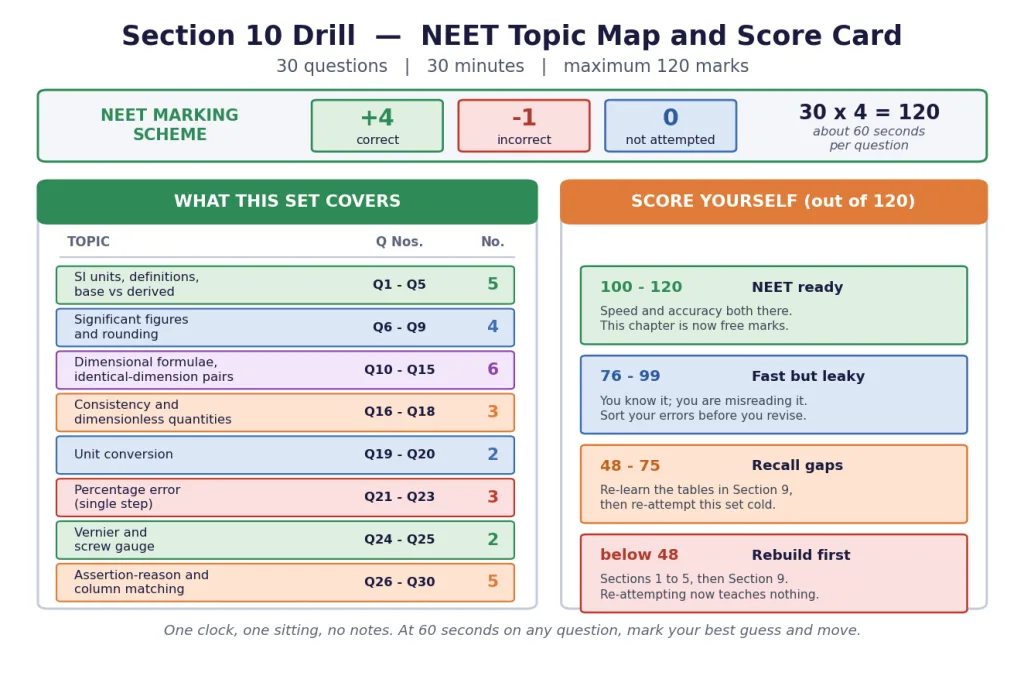
| Topic | Questions | How many |
|---|---|---|
| SI units, definitions, base vs derived | Q1 to Q5 | 5 |
| Significant figures and rounding | Q6 to Q9 | 4 |
| Dimensional formulae and identical-dimension pairs | Q10 to Q15 | 6 |
| Dimensional consistency and dimensionless quantities | Q16 to Q18 | 3 |
| Unit conversion | Q19 to Q20 | 2 |
| Percentage error, single step | Q21 to Q23 | 3 |
| Vernier callipers and screw gauge | Q24 to Q25 | 2 |
| Assertion-reason and column matching | Q26 to Q30 | 5 |
That weighting is not arbitrary — it is how NEET actually samples this chapter. Dimensions alone account for 9 of the 30, because in the real paper they account for most of what gets asked here. The last five drill the two formats NEET uses and JEE does not: three assertion-reason items and two column matches. If you have never sat one of those under time pressure, they are the questions in this set most likely to cost you marks.
The difficulty mix is deliberately NEET-calibrated: roughly 35% easy, 45% medium, 20% hard. If a question feels like it needs three lines of algebra, re-read it. You have almost certainly misread it.
Mark It Honestly, Then Read Your Own Answer Sheet
Score with the real scheme: for every correct answer, for every wrong one, for every blank. No half marks for "I nearly had that one". The number you end up with is the number that means something.
The bands
| Your score (out of 120) | Verdict | What to do next |
|---|---|---|
| 100 to 120 | NEET ready. Over 83% on a full-length set, inside the time. | This chapter is now free marks for you. Revisit only the specific items you missed and move to the next chapter. |
| 76 to 99 | Fast but leaky. You know the material; something is leaking on the way to the answer sheet. | Almost always a misread question or a forgotten exponent, not a gap. Redo every wrong question without the explanation first, and see how many you fix on your own. |
| 48 to 75 | Recall gaps. The speed is not the problem; the lookup is. | Go back to Section 9's tables — base quantities, the dimensional families, the least-count values — and learn them as flashcards. Then re-attempt this set cold, not from memory of the answers. |
| Below 48 | Rebuild first. | Work Sections 1 to 5 properly, then Section 9, then Section 6's solved examples. Re-attempting this set today would teach you nothing except the answer key. |
Sort your mistakes into three piles
Do this before you read a single explanation. It is the most useful ten minutes in this section.
- Did not know it. A dimensional formula you could not recall, a definition you had never learnt. These are the cheapest to fix — it is a memory job, and it takes an evening.
- Knew it, computed it wrong. You forgot to multiply the error by the exponent, or you subtracted the zero error the wrong way. Slow down for four seconds on the final line.
- Knew it, answered a different question. You gave the least count when it asked for the reading, or gave when it asked for a percentage. NEET's distractors are built specifically to reward this mistake, and it is the pile most students refuse to take seriously.
Key Point: Two students both score 84. The first has four pile-1 mistakes and a syllabus gap that revision closes in a day. The second has nine pile-3 mistakes and a reading habit that will follow them into the exam hall. Pile 3 is the expensive one — count it before you explain it away.
One more pass, then move on
Every question below has a full step-by-step explanation, and most of them name the shortcut that would have got you there faster. Read the explanation even for the questions you got right — on a paper this tight, the difference between a 30-second method and a 90-second method decides whether you finish Physics at all.
[Important] When you are done, do not immediately re-attempt the set. You will be scoring your memory of the answer key, not your physics. Leave it a week, then sit it again cold with the same 30-minute timer. The second score is the honest one.