
A Result Can Never Be Better Than Its Inputs
Section 2 taught you to count significant figures in a number that is handed to you. Now comes the part that actually shows up in your answer script: what happens when you calculate with such numbers.
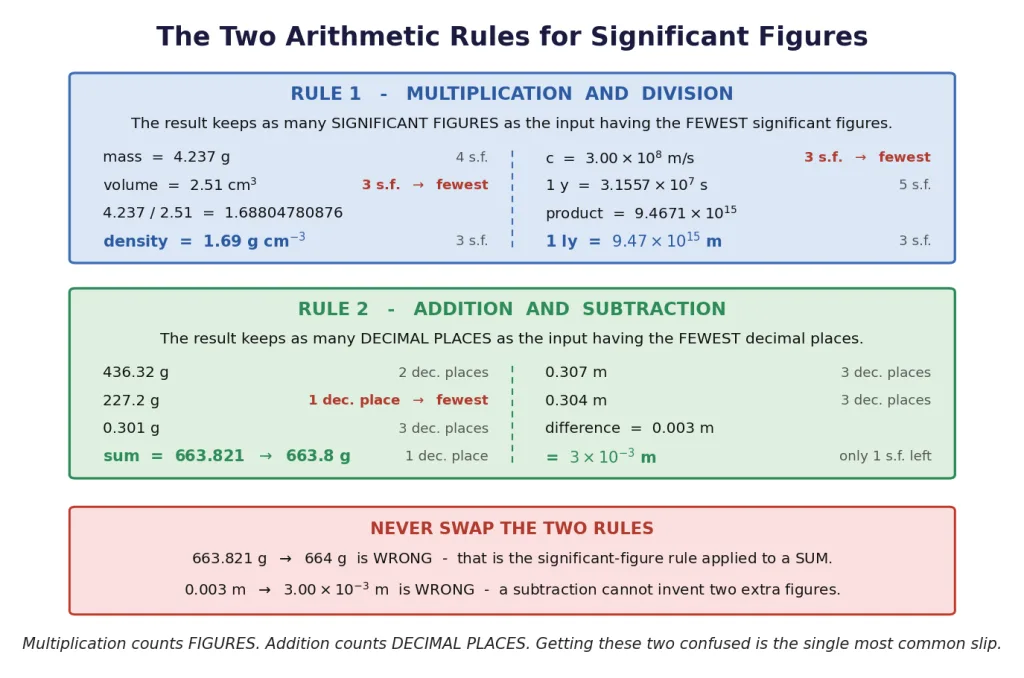
Let's break this down with a concrete case. Suppose you measure the mass of an object as 4.237 g (4 significant figures) and its volume as 2.51 cm (3 significant figures). Density is mass over volume, so you punch it into a calculator:
Eleven decimal places. Here is the thing: that number is a lie. Your volume measurement was only good to three figures — you had no idea whether the true volume was 2.505 or 2.514 cm. So where exactly did the "80876" at the end come from? Not from the laboratory. It came from the calculator's willingness to keep dividing.
Key Point: The result of a calculation involving approximate measured values must reflect the uncertainties in the original measured values. It cannot be more accurate than the original measured values themselves on which the result is based. In general, the final result should not have more significant figures than the original data from which it was obtained.
The one idea behind both rules
Every rule in this section is that sentence, made mechanical. A calculation cannot manufacture precision. If one of your inputs is sloppy, the answer is sloppy — and your job is to report it as sloppy rather than dress it up with digits nobody measured.
So the honest answer to the density problem is
three significant figures, matching the weakest input.
[Board Important] Writing 1.688 or 1.6880 in a Board answer is a marks-losing mistake even though the arithmetic is flawless. Precision is part of the answer, not decoration.
Two rules, and they are different
There are exactly two rules, and the whole topic hinges on not mixing them up:
| Operation | What you count | What limits the answer |
|---|---|---|
| Multiplication, division | Significant figures | The input with the FEWEST significant figures |
| Addition, subtraction | Decimal places | The input with the FEWEST decimal places |
Read that table twice. Multiplication counts figures; addition counts decimal places. Students who memorise "least significant figures" for everything get every addition question wrong.
Rule 1 — Multiplication and Division
Key Point (Rule 1): In multiplication or division, the final result should retain as many significant figures as are there in the original number with the least significant figures.
How to apply it in three steps
- Count the significant figures in every input (Section 2's counting rules do this job).
- Do the arithmetic in full, exactly as the calculator gives it.
- Round the answer to the smallest of those counts.
Notice that step 3 comes last. You do not round the inputs first — you round the answer.
Worked case 1: the density again
- g → 4 significant figures
- cm → 3 significant figures ← the weakest link
- Raw quotient:
- Round to 3 significant figures: 1.69 g cm
Worked case 2: the light year
The speed of light is m s (three significant figures) and one year, with d, is s (five significant figures). A light year is the distance light covers in one year:
The weakest input has 3 significant figures, so
[JEE/NEET] The powers of ten never enter the count — only the base numbers do. That is exactly why Section 2 pushed you towards scientific notation before this section arrived.
Things that do NOT limit your answer
Some numbers in a formula carry infinite significant figures and can never be the weakest link (Section 2 covered why):
- exact counted numbers, like the in ;
- exact defined factors, like the 2 in or in ;
- exact unit conversions, like cm;
- mathematical constants such as — take as many of its digits as you need.
[JEE Tip] A very common trap: "A wire of radius 0.35 cm… find the area of cross-section." . The does not count, the 0.35 does. Answer to 2 significant figures.
The rule survives chains
If a calculation multiplies and divides four quantities, you still take the single smallest significant-figure count in the whole chain. A chain of multiplications is no worse than its worst measurement — but no better either.
Rule 2 — Addition and Subtraction
Here is where careful students still lose marks, because the rule changes shape completely.
Key Point (Rule 2): In addition or subtraction, the final result should retain as many decimal places as are there in the number with the least decimal places.
Not significant figures. Decimal places.
Why the rule has to change
Think of it this way. When you add, the numbers are lined up at the decimal point. If one of your measurements is blind past the first decimal place, then the sum is blind past the first decimal place too — no matter how many digits the other measurements carry. Uncertainty lives in a column, not in a count.
A worked sum
Add 436.32 g, 227.2 g and 0.301 g.
| Measurement | Decimal places | Significant figures |
|---|---|---|
| 436.32 g | 2 | 5 |
| 227.2 g | 1 ← least | 4 |
| 0.301 g | 3 | 3 |
Straight arithmetic gives g. But the least precise measurement, 227.2 g, is correct to only one decimal place. The final result must therefore be rounded off to
Key Point: Notice what would happen if you wrongly applied Rule 1 here. The fewest significant figures among the inputs is 3 (in 0.301 g), which would give 664 g — and that is wrong. It does not convey the precision of the measurement properly.
A worked difference
Both inputs have three decimal places, so the answer keeps three decimal places: 0.003 m. Written in scientific notation that is m — a single significant figure.
And again, do not be tempted to write m because the inputs "had 3 significant figures each". Subtraction cannot invent two extra reliable digits.
Subtraction is a precision destroyer
Look at what just happened. Two measurements each carrying 3 significant figures produced an answer carrying 1. That is not a mistake in the rule — it is a real physical effect, and it has a name: loss of significance.
Another instance: , both specified to three significant figures, cannot properly be evaluated as 5.84 g but only as 5.8 g — because 12.9 g has only one decimal place.
Key Point: If a set of experimental data is specified to significant figures, a result obtained by combining the data will also be valid to significant figures. However, if data are subtracted, the number of significant figures can be reduced.
[JEE Tip] Whenever an experiment asks you to subtract two nearly equal readings — a final minus an initial temperature, two vernier readings, two nearly equal lengths — expect the answer to have far fewer significant figures than the inputs. Examiners love that gap.
[NEET Important] Mixed expressions are handled one operation at a time: apply Rule 2 to the bracketed sum or difference first, note how many figures survive, and only then apply Rule 1 to the multiplication.
Rounding Off the Uncertain Digits
Both rules end with the same instruction — "round off" — so we had better be precise about what that means.
Key Point: The result of a computation with approximate numbers, which contains more than one uncertain digit, should be rounded off.
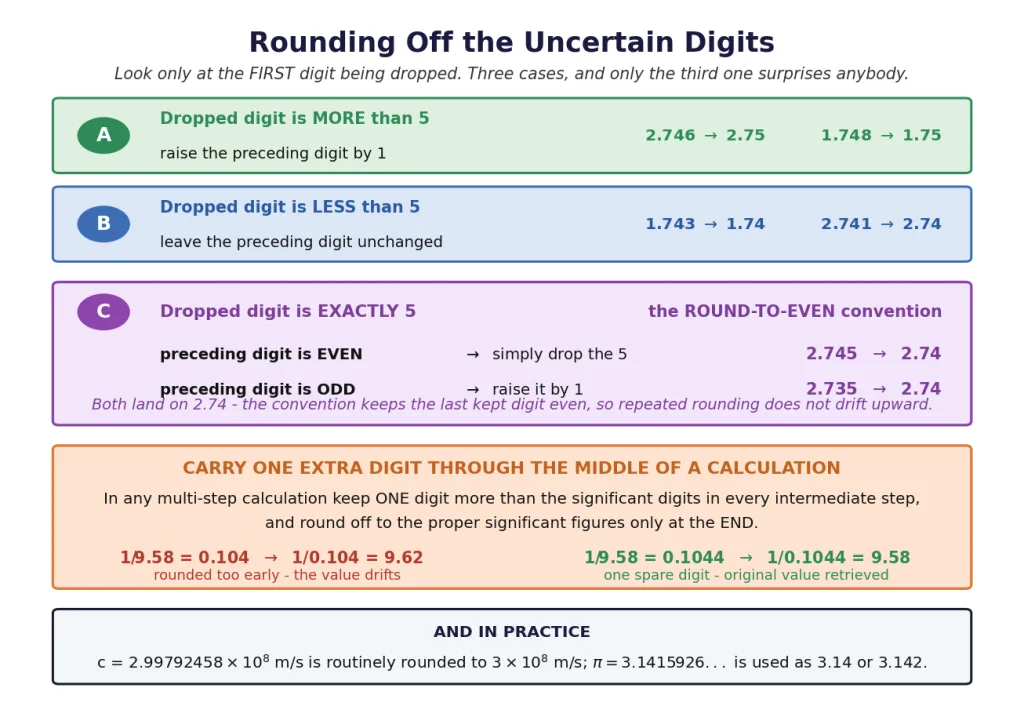
You look at exactly one thing: the first digit you are about to drop (the insignificant digit).
The two easy cases
Key Point: The preceding digit is raised by 1 if the insignificant digit to be dropped is more than 5, and is left unchanged if it is less than 5.
- to three significant figures (dropped 6, which is more than 5, so 4 becomes 5).
- to three significant figures (dropped 3, which is less than 5, so 4 stays).
The case that catches everybody: the insignificant digit is exactly 5
Now what about 2.745, where the digit to be dropped is exactly 5? Rounding up would systematically nudge every such number upward, and over a long calculation those nudges accumulate into a genuine bias. So physics uses a fairer convention.
Key Point (Round-to-even convention): If the insignificant digit to be dropped is 5, then — if the preceding digit is even, the insignificant digit is simply dropped; and if the preceding digit is odd, the preceding digit is raised by 1.
Both examples land on the same answer, which is the fastest way to remember the rule:
| Number | Preceding digit | Even or odd? | Action | Result (3 s.f.) |
|---|---|---|---|---|
| 2.745 | 4 | even | drop the 5 | 2.74 |
| 2.735 | 3 | odd | raise 3 to 4 | 2.74 |
The point of the convention is right there in the answer column: whichever side you approach from, you end on an even last digit. Half the borderline cases round down and half round up, so the bias cancels out instead of piling up.
[JEE Tip] Examiners test this with pairs designed to look identical. but (5 is odd, so it goes up). If you round both up out of habit, you get one of them wrong.
Key Point: The round-to-even convention applies only when the digit to be dropped is exactly 5 with nothing after it. If it is 2.7451, the dropped part is more than 5, so you round up normally: .
Multi-Step Calculations: Carry One Spare Digit
Suppose a problem needs three operations before you get an answer. Should you round after every step?
No. Rounding early throws away information you still need, and the errors compound.
Key Point: In any involved or complex multi-step calculation, you should retain, in intermediate steps, one digit more than the significant digits, and round off to proper significant figures only at the end of the calculation.
The proof that this matters
Take the number 9.58 and go there and back by reciprocals.
The careless way — round at every step:
You started at 9.58 and came back to 9.62. The value has drifted, purely from rounding.
The careful way — keep one spare digit in the middle:
Exactly the number you started with. One spare digit was all it took.
Key Point: Intermediate results in a multi-step computation should be calculated to one more significant figure in every measurement than the number of digits in the least precise measurement. Otherwise rounding errors build up.
Rounding a very well-known constant
Some constants are known to far more figures than your calculation needs, and it is perfectly legitimate to trim them:
- The speed of light in vacuum is m s, and is routinely rounded to the approximate value m s for computations.
- is known to a large number of significant figures. You may take it as 3.142 or 3.14, with a limited number of significant figures as required in specific cases.
[JEE Tip] If a numerical problem hands you data to 3 significant figures, using is fine. If the data is to 5 figures, using 3.14 will corrupt your answer — step up to 3.1416. Match the constant to the data.
The working habit to adopt
- Do not round the given data.
- Carry one extra digit through every intermediate line of your solution.
- Decide the correct number of significant figures from the original data using Rule 1 or Rule 2.
- Round once, at the very last line, and state the units.
[Board Important] Show the unrounded intermediate value and then the rounded final answer. Examiners award the method mark for the working and the accuracy mark for the correct rounding — you want both.
Uncertainty in the Result of a Calculation
Significant figures are a coarse tool: they tell you how many digits to keep, but not how much your answer could be off by. A third rule set goes one step further and attaches an actual to the result.
Start with what a reading really means
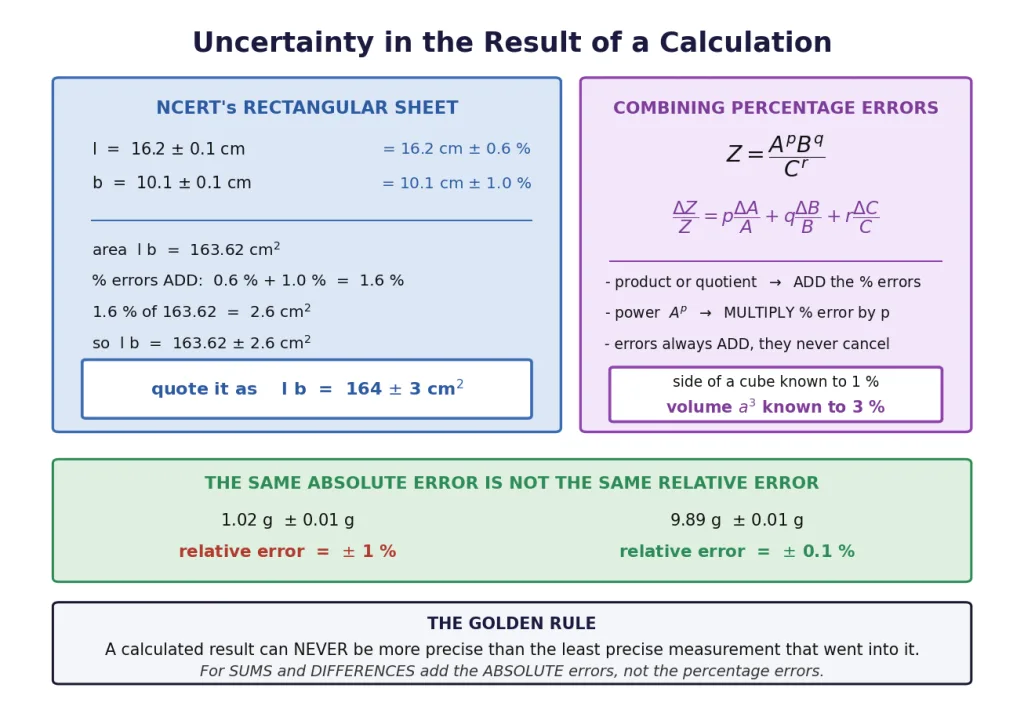
A metre scale reads to the nearest millimetre, so a length written as 16.2 cm really means cm. Convert that absolute uncertainty into a percentage:
For the breadth cm:
A worked rectangular sheet
Multiply them to get the area. For a product, the percentage errors add.
Turn that percentage back into an absolute figure: 1.6% of 163.62 is 2.6, so
An uncertainty of 2.6 in the units column makes the digits after the decimal point meaningless, so the honest way to quote this is
Here 3 cm is the uncertainty or error in the estimation of the area of the rectangular sheet.
The combination rules
For a quantity built out of measured quantities as
the fractional (and hence percentage) errors combine as
Three things to notice, because all three are tested:
- For a product or a quotient, you add the percentage errors. Division does not subtract them.
- For a power, you multiply the percentage error by the exponent. A side measured to 1% gives a volume good to 3%.
- Errors always add. They never cancel, because you are estimating the worst case.
Key Point: For sums and differences, add the absolute errors, not the percentage errors. The percentage-error rules above belong to products, quotients and powers only.
The same absolute error is not the same relative error
Key Point: The relative error of a value specified to significant figures depends not only on but also on the number itself.
A balance accurate to g gives two readings:
| Reading | Absolute error | Relative error |
|---|---|---|
| 1.02 g | g | % |
| 9.89 g | g | % |
Same instrument, same absolute error, ten times the relative error. That is why experimenters prefer to make a measurement near the top of an instrument's range.
[JEE/NEET] This is why you weigh a sample of about 10 g rather than about 1 g on the same balance, and why you time 20 oscillations rather than 1. Increasing the measured quantity shrinks the relative error without touching the instrument.
Where this goes next
The full machinery — systematic versus random errors, absolute error , mean absolute error, the derivation of the propagation formulae, and the least count of a vernier calliper and screw gauge — is competitive-exam territory and lives in Section 7 (JEE Corner). What you have here is the Board-level statement — exactly what the Board paper asks for.
Solved Examples
Example 1: The cube
Each side of a cube is measured to be 7.203 m. What are the total surface area and the volume of the cube to appropriate significant figures?
Solution:
- Count the input figures. The measured length 7.203 m has 4 significant figures (all non-zero digits plus a sandwiched zero). Since area and volume come from multiplication, Rule 1 applies and both answers must be rounded to 4 significant figures.
- Surface area. A cube has 6 identical faces, so . The 6 is an exact counted number and does not limit anything.
- Round to 4 significant figures. The four digits to keep are 3, 1, 1, 2; the first digit dropped is 9, which is more than 5, so the 2 is raised to 3.
- Volume. .
- Round to 4 significant figures. Keep 3, 7, 3, 7; the first dropped digit is 1, less than 5, so the 7 stays.
Final Answer: Surface area m, volume m.
Takeaway: One measurement with 4 significant figures in, two answers with 4 significant figures out. The exact factor 6 and the exponents 2 and 3 never affect the count.
Example 2: Density of a substance
5.74 g of a substance occupies 1.2 cm. Express its density by keeping the significant figures in view.
Solution:
- Count both inputs. There are 3 significant figures in the measured mass 5.74 g, whereas there are only 2 significant figures in the measured volume 1.2 cm.
- Identify the weakest link. Division means Rule 1, so the density should be expressed to only 2 significant figures.
- Divide in full.
- Round to 2 significant figures. Keep 4 and 7; the first dropped digit is 8, which is more than 5, so the 7 is raised to 8.
Final Answer: g cm.
Takeaway: A single carelessly measured quantity — that 1.2 cm — drags a 3-figure mass measurement down to a 2-figure answer. In the lab, the cheapest way to improve a result is to improve its worst measurement.
Example 3: Density again, with sharper data
The mass of an object is measured as 4.237 g and its volume as 2.51 cm. Report its density correctly.
Solution:
- Count: 4.237 g → 4 significant figures; 2.51 cm → 3 significant figures (the least).
- Divide:
- Recognise the absurdity. Eleven decimal places from data good to three figures is meaningless — the calculator is reporting digits your data never contained.
- Round to 3 significant figures: the three digits kept are 1, 6, 8, and the first digit dropped is the next 8, which is more than 5 — so the third digit is raised from 8 to 9.
Final Answer: density g cm.
Takeaway: Trust the rule over the display. A calculator has no idea which of your digits came from an instrument.
Example 4: The light year
Given the speed of light as m s and one year as s, calculate one light year to the correct number of significant figures.
Solution:
- Count: → 3 significant figures (the trailing zeros after the decimal point are significant). → 5 significant figures. Only the base numbers count; the powers of ten are irrelevant.
- Multiply, base numbers and powers separately.
- Apply Rule 1. The least count of significant figures is 3, so round to 3 figures. The first dropped digit is 7, more than 5, so the 6 is raised to 7.
Final Answer: light year m.
Takeaway: Scientific notation makes Rule 1 almost free — multiply the base numbers, add the exponents, and round the base number to the smallest input count.
Example 5: Addition and subtraction together
(a) Add 436.32 g, 227.2 g and 0.301 g. (b) Subtract 0.304 m from 0.307 m. Give both answers correctly.
Solution:
- (a) List the decimal places: 436.32 → 2; 227.2 → 1 (the least); 0.301 → 3.
- Add in full: g.
- Round to 1 decimal place. The first dropped digit is 2, less than 5, so the 8 stays: 663.8 g.
- Check the trap: the fewest significant figures among the inputs is 3, which would suggest 664 g. That is wrong — for addition the rule is in terms of decimal places, not significant figures.
- (b) Both inputs have 3 decimal places, so the answer keeps 3 decimal places:
- Do not "improve" it to m. Only one significant figure survived, and that is the honest report.
Final Answer: (a) 663.8 g (b) m.
Takeaway: These are the two errors to watch for — 664 g and m. Knowing the wrong answers is as useful as knowing the right ones.
Example 6: Subtraction destroys significant figures
Evaluate , both quantities being specified to three significant figures.
Solution:
- Decimal places: 12.9 g has 1; 7.06 g has 2. The least is 1.
- Subtract in full: g.
- Round to 1 decimal place: the first dropped digit is 4, less than 5, so the 8 stays.
- Count what survived: the answer 5.8 g has only 2 significant figures, though both inputs had 3.
Final Answer: 5.8 g.
Takeaway: If data are subtracted, the number of significant figures can be reduced, because uncertainties in addition and subtraction combine through decimal places rather than through figure counts.
Example 7: A rounding-off drill
Round each of the following to three significant figures: (i) 2.746 (ii) 1.743 (iii) 2.745 (iv) 2.735 (v) 0.08256 (vi) 12.45.
Solution:
- (i) 2.746: the digit dropped is 6, which is more than 5, so the preceding 4 is raised. → 2.75
- (ii) 1.743: the digit dropped is 3, less than 5, so the preceding 4 is unchanged. → 1.74
- (iii) 2.745: the digit dropped is exactly 5. The preceding digit is 4, which is even, so the 5 is simply dropped. → 2.74
- (iv) 2.735: the digit dropped is exactly 5. The preceding digit is 3, which is odd, so it is raised by 1. → 2.74
- (v) 0.08256: the leading zeros are not significant, so the three figures kept are 8, 2, 5. The dropped digit is 6, more than 5, so the 5 is raised. → 0.0826
- (vi) 12.45: the dropped digit is exactly 5 and the preceding digit is 4, which is even, so drop it. → 12.4
Final Answer: 2.75, 1.74, 2.74, 2.74, 0.0826, 12.4.
Takeaway: Parts (iii) and (iv) approach 2.74 from opposite sides and both land on it. Whenever a trailing 5 is the only thing you are dropping, the answer's last digit will always come out even.
Example 8: Area and volume of a rectangular sheet
The length, breadth and thickness of a rectangular sheet of metal are 4.234 m, 1.005 m and 2.01 cm respectively. Give the area and volume of the sheet to correct significant figures.
Solution:
- Convert to one unit system first. m. Converting units does not change the count (Section 2), so still has 3 significant figures.
- Count all three: 4.234 → 4; 1.005 → 4; 0.0201 → 3 (the least). Both answers must be rounded to 3 significant figures.
- Total surface area :
- Round to 3 significant figures: the first dropped digit is 0, less than 5. → m.
- Volume :
- Round to 3 significant figures. The figures kept are 8, 5, 5 (the leading zeros do not count); the first dropped digit is 2, less than 5. → m.
Final Answer: m, m.
Takeaway: Convert units before you calculate, keep the full products through the middle, and round once at the end. The 2 in is exact and never limits the count.
Example 9: A multi-step calculation done properly
Show, by taking reciprocals twice, why you should carry one extra digit through intermediate steps. Start from 9.58, which is known to three significant figures.
Solution:
- The careless route. , rounded to three significant figures is .
- Now take the reciprocal again: , rounded to three significant figures is .
- Compare: you started at 9.58 and returned to 9.62. Rounding in the middle shifted the value by 0.04 — larger than the uncertainty in the original measurement.
- The careful route. Keep one extra digit: .
- Take the reciprocal: , which rounds to — the original value, retrieved exactly.
Final Answer: Rounding early gives 9.62; carrying one spare digit gives back 9.58.
Takeaway: That is the whole justification for the extra-digit habit. Round the answer, never the working.
Example 10: A rectangular sheet with uncertainties
The length and breadth of a thin rectangular sheet are measured with a metre scale as 16.2 cm and 10.1 cm. Find the area with its uncertainty.
Solution:
- Read the least count into the data. A metre scale resolves to 1 mm, so each measurement carries cm:
- Convert to percentage errors. so cm % and cm %.
- Multiply and add the percentage errors (the product rule):
- Convert back to an absolute uncertainty: 1.6% of cm, so cm.
- Quote it sensibly. With an uncertainty of about 3 in the units place, the decimals are meaningless.
Final Answer: cm.
Takeaway: The uncertainty decides where the answer must be truncated — here it forces a 5-digit product down to 3 digits. Percentage errors add for a product; they never cancel.
Example 11: Same instrument, very different relative error
A balance reads to g. Two samples weigh 1.02 g and 9.89 g. Compare their relative errors and comment.
Solution:
- First sample: relative error , i.e. about %.
- Second sample: relative error , i.e. about %.
- Compare: the absolute error is identical, but the relative error of the lighter sample is about ten times larger.
- Comment: the relative error of a value specified to significant figures depends not only on but also on the number itself. Both readings have 3 significant figures, yet they are not equally trustworthy in percentage terms.
Final Answer: % for 1.02 g and % for 9.89 g.
Takeaway: Measure near the top of an instrument's range whenever you can. Weighing 10 g instead of 1 g on the same balance improves your result tenfold, for free.
Example 12: Density with its percentage error
A body has mass g and volume cm. Find its density and the percentage error in it, and quote the result properly.
Solution:
- Density from Rule 1. The volume has only 2 significant figures, so the density is reported to 2:
- Percentage error in mass: .
- Percentage error in volume: .
- A quotient adds the percentage errors:
- Absolute uncertainty: 8.5% of , which rounds to 0.4 g cm.
Final Answer: g cm, a percentage error of about 8.5%.
Takeaway: Look at where the error came from — 8.3 of the 8.5 percentage points are the volume's fault. Both the significant-figure rule and the error rule point their finger at the same weak measurement, which is exactly the point of this whole section.