
How to Use This Section
This is the last section of the chapter, and it is built for one job: to be read the night before the paper — and again in the queue outside the hall.
Nothing new is taught here. Every card below is a compression of something Sections 1 to 10 worked through properly, in the same notation, so if a line surprises you, that is your signal to go back and reread that section rather than to memorise the line.
Six cards, one mistake checklist, one 60-second panic list. Screenshot the three figures.
Card 1 — Units and the SI System
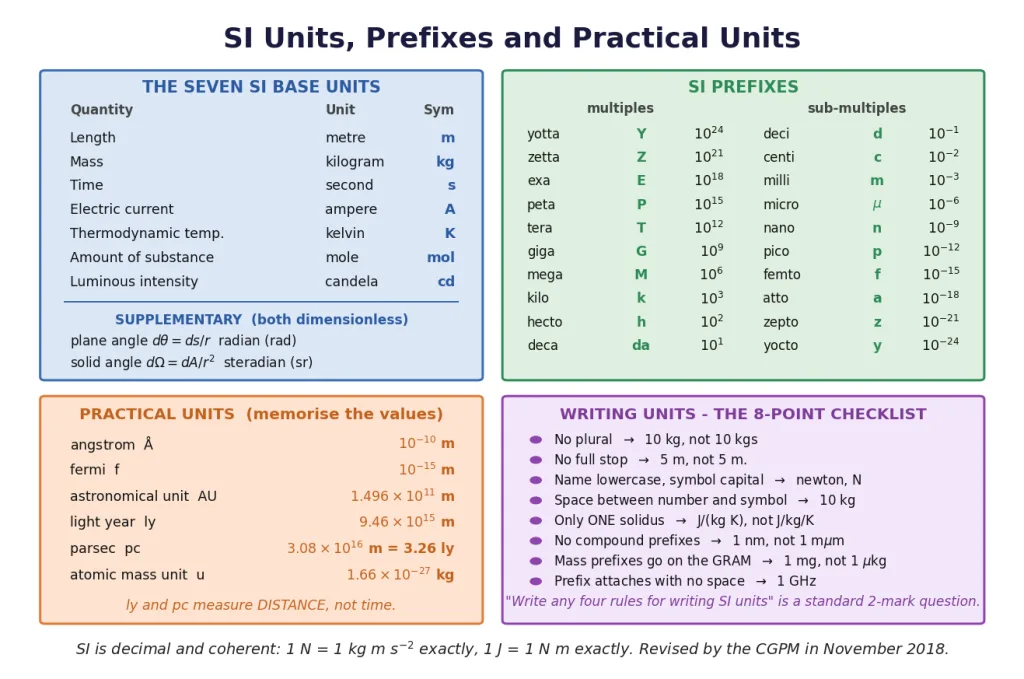
The seven SI base units
| Base quantity | SI unit | Symbol | Defined through |
|---|---|---|---|
| Length | metre | m | speed of light |
| Mass | kilogram | kg | Planck constant |
| Time | second | s | caesium-133 frequency |
| Electric current | ampere | A | elementary charge |
| Thermodynamic temperature | kelvin | K | Boltzmann constant |
| Amount of substance | mole | mol | Avogadro number |
| Luminous intensity | candela | cd | luminous efficacy |
Key Point: SI is an extension of MKS, revised by the General Conference on Weights and Measures in November 2018 so that every base unit rests on a constant of nature, not on a man-made artefact. The kilogram is the only base unit that already carries a prefix — which is why mass multiples are formed on the gram (1 mg, never "1 μkg").
The two supplementary units — both dimensionless
| Quantity | Definition | Unit | Full value |
|---|---|---|---|
| Plane angle | radian (rad) | full circle rad | |
| Solid angle | steradian (sr) | full sphere sr |
rad, so rad, rad, rad.
SI prefixes
| Multiple | Symbol | Factor | Sub-multiple | Symbol | Factor |
|---|---|---|---|---|---|
| yotta | Y | deci | d | ||
| zetta | Z | centi | c | ||
| exa | E | milli | m | ||
| peta | P | micro | μ | ||
| tera | T | nano | n | ||
| giga | G | pico | p | ||
| mega | M | femto | f | ||
| kilo | k | atto | a | ||
| hecto | h | zepto | z | ||
| deca | da | yocto | y |
Practical units worth memorising
| Unit | Symbol | Value |
|---|---|---|
| angstrom | Å | m |
| fermi | f | m |
| astronomical unit | AU | m |
| light year | ly | m |
| parsec | pc | m ly |
| unified atomic mass unit | u | kg |
Also worth carrying: 1 y s, 1 L , 1 t kg, 1 bar Pa, 1 atm Pa, 1 ha , 1 barn .
[JEE/NEET] Light year and parsec measure distance, not time. Ranking: AU < light year < parsec.
Writing units correctly — the 8-point checklist
- Symbols are never pluralised — 10 kg, not 10 kgs.
- No full stop after a symbol — 5 m, not 5 m.
- Unit name is lowercase, unit symbol is capitalised — newton, N.
- Leave a space between number and symbol — 10 kg, not 10kg.
- Use only one solidus — or J/(kg K), never J/kg/K.
- No compound prefixes — 1 nm, not 1 mμm.
- Mass prefixes attach to the gram — 1 mg, not 1 μkg.
- A prefix attaches with no space — 1 GHz, not 1 G Hz.
Key Point (Board): "Write any four rules for writing SI units" is a standard 2-mark question. Four of the eight, learnt cold, are four free marks.
Card 2 — Significant Figures, Rounding and Order of Magnitude
A measured value carries all the digits known reliably, plus the first uncertain digit. That is the whole topic in one sentence.
Counting: the five rules
| # | Rule | Examples |
|---|---|---|
| 1 | All non-zero digits are significant | 287.5 → 4; 1.62 → 3 |
| 2 | Zeros between two non-zero digits are significant | 2.308 → 4; 1005 → 4 |
| 3 | In a number less than 1, zeros before the first non-zero digit are not significant | 0.002308 → 4; 0.1250 → 4 |
| 4 | Trailing zeros without a decimal point are not significant | 12300 cm → 3 |
| 5 | Trailing zeros with a decimal point are significant | 3.500 → 4; 0.06900 → 4 |
Key Point: A change of units cannot change the count. 2.308 cm 0.02308 m 23.08 mm — four significant figures every time. Writing the value as with removes every trailing-zero ambiguity, because only the digits of the base number are counted and the power of ten is irrelevant.
Arithmetic: the two rules, and they are different
| Operation | You count | The answer keeps |
|---|---|---|
| Multiplication, division | significant figures | the least number of significant figures among the inputs |
| Addition, subtraction | decimal places | the least number of decimal places among the inputs |
- (3 s.f., set by 2.51).
- g (1 decimal place, set by 227.2). Applying the multiplication rule here would give 664 g, which is wrong.
- m m. Two 3-figure inputs, a 1-figure answer: subtraction destroys significance.
Exact numbers have infinite significant figures
The 2 in , the 2 in , the in (you counted the oscillations), defined conversions like 1 m cm, and itself — none of them can ever be the weakest link.
[JEE Tip] 20 oscillations timed as 32.4 s gives s to three significant figures. The 20 is exact and limits nothing.
Rounding off
Key Point: Look only at the first digit being dropped.
- dropped digit more than 5 → raise the preceding digit by 1 ()
- dropped digit less than 5 → leave it unchanged ()
- dropped digit exactly 5 → round to even: preceding digit even, drop the 5 (); preceding digit odd, raise it (, )
Round-to-even applies only when the dropped part is exactly 5 with nothing after it. by the ordinary rule.
In a multi-step calculation, carry one extra digit through the intermediate lines and round once, at the end.
Order of magnitude
Write the quantity as . Then
| Quantity | Value | Order |
|---|---|---|
| Diameter of the Earth | m | 7 |
| Height of Mt Everest | m | 4 (8.8 > 5) |
| Diameter of a hydrogen atom | m | |
| Mass of an electron | kg | (9.1 > 5) |
The Earth is orders of magnitude larger than a hydrogen atom.
Card 3 — The Dimensional Formula Master Table
This is the highest-value card in the chapter. Dimensions are the powers to which the base quantities are raised, written in square brackets; magnitudes are deliberately thrown away, so a snail and a photon share the dimensions .
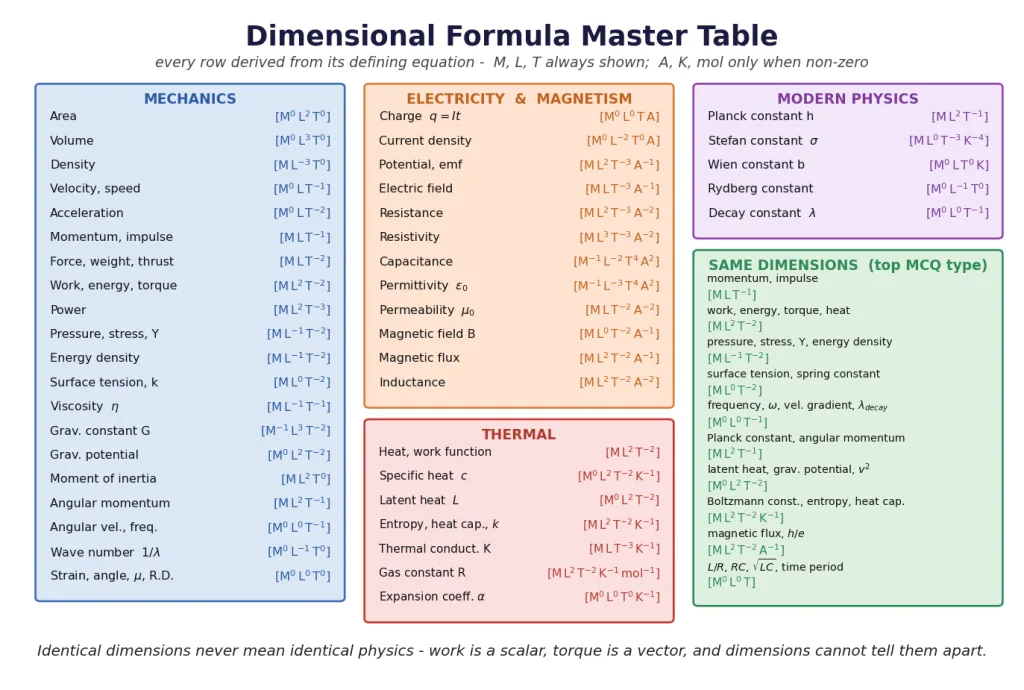
Notation used throughout the chapter: , , are always written out (with an explicit zero power where it applies); , and appear only when their power is non-zero.
Mechanics
| Quantity | Defining relation | Dimensional formula |
|---|---|---|
| Area | ||
| Volume | ||
| Density | ||
| Velocity, speed | ||
| Acceleration | ||
| Momentum, impulse | , | |
| Force, weight, thrust | ||
| Work, energy, torque, heat | ||
| Power | ||
| Pressure, stress, Young's modulus | ||
| Energy density | ||
| Surface tension, spring constant | ||
| Coefficient of viscosity | ||
| Gravitational constant | ||
| Gravitational potential, latent heat | , | |
| Moment of inertia | ||
| Angular momentum | ||
| Angular velocity, frequency | , | |
| Wave number | ||
| Strain, angle, , refractive index, relative density | ratio of like quantities |
Electricity and magnetism
| Quantity | Defining relation | Dimensional formula |
|---|---|---|
| Electric charge | ||
| Current density | ||
| Potential, emf | ||
| Electric field | ||
| Resistance | ||
| Resistivity | ||
| Capacitance | ||
| Permittivity | ||
| Permeability | ||
| Magnetic field | ||
| Magnetic flux | ||
| Self-inductance |
Thermal and modern physics
| Quantity | Defining relation | Dimensional formula |
|---|---|---|
| Specific heat capacity | ||
| Heat capacity, entropy, Boltzmann constant | ||
| Thermal conductivity | ||
| Gas constant | ||
| Coefficient of linear expansion | ||
| Planck constant | ||
| Stefan constant | ||
| Wien constant | ||
| Rydberg constant | ||
| Decay constant | ||
| Work function | an energy |
Quantities with identical dimensions — the highest-frequency MCQ in the chapter
| Group | Common dimensional formula |
|---|---|
| impulse, linear momentum | |
| work, energy, torque, heat, work function | |
| pressure, stress, Young's modulus, bulk modulus, energy density | |
| surface tension, spring constant, surface energy per unit area | |
| frequency, angular velocity, velocity gradient, decay constant | |
| Planck constant, angular momentum | |
| latent heat, gravitational potential, | |
| Boltzmann constant, entropy, heat capacity | |
| magnetic flux, | |
| , , , time period |
Key Point: Identical dimensions never mean identical physics. Work is a scalar and torque is a vector; dimensions record the recipe, not the meaning.
Dimensionless, unitless, or both?
| Category | Examples |
|---|---|
| Has dimensions and a unit | force, energy, pressure — the vast majority |
| No dimensions but has a unit | plane angle (radian), solid angle (steradian) |
| No dimensions and no unit | strain, refractive index, relative density, coefficient of friction |
There is no fourth box — nothing has dimensions but no unit.
Card 4 — Dimensional Analysis
The principle of homogeneity
Key Point: Only quantities with the same dimensions can be added or subtracted. Therefore in any correct physical equation, (1) every term that is added or subtracted carries the same dimensions, and (2) the left-hand side and the right-hand side carry the same dimensions.
Pure numbers (, , , ) are and vanish. The argument of any , , or must be dimensionless.
Application 1 — checking an equation
Check every term separately. For :
Key Point (the one-way rule): Dimensionally wrong certainly wrong. Dimensionally right not yet proved right. Dimensional correctness is necessary but not sufficient.
Application 2 — deducing a relation
Key Point — the recipe:
- Assume a product form: , with a dimensionless constant.
- Replace every symbol, including the left-hand side, by its dimensional formula.
- Collect the powers of , , using the laws of indices.
- Equate the exponent of each base quantity separately — three base quantities, three equations.
- Solve for , , and substitute back.
The pendulum: assuming gives , , , so . The zero exponent is a real prediction — the period does not depend on the mass of the bob. Only experiment (or Chapter 13) supplies .
Application 3 — converting between systems
Since the magnitude of a quantity does not depend on the system used to describe it,
where , , are the exponents in , subscript 1 is the old system and subscript 2 the new one. Every ratio is old over new.
| Quantity | Formula | Working | Result |
|---|---|---|---|
| Force | 1 N dyne | ||
| Energy, work | 1 J erg | ||
| Power | 1 W erg per second |
Key Point (the check that never fails): Bigger unit smaller number. If you move to a smaller unit and your number shrinks, you have flipped a ratio.
Limitations — learn all five
| Dimensional analysis can | Dimensional analysis cannot |
|---|---|
| prove an equation wrong | prove an equation right |
| find the powers in a product relation | find the dimensionless constant |
| convert between systems of units exactly | derive a relation that is a sum of terms, like |
| fix , , from a function's argument | handle , or themselves |
| handle up to three quantities in mechanics | handle four or more unknown exponents |
| — | tell work from torque |
Card 5 — Error Analysis and Least Count
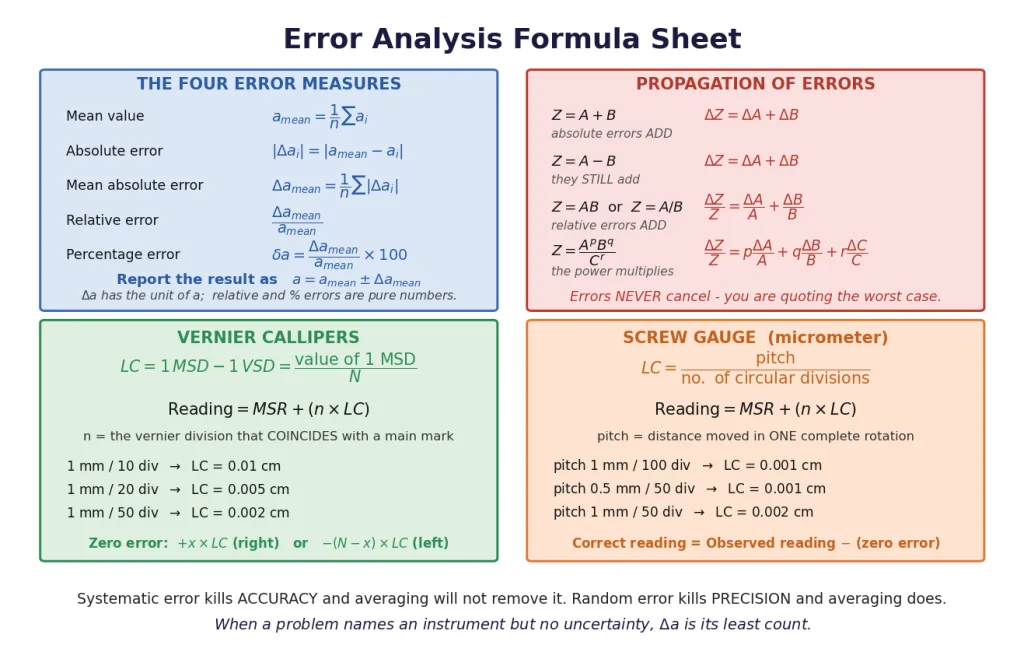
Accuracy, precision and the two families of error
Key Point: Accuracy is closeness to the true value; precision is the resolution of the measurement and how well repeated readings agree with one another. A clock running 5 minutes fast is extremely precise and completely inaccurate.
| Systematic error | Random error | |
|---|---|---|
| Sign | always the same direction | varies, both signs |
| Sources | instrumental (zero error), faulty technique, personal bias | unpredictable fluctuations |
| Damages | accuracy | precision |
| Cure | recalibrate, correct, improve technique | take many readings and average |
| Does averaging help? | No | Yes |
Least count error is the uncertainty set by the instrument's resolution. When a problem names an instrument but quotes no uncertainty, is the least count.
The four error measures
Report the result as . Take the modulus before averaging, or the deviations cancel to zero. Absolute error carries the unit of ; relative and percentage errors are pure numbers.
Propagation of errors — the four rules
| Combination | Rule |
|---|---|
| (absolute errors add) | |
| (they still add) | |
| or | (relative errors add) |
Key Point: (1) Errors always add — you are quoting a worst case, so nothing ever cancels, not even for a difference or a division. (2) The exponent enters as a positive multiplier regardless of its sign or position, so the quantity raised to the highest power dominates the error budget.
A radius measured to 2% gives a volume good to only %.
Vernier callipers
Here is the vernier division that coincides with a main scale mark. With 1 mm divisions and , mm cm.
Screw gauge
Here is the circular scale division on the reference line. Pitch 1 mm with 100 divisions gives mm cm.
Zero error, for both instruments
Note the for a negative zero error — you count backwards. Always rotate a screw gauge in one direction to avoid backlash error.
Card 6 — The Twelve Mistakes That Cost the Most Marks
Every one of these was flagged somewhere in Sections 1 to 10. They are ordered roughly by how often they actually appear in answer scripts.
1. Applying the multiplication rule to an addition. is 663.8 g (least decimal places), not 664 g (least significant figures). Multiplication counts figures; addition counts decimal places.
2. Letting an exact number limit the significant figures. In you counted the oscillations, so is exact with infinite significant figures. 20 oscillations in 32.4 s gives s — three figures, not two. The same applies to the 2 in , to , and to defined conversions like 1 m cm.
3. Rounding every trailing 5 upward. When the dropped digit is exactly 5, round to even: but . Examiners set these in pairs precisely to catch the habit.
4. Rounding at every intermediate step. then — you have drifted off your own starting value. Carry one extra digit through the middle and round once at the end.
5. Reading the order of magnitude straight off the exponent. has order 4, not 3, because . Likewise has order . Always test the base number against 5 first.
6. Forgetting to raise the conversion factor to the same power as the unit. , not . This is the single most common conversion error in Class 11, and it bites again in .
7. Feeding degrees or arcseconds into . The small-angle relation demands in radians, because the radian is the only angle unit defined as a pure ratio. Convert first: rad.
8. Inverting a ratio in the conversion formula. wants old over new. Sanity-check with "bigger unit means smaller number" every single time.
9. Claiming a dimensionally correct equation is therefore physically correct. is dimensionally perfect and physically wrong. Dimensional correctness is necessary, never sufficient — and the converse ("dimensionally wrong means wrong") is the half that is always true.
10. Trying to derive a sum by dimensional analysis. The method assumes a product of powers, so and can be checked but never derived. And no method of dimensions will ever hand you the in .
11. Assuming errors cancel. For a difference the absolute errors still add; for a quotient the relative errors still add. And the exponent multiplies the relative error, so a 2% error in a radius becomes 6% in a volume. Errors are a worst-case estimate, and worst cases never cancel.
12. Getting the negative zero error backwards. A positive zero error is , but a negative one is — you count backwards from . Then subtract it: correct reading observed reading (zero error), so a negative zero error ends up being added back on.
Key Point: Two more that cost single marks: "dimensionless" does not mean "unitless" (the radian has a unit but no dimensions), and unit-writing slips — 25 Kg, 10 secs, 5 Newtons, 8 m/s/s, 1 mμm, 3 μkg — are all worth a mark each in a Board paper.
The 60-Second Revision
You are in the queue outside the hall. This is the irreducible minimum.
Units. Seven base units: m, kg, s, A, K, mol, cd. Two supplementary and dimensionless: radian, steradian. SI extends MKS, revised November 2018 on constants of nature. Å m, 1 ly m, 1 pc m ly, 1 u kg. Light year is distance.
Significant figures. Non-zero digits count; sandwiched zeros count; leading zeros never count; trailing zeros count only with a decimal point. Multiply/divide keeps the least significant figures; add/subtract keeps the least decimal places. Exact and counted numbers have infinite significant figures. Dropped digit exactly 5 round to even.
Order of magnitude. with gives ; with gives .
Dimensions. and everything in mechanics follows from it: work/energy/torque , power , pressure/stress/Young's modulus , momentum/impulse , is , and angular momentum are both .
Dimensional analysis. Homogeneity: added terms and both sides share dimensions. Wrong dimensions wrong; right dimensions maybe. Assume and equate exponents base by base. Convert with , old over new. 1 N dyne, 1 J erg. It can never give you .
Errors. , percentage error . Sums and differences: absolute errors add. Products and quotients: relative errors add. Powers: multiply by the exponent. Errors never cancel.
Instruments. Vernier ; screw gauge ; reading ; correct reading observed zero error.
That is the whole chapter. Go and get the marks.