
Every Measurement Has a Last, Doubtful Digit
Here is an uncomfortable truth that Section 1 hinted at and this section makes explicit: every measurement involves error. Not because you were careless — because no instrument is infinitely fine.
Suppose you time a pendulum and report its period as 1.62 s. What that really says is: "the 1 and the 6 I am sure about; the 2 is my best estimate of a digit my stopwatch cannot fully resolve."
Key Point (Definition): The reported result of a measurement is a number that includes all the digits known reliably, plus the first digit that is uncertain. Together these are called the significant digits or significant figures.
So 1.62 s has 3 significant figures — two reliable, one uncertain. A length of 287.5 cm has 4 significant figures: the 2, 8 and 7 are certain, the 5 is doubtful.
Why not just write more digits?
Because writing more digits than you actually know is not "more accurate" — it is misleading. It advertises a precision your instrument never delivered.
If your metre scale has a least count of 1 mm, then reporting a length as 45.6238 cm is a fiction. You can honestly claim 45.6 cm, and nothing more.
Key Point: Significant figures tell the reader about the precision of the measurement, which depends on the least count of the instrument used. They are a statement of honesty, not of arithmetic.
[JEE/NEET] This single idea drives the whole topic. Whenever you are unsure how many figures to keep, ask: how many digits did the instrument actually justify?
What is coming next
This section teaches you to count significant figures in a given number. Section 3 then teaches you what to do when you calculate with such numbers — the multiplication, addition and rounding-off rules. Do not mix the two up; counting comes first.
The Five Counting Rules
All the rules flow from one worked example. The length 2.308 cm has four significant figures — and in other units it becomes 0.02308 m, or 23.08 mm, or 23080 μm. Every one of those still has the same four significant digits: 2, 3, 0, 8.
Key Point: A change of units cannot change the number of significant figures. The location of the decimal point is of no consequence in determining the count.
Hold on to that sentence — it is the test that every rule below must pass.
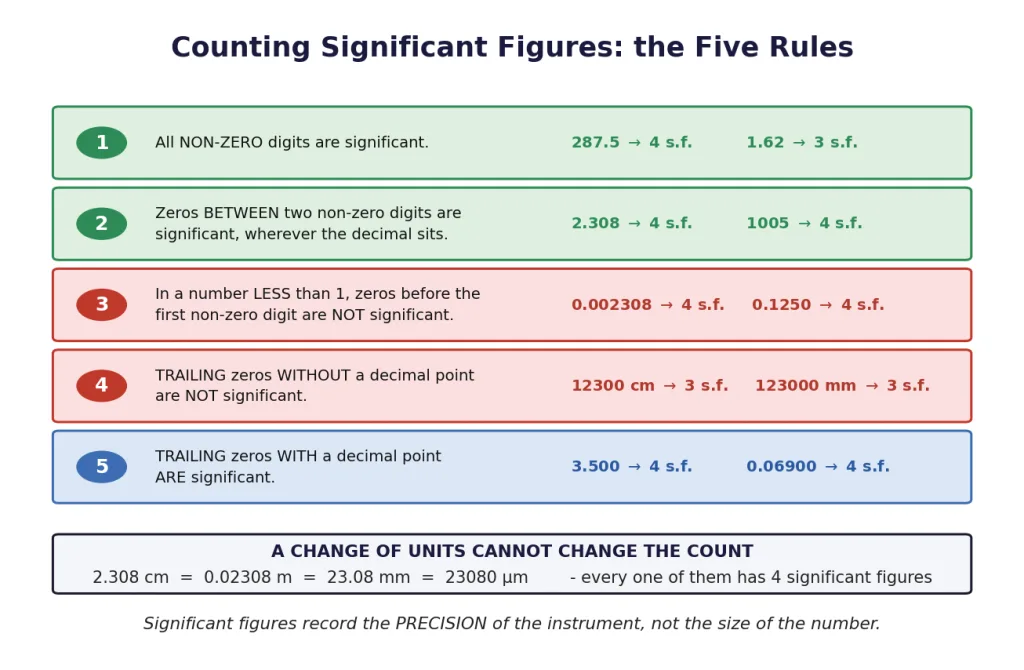
Rule 1 — All non-zero digits are significant
287.5 has 4. 1.62 has 3. 9 has 1. No exceptions, no thinking required.
Rule 2 — Zeros between two non-zero digits are significant
…no matter where the decimal point is, if at all. So 2.308 has 4, and 1005 has 4. These are sometimes called sandwiched or captive zeros.
Rule 3 — In a number less than 1, the zeros before the first non-zero digit are NOT significant
In 0.002308, the underlined zeros in 0.002308 do no measuring work at all — they are placeholders that only tell you where the decimal point sits. So 0.002308 has 4 significant figures, exactly like 2.308. And 0.1250 has 4 (the 1, 2, 5 and the trailing 0).
Note the special case built into this rule: the 0 conventionally written to the left of the decimal point in a number less than 1 (as in 0.1250) is never significant.
Rule 4 — Trailing zeros in a number WITHOUT a decimal point are NOT significant
Thus 123 m = 12300 cm = 123000 mm all have three significant figures — the trailing zeros arrived only because we changed units, and (by the boxed rule above) a change of units cannot manufacture precision.
Rule 5 — Trailing zeros in a number WITH a decimal point ARE significant
3.500 has 4. 0.06900 has 4. Here the zeros were written deliberately: if they meant nothing, it would have been superfluous to write them at all.
[JEE Tip] Rules 4 and 5 are the only two students actually get wrong. Compress them into one line: a decimal point promotes trailing zeros to significant.
The Trailing-Zero Trap and How Scientific Notation Kills It
Rules 4 and 5 rescue most cases, but there is one genuinely ambiguous situation, and it is worth walking through deliberately.
Suppose a length is reported as 4.700 m. Those two trailing zeros are clearly meant to convey precision — otherwise the experimenter would simply have written 4.7 m. So this is 4 significant figures. Now change units:
Look at the third form. 4700 mm has trailing zeros and no decimal point, so Rule 4 would say two significant figures — which is nonsense, because merely walking from metres to millimetres cannot destroy precision the experimenter earned.
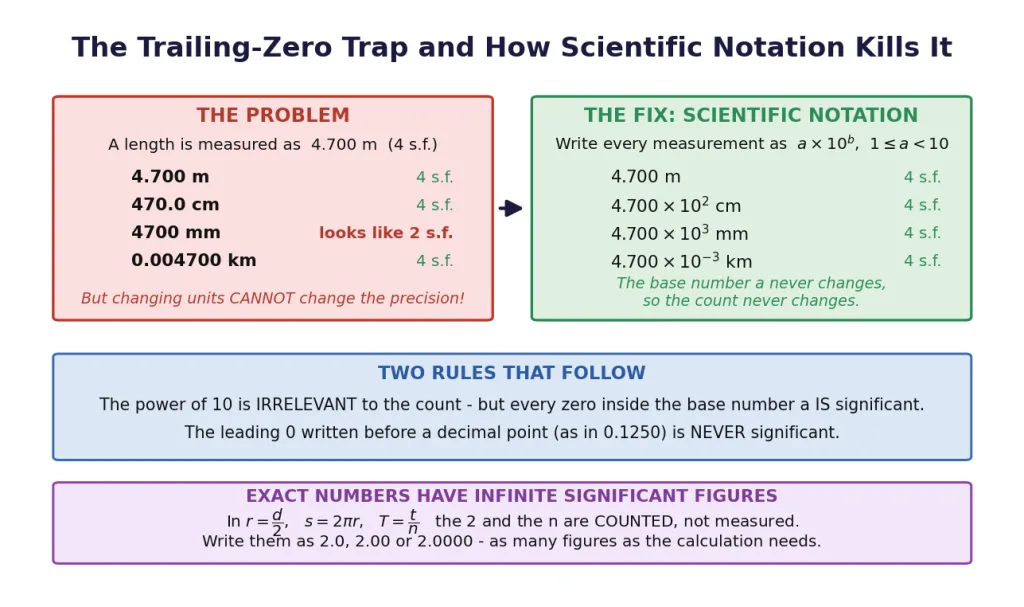
The fix: report every measurement in scientific notation
Write every number as
where is the base number and is any positive or negative integer. Then:
The base number is 4.700 in every single case — so the count is 4 in every single case, and the ambiguity simply cannot arise.
Key Point: The power of 10 is irrelevant to determining significant figures. But all zeros appearing in the base number are significant — in scientific notation, trailing zeros are always meaningful.
If scientific notation is not used
Then you fall back on the plain-language versions of Rules 4 and 5:
- For a number greater than 1 with no decimal point, the trailing zeros are not significant.
- For a number with a decimal point, the trailing zeros are significant.
[JEE Tip] In an MCQ, if you see a bare number like 5000 with no decimal and no context, the intended answer is almost always 1 significant figure. If the paper wanted more, it would have written .
Exact Numbers Have Infinite Significant Figures
Not every number in a physics formula came out of an instrument. Some are counted or defined, and those carry no uncertainty at all.
Key Point: Multiplying or dividing factors which are neither rounded numbers nor numbers representing measured values are exact, and have an infinite number of significant digits.
Three standard examples:
- In , the 2 is exact — a radius is defined as half a diameter, not measured to be half.
- In , the 2 is exact.
- In , where you time oscillations and divide, the is exact — you counted 20 swings, you did not measure "about 20".
Such a factor can be written as 2, or 2.0, or 2.00, or 2.0000 — as many figures as the rest of the calculation happens to need. It will never be the thing that limits your precision.
Defined conversions are exact too
exactly. exactly. These are definitions, not measurements, so they never cost you a significant figure.
[JEE Tip] A classic trap: "A student times 20 oscillations as 32.4 s. To how many significant figures should the period be reported?" The 20 is exact, so the answer is limited only by 32.4 (3 s.f.): s, three significant figures. Students who "round to 2 s.f. because of the 20" lose the mark.
Key Point: is also exact in the sense that it is a defined mathematical constant — use as many of its digits as you need () and let the measured quantities decide the precision of the answer.
Order of Magnitude — Physics at a Glance
Sometimes you do not want a precise value at all. You want to know: roughly how big is this thing? That is what an order of magnitude tells you, and it is the fastest sanity check in all of physics.
The recipe
Write the quantity in scientific notation as . Then round the base number:
- if , round down to 1, so the quantity and the order of magnitude is ;
- if , round up to 10, so the quantity and the order of magnitude is .
Key Point (Definition): When the quantity is expressed approximately as , the exponent is called the order of magnitude of the physical quantity.
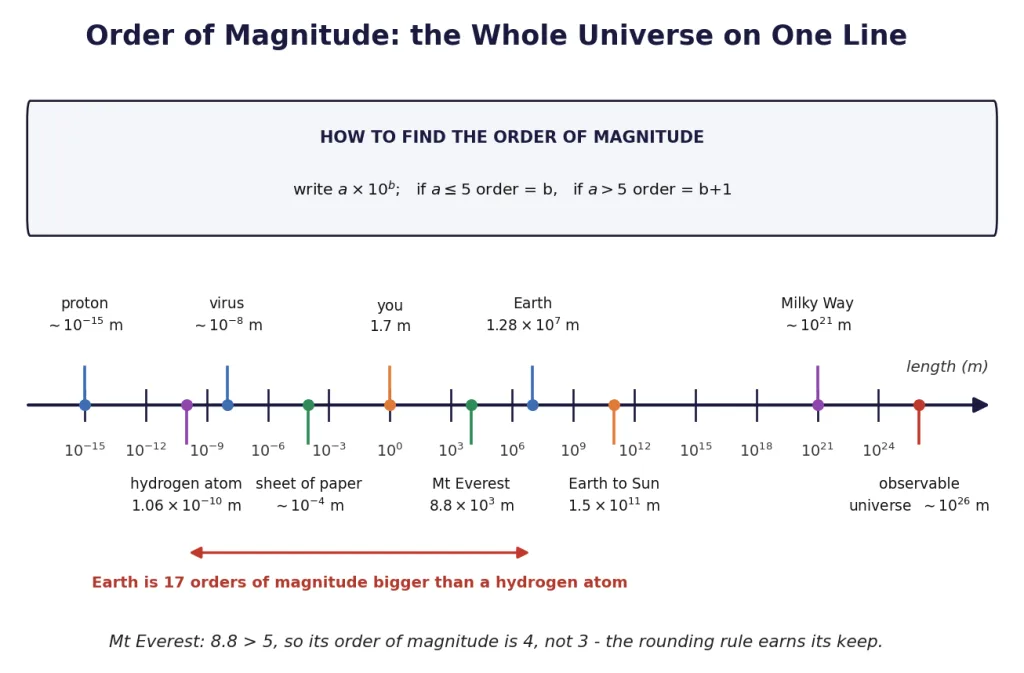
Worked instances
| Quantity | Value | Base number | Order of magnitude |
|---|---|---|---|
| Diameter of the Earth | m | 1.28 (≤ 5) | 7 |
| Diameter of a hydrogen atom | m | 1.06 (≤ 5) | −10 |
| Height of Mt Everest | m | 8.8 (> 5) | 4 |
| Speed of light | 3 (≤ 5) | 8 | |
| Mass of an electron | kg | 9.1 (> 5) | −30 |
| Planck constant | J s | 6.6 (> 5) | −33 |
Notice Mt Everest and the electron: both get bumped up one power because their base number exceeds 5. Students who skip the rounding rule and just read off the exponent get those two wrong.
Comparing sizes
The real power of the idea is comparison. The Earth is m across and a hydrogen atom is m across, so
The Earth is 17 orders of magnitude larger than a hydrogen atom. One subtraction, , replaces a messy division.
[JEE/NEET] Order-of-magnitude estimation shows up in "which of these is closest to…" questions where four options differ by powers of ten. You never need the exact arithmetic — just the exponents.
Solved Examples
Example 1: Counting practice
State the number of significant figures in: (i) (ii) kg (iii) (iv) 6.320 J (v) (vi) .
Solution:
- (i) : the zeros are only placeholders before the first non-zero digit (Rule 3). → 1 significant figure.
- (ii) : only the base number counts, the power of 10 is irrelevant. → 3.
- (iii) : leading 0 not significant; 2, 3, 7 significant; the trailing 0 after a decimal point IS significant (Rule 5). → 4.
- (iv) : three non-zero digits plus a significant trailing zero. → 4.
- (v) : the zero is sandwiched between non-zero digits (Rule 2). → 4.
- (vi) : leading zeros are placeholders; the sandwiched zero counts. → 4.
Takeaway: Parts (iii)–(vi) all give 4. Different-looking numbers, same precision — exactly what the "change of units cannot change the count" principle predicts.
Example 2: The 4.700 m problem
A length is measured as 4.700 m. Express it in cm, mm and km, and state the number of significant figures in each.
Solution:
- Convert: .
- Count naively: 4.700 → 4; 470.0 → 4; 4700 → appears to be 2; 0.004700 → 4.
- Spot the contradiction: the 4700 mm form seems to lose two figures, which is impossible — the ruler did not get worse when we said "millimetres".
- Resolve with scientific notation: .
Final Answer: All four forms have 4 significant figures.
Takeaway: Whenever trailing zeros make you hesitate, rewrite in scientific notation. The base number settles the argument immediately.
Example 3: Mixed bag
How many significant figures are in: (i) km (ii) 2.008 (iii) 200 (iv) 200.0 (v) 0.00500 (vi) ?
Solution:
- (i) Base number 4.700 → 4.
- (ii) Two sandwiched zeros between 2 and 8 → 4.
- (iii) Trailing zeros, no decimal point → 1.
- (iv) Trailing zeros WITH a decimal point → 4.
- (v) Leading zeros are placeholders, the two trailing zeros after the 5 are significant → 3.
- (vi) Base number 2.00 → 3.
Takeaway: Compare (iii), (iv) and (vi). The very same physical value, 200, can carry 1, 4 or 3 significant figures depending on how it is written. That is not a trick — it is the notation doing its job.
Example 4: Rewrite in scientific notation
Express in scientific notation and state the significant figures: (i) 0.000042 m (ii) 543000 kg (iii) 0.0708 s (iv) 6400 km, given that it is known to 2 significant figures.
Solution:
- (i) Move the decimal 5 places right: m → 2 s.f.
- (ii) Move the decimal 5 places left: kg → 3 s.f. (the trailing zeros were placeholders).
- (iii) s → 3 s.f. (the sandwiched zero counts, the leading ones do not).
- (iv) To show 2 s.f. unambiguously, write km. Writing "6400 km" would have left a reader guessing.
Takeaway: Scientific notation is not a formatting preference — it is the only way to state your precision without ambiguity.
Example 5: Exact numbers in action
A student measures the time for 20 oscillations of a pendulum as 32.4 s. Find the time period and state it to the correct number of significant figures.
Solution:
- Formula: , where is the number of oscillations.
- Identify what is exact: was counted, not measured. It is an exact number with infinite significant figures.
- Identify what limits precision: only s, which has 3 significant figures.
- Compute: s.
Final Answer: s, to 3 significant figures.
Takeaway: The instinct to say "20 has only 1 or 2 significant figures, so round harder" is wrong and costs marks. Counted numbers never limit precision.
Example 6: Which factors are exact?
In each expression, identify the exact numbers: (i) (ii) (iii) where m and s (iv) converting 2.50 m to cm.
Solution:
- (i) The 2 is exact; is a defined mathematical constant, so it too imposes no limit. Only the measured matters.
- (ii) The 2 is exact (a definition of radius).
- (iii) Nothing here is exact — both 45.6 and 12.3 are measurements, each with 3 s.f.
- (iv) is a definition, so the 100 is exact. , still 3 s.f.
Takeaway: Ask one question of every number in a formula: did an instrument produce this, or did a definition? Only instruments cost you significant figures.
Example 7: Order of magnitude, straight application
Find the order of magnitude of: (i) m (ii) m (iii) kg (iv) J s (v) .
Solution:
- (i) , so round down to 1: order 7.
- (ii) , so round up to 10: . Order 4.
- (iii) : . Order −30.
- (iv) : order −33.
- (v) : order 8.
Takeaway: Half of these change the exponent and half do not. Always check the base number against 5 before answering — do not just read off the power.
Example 8: Comparing across the universe
(i) By how many orders of magnitude is the diameter of the Earth ( m) larger than that of a hydrogen atom ( m)? (ii) Compare the mass of the Sun ( kg) with the mass of an electron ( kg).
Solution:
- (i) Orders: Earth → 7 (since ); hydrogen atom → (since ).
- Subtract: . The Earth is 17 orders of magnitude larger.
- (ii) Orders: Sun → 30 (since ); electron → (since ).
- Subtract: 60 orders of magnitude.
Takeaway: Comparing orders of magnitude is subtraction of exponents. No calculator, no long division — and the answer is instantly quotable.
Example 9: Order of magnitude of a derived quantity
The radius of a hydrogen atom is about m. Estimate the order of magnitude of its volume.
Solution:
- Formula: .
- Cube the radius: .
- Multiply: .
- Order: , so order −30.
Final Answer: The volume is of the order of .
Takeaway: When a quantity is cubed, its order of magnitude roughly triples. Estimating first and checking the exact value afterwards is a habit worth building.
Example 10: Which measurement is most precise?
Three students measure the same rod and report: A → 4.5 cm, B → 4.50 cm, C → 4.500 cm. Which is the most precise, and what does each imply about the instrument used?
Solution:
- Count significant figures: A has 2, B has 3, C has 4.
- Read off the precision: A is certain to the nearest 0.1 cm (a plain scale), B to 0.01 cm (vernier callipers), C to 0.001 cm (a screw gauge).
- Conclude: C is the most precise, because it claims knowledge of the smallest division.
Final Answer: C (4.500 cm) is the most precise.
Takeaway: Trailing zeros after a decimal point are never decoration. Each one is a claim about the instrument — which is exactly why Rule 5 exists.
Example 11: Reporting a value honestly
A mass is measured as 1 kg on a balance whose least count is 1 g. How should the value be written, and how many significant figures does it carry?
Solution:
- What the instrument justifies: a least count of 1 g means the reading is certain to the nearest gram, i.e. to 0.001 kg.
- Write it out: the value should be reported as 1.000 kg — the three trailing zeros are earned, and by Rule 5 they are significant.
- Count: 4 significant figures.
- Contrast: writing simply "1 kg" would claim only 1 significant figure and throw away real information the balance gave you.
Takeaway: Under-reporting is as dishonest as over-reporting. Write exactly the digits your instrument justifies — no more, no fewer.
Example 12: An estimation problem
Estimate the order of magnitude of the number of seconds in an average human lifetime of 70 years, and of the number of heartbeats in that lifetime at 70 beats per minute.
Solution:
- Seconds in a year: s (Section 1, Example 5).
- Seconds in 70 years: s. Since , the order of magnitude is 9.
- Heartbeats: at 70 per minute the rate is beats per second, so the total is beats.
- Order: , so the order of magnitude is again 9.
Final Answer: Both are of the order of , i.e. a few billion.
Takeaway: Two very different quantities landing on the same order of magnitude is the whole point of the concept — it tells you they are comparable in scale, without pretending to a precision nobody has.