
Why Plants Discourage Self-Pollination
In Section 6 we saw that xenogamy (cross-pollination) is genetically more valuable than autogamy or geitonogamy because it brings together different genotypes — producing offspring with genetic variation.
But in a hermaphrodite flower (with both stamens and carpels right next to each other), what's to stop the pollen from simply landing on its own stigma? Self-pollination is anatomically easy in such flowers.
So evolution has invented a suite of outbreeding devices — anatomical, physiological, and genetic mechanisms that discourage self-pollination and force cross-pollination. These are tested in NEET every year.
NCERT-canonical phrase: "Continued self-pollination results in inbreeding depression. Flowering plants have developed many devices to discourage self-pollination and to encourage cross-pollination."
Inbreeding depression — the cost of self-pollination
Continued self-pollination over generations leads to:
- Loss of vigour (smaller plants, fewer fruits).
- Accumulation of harmful recessive alleles (homozygous deleterious traits surface).
- Reduced fitness over time.
This phenomenon is inbreeding depression — the genetic motivation for outbreeding devices.
The Five Outbreeding Devices
NCERT lists four strategies (wider botany names them dichogamy, herkogamy, self-incompatibility, and unisexuality). Each operates on a different "axis."
1. Dichogamy — temporal separation
Anthers and stigma of the SAME flower mature at DIFFERENT TIMES, preventing self-pollination by timing mismatch.
Two sub-types:
- Protandry — anthers mature BEFORE stigma. By the time the stigma is receptive, all the pollen of the same flower has been shed and lost. Example: cotton, sunflower.
- Protogyny — stigma matures BEFORE anthers. By the time anthers shed pollen, the stigma of the same flower is past its receptive phase. Example: figs.
2. Herkogamy — spatial separation
Anthers and stigma are positioned in such a way that the pollen cannot reach the stigma of the same flower. This is a purely geometric/anatomical device — no temporal trick involved. Example: Hibiscus (in some configurations).
3. Self-incompatibility — genetic block
The pollen of a flower lands on its own stigma and even germinates — but the pollen tube growth is inhibited by genetic recognition. The pollen recognises its own genetic signature on the stigma and refuses to grow.
NCERT-canonical phrase: "Self-incompatibility is a genetic mechanism and prevents self-pollen (from the same flower or other flowers of the same plant) from fertilising the ovules by inhibiting pollen germination or pollen tube growth in the pistil."
This is the most sophisticated outbreeding device. It works at the molecular level.
4. Production of unisexual flowers — monoecy
Male and female flowers are SEPARATE but on the SAME plant. Self-pollination is prevented because unisexuality in a monoecious plant prevents autogamy but NOT geitonogamy (NCERT) — pollen still moves freely between flowers of the same plant. Example: maize, castor (Ricinus communis).
5. Production of unisexual flowers — dioecy
Male and female flowers are on SEPARATE PLANTS. This is the most foolproof device — self-pollination is physically impossible. Example: papaya (Carica papaya), date palm.
Memorising the five
| Device | Mechanism | Example |
|---|---|---|
| Dichogamy (protandry/protogyny) | Temporal mismatch | Cotton (protandry), Fig (protogyny) |
| Herkogamy | Spatial mismatch | Hibiscus |
| Self-incompatibility | Genetic block on pollen tube | Many crops |
| Monoecy | Separate male/female flowers, same plant | Maize, castor |
| Dioecy | Male/female flowers on separate plants | Papaya, date palm |
Pollen-Pistil Interaction — The Chemical Dialogue
Once pollen lands on a compatible stigma, an intricate chemical dialogue begins between the pollen and the pistil. This dialogue determines whether the pollen will be allowed to grow or rejected.
\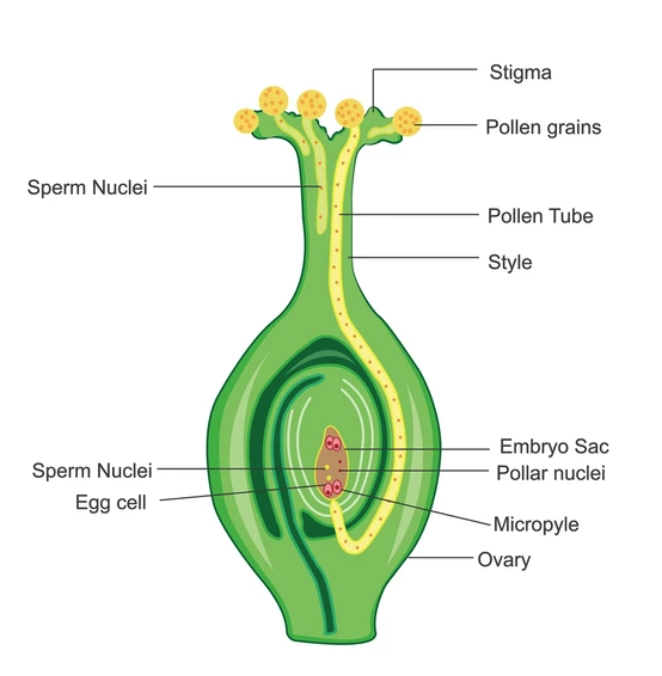
Step 1: Compatibility check (stigma surface)
Pollen lands on the stigma. The stigma surface contains proteins and chemicals that interact with proteins on the pollen exine. If the chemical "key" of the pollen matches the chemical "lock" of the stigma, the pollen is accepted. Otherwise, it's rejected (this is the self-incompatibility filter).
Step 2: Pollen germination
A compatible pollen grain absorbs water and nutrients from the stigma. The intine bulges out through a germ pore as the pollen tube. This is pollen germination.
Step 3: Pollen tube growth through the style
The pollen tube grows DOWN through the style, navigating the stylar tissue. In most plants, the style is solid (filled with transmitting tissue); in some, it's hollow (with a central canal).
The pollen tube carries:
- The vegetative nucleus (at the tip — guides growth).
- The generative cell (which divides to 2 male gametes if it hasn't already).
Step 4: Entry into the ovule
The pollen tube grows along the placenta, then along the funicle, and finally enters the ovule via the micropyle. This entry path through the micropyle is called porogamy (the most common type in the vast majority of angiosperms).
Step 5: Entry into the embryo sac
The pollen tube enters one of the two synergids via the filiform apparatus (which we met in Section 5). The synergid breaks down, releasing the two male gametes into the cytoplasm of the synergid (NCERT).
The complete map
Three entry types into the ovule (NEET trivia)
- Porogamy — through the micropyle (most common, ~80%).
- Chalazogamy — through the chalaza (e.g., Casuarina).
- Mesogamy — through the funicle or integument (rare).
Memorise this trio — appears as NEET MCQ.
Artificial Hybridisation — Plant Breeding by Humans
Now we move from natural processes to applied biology. Artificial hybridisation is the deliberate cross-pollination of two different parent plants to produce hybrid offspring with desirable traits. This is the foundation of modern crop improvement.
Why hybridise?
Plant breeders want to combine desirable traits from two parents — say, the disease resistance of one wheat variety with the high yield of another. Cross-pollinating them produces hybrid seeds; the F1 generation often shows hybrid vigour (superior performance over both parents).
The two key techniques
Technique 1: Emasculation
Definition: The removal of the anthers from a flower BEFORE they shed pollen.
In a BISEXUAL flower, the breeder must remove the anthers before they release pollen, so that the flower doesn't self-pollinate. This is done with forceps, typically before the bud opens (so anthers are still immature). Once anthers are removed, the flower has only its female organs — it can only receive pollen from outside.
In a UNISEXUAL flower (e.g., maize), emasculation is unnecessary — the flower has no anthers to begin with.
Technique 2: Bagging
Definition: Covering the emasculated flower with a bag of suitable size, generally made of butter paper to prevent unwanted pollen from landing on the stigma.
The bag isolates the flower from all external pollen until the breeder is ready. When the stigma is receptive, the breeder:
- Removes the bag briefly.
- Dusts pollen from the desired male parent onto the stigma.
- Re-bags the flower.
This ensures that ONLY the chosen pollen fertilises the ovule.
Step-by-step for a bisexual flower
- Choose the female parent plant.
- Select a bud before it opens (so anthers are immature).
- Emasculate — remove anthers using forceps (anthers still immature, no pollen released).
- Bag the emasculated flower.
- Wait until the stigma matures.
- Pollinate with desired pollen from the male parent.
- Re-bag until fertilisation is confirmed.
- Collect seeds = hybrid seeds.
Step-by-step for a unisexual flower (e.g., maize)
Emasculation is not needed (no anthers in the female flower). The breeder just bags the female flower before its silks are receptive, then later dusts desired pollen on the silks.
NCERT-canonical phrase: "If the female parent bears bisexual flowers, removal of anthers from the flower bud before the anther dehisces, using a pair of forceps, is necessary. This step is referred to as emasculation."
Real-world impact
Hybrid varieties of wheat, maize, rice, sugarcane, vegetables, and ornamental flowers all rely on these techniques. Modern Indian agriculture (Green Revolution) was substantially built on hybrid seeds developed via emasculation + bagging.
Small Memory Capsule — Section 7
Compact lock-in before the famous double fertilisation.
Five outbreeding devices
| # | Device | Mechanism | Example |
|---|---|---|---|
| 1 | Dichogamy | Temporal mismatch (protandry / protogyny) | Cotton (protandry); Fig (protogyny) |
| 2 | Herkogamy | Spatial mismatch in anther-stigma position | Some Hibiscus |
| 3 | Self-incompatibility | Genetic block on pollen tube growth | Many crops |
| 4 | Monoecy | Unisexual flowers, same plant | Maize, castor |
| 5 | Dioecy | Unisexual flowers, separate plants | Papaya, date palm |
Pollen-pistil interaction (the path)
Three entry types into ovule
- Porogamy (micropyle) — ~80%, most common.
- Chalazogamy (chalaza) — Casuarina.
- Mesogamy (funicle/integument) — rare.
Artificial hybridisation
- Emasculation = remove anthers BEFORE dehiscence (only for bisexual flowers).
- Bagging = cover emasculated flower to keep out unwanted pollen.
- Goal: ensure ONLY chosen pollen fertilises the chosen flower.
One-line takeaway
Plants use 5 devices (dichogamy, herkogamy, self-incompatibility, monoecy, dioecy) to enforce cross-pollination; the pollen tube navigates from stigma → style → micropyle → synergid; and humans replicate this control via emasculation + bagging in hybrid crop breeding.
Solved Examples
Example 1: Naming the five outbreeding devices
List the five outbreeding devices used by flowering plants to discourage self-pollination. Give one example of each.
Solution:
| # | Device | Mechanism | Example |
|---|---|---|---|
| 1 | Dichogamy | Temporal — anthers and stigma mature at different times | Cotton (protandry); Fig (protogyny) |
| 2 | Herkogamy | Spatial — anthers and stigma positioned to prevent self-contact | Some Hibiscus |
| 3 | Self-incompatibility | Genetic — pollen tube growth inhibited on own stigma | Many flowering crops |
| 4 | Monoecy | Unisexual flowers on the same plant | Maize, castor |
| 5 | Dioecy | Unisexual flowers on separate plants (male/female) | Papaya, date palm |
The pattern:
- Devices 1 + 2 = same flower has both sexes, but they don't connect (timing or geometry).
- Device 3 = molecular recognition prevents fertilisation even if pollen reaches stigma.
- Devices 4 + 5 = separate sexes (monoecy = same plant; dioecy = different plants).
Answer: Five devices: dichogamy (temporal), herkogamy (spatial), self-incompatibility (genetic), monoecy (unisexual, same plant), dioecy (unisexual, separate plants).
[Board Important] Standard CBSE 3-mark or 5-mark question. Always pair name with mechanism AND example for full marks.
Example 2: Protandry vs protogyny
Define protandry and protogyny. Which is more common in flowering plants, and why?
Solution:
| Term | Meaning | Order of maturation | Example |
|---|---|---|---|
| Protandry | Anthers mature FIRST | Anthers → Stigma | Cotton, sunflower |
| Protogyny | Stigma matures FIRST | Stigma → Anthers | Fig, banana |
Why this matters:
In both cases, by the time the second organ becomes mature, the first has already passed its phase. So self-pollination is prevented by the temporal mismatch.
Which is more common?
Protandry is more common in nature. This is because:
- Anthers maturing first → pollen released early → pollen is available before the stigma is ready to receive its own pollen.
- The stigma matures later, by which time the OWN flower's pollen is gone, but pollen from OTHER flowers (which are at various stages) is available.
Protogyny is less common but happens in figs and some others.
Both are forms of dichogamy — the umbrella term for temporal separation of anther and stigma maturation.
Answer: Protandry = anthers mature first (e.g., cotton, sunflower); Protogyny = stigma matures first (e.g., fig, banana). Protandry is more common in flowering plants.
[NEET Important] "Protandry vs protogyny" is a recurring NEET MCQ. Drill the examples especially.
Example 3: Tracing the pollen tube from stigma to egg
Describe the path taken by the pollen tube from the moment it germinates on the stigma to the moment it releases its male gametes inside the embryo sac.
Solution:
The pollen tube's journey follows a specific anatomical route:
Step 1: Pollen germination on stigma
- Pollen lands on a compatible stigma.
- The intine bulges out through a germ pore in the exine, forming the pollen tube.
- The vegetative nucleus moves to the tip; the generative cell (or 2 male gametes, if 3-celled pollen) trails behind.
Step 2: Growth through the style
- The pollen tube grows downward through the style (the stylar tissue may be solid or hollow depending on species).
- Growth is guided by chemoattractants from the stylar tissue.
Step 3: Entry into the ovary
- Pollen tube enters the ovary cavity.
- It travels along the placenta.
Step 4: Entry into the ovule (via the funicle)
- Pollen tube continues along the funicle (the ovule's stalk).
- Then enters the ovule through the micropyle — this entry is called porogamy (the most common ovule-entry mode in the vast majority of angiosperms).
Step 5: Entry into the embryo sac (via the synergid)
- Pollen tube enters one of the two synergids via the filiform apparatus (the synergid's chemoattractive cell-wall projection).
- The synergid breaks down (degenerates), releasing the 2 male gametes into the embryo sac cytoplasm.
The full path:
Answer: Stigma → germinate → grow through style → enter ovary → along placenta → along funicle → enter ovule via micropyle → enter one synergid via filiform apparatus → synergid degenerates → 2 male gametes released into embryo sac.
[Board Important] Classic 3-mark or 5-mark CBSE question. Memorise the full path word-for-word for top marks.
Example 4: Emasculation — purpose and procedure
What is emasculation? Why is it necessary in artificial hybridisation? In which type of flower is it NOT required?
Solution:
Definition:
Emasculation is the removal of anthers from a flower bud BEFORE the anther dehisces (i.e., before pollen is released).
Why is it necessary?
In artificial hybridisation, the breeder wants to ensure that ONLY a specific chosen pollen fertilises the female parent. If the female parent's own flower has anthers, those anthers might shed pollen onto the same flower's stigma → self-pollination → not a hybrid.
So emasculation removes this risk: with no anthers, the flower CAN'T self-pollinate. It must wait for the breeder to apply the chosen male pollen.
Procedure:
- Select a bud of the female parent (before the flower opens).
- Use forceps to gently remove all anthers from the bud.
- The anthers must still be immature (not yet released pollen).
- Bag the emasculated flower immediately to prevent stray pollen from landing on it.
- When the stigma matures, dust on the chosen male pollen.
When is emasculation NOT needed?
In UNISEXUAL flowers — flowers that have only female parts (e.g., the female flowers of maize, papaya, castor). Since these flowers don't have anthers in the first place, there's nothing to emasculate.
Answer: Emasculation = removal of anthers from a bisexual flower before anthesis to prevent self-pollination. Necessary because the breeder wants to control which pollen fertilises the female parent. NOT needed in unisexual flowers (e.g., maize, papaya).
[Board Important] Classic 3-mark CBSE Q. Always include: definition, purpose, bisexual vs unisexual distinction.
Example 5: Papaya is dioecious — implications
Papaya (Carica papaya) is a dioecious plant. (a) What does this mean? (b) Is self-pollination possible? (c) Is emasculation required for hybridisation?
Solution:
(a) Dioecy means:
The plant has unisexual flowers, and male and female flowers occur on SEPARATE plants. So a population of papaya plants has two kinds of plants:
- Male plants — bearing only male (staminate) flowers.
- Female plants — bearing only female (pistillate) flowers.
The two are physically separate organisms.
(b) Is self-pollination possible?
No — self-pollination is physically impossible in dioecious species. The pollen-producing plant and the stigma-bearing plant are different individuals. Cross-pollination is mandatory.
So dioecy is the most foolproof outbreeding device of all five.
(c) Is emasculation required?
No. Female papaya flowers have NO anthers (they're unisexual). So there's nothing to emasculate. The breeder just bags the female flower before its stigma is receptive, then dusts on chosen pollen from a male plant.
Putting it all together:
- Dioecy = unisexual + separate plants.
- No self-pollination possible.
- No emasculation needed.
Other dioecious examples: Date palm (Phoenix dactylifera), willow, holly.
Answer: (a) Dioecy = male and female flowers on separate plants. (b) Self-pollination is impossible — only cross-pollination occurs. (c) Emasculation is NOT required, because the female flower has no anthers to begin with.
[NEET Important] Classic NEET MCQ pattern — papaya as a dioecy example. Memorise the genus name Carica papaya.