
From Gametophyte to Fertilisation — The Need for Pollination
We've now built both gametophytes — the male (pollen grain) and the female (embryo sac). The two are sitting in different parts of the flower: pollen in the anther, embryo sac inside the ovule. For fertilisation to happen, the pollen MUST be transferred to the stigma.
This transfer is called pollination, and it is the gateway to everything that follows in the chapter — fertilisation, seed, fruit.
NCERT-canonical definition: "Pollination is the transfer of pollen grains (shed from the anther) to the stigma of a pistil."
Memorise the definition word-for-word. Note three things:
- It's the transfer of pollen, not gametes.
- It happens AFTER the anther has shed (released) the pollen.
- The transfer is to the stigma of any pistil (not necessarily the same flower).
Why is pollination NOT the same as fertilisation?
This is the most common Board exam confusion. Let me clarify:
| Pollination | Fertilisation | |
|---|---|---|
| What's transferred | Pollen grains (whole grain) | Male gametes (only) |
| Where | Anther → Stigma | Inside the embryo sac |
| When | First | After pollination, after pollen tube growth |
| Outcome | Pollen lands on stigma | Zygote + PEN form |
Pollination is the journey; fertilisation is the destination.
Three Types of Pollination
Based on the source of pollen relative to the receiving stigma, NCERT recognises three types:
\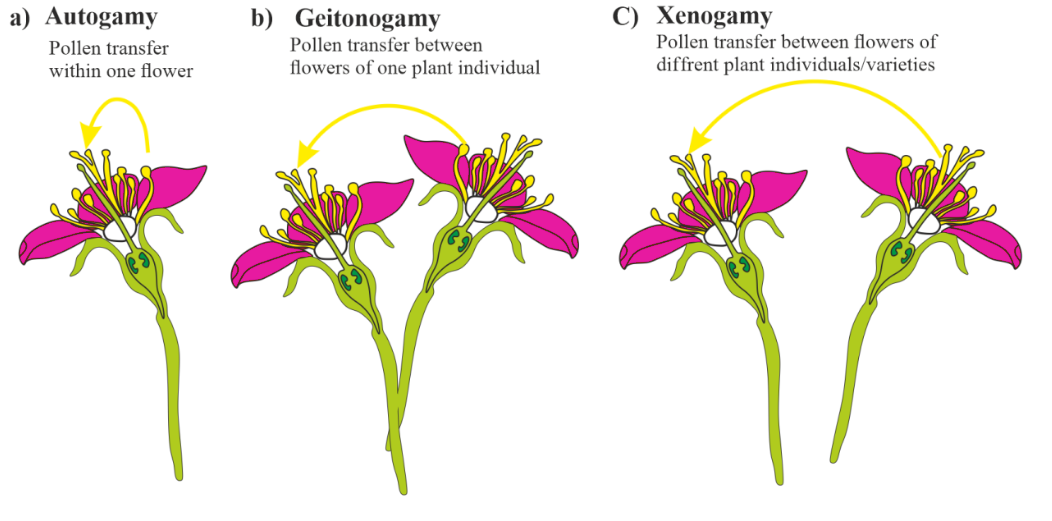
1. Autogamy (Self-pollination)
The pollen lands on the stigma of the SAME flower. This is the purest form of self-pollination.
For autogamy to happen, two conditions must be met:
- Synchrony — anther and stigma mature at the same time.
- Proximity — they are close enough that pollen can transfer (often via wind or insect within the flower).
Flowers come in two types (NCERT); autogamy in open flowers is rare and conditional:
a. Chasmogamous flowers — open flowers with exposed anthers and stigma. Pollination happens through external agents but within the same flower. Most flowers fall in this category.
b. Cleistogamous flowers — flowers that NEVER OPEN (closed throughout their lifespan). The anther releases pollen INSIDE the closed flower, which deposits directly on the stigma. Autogamy is assured because no external agent can interfere.
NCERT examples: Viola, Oxalis and Commelina produce BOTH chasmogamous and cleistogamous flowers on the same plant.
Why have cleistogamous flowers? Autogamy is guaranteed — useful when pollinators are unreliable or absent. But the cost: no genetic variation because every seed is essentially genetically identical to the parent.
2. Geitonogamy (Same-plant pollination)
Pollen from one flower lands on the stigma of another flower on the same plant. Functionally, this is still self-pollination (same genotype is involved). But ecologically, an external agent (insect, wind) has carried the pollen.
Important: Geitonogamy = ecologically cross-pollination, but genetically self-pollination.
3. Xenogamy (Cross-pollination)
Pollen from one plant lands on the stigma of a genetically different plant (same species). This is the only type that brings genetically different gametes together and is the only true cross-pollination.
NCERT-canonical phrase: "Xenogamy is the transfer of pollen grains from the anther to the stigma of a different plant. This is the only type of pollination which during pollination brings genetically different types of pollen grains to the stigma."
Quick comparison table
| Type | Source of pollen | Genetically equivalent to |
|---|---|---|
| Autogamy | Same flower | Self |
| Geitonogamy | Another flower of the same plant | Self |
| Xenogamy | Another plant of the same species | Cross |
Agents of Pollination — Abiotic
Pollen doesn't have legs. So how does it travel? An external agent — biotic (alive) or abiotic (non-living) — carries it.
We start with abiotic agents (wind and water).
Anemophily — Wind Pollination
Pollen is carried by wind.
Characteristic adaptations of wind-pollinated flowers:
- Small, light, dusty pollen — easy to be airborne.
- Stigma is large and feathery — to maximise the chance of catching airborne pollen.
- Flowers are small, dull-coloured, often unisexual — no need for showy petals.
- Anthers are well-exposed — to release pollen freely into the air.
- Huge pollen quantity — to compensate for the inefficiency of wind dispersal.
Examples: All grasses (rice, wheat, maize), coconut palm; maize cob hairs are the styles/stigmas.
NCERT example to memorise: Maize — the maize tassel is the male inflorescence at the top of the plant, releasing massive amounts of pollen onto the wind. The female inflorescence (the cob) catches some of it.
Hydrophily — Water Pollination
Far rarer than wind pollination. Found in only a few aquatic plants.
Two sub-types of hydrophily:
a. Epihydrophily (pollen carried on the water SURFACE)
- Example: Vallisneria (a freshwater submerged plant).
- The male flowers detach from the parent plant, float on the surface, and the female flowers (also floating) catch them.
b. True hydrophily (pollen carried UNDER the water)
- Example: Zostera (marine seagrass).
- Pollen is released under water and is carried by water currents to the female flowers.
- Pollen of these plants is often long, ribbon-like and devoid of the typical sporopollenin exine (which would not be needed under water).
NCERT-canonical phrase: "NCERT makes two separate points: in a majority of water-pollinated species pollen is protected from wetting by a mucilaginous covering."
Wind vs Water — comparison
| Feature | Wind (Anemophily) | Water (Hydrophily) |
|---|---|---|
| Examples | Grasses, maize, coconut | Vallisneria, Zostera |
| Pollen shape | Light, dusty | Long, ribbon-like |
| Stigma | Feathery, large | Often unspecialised |
| Frequency in nature | Very common | Rare (mostly aquatic plants) |
Agents of Pollination — Biotic
Most flowering plants are pollinated by biotic agents — animals — accounting for the large majority of pollination events in nature (NCERT gives no percentage). The diversity of pollinators is staggering: insects, birds, bats, even monkeys and lizards.
Entomophily — Insect Pollination
By far the dominant biotic pollination type. Insects (bees, butterflies, moths, beetles, wasps) are the workhorses of pollination.
Adaptations of insect-pollinated flowers:
- Bright colours — to attract insects visually.
- Fragrance — to attract from a distance.
- Nectar — a sugary reward that motivates repeated visits.
- Sticky pollen — to adhere to insect bodies.
- Special structures — landing platforms, nectar guides (UV-visible patterns), tube-shaped flowers (matching pollinator anatomy).
Special pollinator-plant relationships
Some plants and pollinators have co-evolved so tightly that they cannot reproduce without each other.
1. Yucca and the Yucca moth (textbook mutualism)
NCERT-canonical phrase: "Some plants and their animal pollinators have co-evolved so closely that neither can complete its life cycle without the other (Yucca and a species of moth — Tegeticula)."
- The female Tegeticula moth is the ONLY pollinator of Yucca.
- The moth lays its eggs inside the Yucca's ovary while pollinating it.
- The Yucca cannot set seeds without the moth.
- The moth larvae feed on some (not all) of the developing seeds.
- Both species depend completely on each other.
2. Amorphophallus and carrion-fly attraction (foul-odour pollination)
Amorphophallus titanum — the tallest inflorescence in the plant world (~6 feet tall) — emits the smell of rotting flesh to attract carrion flies and beetles, which serve as pollinators. The flies, expecting a meal of dead flesh, instead end up pollinating the plant.
Ornithophily and Chiropterophily
Ornithophily = bird pollination. Examples: hummingbirds (in tropical Americas), sunbirds (in Asia/Africa). Flowers are usually red, tube-shaped, and produce abundant nectar.
Chiropterophily = bat pollination. Examples: Adansonia (baobab), Anthocephalus (kadam). Flowers open at night, white-coloured (visible at night), produce abundant nectar, often with strong scent.
Rewards for Pollinators — Why They Show Up
Pollinators don't pollinate out of altruism. They visit flowers because flowers offer rewards. The most common rewards are:
Nectar — a sugary, energy-rich liquid produced by nectaries inside the flower. Used by bees (for honey), butterflies, hummingbirds, bats.
Pollen as food — many bees and beetles eat pollen for its protein and lipid content. Some flowers produce excess pollen specifically for this.
Shelter and safe place to mate — some flowers function as overnight roost sites for insects (e.g., the flowers of Aristolochia, which traps and releases insects).
Floral oils — some flowers produce non-nectar oils used by certain bees.
Brood site — Some flowers (e.g., the fig family Ficus) allow specific wasps to lay eggs inside the flower itself. The wasp larvae develop inside, and adult wasps emerge already carrying pollen.
Bee importance
Honey bees (Apis spp.) are the single most important pollinators worldwide. Their decline (Colony Collapse Disorder) is a major agricultural concern — many crops depend almost entirely on bee pollination.
A useful evolutionary insight
The dazzling diversity of flower forms, colours, scents, and nectar types is NOT for human appreciation — it's the evolutionary outcome of millions of years of co-evolution with specific pollinators. Each flower's design is a lock that fits a particular pollinator key.
Small Memory Capsule — Section 6
Lock in before the outbreeding devices.
The 3 types of pollination
| Type | Pollen source | Genetic outcome |
|---|---|---|
| Autogamy | Same flower | Self |
| Geitonogamy | Another flower, same plant | Self |
| Xenogamy | Different plant, same species | CROSS (only true cross) |
Two important autogamy variants
- Chasmogamous — open flowers (most flowers).
- Cleistogamous — closed flowers; assured autogamy; examples: Viola, Oxalis, Commelina.
Abiotic agents
- Anemophily (wind): grasses, maize, coconut. Pollen = light, dusty. Stigma = feathery.
- Hydrophily (water):
- Epihydrophily (surface): Vallisneria.
- True hydrophily (underwater): Zostera. Pollen = ribbon-like, no sporopollenin.
Biotic agents
- Entomophily = insects (bees, butterflies, moths, beetles).
- Ornithophily = birds (hummingbirds, sunbirds).
- Chiropterophily = bats (baobab).
Iconic examples
- Yucca + Tegeticula moth: obligate mutualism — neither survives without the other.
- Amorphophallus: foul-odoured giant inflorescence attracting carrion flies.
Rewards for pollinators
- Nectar, pollen as food, shelter, oils, brood sites.
One-line takeaway
Pollination is the transfer of pollen from anther to stigma; three types differ by source (same flower/plant/different plant) and two agent categories (abiotic wind/water vs biotic insects/birds/bats).
Solved Examples
Example 1: Defining the three types of pollination
Define autogamy, geitonogamy, and xenogamy with examples. Which is the only TRUE cross-pollination?
Solution:
| Type | Definition | Genetic effect |
|---|---|---|
| Autogamy | Pollen transferred to the stigma of the SAME flower | Genetically self |
| Geitonogamy | Pollen from one flower to another flower on the SAME plant | Genetically self |
| Xenogamy | Pollen from one plant to a different plant of the same species | Genetically CROSS |
Xenogamy is the ONLY type that brings genetically different pollen to the stigma. Why? In autogamy and geitonogamy, the source plant and the receiving plant are the same genotype — so even though the pollen has travelled, the genes are identical.
The trap (NEET classic):
Students confuse geitonogamy with xenogamy because both involve pollen "travelling between flowers." But geitonogamy is still self-pollination GENETICALLY (same plant = same genotype). Only xenogamy crosses two different plants.
Examples:
- Autogamy: most cleistogamous flowers (e.g., Viola).
- Geitonogamy: any plant with multiple flowers where insects move between them.
- Xenogamy: cross-pollinated species like mustard, papaya.
Answer: Autogamy (same flower) — self; Geitonogamy (same plant, different flowers) — self; Xenogamy (different plants) — cross. Only xenogamy is genetically cross-pollination.
[NEET Important] "Geitonogamy is genetically self-pollination" — this exact statement has appeared in NEET. Memorise.
Example 2: Chasmogamous vs cleistogamous
What is the difference between chasmogamous and cleistogamous flowers? Give one example and one advantage/disadvantage of each.
Solution:
Chasmogamous flowers:
- Definition: Flowers that OPEN as they mature, exposing anthers and stigma.
- Pollination: Can be by self or cross-pollination, depending on the agent.
- Example: Most flowering plants — Hibiscus, mustard, mango.
- Advantage: Allows cross-pollination (xenogamy) → genetic variation.
- Disadvantage: Depends on pollinator availability — may fail if pollinators are absent.
Cleistogamous flowers:
- Definition: Flowers that NEVER OPEN. Pollination happens inside the closed bud.
- Pollination: Strictly AUTOGAMY (self-pollination is assured).
- Example: Viola (some species), Oxalis, Commelina.
- Advantage: Seed-set is GUARANTEED regardless of weather or pollinator scarcity.
- Disadvantage: No genetic variation — every seed is genetically identical to the parent (essentially clonal).
NCERT-canonical phrase: "Cleistogamous flowers do not open at all… Such flowers invariably are autogamous as there is no chance of cross-pollen landing on the stigma. Cleistogamous flowers produce assured seed-set even in the absence of pollinators."
Answer: Chasmogamous = open flowers, may cross-pollinate, depend on pollinators; Cleistogamous = closed flowers, assured autogamy, no pollinator needed, but no genetic variation.
[NEET Important] A classic NEET MCQ on cleistogamy. Memorise the names and the "assured seed-set" phrase.
Example 3: Wind vs water pollination — comparison
Compare anemophily (wind pollination) and hydrophily (water pollination) with respect to (a) examples, (b) pollen characteristics, (c) stigma type.
Solution:
| Feature | Anemophily (Wind) | Hydrophily (Water) |
|---|---|---|
| (a) Examples | Grasses (wheat, rice, maize), coconut | Vallisneria, Zostera |
| (b) Pollen | Small, light, dusty, with sporopollenin exine | Long, ribbon-like; may lack typical exine (in Zostera) |
| (c) Stigma | Large, feathery (maximum surface area to catch pollen) | Often unspecialised |
| Coverage | Very common (most cereals, conifers) | Rare (limited to aquatic plants) |
| Flowers | Small, dull, often unisexual | Inconspicuous |
| Pollen quantity | Massive | Modest |
Two sub-types of hydrophily:
- Epihydrophily (surface) — Vallisneria.
- True hydrophily (underwater) — Zostera.
Why the differences?
- Wind is unreliable and unaerodynamic for large objects → tiny, abundant, exposed pollen.
- Water immersion would destroy normal pollen with exine → underwater pollen evolved long, ribbon-like shapes without sporopollenin (it's not needed underwater).
Answer: Wind: grasses with light dusty pollen and feathery stigmas. Water: Vallisneria (epi) and Zostera (true), with long ribbon-like pollen and often special anatomy. Wind is far more common; water pollination is restricted to aquatic angiosperms.
[NEET Important] Memorise both genera (Vallisneria, Zostera) and their pollination types — recurring NEET MCQ pattern.
Example 4: The Yucca-moth mutualism
Describe the relationship between Yucca and the Tegeticula moth. Why is this called an obligate mutualism?
Solution:
The setup:
- Yucca (a desert flowering plant) and Tegeticula (a small moth species) have co-evolved so tightly that neither can complete its life cycle without the other.
The relationship — step by step:
- The female Tegeticula moth visits a Yucca flower at night.
- She collects pollen from the anthers, rolling it into a sticky ball with her specialised mouthparts.
- She flies to another Yucca flower (cross-pollinating).
- She pushes the pollen ball directly onto the stigma (manually pollinating the flower).
- Simultaneously, she lays her eggs inside the Yucca's ovary.
- The flower develops into a fruit with seeds.
- The moth's eggs hatch into larvae that eat some (not all) of the seeds.
Why "obligate mutualism"?
- Yucca* needs *Tegeticula — no other pollinator effectively pollinates *Yucca*. Without the moth, no seeds, no next generation.
- Tegeticula* needs *Yucca — the moth's larvae can only develop inside *Yucca* fruits. No Yucca, no moth.
- Both are 100% dependent on the other. Neither can survive without the partner.
NCERT-canonical phrase: "Some plants and their animal pollinators have co-evolved so closely that neither can complete its life cycle without the other (Yucca and a species of moth — Tegeticula)."
Answer: Yucca and Tegeticula moth depend completely on each other for reproduction. The moth is the only pollinator of Yucca; the moth's larvae develop only inside Yucca fruits. This 100% mutual dependency makes it an OBLIGATE mutualism — a textbook example of co-evolution.
[Board Important] Classic CBSE 3-mark question. Always quote the NCERT phrase about co-evolution.
Example 5: Identifying pollination types from clues
Identify the pollination type from each description:
(a) Vallisneria releases male flowers that float on the water surface to reach female flowers. (b) Pollen from a wheat plant is carried by wind to another wheat plant of a different cultivar. (c) A bee collects nectar from one mustard flower, then visits a different mustard plant. (d) A cleistogamous flower of Commelina sets seeds inside the closed bud. (e) A bee transfers pollen from one flower to another flower on the same mango tree.
Solution:
We classify each:
(a) Vallisneria — pollen carried on water SURFACE = Epihydrophily (a sub-type of hydrophily); also classify as xenogamy (cross-pollination, different plants).
(b) Wheat — wind carries pollen between different plants = Anemophily; also xenogamy (cross-pollination).
(c) Bee + mustard between different plants = Entomophily (insect agent); also xenogamy (cross-pollination).
(d) Commelina cleistogamous = Autogamy (self-pollination); pollination happens inside closed bud with no agent.
(e) Bee + same mango tree, different flowers = Entomophily (insect agent); but genetically geitonogamy (same plant, so genetically self-pollination).
Summary table:
| Case | Pollination type by agent | Pollination type by genetic source |
|---|---|---|
| (a) | Epihydrophily | Xenogamy |
| (b) | Anemophily | Xenogamy |
| (c) | Entomophily | Xenogamy |
| (d) | Auto-pollination (no agent) | Autogamy |
| (e) | Entomophily | Geitonogamy |
Important insight: Pollination has TWO classification axes — by AGENT (anemophily, hydrophily, entomophily etc.) and by GENETIC SOURCE (autogamy, geitonogamy, xenogamy). Both need to be recognised separately.
Answer: As above. The bee/mango-tree case is the classic NEET trap — entomophily by agent but geitonogamy genetically.
[NEET Important] Practice classifying both axes for every example. NEET often asks "What type of pollination?" and the answer depends on which axis is meant.