
The Defining Event of Angiosperms
Now we arrive at the single most important event in this chapter — the event that defines flowering plants as a unique evolutionary lineage. It's called double fertilisation.
Why is it so important? Because no other plant group in the entire kingdom Plantae performs double fertilisation. Gymnosperms don't. Pteridophytes don't. Bryophytes don't. Algae don't. Only angiosperms. This event is the angiosperm signature.
And yet, despite its uniqueness, double fertilisation is also one of the most elegantly simple events in plant biology — TWO simultaneous fusion events inside a single embryo sac.
NCERT-canonical phrase: "Since the two types of fusions, syngamy and triple fusion, take place in an embryo sac, the phenomenon is termed double fertilisation, an event unique to flowering plants."
Memorise this phrase verbatim. It contains every key fact.
A brief history (NEET trivia)
Double fertilisation was discovered in 1898 by the Russian botanist S.G. Nawaschin (sometimes spelled Navashin) — a name occasionally tested in NEET MCQs.
The Setup — What's Inside the Embryo Sac at Fertilisation
Before we describe the event, let's recall the players. The mature embryo sac contains (from Section 5):
- 1 egg cell (at micropylar end, )
- 2 synergids ( each)
- 1 central cell with 2 polar nuclei (both )
- 3 antipodals ( each) = 7 cells, 8 nuclei, all haploid.
And the pollen tube has just released 2 male gametes into the cytoplasm of the synergid (NCERT) after entering it via the filiform apparatus.
So now we have: 8 nuclei from the embryo sac + 2 male gametes = 10 nuclei in total inside the embryo sac.
What happens to these?
Event 1 — Syngamy (Fusion of male gamete with egg)
\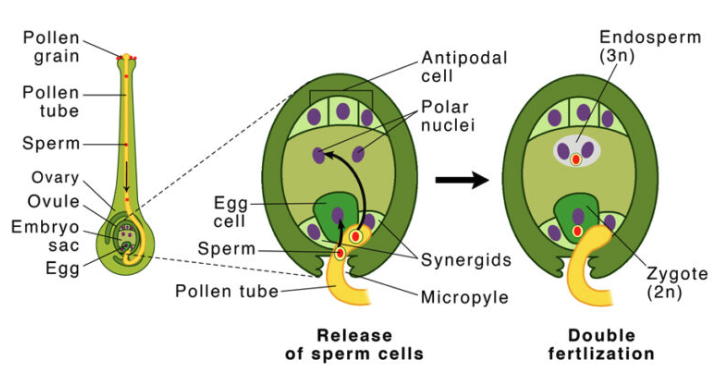
The first male gamete fuses with the egg cell.
This fusion is called syngamy (Greek: syn = together + gamy = marriage = "marrying together"). It's the standard fertilisation that you've seen in animals — two haploid gametes fuse to form a diploid zygote.
The resulting zygote is diploid (). This zygote will later develop into the embryo (Section 9).
Where does this happen?
In the egg apparatus, near the micropylar end. The egg cell is the receiver.
Event 2 — Triple Fusion (Male gamete + 2 polar nuclei)
The second male gamete doesn't sit idle. Simultaneously with syngamy, it moves toward the central cell and fuses with the 2 polar nuclei.
The central cell after triple fusion becomes the primary endosperm cell (PEC) (NCERT); the PEN lies within it.
This fusion involves THREE nuclei (1 male gamete + 2 polar nuclei), hence the name triple fusion.
Because three haploid nuclei fuse, the resulting Primary Endosperm Nucleus (PEN) is TRIPLOID (). This PEN will divide repeatedly to form the endosperm — the food-storage tissue of the seed (Section 9).
Why is this so special?
In every other fertilisation system in nature (animals, gymnosperms), fertilisation involves only ONE fusion (1 sperm + 1 egg). Only in angiosperms does ONE pollen grain produce TWO male gametes, both of which fuse simultaneously to give:
- A diploid embryo precursor (zygote).
- A triploid nutritive tissue precursor (PEN).
Both fusion events are CONNECTED — they happen at the same time, inside the same embryo sac, using gametes from the same pollen grain. No second pollen tube is needed. One pollen grain handles everything.
NCERT-canonical phrase: "Since this involves the fusion of three haploid nuclei it is termed triple fusion."
The Outcome — Ploidy of Every Structure
After double fertilisation is complete, every structure in the developing ovule has a well-defined ploidy. Memorise this table — it's one of the most heavily tested in NEET.
| Structure | Origin | Ploidy |
|---|---|---|
| Zygote | Egg + male gamete (syngamy) | |
| Primary Endosperm Nucleus (PEN) | 2 polar nuclei + male gamete (triple fusion) | |
| Endosperm | Develops from PEN | |
| Embryo | Develops from zygote | |
| Seed coat | Develops from integuments (parental tissue) | |
| Nucellus (often persists) | Parental tissue | |
| Perisperm (if present) | Develops from persistent nucellus | |
| Pericarp (fruit wall) | Develops from ovary wall | |
| Synergids, antipodals | Embryo sac cells | (degenerate after fertilisation) |
Quick recall: the unique tissue
Only ONE tissue in the entire seed is triploid: the endosperm. This is a unique angiosperm feature.
Comparison with gymnosperms
Gymnosperms also have endosperm — BUT it's haploid () because it's just the female gametophyte tissue, formed BEFORE fertilisation. In angiosperms, endosperm is triploid () because it forms AFTER fertilisation, via triple fusion.
This is a frequent NEET trap. Angiosperm endosperm = 3n; gymnosperm endosperm = n.
Why Double Fertilisation — The Evolutionary Logic
Why has evolution built this elaborate two-fusion system in angiosperms?
The answer lies in resource efficiency.
The single-fertilisation problem
Consider gymnosperms. They build a haploid endosperm BEFORE fertilisation happens. If fertilisation FAILS (e.g., no pollen reaches the ovule), the endosperm is built but unused — a complete waste of resources.
The angiosperm solution
In angiosperms, endosperm is built ONLY AFTER fertilisation. If fertilisation succeeds, BOTH the embryo and the endosperm form simultaneously. If fertilisation fails, neither forms — and the plant has lost essentially nothing.
This is conditional resource allocation:
Endosperm is built ONLY when fertilisation succeeds — preventing wasted investment.
This evolutionary efficiency is one of the reasons angiosperms have become the dominant plant group on Earth, with over 300,000 species (compared to ~1,000 gymnosperms).
Three quick advantages of double fertilisation
- Resource efficiency — endosperm only forms if fertilisation succeeds.
- Synchrony — embryo and its food supply (endosperm) form together.
- Genetic uniqueness — the triploid endosperm carries genes from BOTH parents (1 from father via male gamete + 2 from mother via polar nuclei), making it a maternal-paternal hybrid tissue specifically tuned for embryo support.
NCERT-canonical phrase: "Double fertilisation is a phenomenon unique to flowering plants."
Small Memory Capsule — Section 8
THE most important capsule in the chapter (along with Section 5).
The two events of double fertilisation
| Event | Participants | Product | Ploidy |
|---|---|---|---|
| Syngamy | Male gamete + Egg cell | Zygote (→ embryo) | |
| Triple fusion | Male gamete + 2 polar nuclei | PEN (→ endosperm) |
Both events happen simultaneously inside ONE embryo sac, from gametes of ONE pollen grain.
The defining facts
- Double fertilisation is unique to angiosperms — not found in gymnosperms.
- Discovered by S.G. Nawaschin in 1898.
- One pollen grain → 2 male gametes → both fuse simultaneously.
Ploidy table — drill this
| Structure | Ploidy |
|---|---|
| Zygote | |
| Embryo | |
| PEN | |
| Endosperm | |
| Seed coat | |
| Nucellus | |
| Pericarp |
Angiosperm vs Gymnosperm endosperm
- Angiosperm endosperm = (post-fertilisation, from triple fusion).
- Gymnosperm endosperm = (pre-fertilisation, female gametophyte tissue).
Why double fertilisation evolved
Resource efficiency — endosperm only forms IF fertilisation succeeds. No wasted investment.
One-line takeaway
Double fertilisation = syngamy (male gamete + egg → 2n zygote) + triple fusion (male gamete + 2 polar nuclei → 3n PEN), unique to angiosperms, ensuring conditional resource allocation to the embryo.
Solved Examples
Example 1: Defining double fertilisation
What is double fertilisation? Why is it considered unique to flowering plants?
Solution:
Definition:
Double fertilisation is the simultaneous occurrence of TWO fusion events inside a single embryo sac:
- Syngamy — one male gamete fuses with the egg cell → diploid () zygote.
- Triple fusion — the other male gamete fuses with the two polar nuclei → triploid () Primary Endosperm Nucleus (PEN).
Both events involve gametes from the SAME pollen grain and happen SIMULTANEOUSLY.
Why unique to angiosperms?
In other plant groups:
- Gymnosperms: Only one fusion (syngamy). Endosperm is haploid female gametophyte tissue, formed BEFORE fertilisation.
- Pteridophytes, bryophytes, algae: Only single fertilisation. No equivalent of triple fusion.
Only angiosperms have evolved the second fusion (triple fusion) that produces a triploid endosperm AFTER fertilisation.
Significance:
- Resource efficiency — endosperm only forms if fertilisation succeeds.
- Genetic uniqueness — endosperm is triploid (one paternal + two maternal contributions).
- Discovered by S.G. Nawaschin in 1898.
Answer: Double fertilisation = syngamy + triple fusion happening simultaneously inside one embryo sac. Unique to angiosperms because only they perform triple fusion. Provides evolutionary efficiency by ensuring endosperm forms only when fertilisation succeeds.
[Board Important] Classic CBSE 3-mark or 5-mark question. Always include both events, both products, both ploidies, and the uniqueness statement.
Example 2: Syngamy vs triple fusion
Differentiate between syngamy and triple fusion with respect to (a) participants, (b) ploidy of product, (c) outcome.
Solution:
| Feature | Syngamy | Triple Fusion |
|---|---|---|
| (a) Participants | 1 male gamete + 1 egg cell (2 nuclei involved) | 1 male gamete + 2 polar nuclei (3 nuclei involved) |
| (b) Ploidy of product | Diploid () | Triploid () |
| (c) Product | Zygote → develops into embryo | Primary Endosperm Nucleus (PEN) → develops into endosperm |
Etymology hint:
- Syngamy (Greek: syn = together + gamy = union) — TWO units coming together. Classic fertilisation as in animals.
- Triple fusion — THREE nuclei fusing into one. Unique to angiosperms.
Where each happens:
- Syngamy occurs in the egg apparatus (near micropylar end).
- Triple fusion occurs in the central cell (central region of embryo sac).
Connectivity:
Both events use gametes from the SAME pollen grain, happen at the SAME time. The result: ONE embryo + ONE endosperm = ONE seed.
Answer: Syngamy = 1 male gamete + 1 egg → 2n zygote → embryo. Triple fusion = 1 male gamete + 2 polar nuclei → 3n PEN → endosperm. Both simultaneous; both inside one embryo sac; together they constitute double fertilisation.
[NEET Important] Direct NEET MCQ pattern — drill the ploidy values ( vs ).
Example 3: Why is the angiosperm endosperm triploid?
Why is the angiosperm endosperm (triploid) while the gymnosperm endosperm is (haploid)?
Solution:
The difference comes from WHEN the endosperm forms.
Angiosperm endosperm — :
- Forms AFTER fertilisation.
- Triple fusion: 1 male gamete () + 2 polar nuclei () → PEN ().
- PEN divides to form the endosperm — every cell carries 3 sets of chromosomes.
- One paternal contribution + two maternal contributions.
Gymnosperm endosperm — :
- Forms BEFORE fertilisation.
- It's simply the haploid female gametophyte tissue (multicellular, n).
- After the egg is fertilised, this haploid tissue acts as the nutritive layer for the developing embryo.
- Both contributions are maternal (no paternal contribution).
The big idea:
| Group | Endosperm timing | Endosperm origin | Ploidy |
|---|---|---|---|
| Angiosperms | AFTER fertilisation | Triple fusion (2 maternal + 1 paternal) | |
| Gymnosperms | BEFORE fertilisation | Female gametophyte directly |
Evolutionary advantage:
The angiosperm system is more efficient — endosperm only builds if fertilisation succeeds. Gymnosperms build endosperm regardless, even if no pollen arrives — wasting resources.
Answer: Angiosperm endosperm is triploid because it forms via triple fusion (1 male gamete + 2 polar nuclei) AFTER fertilisation. Gymnosperm endosperm is haploid female gametophyte tissue formed BEFORE fertilisation.
[NEET Important] Recurring NEET MCQ stem: "Endosperm in angiosperms is , while in gymnosperms it is ." Always answer .
Example 4: Ploidy of every part of a developing seed
State the ploidy of: (a) egg cell, (b) zygote, (c) PEN, (d) endosperm, (e) embryo, (f) seed coat, (g) nucellus.
Solution:
We apply the post-fertilisation ploidy map.
| Item | Ploidy | Reasoning |
|---|---|---|
| (a) Egg cell | Female gamete; one nucleus from haploid embryo sac | |
| (b) Zygote | Egg () + male gamete () = | |
| (c) PEN | Two polar nuclei () + male gamete () = | |
| (d) Endosperm | Develops from PEN; same ploidy | |
| (e) Embryo | Develops from zygote; same ploidy | |
| (f) Seed coat | Develops from integuments (parental, sporophytic) | |
| (g) Nucellus | Parental sporophytic tissue |
The pattern in one line:
Anything that includes a male gamete contribution: (embryo) or (endosperm). Anything purely maternal (sporophytic): . Anything inside the embryo sac before fertilisation: .
Answer: .
The 3n outlier: Endosperm (and PEN before it) is the only tissue in the entire seed. Drill this exception.
[NEET Important] Most frequent ploidy-tracking MCQ in NEET. Memorise the entire table.
Example 5: Tracing all 4 fates inside the embryo sac
What happens to each of the following AFTER double fertilisation: (a) egg cell, (b) synergid (entered by pollen tube), (c) other synergid, (d) antipodals, (e) 2 polar nuclei?
Solution:
We track each cell of the original 7-celled embryo sac plus the 2 male gametes.
| Original Cell/Component | After Fertilisation | Fate |
|---|---|---|
| (a) Egg cell () | Becomes the ZYGOTE () after fusing with male gamete | Develops into the embryo (Section 9) |
| (b) Synergid entered by pollen tube | Degenerates (broken down to release the male gametes) | Disintegrates |
| (c) Other (unentered) synergid | Degenerates | Also disintegrates (sometimes more slowly) |
| (d) Antipodal cells | Degenerate before/during fertilisation | Vestigial role |
| (e) 2 polar nuclei | Fuse with male gamete → PEN () | PEN → endosperm tissue |
The big picture:
Of the original 8 nuclei in the embryo sac:
- 3 nuclei participate in fertilisation events that produce viable products (egg → zygote; 2 polar nuclei → PEN).
- 5 nuclei (2 synergids + 3 antipodals — both polar nuclei are incorporated into the PEN, neither degenerates) degenerate or are absorbed during/after fertilisation.
Of the 2 male gametes:
- 1 contributes to syngamy.
- 1 contributes to triple fusion.
- Both are utilised; neither is wasted.
Answer: Egg → zygote (); both synergids → degenerate; antipodals → degenerate; 2 polar nuclei + male gamete → PEN (). Only the zygote and PEN have a developmental future.
[Board Important] Standard 5-mark CBSE question — "trace the fate of every cell in the embryo sac after fertilisation." This is the answer template.