
The Mature Seed — Architecture and Categories
After the embryo and endosperm have formed (Section 9), the ovule continues to mature. Water content decreases, integuments harden into the seed coat, and the whole structure dries out into a dormant mature seed.
A seed is, biologically, a ripened ovule containing:
- Seed coat — protective outer covering (from integuments).
- Embryo — the future plant (from zygote).
- Cotyledons — food storage / absorption (one or two depending on dicot/monocot).
- Endosperm — food storage (in some seeds).
Two layers of the seed coat
The seed coat is usually two-layered:
- Testa — outer layer (from the outer integument). Hard, sometimes coloured.
- Tegmen — inner layer (from the inner integument). Thinner.
Two old scars are visible on a seed:
- Hilum — where the funicle was attached (from Section 4).
- Micropyle — a tiny opening just next to the hilum (entry point for oxygen and water during germination — NCERT).
NCERT-canonical phrase: "NCERT idea (paraphrased): seeds are albuminous (endospermic) or non-albuminous (ex-albuminous), based on whether the endosperm persists in the mature seed."
Three Categories of Seeds
Seeds are classified into three categories based on where the food is stored.
Category 1: Albuminous (endospermic) seeds
Endosperm PERSISTS in the mature seed as the main food store.
Examples (memorise these): Wheat, rice, maize, castor, coconut, sunflower.
In these seeds, the cotyledon(s) are typically thin and play an absorptive role during germination. The bulk of the food is in the endosperm.
Category 2: Non-albuminous (non-endospermic) seeds
Endosperm is COMPLETELY CONSUMED during seed development. The cotyledons absorb all the endosperm food and store it themselves.
Examples (memorise): Pea, gram, bean, groundnut, mustard.
In these seeds, cotyledons are large, fleshy, and food-rich. There's NO endosperm in the mature seed — only the fleshy cotyledons remain to feed the embryo during germination.
Category 3: Perisperm-containing seeds
A third, RARE category — the nucellus persists as a tissue called perisperm (because it surrounds, "peri-", the embryo).
Examples (memorise — these are NEET classics): Black pepper (Piper nigrum), beet (Beta vulgaris).
The perisperm is a DIPLOID () tissue (since it comes from the maternal nucellus). Don't confuse it with endosperm ().
Summary table
| Category | Food stored in | Examples |
|---|---|---|
| Albuminous | Endosperm (3n) | Wheat, rice, maize, barley, castor, coconut |
| Non-albuminous | Cotyledons (2n) | Pea, gram, bean, groundnut |
| Perisperm-containing | Perisperm (2n, from nucellus) | Black pepper, beet |
Seed Dormancy and Viability — A Big NEET Topic
What is dormancy?
After maturation, many seeds enter a state of dormancy — they refuse to germinate even under favourable conditions until certain triggers are met (light, temperature, scarification, chemical signal, etc.). Dormancy is a survival strategy that delays germination until conditions are right.
Why seeds dehydrate
A mature seed typically contains only 10–15% water (compared to 95% in fresh tissue). This drying-out has two key advantages:
- Reduces metabolic activity to near zero.
- Allows long-term storage without spoiling.
Spectacular viability records
Seeds can survive for astonishingly long times:
Lupinus arcticus — recovered from 10,000-year-old sediments in the Arctic, then germinated successfully. The current viability record for any seed.
Phoenix dactylifera (date palm) — 2,000-year-old seeds recovered from the King Herod's palace at Masada, Israel. Successfully germinated.
Nelumbo nucifera (sacred lotus) — over 1,000-year-old seeds from a dry lakebed in China.
NCERT-canonical phrase: "NCERT idea (paraphrased): some seeds remain viable for centuries to millennia, e.g., Lupinus arcticus and the date palm Phoenix dactylifera."
These figures appear in NEET. Memorise the Lupinus arcticus = 10,000 years and Phoenix dactylifera = 2,000 years specifically.
From Ovary to Fruit
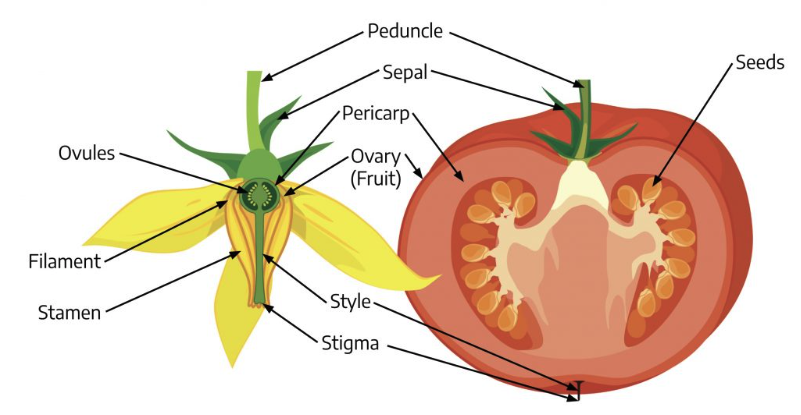
Once the seed is mature, the surrounding ovary doesn't sit idle either. It transforms into the FRUIT — the structure that contains, protects, and disperses the seeds.
\
The basic transformation
| Before fertilisation | After fertilisation |
|---|---|
| Pistil | Fruit |
| Ovary | Fruit wall (pericarp) |
| Ovule | Seed |
Parts of a fruit
The wall of the ovary becomes the pericarp, which is usually three-layered:
- Epicarp (exocarp) — outermost layer (often called the "skin" of the fruit).
- Mesocarp — middle layer (often the fleshy edible part).
- Endocarp — innermost layer (often hard or stony around the seed).
Example: Mango.
- Epicarp = thin outer skin (peel).
- Mesocarp = juicy yellow fleshy pulp (the edible part).
- Endocarp = hard inner shell (the "stone" containing the seed).
True fruits vs false fruits
True fruit: Fruit develops ONLY from the ovary, with no other floral parts contributing.
False fruit (also called pseudocarp): Fruit develops from the ovary PLUS some OTHER floral parts (typically the thalamus or receptacle).
NCERT-canonical phrase: "In a few species such as apple, strawberry, cashew, etc., the thalamus also contributes to fruit formation. Such fruits are called false fruits."
Famous examples of false fruits (NEET-must-knows)
| Fruit | What contributes besides the ovary? |
|---|---|
| Apple | Thalamus (the fleshy red part is the thalamus, not the ovary!) |
| Strawberry | Thalamus (the red fleshy part is the receptacle; tiny "seeds" on the surface are the real fruits) |
| Cashew | Thalamus (the apple-like fleshy part = thalamus; the kidney-shaped nut = the true fruit) |
In a true fruit (e.g., mango, tomato), the entire edible part comes from the ovary.
Parthenocarpy — Seedless Fruits
Sometimes a fruit develops WITHOUT fertilisation having occurred. This phenomenon is called parthenocarpy.
Definition
Parthenocarpy = Development of a fruit WITHOUT fertilisation.
Such fruits are SEEDLESS because no seeds form (since fertilisation didn't happen).
Examples
The classic NEET example:
BANANA — the cultivated edible banana is parthenocarpic. The seeds inside it are just small dark specks; they don't develop into proper seeds. (Wild bananas have large hard seeds.)
Other examples: seedless grapes, some varieties of seedless oranges, certain seedless watermelons.
How is it induced?
Parthenocarpy can be:
- Natural (in some species — e.g., banana).
- Induced artificially by spraying flowers with growth hormones like auxins (e.g., IAA, NAA). This makes the ovary develop into a fruit even though no fertilisation has happened.
Significance
Parthenocarpy is commercially valuable — seedless fruits are easier to eat and process. Modern agriculture uses parthenocarpy (sometimes combined with selective breeding for low-seed varieties) to produce seedless table grapes, watermelons, and oranges.
NCERT-canonical phrase: "Parthenocarpy is the development of fruit without fertilisation. Parthenocarpic fruits, e.g., banana, are seedless. Parthenocarpy can be induced through the application of growth hormones."
Memorise this exact phrase — appears in Board PYQs.
Small Memory Capsule — Section 10
Lock-in before apomixis.
Mature seed components
- Seed coat = testa (outer) + tegmen (inner). From integuments (2n).
- Embryo = from zygote (2n).
- Cotyledons = from embryo (2n).
- Endosperm (in some seeds) = from PEN (3n).
- Perisperm (in rare seeds) = persistent nucellus (2n).
Three seed categories
| Category | Food stored in | Examples |
|---|---|---|
| Albuminous (endosperm persists) | Endosperm (3n) | Wheat, rice, maize, barley, castor, coconut |
| Non-albuminous (endosperm consumed) | Cotyledons (2n) | Pea, gram, bean, groundnut |
| Perisperm-containing | Perisperm (2n) | Black pepper, beet |
Spectacular viability records
- Lupinus arcticus — 10,000 years (Arctic sediments).
- Phoenix dactylifera (date palm) — 2,000 years (Masada, Israel).
Ovary → Fruit transformation
- Ovary → Fruit.
- Ovule → Seed.
- Ovary wall → Pericarp (epicarp + mesocarp + endocarp).
True vs false fruits
- True fruit = ovary only. Example: mango, tomato.
- False fruit (pseudocarp) = ovary + thalamus. Examples: apple, strawberry, cashew.
Parthenocarpy
- Fruit development WITHOUT fertilisation → SEEDLESS fruit.
- Example: banana.
- Induced by auxins (IAA, NAA).
One-line takeaway
A mature seed has seed coat + embryo + (sometimes) endosperm/perisperm; seeds fall into 3 categories (albuminous, non-albuminous, perisperm-containing); the ovary becomes the fruit (true if from ovary alone, false if thalamus contributes); parthenocarpy produces seedless fruits like banana.
Solved Examples
Example 1: Three categories of seeds
Classify seeds into three categories based on the persistence of endosperm. Give two examples of each.
Solution:
| Category | Definition | Food stored in | Examples |
|---|---|---|---|
| Albuminous (endospermic) | Endosperm PERSISTS in the mature seed | Endosperm (3n) | Wheat, rice, maize, castor, coconut |
| Non-albuminous (non-endospermic) | Endosperm is CONSUMED during seed maturation; cotyledons take over food storage | Cotyledons (2n) | Pea, gram, bean, groundnut, mustard |
| Perisperm-containing | Nucellus persists as perisperm; rare category | Perisperm (2n) | Black pepper, beet |
The key difference between albuminous and non-albuminous seeds:
- In albuminous seeds (e.g., wheat), the endosperm is NEVER consumed during seed development. It STAYS in the seed and is available during germination. The cotyledon is thin, just an absorber.
- In non-albuminous seeds (e.g., pea), the cotyledons absorb the endosperm during seed maturation. By the time the seed is mature, no endosperm is left — only the fleshy food-rich cotyledons.
The exotic perisperm case:
In a few species, the maternal nucellus doesn't completely disappear during ovule development. Instead, it persists in the mature seed as a separate food-storage tissue called the perisperm. Because it comes from the maternal nucellus (a tissue), perisperm is DIPLOID — not triploid like endosperm. This is a NEET trap.
Answer: Three categories: albuminous (wheat, rice — food in endosperm), non-albuminous (pea, gram — food in cotyledons), perisperm-containing (black pepper, beet — food in perisperm).
[Board Important] Standard 3-mark CBSE question. Always give 2-3 examples for each category.
Example 2: Coconut — a tricky seed
Is coconut an albuminous or non-albuminous seed? What does the seed of coconut contain, and what is its commercial use?
Solution:
Classification: Albuminous (endospermic).
Coconut's endosperm PERSISTS — in fact, it makes up the bulk of the mature seed. Let's trace the parts of a coconut:
Parts of a coconut (fruit, not just seed):
| Layer | Structure |
|---|---|
| Outermost (husk) | Epicarp + fibrous mesocarp (coir); with the hard endocarp these three layers form the pericarp |
| Inner shell | Endocarp (the hard "shell") |
| Inside the shell | The seed — consisting of: |
| • Seed coat (thin papery layer) | |
| • Endosperm — water (free-nuclear stage) + white meat (cellular endosperm) | |
| • Embryo (tiny, embedded in one side of the white meat) |
So the coconut you buy at the store is the FRUIT. Inside it, the actual seed contains a tiny embryo embedded in a large mass of endosperm (water + meat).
Commercial uses:
- Coconut water — natural beverage, used as oral rehydration in emergencies.
- Coconut meat (kernel) — eaten fresh or dried (copra); used to extract coconut oil.
- Coconut oil — cooking, hair-care, soap-making.
- Coir (from the husk fibres) — used for ropes, doormats, mattresses.
- Coconut shell — used as containers, fuel, charcoal.
Ploidy of coconut tissues:
| Tissue | Ploidy |
|---|---|
| Coconut water (free-nuclear endosperm) | 3n |
| Coconut white meat (cellular endosperm) | 3n |
| Embryo | 2n |
| Seed coat | 2n |
| Husk (pericarp) | 2n |
Answer: Coconut is albuminous — endosperm persists as the bulk of the seed (water + white meat). Embryo is tiny. Commercial uses include the water (beverage), meat (food/oil), and husk (coir).
[NEET Important] "Is coconut albuminous?" — Yes. NEET-tested fact.
Example 3: True vs false fruits — apple example
Why is the apple called a "false fruit"? Which part of the apple is the actual ovary-derived fruit?
Solution:
The standard definition:
A true fruit develops from the ovary ONLY. A false fruit (pseudocarp) has contributions from OTHER floral parts (typically the thalamus/receptacle) in addition to the ovary.
Apple anatomy:
In an apple:
- The fleshy red/green outer part that you eat is NOT derived from the ovary. It is derived from the THALAMUS (the swollen receptacle on which the flower's whorls were inserted).
- The CORE of the apple — the hard inedible centre, with seeds embedded in it — is the actual ovary-derived part. The core is the TRUE FRUIT.
- The seeds inside the core are the actual ovule-derived structures.
So when you "eat an apple," you're eating mostly the enlarged thalamus, not the fruit in the strict botanical sense.
Why this matters:
This is one of the most NEET-tested examples of a false fruit. Always remember: apple's red flesh = thalamus, apple's core = true fruit.
Other famous false fruits:
- Strawberry — the red fleshy "berry" is the thalamus; the tiny black "seeds" on its surface are actually small individual TRUE fruits (each containing a seed). Strawberry is technically not even a berry botanically — it's a collection of true fruits on a fleshy thalamus.
- Cashew — the apple-like fleshy part (the "cashew apple") is the thalamus. The kidney-shaped nut hanging below is the true fruit (with the seed inside).
NCERT-canonical phrase: "In a few species such as apple, strawberry, cashew, etc., the thalamus also contributes to fruit formation. Such fruits are called false fruits."
Answer: Apple is a false fruit because the fleshy edible part is derived from the THALAMUS, not the ovary. The actual ovary-derived true fruit is the inner CORE of the apple, which contains the seeds.
[NEET Important] A recurring NEET MCQ. Memorise: apple, strawberry, cashew = false fruits.
Example 4: Parthenocarpy in banana
What is parthenocarpy? Explain why cultivated bananas are seedless using this concept.
Solution:
Definition:
Parthenocarpy = development of a fruit WITHOUT fertilisation. Since fertilisation didn't happen, no seeds form. The resulting fruit is seedless.
The cultivated banana case:
A wild banana plant has flowers that, upon fertilisation, develop into fruits containing large hard seeds. These wild bananas are nearly inedible — they're mostly seed.
Cultivated bananas are different. They have been selectively bred for a parthenocarpic trait — meaning:
- The female flowers develop into fruits WITHOUT fertilisation.
- The ovary grows fleshier even though no seeds form inside.
- The resulting banana has just tiny dark specks in its centre (rudimentary undeveloped ovules) — not true seeds.
This is why cultivated bananas are seedless.
How is parthenocarpy maintained?
Since cultivated bananas don't produce viable seeds, they CAN'T reproduce sexually. Instead, banana plantations propagate through vegetative means — typically by separating side-shoots (suckers) from the mother plant. Every cultivated banana plant is essentially a clone.
Inducing parthenocarpy artificially:
Parthenocarpy can also be INDUCED in normally non-parthenocarpic species by:
- Spraying flowers with auxin hormones (IAA, NAA, 2,4-D).
- Genetic engineering (in some crops).
This is commercially used to produce seedless grapes, seedless watermelons, and seedless oranges. Consumers prefer seedless fruits → market value increases.
Answer: Parthenocarpy = fruit development without fertilisation, resulting in seedless fruits. Cultivated bananas show natural parthenocarpy — their ovaries develop into fruits without fertilisation, so no seeds form, only tiny dark specks. Parthenocarpy can be induced artificially by spraying auxins.
[Board Important] Classic CBSE 2- or 3-mark question. Always include: definition + banana example + auxin induction.
Example 5: Tracing the parts of a developing seed
In a typical mature angiosperm seed, identify the origin of each structure: (a) seed coat, (b) cotyledons, (c) endosperm, (d) embryo, (e) hilum, (f) micropyle.
Solution:
We map each structure back to its pre-fertilisation origin.
| Structure | Origin | Ploidy |
|---|---|---|
| (a) Seed coat (testa + tegmen) | From INTEGUMENTS of the ovule | (parental sporophytic) |
| (b) Cotyledons | From embryo (which came from zygote) | |
| (c) Endosperm (if present) | From PEN (Primary Endosperm Nucleus, ) | |
| (d) Embryo | From zygote (egg + male gamete) | |
| (e) Hilum | Where the FUNICLE attached the ovule to the placenta — leaves a scar | — (morphological feature) |
| (f) Micropyle | From the MICROPYLE of the ovule (the opening through which the pollen tube entered) | — (morphological feature) |
The big logical map:
| Ovule structure | → | Seed structure |
|---|---|---|
| Integuments | → | Seed coat (testa + tegmen) |
| Funicle attachment | → | Hilum (scar) |
| Micropyle | → | Persists as micropyle in seed |
| Nucellus | → | Usually consumed; perisperm in rare cases |
| Embryo sac | → | Inside: zygote → embryo; PEN → endosperm |
| Egg cell | → | Zygote → embryo |
| Polar nuclei + male gamete | → | PEN → endosperm |
Two scars to recognise:
- Hilum — a small scar where the funicle was attached.
- Micropyle — a tiny opening just next to the hilum (water entry during germination).
Answer: (a) Seed coat from integuments. (b) Cotyledons from embryo. (c) Endosperm from PEN. (d) Embryo from zygote. (e) Hilum = funicle attachment scar. (f) Micropyle persists from ovule's micropyle.
[NEET Important] Standard "trace the origin" question. Drill the ovule-to-seed mapping table.