
The Pollen Grain — A Microscopic Marvel
In Section 2 we watched the microspore being born inside the anther. Now we follow that microspore as it matures into a fully-formed pollen grain — the male gametophyte.
A pollen grain is, in plain words, a tiny travelling capsule carrying half the genetic information needed to build the next plant. Its job is simple but extraordinary: survive the journey from anther to stigma — potentially across kilometres, through hostile weather, against UV radiation, sometimes for months — and then deliver two male gametes to an egg cell. Everything about its design is engineered for this single mission.
Size and visibility
A typical pollen grain is 25–50 μm in diameter. That's smaller than a human hair's width. Yet under a microscope, each grain shows astonishing structural complexity: sculpted walls, precise pores, intricate surface patterns unique to each species. Palynology — the study of pollen — is so reliable that forensic scientists use pollen to track crime scenes, archaeologists use it to reconstruct ancient climates, and honey inspectors use it to verify the floral origin of honey.
Ploidy reminder
Pollen grain = haploid (). It came from a microspore, which came from meiosis. So the entire pollen grain — every cell inside it, every nucleus — is haploid. This is the male gametophyte stage of the plant life cycle.
NCERT-canonical phrase to memorise: "The pollen grain represents the male gametophyte."
The Two-Layered Wall — Exine and Intine
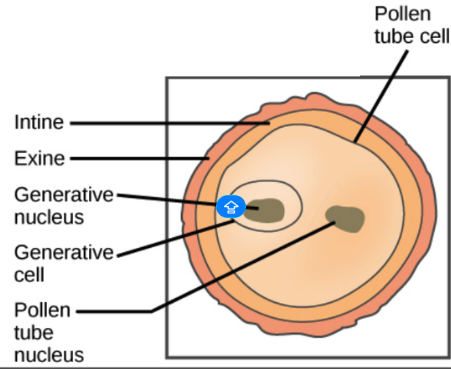
The pollen grain has perhaps the toughest cell wall in the entire plant kingdom. It is two-layered, and each layer is built for a specific purpose.
\
Outer layer — the Exine
The exine is the outer wall and it's made of a remarkable molecule: sporopollenin. This is arguably one of the most resistant organic substances known to science. It cannot be degraded by any enzyme. It resists high temperatures, strong acids, alkalis, UV radiation, and time itself — pollen grains from rocks millions of years old have been recovered intact thanks to sporopollenin.
A few key facts about sporopollenin:
- Synthesised by the tapetum (recall from Section 2).
- Resistant to physical, chemical, and biological degradation.
- Within the pollen grain it occurs only in the exine; sporopollenin is also found in the spore walls of lower plants (bryophytes, pteridophytes).
- Allows fossil pollen to survive intact for hundreds of millions of years.
The exine is NOT a continuous layer — it has thin spots called germ pores, where sporopollenin is absent. Through these pores, the pollen tube will eventually emerge during germination. The number and arrangement of germ pores is species-specific (e.g., grasses have one pore; lilies have one furrow; many dicots have three pores arranged equidistantly).
Inner layer — the Intine
Beneath the exine, lining the pollen grain like an inner skin, is the intine. It is:
- Made of cellulose and pectin (familiar plant cell wall stuff).
- A continuous layer (no pores).
- Thin and flexible.
The intine is the wall that eventually bulges out through a germ pore as the pollen tube during germination.
| Property | Exine (outer) | Intine (inner) |
|---|---|---|
| Made of | Sporopollenin | Cellulose + pectin |
| Continuity | Discontinuous (germ pores) | Continuous |
| Resistance | Extremely resistant | Normal cellulose-pectin wall |
| Role | Protection | Forms the pollen tube |
| Synthesised by | Tapetum | Pollen grain itself |
[NEET Important] "What is the most resistant organic materials known (per NCERT: one of the most)?" — Sporopollenin. This is a recurring NEET MCQ stem.
Inside the Pollen — Two Cells or Three?
The mature pollen grain is NOT a single empty bag. It contains a small number of cells, arranged in a specific way.
The 2-celled stage (most common at shedding)
When the microspore matures, its nucleus undergoes mitosis to produce two nuclei, which then partition the cytoplasm into two unequal cells:
- Vegetative cell — large, with abundant cytoplasm, food reserves, and an irregularly shaped vegetative nucleus. Its job: build the pollen tube.
- Generative cell — small, spindle-shaped, with dense cytoplasm and a prominent generative nucleus. Its job: divide later to produce two male gametes.
In about 60% of angiosperms, pollen is shed at this 2-celled stage (vegetative + generative). The generative cell divides further AFTER pollination, inside the pollen tube.
The 3-celled stage (less common at shedding)
In the remaining ~40% of angiosperms, the generative cell undergoes mitosis before the pollen is even shed. So at shedding, the pollen grain already contains:
- 1 vegetative cell
- 2 male gametes
These are the 3-celled pollen species (e.g., grasses like Triticum, Oryza, maize).
Memorise these examples (NEET-tested)
| Pollen state at shedding | Examples |
|---|---|
| 2-celled (~60% of angiosperms) | Hibiscus, Petunia, pea (Pisum sativum) |
| 3-celled (~40% of angiosperms) | All grasses — wheat (Triticum), rice (Oryza), maize (Zea mays) |
A useful unifying rule
Whether pollen is 2-celled or 3-celled at shedding, by the time it reaches the egg, it must contain 2 male gametes + 1 vegetative cell. The two states differ only in when the generative cell divides — before shedding (3-celled) or after (2-celled, inside the pollen tube).
NCERT-canonical phrase: "In over 60% of angiosperms, pollen grains are shed at this 2-celled stage. In the remaining species, the generative cell divides mitotically to give rise to the two male gametes before pollen grains are shed (3-celled stage)."
Pollen Viability — How Long Does Pollen Live?
Once shed, pollen has a clock ticking. Each species has a characteristic viability window — the time during which the pollen can still successfully germinate on a compatible stigma.
The viability range
The window varies enormously across species:
- Cereals (rice, wheat): Only ~30 minutes after release. Wind-pollinated species generally have short viability — they're betting on speed.
- Rosaceae, Leguminosae, Solanaceae: Can stay viable for months. These are the families to remember.
This range — from 30 minutes to months — appears as a NEET MCQ.
Pollen banks — preserving pollen at −196°C
Just as we have seed banks, we have pollen banks to preserve germplasm. The trick is cryopreservation:
- Pollen is stored in liquid nitrogen at −196°C.
- At this temperature, all cellular activity ceases.
- Pollen can stay viable for years under these conditions.
- This pollen can later be used in crop breeding programmes — particularly useful for crossing distant relatives whose flowering seasons don't overlap.
Why pollen banks matter agriculturally
Imagine you want to cross a North Indian wheat variety with a South African one — but they bloom 6 months apart. Pollen banks solve this by allowing the breeder to "save" pollen from one and use it on the other later. This is why pollen banks are mainstays of modern plant breeding.
[NEET Important] "At what temperature is pollen preserved in pollen banks?" — −196°C in liquid nitrogen. Memorise this exact figure.
Pollen Allergy and Pollen Products
Two human-interest topics that appear in Board and NEET MCQs.
Pollen allergy — Parthenium
Some pollen grains cause severe allergic reactions in humans, including chronic respiratory disorders, asthma, bronchitis, and skin allergies.
The single most notorious example in Indian NCERT:
NCERT-canonical phrase: "Pollen grains of Parthenium or carrot grass that came into India as a contaminant with imported wheat, has become ubiquitous in our surroundings and cause pollen allergy."
Key facts to remember:
- Species: Parthenium hysterophorus (common name: carrot grass / congress grass).
- Origin: Came into India as a contaminant with imported wheat.
- Effects: Causes asthma, bronchitis, hay fever, dermatitis.
- This is one of the most heavily-tested factoids in NEET-Biology.
Pollen as a dietary supplement
In contrast, some pollen has commercial dietary value:
- Marketed as bee pollen capsules / pollen tablets in health-food stores.
- Claimed benefits: high in proteins, lipids, vitamins, and minerals.
- Used by athletes and racehorses for performance enhancement (anecdotal — limited scientific support).
NCERT-canonical phrase: "Pollen products in the form of tablets and syrups are becoming popular as food supplements."
This appears as a 1-mark Board question: "What are some commercial uses of pollen grains?" → Mention tablets/syrups + bee-keeping connection.
Small Memory Capsule — Section 3
Compact lock-in before the female side.
Pollen wall — two layers
| Layer | Made of | Continuous? | Synthesised by |
|---|---|---|---|
| Exine (outer) | Sporopollenin (most resistant biomaterial) | No — has germ pores | Tapetum |
| Intine (inner) | Cellulose + pectin | Yes | Pollen grain itself |
Pollen contents at shedding
- 2-celled (~60% angiosperms): vegetative cell + generative cell. Examples: Hibiscus, Petunia, pea.
- 3-celled (~40% angiosperms): vegetative cell + 2 male gametes. Examples: grasses — wheat, rice, maize.
- By the time of fertilisation: ALL pollen has 2 male gametes (3-celled equivalent).
Master ploidy
Pollen grain = (haploid). Every cell inside (vegetative, generative, male gametes) = .
Viability + preservation
- Range: 30 min (cereals) → months (Rosaceae).
- Pollen banks store pollen at −196°C in liquid nitrogen for years.
Three "famous" pollen facts
- Sporopollenin = most resistant organic material; fossil pollen survives millions of years.
- Parthenium (carrot grass) — Indian pollen allergy notorious; came as wheat contaminant.
- Pollen tablets/syrups — sold as dietary supplements.
One-line takeaway
The pollen grain is a haploid, two-walled, 2- or 3-celled travelling capsule whose outer sporopollenin armour is the toughest biomaterial known.
Solved Examples
Example 1: Why is sporopollenin so important?
Why is the exine made of sporopollenin called "the toughest biomaterial known"? Mention three specific properties and three biological consequences.
Solution:
Three properties of sporopollenin:
- Chemically inert — resistant to acids, alkalis, organic solvents. Not degraded by any known enzyme.
- Physically resistant — resists abrasion, drying, and UV radiation.
- Biologically indestructible — no fungus, no bacterium, no animal enzyme can break it down.
Three biological consequences:
- Pollen fossils survive millions of years. Sporopollenin's resistance allows palynologists to study ancient plant communities from pollen extracted from ancient rocks and sediments. This is the basis of palynology as a reliable historical science.
- Pollen survives harsh dispersal conditions — UV from sun, drying winds, water immersion. Without sporopollenin, only flowers blooming for a single sunny day would reproduce successfully.
- Forensics, archaeology, honey-authentication — all rely on identifying preserved pollen.
Answer: Sporopollenin is highly resistant (chemically, physically, biologically), allowing pollen to survive dispersal stress, preserve as fossils, and serve as evidence in forensics/archaeology.
[Board Important] Common 2-mark or 3-mark CBSE question. Always quote the canonical phrase "most resistant organic materials known (per NCERT: one of the most).
Example 2: 2-celled vs 3-celled pollen
Distinguish between the 2-celled and 3-celled stages of a mature pollen grain at the time of shedding. Give two examples of each and explain why the difference exists.
Solution:
Structural difference:
| Feature | 2-celled pollen | 3-celled pollen |
|---|---|---|
| Number of cells at shedding | 2 | 3 |
| Composition | Vegetative cell + Generative cell | Vegetative cell + 2 male gametes |
| When does generative cell divide? | AFTER landing on stigma (inside pollen tube) | BEFORE shedding |
| % of angiosperms | ~60% | ~40% |
| Examples | Hibiscus, Pisum sativum (pea), Petunia | Triticum (wheat), Oryza (rice), maize |
Why the difference exists:
The 3-celled pollen "front-loads" the work of male-gamete production. It's pre-equipped for rapid fertilisation as soon as it lands. The 2-celled pollen "saves" this step for later — waiting for confirmation that it has landed on a compatible stigma before producing gametes (which carry a metabolic cost).
Both strategies work; both exist; neither is "better." It's an evolutionary trade-off.
Convergence at fertilisation:
Regardless of the starting state, by the time the pollen reaches the egg, all pollen contains 2 male gametes + 1 vegetative cell. The two strategies differ only in timing of the generative cell's mitosis.
Answer: 2-celled = vegetative + generative; 3-celled = vegetative + 2 male gametes. Difference is timing of generative-cell mitosis. ~60% vs ~40% of angiosperms. Examples: pea vs wheat.
[NEET Important] This is a high-frequency NEET MCQ. Memorise both percentages and examples.
Example 3: Ploidy of every cell in a pollen grain
Determine the ploidy of: (a) microspore mother cell, (b) microspore, (c) vegetative cell, (d) generative cell, (e) male gamete. Show your reasoning.
Solution:
We apply the single-meiosis rule from Section 2: only ONE meiosis happens in the male line — at the PMC → microspore step. Everything else is mitosis (no ploidy change).
| Cell | Ploidy | Reasoning |
|---|---|---|
| (a) Microspore mother cell | Sporophytic; pre-meiosis. | |
| (b) Microspore | Just produced by meiosis. | |
| (c) Vegetative cell | Mitotic division of microspore — no ploidy change. | |
| (d) Generative cell | Same mitotic division — no ploidy change. | |
| (e) Male gamete | Mitotic division of generative cell — no ploidy change. |
Answer: .
The pattern: Once you cross meiosis, you stay haploid forever. Mitosis can never change ploidy.
A useful shortcut for the entire chapter:
- Anything inside the pollen grain = .
- Anything in the anther wall + sporogenous tissue + PMC = .
- Anything inside the embryo sac = (except the central cell, which has 2 polar nuclei, so it becomes at the moment of fusion — covered in Section 5).
[NEET Important] Ploidy MCQs are guaranteed in every NEET paper. Drill this table until it's reflex.
Example 4: Pollen viability and pollen banks
A plant breeder wants to cross a Punjab wheat cultivar with a Kerala wheat cultivar, but they flower 3 months apart. How can a pollen bank help, and at what temperature is pollen stored?
Solution:
The problem:
Two cultivars flowering 3 months apart cannot, naturally, cross-pollinate — by the time the Kerala variety is in flower, the Punjab pollen has died (cereal pollen lives ~30 minutes after release).
The pollen bank solution:
- Collect pollen from the Punjab cultivar when it flowers.
- Cryopreserve the pollen by storing it in liquid nitrogen at −196°C.
- At this temperature, all cellular activity is suspended; pollen remains viable for years.
- When the Kerala cultivar flowers (3 months later), retrieve the stored pollen, thaw it, and dust it onto the Kerala plant's stigma.
- Cross successful — hybrid seeds collected.
Why this works: Liquid nitrogen at −196°C is cold enough to halt all enzymatic activity but not so cold (like absolute zero) that it damages the pollen. Sporopollenin's resistance helps it tolerate the freeze-thaw stress.
Answer: A pollen bank stores pollen at −196°C in liquid nitrogen, halting all metabolism while preserving viability for years. The breeder collects Punjab pollen, freezes it, and uses it later on Kerala flowers — bypassing the seasonal mismatch.
[Board Important] A standard CBSE 2- or 3-mark question on "applications of pollen banks." Always mention temperature + medium.
Example 5: Identifying a famous pollen — the Parthenium trap
Which pollen is famous for causing allergic respiratory disorders in India, and what is the historical story behind its introduction?
Solution:
The plant: Parthenium hysterophorus, commonly called carrot grass or congress grass.
The history:
NCERT-canonical phrase: "Pollen grains of Parthenium or carrot grass that came into India as a contaminant with imported wheat, has become ubiquitous in our surroundings and cause pollen allergy."
So:
- Parthenium is not native to India.
- It entered India as a contaminant in imported wheat shipments (mid-20th century).
- It has now spread across India — roadsides, fields, wastelands.
- Its pollen is highly allergenic.
The medical effects:
- Bronchitis
- Asthma
- Allergic rhinitis (hay fever)
- Contact dermatitis (skin rash from touching the plant)
Why this matters as a botany question:
It's a NEET favourite because it combines: a Latin name, a historical narrative, a real human-health consequence, and the agricultural irony of a contaminant becoming the dominant weed. Examiners love compact narratives like this.
Answer: Parthenium hysterophorus (carrot grass / congress grass) — entered India as a wheat contaminant, now a major pollen allergen causing asthma, bronchitis, hay fever and contact dermatitis.
[NEET Important] Memorise the Latin name Parthenium hysterophorus and the contamination story word-for-word.