
Why This Chapter Matters
Let's start with a number. In NEET-UG, 4 to 6 questions every single year come from this one chapter alone. That is roughly 3-5% of your entire NEET-Biology mark sheet decided here. CBSE Boards typically allocates 8-12 marks to it across short-answer and 5-mark diagram questions. So this chapter is not just biology — it is exam currency.
Why does this chapter carry such weight? Because sexual reproduction in flowering plants sits at a beautiful intersection. It blends:
- Cell biology — meiosis happens here.
- Genetics — variation arises here.
- Anatomy — every diagram in NEET starts here.
- Plant physiology — hormones drive the whole show.
- Evolution — angiosperms dominate Earth's flora because of this very system.
And running through everything is one big idea: angiosperms have evolved one of the most elegant reproductive strategies in the entire biological world — a system involving a flower, two parallel gametophytes, a unique double fertilisation, and a seed wrapped inside a fruit.
By the end of this chapter, you should be able to look at any flower and trace, mentally, the entire journey from pollen formation to a mature seed sitting inside a ripening fruit. That's the goal.
A note on NCERT-canonical phrasing: Examiners reward verbatim NCERT language. Throughout this chapter, you'll see direct NCERT quotes flagged like this — memorise these word-for-word. They are mark-winners.
The Flower — More Than Just Beauty
Why do flowers exist? Most students never ask this question, but it's worth pausing on. We see flowers in vases, in temples, on birthdays, in wedding garlands. We grow up associating them with aesthetics. But biologically speaking, a flower has only one purpose: sexual reproduction.
Every petal colour, every fragrance molecule, every drop of nectar — these are evolved features designed to recruit external help (a pollinator) so that pollen can travel from one flower's anther to another flower's stigma. The bee doesn't know it's serving the plant's reproductive needs. Neither does the moth, the bat, the wind. But the flower has, over hundreds of millions of years, evolved every detail of its architecture to manipulate these agents.
What the flower is, biologically
NCERT describes flowers as:
"morphological and embryological marvels and the sites of sexual reproduction."
That's a phrase worth memorising. Morphological (shape and structure) marvel because of the precision of its parts. Embryological (development of new life) marvel because every flower is, in effect, a gamete factory.
Floriculture — when humans get in the way
A small but exam-tested term: floriculture is the branch of horticulture dealing with the cultivation, marketing and trade of flowering plants for ornamental and commercial purposes. Indian floriculture is centred in Bangalore, Pune, and Kolkata. Crocus sativus gives us saffron from its stigmas; Syzygium aromaticum gives us cloves from its unopened flower buds. These examples are useful general knowledge (not named in the NCERT chapter).
NCERT in-text question: "Have you heard of floriculture — what does it refer to?" Answer: cultivation and trade of flowering plants for ornamental use.
Anatomy of a Typical Bisexual Flower
You met flowers in Class XI. We'll do a focused recap here because every subsequent section of this chapter sits on top of this foundation.
\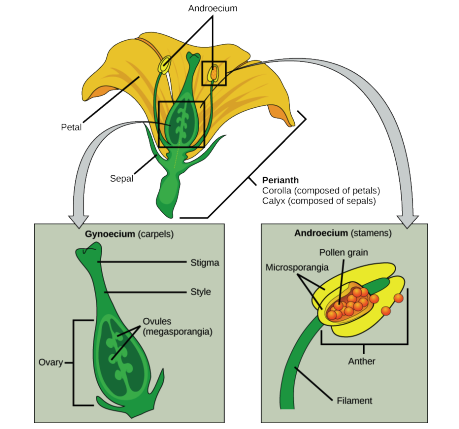
A typical flower is, structurally, a modified shoot. It sits on the swollen tip of a flower stalk. There are two key structural anchors:
- Pedicel — the flower stalk that holds the flower to the branch.
- Thalamus (also called receptacle) — the swollen tip of the pedicel where the flower's whorls are inserted.
On the thalamus, four concentric whorls are arranged from outside to inside:
| Position | Whorl | Made of | Category |
|---|---|---|---|
| Outermost | Calyx | Sepals (green, leaf-like) | Accessory |
| Second | Corolla | Petals (colourful) | Accessory |
| Third | Androecium | Stamens | Essential (male) |
| Innermost | Gynoecium | Carpels / pistils | Essential (female) |
Accessory vs essential — what's the difference?
The names tell you exactly what each whorl is for:
- Accessory whorls (calyx + corolla) help the flower do its job indirectly — sepals protect the developing bud; petals attract pollinators with colour and scent. They never produce gametes themselves.
- Essential whorls (androecium + gynoecium) actually produce the gametes. Without these, no reproduction. Hence "essential."
A flower that has all four whorls is called a complete flower (e.g., Hibiscus). One missing any whorl is incomplete (e.g., grasses lack a clear calyx/corolla).
Bisexual vs unisexual — a different distinction
This is a separate axis of classification:
- Bisexual (hermaphrodite) — has both androecium AND gynoecium (e.g., Hibiscus, mustard).
- Unisexual (imperfect) — has only one (e.g., maize is monoecious; papaya is dioecious — covered in Section 7).
[NEET Important] "Is every bisexual flower also a complete flower?" No. "Bisexual" requires both reproductive whorls; "complete" requires all four. Some flowers (e.g., certain grasses) are bisexual but incomplete because they lack petals/sepals.
Where the Gametes Form — A Preview
We've identified the two essential whorls. Now let's zoom in briefly on where gametes are actually produced — because this is the entry point for the next several sections.
\
Where pollen comes from
A stamen is the male reproductive unit. It has two parts:
- Filament — the stalk.
- Anther — the terminal swollen part where pollen is made.
Inside each anther are four small chambers called microsporangia (pollen sacs). Each microsporangium contains cells that undergo meiosis to produce pollen grains — the male gametophytes.
So the chain is:
Where the egg comes from
A pistil (or carpel) is the female reproductive unit. It has three parts:
- Stigma — the sticky top that catches pollen.
- Style — the slender neck.
- Ovary — the swollen base containing ovules.
Inside each ovule is the megasporangium, where meiosis produces a megaspore, which then develops into the embryo sac — the female gametophyte containing the egg cell.
So the chain is:
The big symmetry — and the big asymmetry
Notice the symmetry: both sides start sporophytic (), undergo meiosis, and produce a haploid gametophyte. That's the alternation of generations you saw in Class XI.
But also notice the asymmetry: pollen grains are tiny, motile (or wind-carried), and produced in enormous numbers. The embryo sac is large, immobile, and unique to each ovule. Male = abundance and dispersal. Female = investment and protection. This evolutionary contrast underlies almost every detail you'll meet in this chapter.
The Three Phases of the Chapter
The whole chapter is one continuous story. Let me give you the three-phase roadmap so that whenever you're in a particular section, you know where you are in the big picture.
Phase 1 — Pre-fertilisation (Sections 2–7)
Before the male and female gametes can meet, both must be built. This phase covers:
- Microsporogenesis (Section 2) — sperm production in anther.
- Pollen grain biology (Section 3) — the male gametophyte.
- Megasporogenesis (Section 4) — egg production in ovule.
- Embryo sac structure (Section 5) — the female gametophyte.
- Pollination (Section 6) — getting pollen to stigma.
- Outbreeding & pollen-pistil interaction (Section 7) — filtering the right pollen.
Phase 2 — Fertilisation (Section 8)
The famous double fertilisation — two simultaneous fusion events in a single embryo sac. This is the angiosperm signature, found nowhere else in the plant kingdom.
Phase 3 — Post-fertilisation (Sections 9–11)
Once the egg has been fertilised, two parallel developments happen:
- Endosperm (Section 9) — the food-storage tissue.
- Embryo (Section 9) — the future plant.
- Seed (Section 10) — the mature ovule.
- Fruit (Section 10) — the mature ovary.
- Apomixis & polyembryony (Section 11) — when seeds form without fertilisation.
Why this matters for you as a student
When you study Section 5 (Embryo Sac), you should already be primed by Section 4 (Ovule). When you reach Section 8 (Double Fertilisation), every cell in the embryo sac you'll see was built earlier in Section 5. Each section sets up the next. Treat them as one continuous narrative, not 11 isolated topics.
One-line takeaway for the chapter: A flower builds male gametophytes (pollen) inside its anther and a female gametophyte (embryo sac) inside its ovule, brings them together via pollination, performs double fertilisation, and turns the ovule into a seed and the ovary into a fruit — producing the next generation.
Small Memory Capsule — Section 1
A compact recap to lock in before moving to Section 2.
Core anatomy
- Pedicel = flower stalk; Thalamus = swollen tip where whorls insert.
- 4 whorls (outside → inside): Calyx → Corolla → Androecium → Gynoecium.
- Accessory (calyx + corolla) = protect + attract. Essential (androecium + gynoecium) = produce gametes.
Two important classifications (don't confuse them)
| Term | Meaning |
|---|---|
| Complete flower | Has all 4 whorls |
| Bisexual flower | Has both reproductive whorls (androecium + gynoecium) |
A flower can be bisexual but incomplete (e.g., some grasses).
Where gametes form
- Stamen → Anther → Microsporangium → Pollen grain (male gametophyte, ).
- Pistil → Ovary → Ovule → Megasporangium → Embryo sac (female gametophyte, ).
Three phases of the chapter
- Pre-fertilisation (Sections 2-7): build gametophytes + bring them together.
- Fertilisation (Section 8): the unique angiosperm double fertilisation.
- Post-fertilisation (Sections 9-11): make seed + fruit + apomixis/polyembryony.
NEET-essential facts
- This chapter contributes 4-6 NEET questions every year.
- Crocus sativus → saffron (stigma); Syzygium aromaticum → cloves (flower buds).
- Floriculture = cultivation of flowering plants for ornamental/commercial trade.
One-line takeaway
A flower is a precision factory whose four concentric whorls produce, deliver, and protect the gametes that build the next generation.
Solved Examples
Example 1: Naming the four whorls in correct order
Name the four whorls of a typical bisexual flower, in correct order from outside to inside, and classify each as accessory or essential. Give a real example of each part.
Solution:
Reasoning by position. The flower is built on the thalamus in concentric circles. Sepals appear first (outermost, protecting the bud). Then petals. Then male parts. Then female parts in the centre.
| Whorl | Position | Made of | Category | Real example |
|---|---|---|---|---|
| Calyx | Outermost | Sepals (green) | Accessory | Green leaf-like sepals of Hibiscus |
| Corolla | 2nd | Petals (colourful) | Accessory | Red petals of Hibiscus rosa-sinensis |
| Androecium | 3rd | Stamens (filament + anther) | Essential — male | Yellow stamens of any flower |
| Gynoecium | Innermost | Carpels / pistils | Essential — female | Central pink pistil of a lily |
Answer: Calyx (accessory) → Corolla (accessory) → Androecium (essential, male) → Gynoecium (essential, female).
Why this works: The "essential" tag specifically means gamete-producing. Pretty petals don't make seeds. Stamens and pistils do.
[Board Important] This is a classic 2-mark CBSE question. Always pair each whorl with its component AND its category to score full marks.
Example 2: Bisexual ≠ Complete (NEET classic trap)
A student says: "If a flower has both stamens and carpels, it must also be a complete flower." Is the student correct? Explain with an example.
Solution:
The student is wrong. "Bisexual" and "complete" measure different things:
- Bisexual (hermaphrodite) asks: Are both reproductive whorls present? Just two things — androecium and gynoecium.
- Complete asks: Are all four whorls present? Four things — calyx, corolla, androecium, and gynoecium.
A flower can be bisexual but incomplete if it has both reproductive whorls but is missing either the calyx or the corolla.
Real example: Many grass flowers (family Poaceae) have stamens and carpels (so they're bisexual), but their perianth (calyx + corolla) is reduced to a few tiny scales called lodicules — so they are incomplete. Yet they reproduce sexually just fine.
Counter-cases:
- A flower can be complete AND bisexual (e.g., Hibiscus — has all four whorls + both sexes).
- A flower can be incomplete AND unisexual (e.g., maize male tassel — only stamens, no calyx or corolla in the typical sense).
Answer: Wrong. Bisexual = both sexes present; Complete = all four whorls present. The two terms test different criteria.
[NEET Important] This trap appears in NEET almost every year, in subtle MCQ wordings. Always pause and check both criteria separately.
Example 3: Where do gametes form?
Pinpoint the exact location inside a flower where (a) male gametes and (b) the female gamete are produced.
Solution:
We trace each chain carefully.
(a) Male gametes:
Each stamen ends in an anther, which contains 4 chambers called microsporangia (pollen sacs). Inside each microsporangium, pollen mother cells (sporophytic, diploid) undergo meiosis to produce haploid microspores. Each microspore matures into a pollen grain — the male gametophyte. The pollen grain later produces (by mitosis) two male gametes.
So the precise location is: inside the microsporangia of the anther, in cells called the sporogenous tissue and PMCs.
(b) Female gamete (egg):
The pistil's ovary contains one or more ovules. Each ovule is the megasporangium of the flower (its central nutritive tissue is the nucellus). Inside the nucellus, a megaspore mother cell undergoes meiosis to produce 4 megaspores; only 1 survives (the functional megaspore). That functional megaspore develops into the embryo sac — the female gametophyte. Inside the embryo sac, at the micropylar end, sits the egg cell — the actual female gamete.
So the precise location is: inside the embryo sac of the ovule, specifically at the micropylar end (in the egg apparatus).
Answer:
| Gamete | Location |
|---|---|
| Male gametes | Pollen grain → inside microsporangium → inside anther → inside stamen |
| Female gamete (egg) | Egg cell → inside embryo sac → inside ovule → inside ovary → inside pistil |
[NEET Important] A frequent NEET MCQ asks for the structure where microsporogenesis occurs (= microsporangium) or where megasporogenesis occurs (= nucellus of ovule). Memorise the precise locations.
Example 4: NCERT in-text — significance of flowers
NCERT poses the question: "Why are flowers considered morphological and embryological marvels?" Answer in 4-5 sentences.
Solution:
Morphological marvel: A flower is a modified shoot in which leaves have been transformed (over evolutionary time) into specialised whorls — protective sepals, attractive petals, gamete-bearing stamens, and seed-bearing carpels. The precision of this transformation — different cell types, distinct hormonal control of each whorl's development, and the spatial arrangement of four concentric layers — makes the flower one of the most morphologically complex structures in the plant body.
Embryological marvel: A flower is the site of sexual reproduction and the only place in a plant's life where meiosis, fertilisation, and embryogenesis occur. Inside a single flower, microsporogenesis builds millions of pollen grains, megasporogenesis builds a 7-celled embryo sac, double fertilisation produces a zygote AND an endosperm, and the entire next-generation seed is packaged inside the ovary that becomes the fruit. So much of life's continuity is concentrated in this one small structure.
Answer: Flowers are morphological marvels because they are precisely engineered modified shoots with four specialised whorls; embryological marvels because they host meiosis, fertilisation, and embryogenesis — the entire sexual life cycle of an angiosperm.
[Board Important] Standard 2-3 mark CBSE question. The phrase "morphological and embryological marvels" is verbatim NCERT and should appear in your answer.
Example 5: The roadmap of the chapter
Arrange the following events in their correct chronological order in the life of a flowering plant:
(i) Megasporogenesis (ii) Pollination (iii) Microsporogenesis (iv) Seed formation (v) Double fertilisation (vi) Embryo development (vii) Fruit formation
Solution:
Anchor on the three phases. Pre-fertilisation events (gametogenesis + pollen delivery) come first. Then fertilisation. Then post-fertilisation development.
Pre-fertilisation phase:
- Microsporogenesis (iii) — pollen formation in anther.
- Megasporogenesis (i) — megaspore formation in ovule. (These two happen roughly in parallel; we list them in any order before pollination.)
- Pollination (ii) — pollen reaches stigma.
Fertilisation phase:
- Double fertilisation (v) — male gametes fuse with egg + polar nuclei inside the embryo sac.
Post-fertilisation phase:
- Embryo development (vi) — zygote divides to form embryo.
- Seed formation (iv) — mature ovule = seed.
- Fruit formation (vii) — mature ovary = fruit (often happens in parallel with seed maturation).
Answer: .
[NEET Important] "Arrange in order" questions are NEET classics. The trick is to anchor on the three big phases. Within each phase, the sub-order is usually obvious — but the phase order (pre → fert → post) is absolute.
Example 6: Floriculture and economic botany
Name (a) the species and the floral part used to produce saffron, and (b) the species and the floral part used to produce cloves. Why are these examples important in NCERT?
Solution:
(a) Saffron:
- Species: Crocus sativus (family Iridaceae).
- Part used: The stigmas (sticky tip of the pistil). Each flower has 3 stigmas. They are hand-picked, dried, and sold as saffron — one of the world's most expensive spices.
- Reason for price: It takes ~150,000 flowers to produce 1 kg of dried saffron.
(b) Cloves:
- Species: Syzygium aromaticum (family Myrtaceae).
- Part used: Unopened flower buds. They are harvested before the bud opens, dried, and sold whole as clove spice (the laung of Indian cuisine).
- Key point: Cloves are flower buds, NOT seeds, NOT fruits. This distinction is often tested.
Why these examples matter (beyond-NCERT enrichment):
Both examples illustrate floriculture as an economic activity — flowering plants cultivated not for food per se, but for specific floral products. They also show that different parts of a flower can be commercially valuable. Saffron from stigmas, cloves from buds, perfumes from petals (roses, jasmine), cooking oils from seeds (sunflower) — the flower is a treasure trove of products.
Answer:
| Spice | Species | Part used |
|---|---|---|
| Saffron | Crocus sativus | Dried stigmas |
| Cloves | Syzygium aromaticum | Unopened flower buds |
[NEET Important] Memorise both species names and both parts used. Both have appeared in NEET MCQs.