
Collision Theory of Reaction Rates
Why do concentration and temperature affect rate the way they do? Collision theory (developed from the kinetic theory of gases) gives the molecular picture: molecules must collide to react, but not every collision leads to reaction.
For a bimolecular reaction products, the rate depends on the collision frequency (number of collisions per second per unit volume) multiplied by the fraction of collisions that are effective:
Two conditions must be met for a collision to be effective:
- The colliding molecules must possess energy (the activation energy).
- They must collide with the proper orientation.
The factor accounts for the energy requirement; the steric (probability) factor accounts for orientation.
Activation Energy and Orientation
Most collisions are too gentle or wrongly aligned to react. Only molecules in the high-energy tail of the distribution, colliding the right way round, succeed.
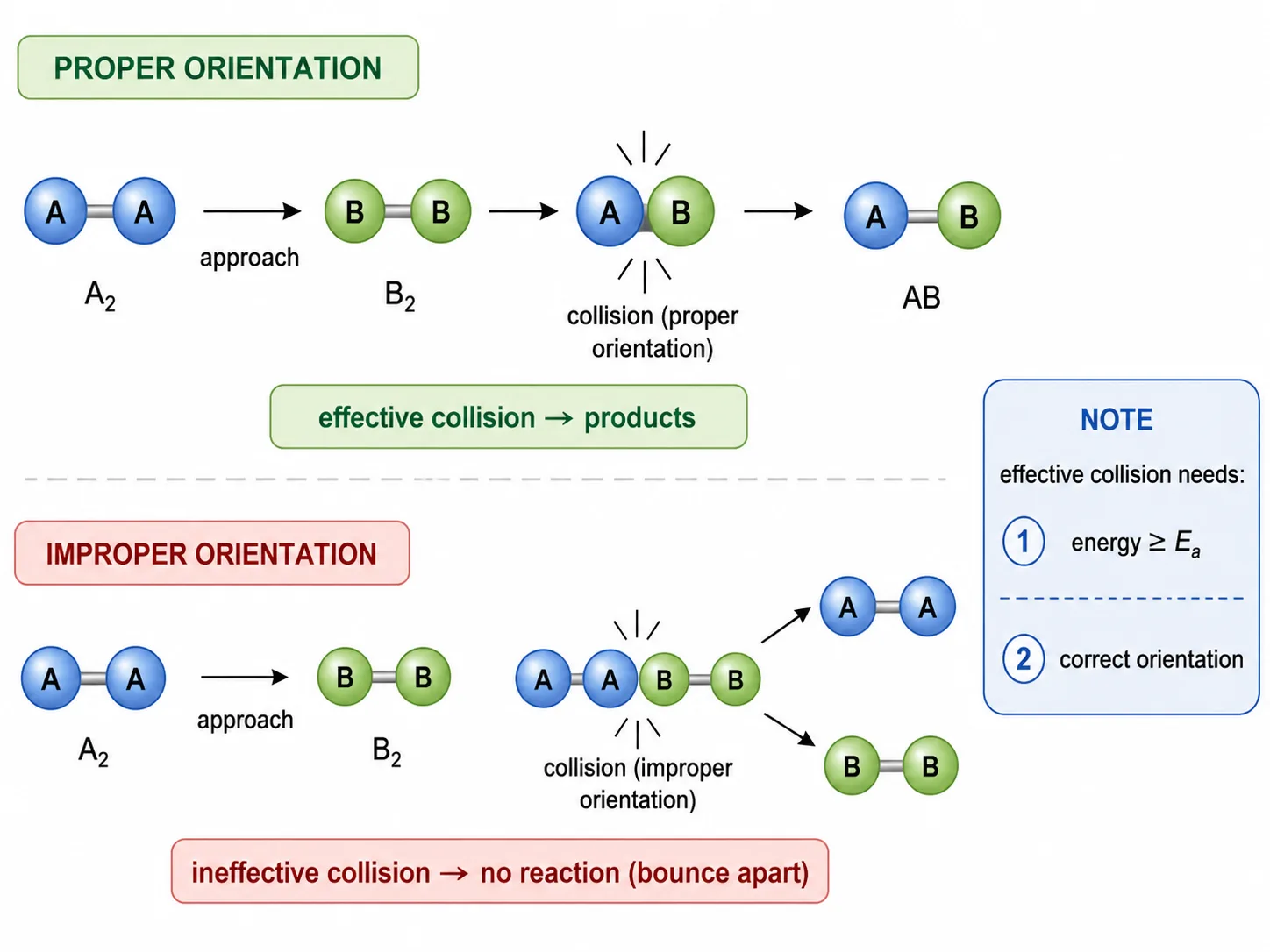
Activated complex: at the moment of an effective collision, the molecules form a short-lived, high-energy activated complex (transition state) at the top of the energy barrier, which then breaks down into products.
The steric factor (also called the probability factor) is introduced because the simple collision formula often overestimates the rate — it corrects for the fraction of collisions with the correct orientation.
The Maxwell-Boltzmann Distribution
At any temperature, molecules have a range of kinetic energies described by the Maxwell-Boltzmann distribution. Only the molecules in the high-energy tail beyond can react.
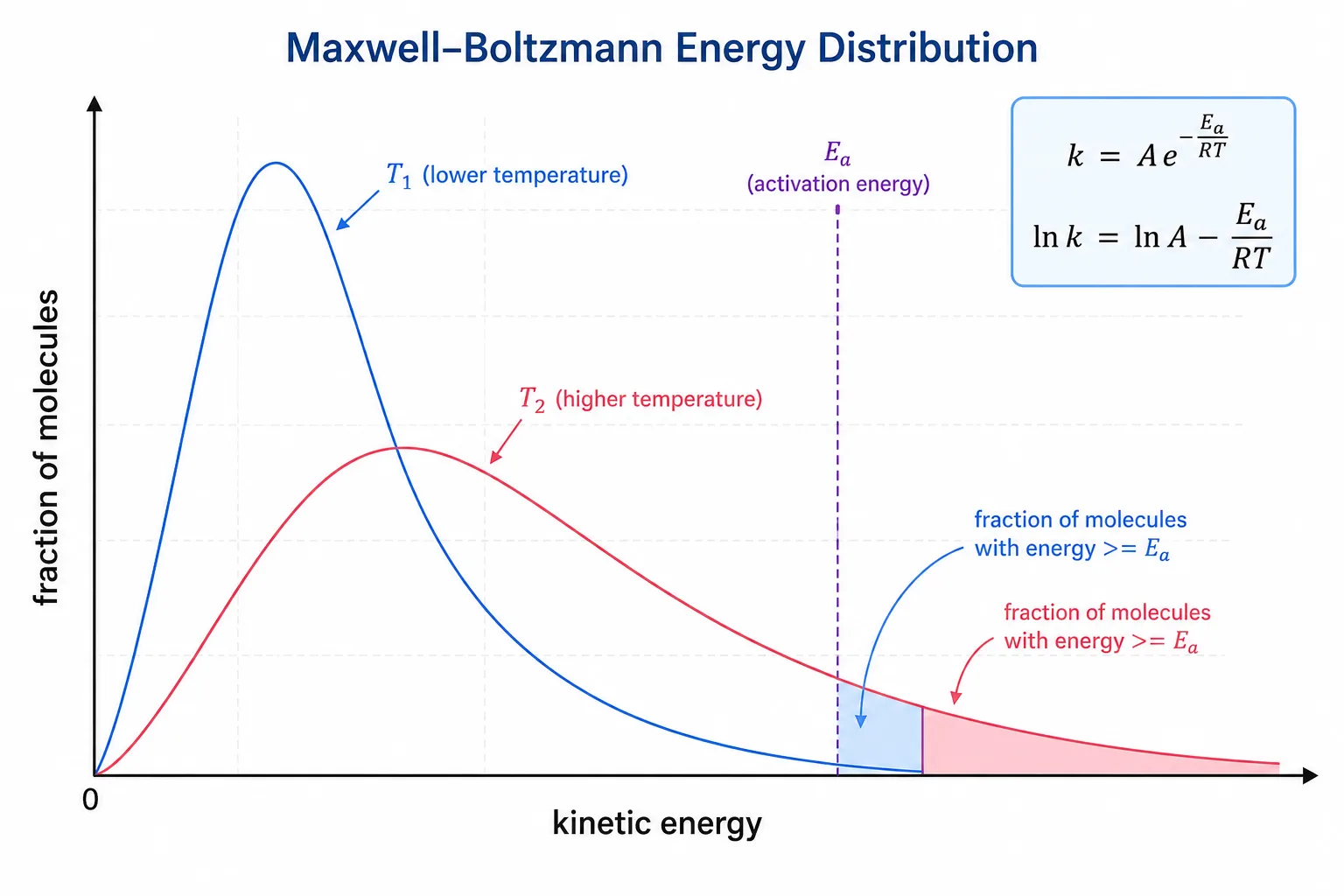
When temperature rises from to :
- the curve broadens and shifts right,
- the area beyond (the reactive fraction) increases sharply.
This is the molecular explanation of the Arrhenius equation: a higher temperature puts many more molecules over the energy barrier.
[NEET Important] The peak of the distribution corresponds to the most probable kinetic energy. Raising temperature lowers and broadens the peak while greatly increasing the high-energy tail — that tail is what drives the rate up.
Solved Examples
Example 1: Two conditions for effective collision
State the two conditions a molecular collision must satisfy to lead to a reaction.
Solution: (1) The molecules must have kinetic energy (the activation energy), and (2) they must collide with the correct orientation.
Example 2: Role of the steric factor
Why is the steric (probability) factor introduced in collision theory?
Solution: The simple collision formula (energy criterion only) often overestimates the rate. corrects for the fact that only collisions with the proper orientation are effective, so the real rate is lower than the energy-only prediction.
Example 3: Effect of temperature on the distribution
How does raising the temperature change the Maxwell-Boltzmann distribution and the rate?
Solution: Higher temperature broadens and shifts the curve to higher energy, increasing the fraction of molecules with energy . More molecules can cross the barrier, so the rate increases.
Example 4: What is the activated complex?
Define the activated complex.
Solution: The activated complex (transition state) is the unstable, high-energy arrangement of atoms formed momentarily at the top of the energy barrier during an effective collision; it then decomposes into products.
Example 5: Why not every collision reacts
In a gas, molecules undergo billions of collisions per second, yet reactions are far slower than that. Why?
Solution: Only a tiny fraction of collisions are effective — those with enough energy () and proper orientation. The vast majority are too weak or wrongly aligned, so no reaction occurs.
Example 6: Collision frequency vs rate
Does increasing concentration increase the rate by increasing collision energy or collision frequency?
Solution: Increasing concentration increases the collision frequency (more molecules per unit volume collide more often). It does not change the energy distribution. More collisions per second means more effective collisions, hence a higher rate.
Example 7: Energy criterion
Two reactions at the same temperature have activation energies 40 and 80 kJ mol. Which has the larger fraction of effective collisions?
Solution: The fraction with energy is , which is larger for the smaller . So the reaction with kJ mol has more effective collisions and is faster.
Example 8: Orientation example
For the reaction of NO with O, why does orientation matter?
Solution: The reactive atoms must meet for bonds to rearrange. If the molecules approach so that the wrong ends collide, no bond formation/breaking can occur — the collision is ineffective despite sufficient energy.
Example 9: Most probable energy
What does the peak of the Maxwell-Boltzmann curve represent, and how does it move on heating?
Solution: The peak represents the most probable kinetic energy. On heating, the peak shifts to higher energy and becomes lower and broader, while the high-energy tail (molecules above ) grows.
Example 10: Linking collision theory to Arrhenius
How does collision theory explain the exponential term in the Arrhenius equation?
Solution: The fraction of collisions with energy is , exactly the exponential factor in . Collision theory thus provides the physical basis for the Arrhenius temperature dependence.