
Why Temperature Speeds Up Reactions
Almost every reaction goes faster when heated. A useful rule of thumb is: the rate roughly doubles for every 10 K rise in temperature. Why such a large effect from a modest temperature change?
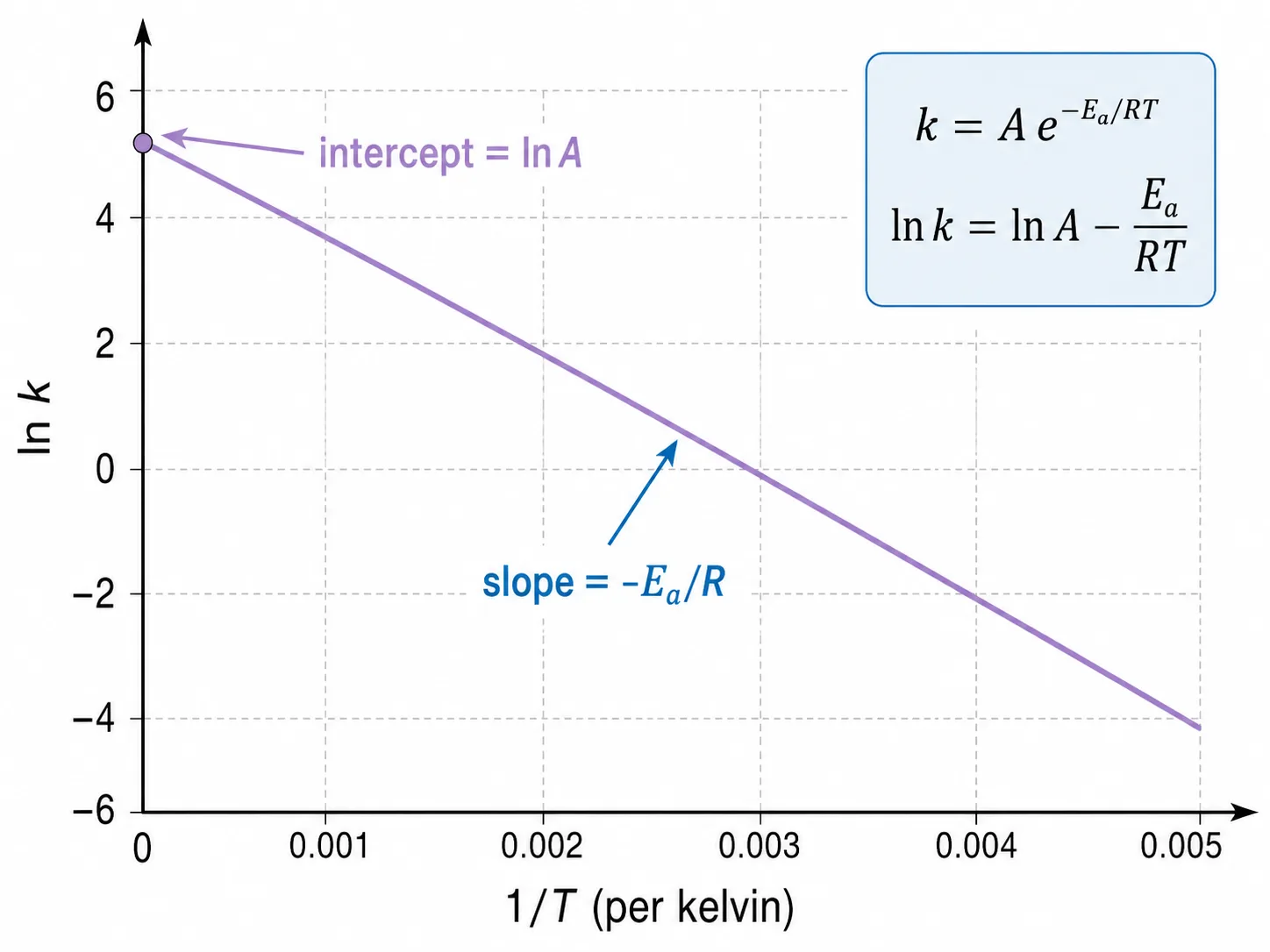
It is not mainly that molecules move a little faster. The real reason is that raising the temperature sharply increases the fraction of molecules that have enough energy to react (the activation energy). This is captured quantitatively by the Arrhenius equation.
- = rate constant,
- = the Arrhenius factor or frequency factor (related to collision frequency and orientation),
- = activation energy (J mol),
- = gas constant (8.314 J K mol),
- = absolute temperature (K).
The Logarithmic Forms
Taking natural logs of the Arrhenius equation:
So a plot of against is a straight line with slope and intercept . In base-10:
Two-temperature form (for rate constants at and at ):
This is the workhorse formula for finding from two rate constants, or one given the other.
Activation Energy and the Energy Barrier
For a reaction to occur, colliding molecules must first form an unstable, high-energy activated complex (transition state) at the top of an energy barrier. The minimum extra energy reactants need to reach that barrier is the activation energy .
- A high means few molecules have enough energy → slow reaction.
- A low means many molecules can react → fast reaction.
The Arrhenius factor is the fraction of molecules that have energy at least at temperature in the simplified Arrhenius picture. Raising or lowering increases this fraction and hence the rate.
Key Point: From , both increasing temperature and decreasing activation energy (e.g. by a catalyst) increase the rate constant. The exponential dependence is why a 10 K rise can nearly double the rate.
[JEE Tip] When using the two-temperature formula, keep in J mol with , or in kJ mol with . Temperatures must be in kelvin. Mismatched units are a common source of error.
Solved Examples
Example 1: Rate doubling rule
The rate of a reaction doubles when temperature rises from 298 K to 308 K. Estimate . ( J K mol)
Solution: . . . J kJ mol.
Example 2: Slope of an Arrhenius plot
An Arrhenius plot of vs has slope K. Find . ()
Solution: slope , so J kJ mol.
Example 3: Finding k at another temperature
A reaction has s at 300 K and kJ mol. Find at 310 K. ()
Solution: . . So , giving s.
Example 4: Activation energy from two rate constants
For a reaction, increases from to s when rises from 300 K to 320 K. Find . ()
Solution: . . . J kJ mol.
Example 5: Meaning of the frequency factor
In , what does represent?
Solution: is the frequency (or Arrhenius) factor — it reflects the frequency of collisions and the fraction with proper orientation. It is approximately the rate constant the reaction would have if the activation barrier were negligible and collisions were effectively successful.
Example 6: Effect of catalyst on Arrhenius terms
How does a catalyst change in the Arrhenius equation?
Solution: A catalyst lowers the activation energy . Since , a smaller makes the exponential term larger, so (and the rate) increases. For a given temperature, is usually taken as unchanged in this simplified treatment.
Example 7: Fraction of molecules above
The term represents what physical quantity?
Solution: It is the fraction of molecules whose kinetic energy is equal to or greater than the activation energy at temperature in the Arrhenius model. Raising increases this fraction sharply.
Example 8: Temperature for a target rate increase
If , what does the Arrhenius equation predict about temperature dependence?
Solution: With , , a constant. The rate constant would be independent of temperature in this idealized case.
Example 9: Two-temperature numerical
A first-order reaction has s at 400 K. If kJ mol, find at 420 K. ()
Solution: . , so s.
Example 10: Why rate rises faster than molecular speed
A 10 K rise increases average molecular speed by only ~2%, yet the rate can double. Explain.
Solution: Rate depends not on average speed but on the fraction of molecules exceeding , given by . This fraction is very sensitive to temperature, so a small rise produces a large rate increase.