
How a Catalyst Works
A catalyst is a substance that increases the rate of a reaction without itself being consumed in the overall reaction. A small amount can speed up the conversion of large amounts of reactant, and it is recovered chemically unchanged at the end.
The secret: a catalyst provides an alternative reaction pathway with a lower activation energy . Because , lowering increases exponentially — so even a modest reduction in the barrier can produce a large rate increase.
A catalyst does NOT:
- get consumed (it is regenerated),
- change the enthalpy change of the reaction,
- change the position of equilibrium (it speeds up forward and backward reactions equally),
- supply the energy of activation — it lowers the barrier rather than adding energy.
Energy Profile Diagrams
A potential-energy vs reaction-coordinate diagram shows the energy barrier the reaction must cross. The catalysed path has a lower peak.
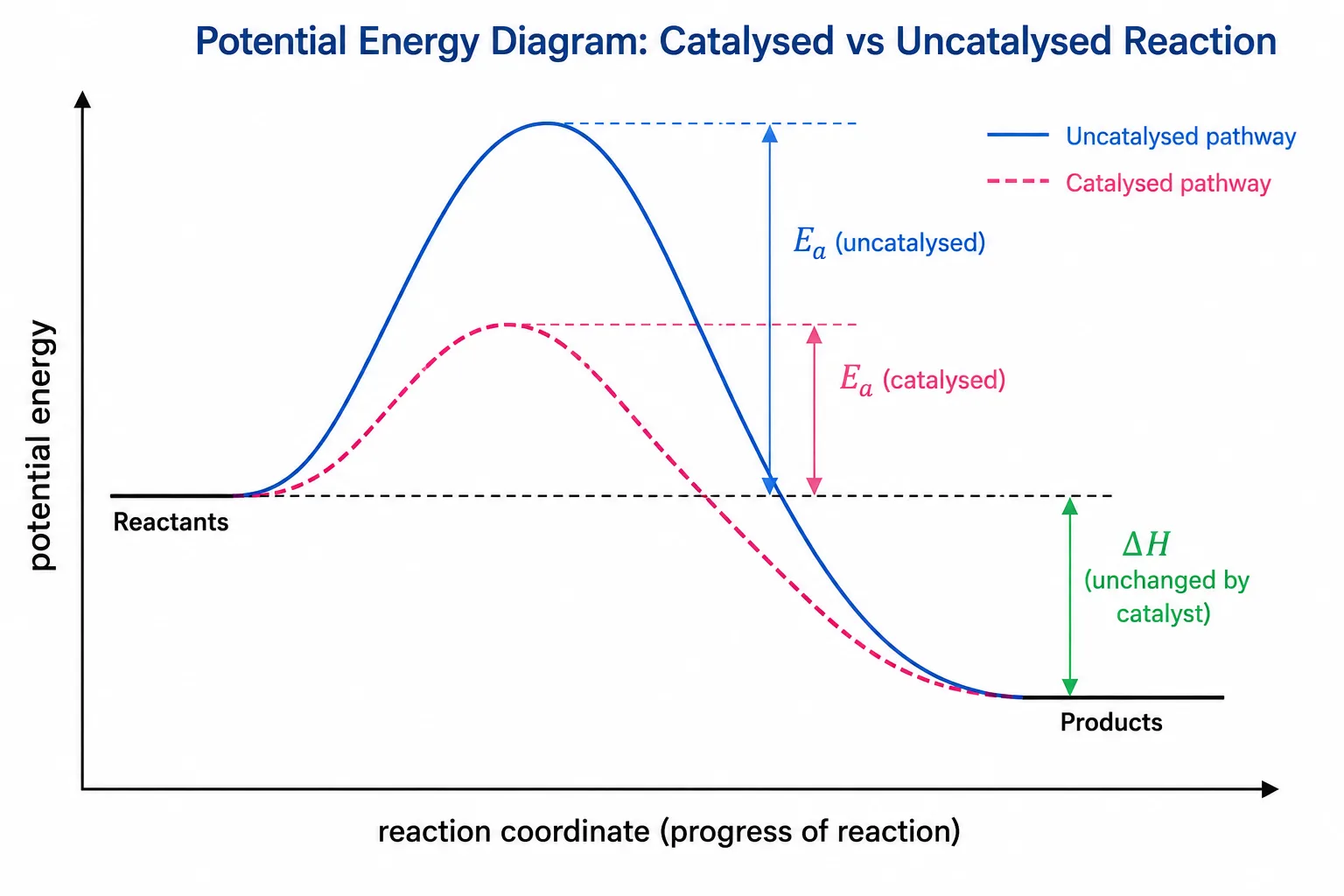
The two key readings:
- The activation energy is lowered (), so more molecules can react → faster rate.
- The reactant and product energy levels are unchanged, so and the equilibrium constant are unchanged. A catalyst helps equilibrium be reached faster, not shifted.
Types and Examples of Catalysis
- Homogeneous catalysis — catalyst and reactants in the same phase (e.g. acid-catalysed ester hydrolysis; oxidation of SO by NO in the lead-chamber process).
- Heterogeneous catalysis — catalyst in a different phase, usually a solid catalyst with gaseous/liquid reactants (e.g. iron in the Haber process for NH; platinum in catalytic converters; finely divided nickel in the hydrogenation of oils).
- Enzymes are highly specific biological catalysts (e.g. amylase, which catalyses starch hydrolysis).
Key Point: A catalyst changes only the rate (kinetics), never the thermodynamics (, , ). It lowers for both the forward and reverse reactions by the same amount.
[JEE Tip] A classic trap: "Does a catalyst change the equilibrium constant?" — No. It lowers the activation energy of both directions equally, so it only makes equilibrium arrive sooner; the value of is untouched.
Solved Examples
Example 1: How a catalyst speeds a reaction
Explain, using the Arrhenius equation, how a catalyst increases the rate.
Solution: A catalyst provides an alternative path with a lower activation energy . Since , a smaller makes larger, so and the rate increase — without changing or .
Example 2: Effect on enthalpy
Does a catalyst change the of a reaction?
Solution: No. The catalyst lowers the energy barrier but the reactant and product energy levels are unchanged, so stays the same.
Example 3: Effect on equilibrium
Does a catalyst shift the position of equilibrium?
Solution: No. A catalyst lowers for the forward and reverse reactions by the same amount, speeding both equally. Equilibrium is reached faster, but the equilibrium constant and the position of equilibrium are unchanged.
Example 4: Homogeneous vs heterogeneous
Classify (a) acid hydrolysis of an ester and (b) the Haber process (Fe catalyst) as homogeneous or heterogeneous catalysis.
Solution: (a) Acid and ester are both in solution → homogeneous catalysis. (b) Solid iron with gaseous N/H → heterogeneous catalysis.
Example 5: Why a small amount suffices
Why can a small amount of catalyst speed up the reaction of a large amount of reactant?
Solution: The catalyst is not consumed — it is regenerated at the end of each cycle and used again and again. So a small quantity can process a large amount of reactant repeatedly.
Example 6: Activation energies of forward and reverse
A catalyst lowers the forward activation energy by 20 kJ mol. By how much does it lower the reverse activation energy?
Solution: By the same 20 kJ mol. Because is unchanged, both barriers drop equally, so the catalyst does not alter .
Example 7: Enzyme catalysis
What kind of catalyst is an enzyme, and give one property.
Solution: An enzyme is a biological catalyst (a protein). A key property is high specificity — each enzyme typically catalyses one particular reaction (e.g. amylase acts on starch).
Example 8: Reading an energy profile
On an energy-profile diagram, what feature is lowered by a catalyst, and what stays the same?
Solution: The catalyst lowers the peak (the activation-energy barrier). The reactant and product energy levels (and hence ) stay the same.
Example 9: Catalyst and rate constant
A catalyst lowers from 75 to 50 kJ mol. Qualitatively, what happens to ?
Solution: Since , reducing makes the exponent less negative, so increases and increases — the reaction goes faster. (At room temperature a 25 kJ mol drop increases by a very large factor.)
Example 10: Catalytic converter
What catalyst type operates in a car's catalytic converter, and what does it do?
Solution: A heterogeneous catalyst (platinum/palladium/rhodium on a solid support). It speeds the conversion of harmful exhaust gases (CO, unburnt hydrocarbons, NO) into less harmful CO, HO and N by lowering their activation energies.