
Order of a Reaction
The order of a reaction is the sum of the powers of the concentration terms in the experimentally determined rate law. For Rate :
Key facts about order:
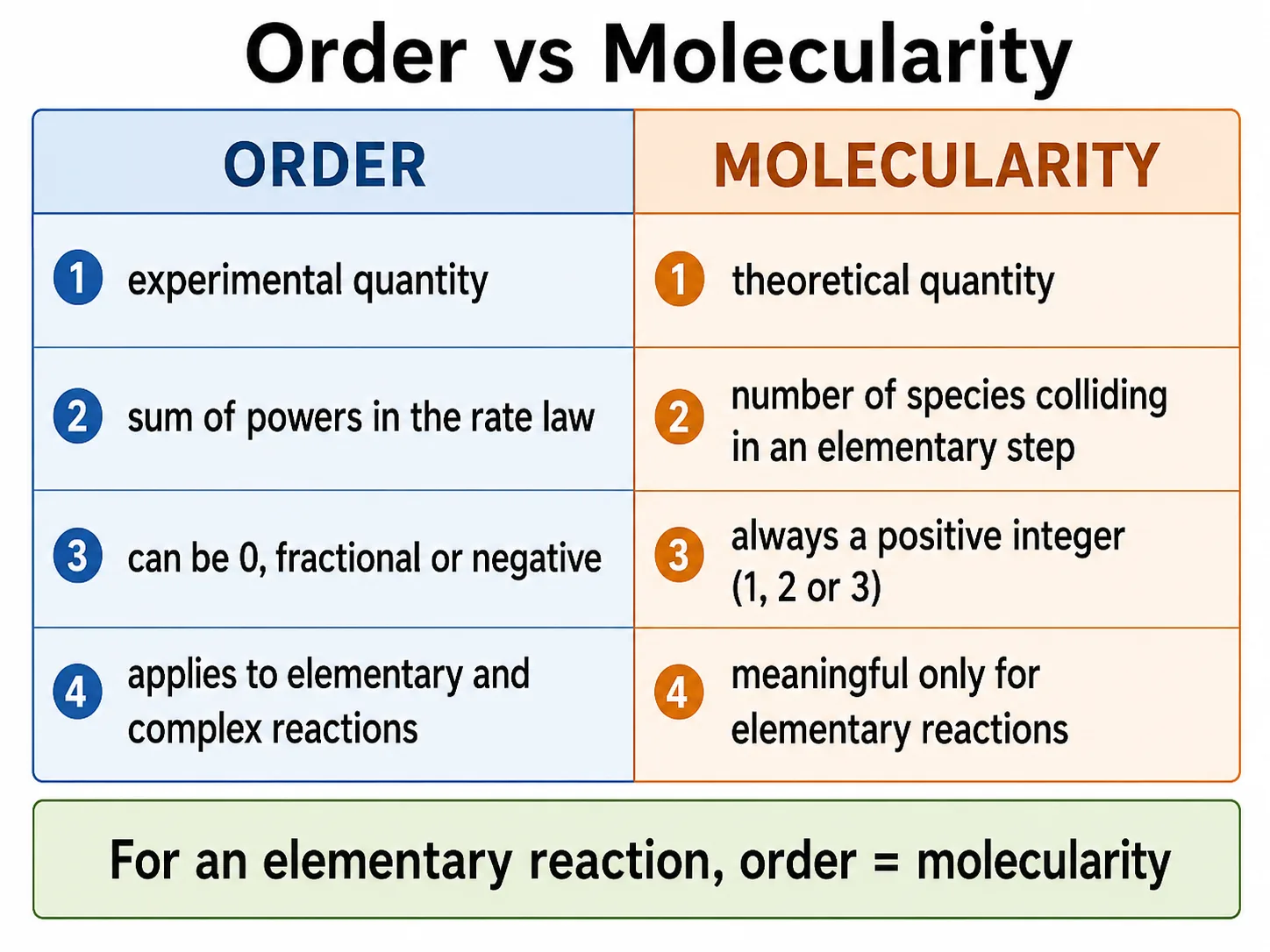
- It is an experimental quantity (not from the equation).
- It can be zero, a whole number, fractional, or even negative.
- The order with respect to a particular reactant is the power of that reactant's concentration.
Examples: For Rate , order . For Rate , order (half order).
Molecularity of a Reaction
Molecularity is the number of reacting species (atoms, ions or molecules) that collide simultaneously in an elementary reaction to bring about the reaction.
- Unimolecular (molecularity 1): one species, e.g. .
- Bimolecular (molecularity 2): two species collide, e.g. .
- Termolecular (molecularity 3): three species collide (rare, because simultaneous three-body collisions are unlikely).
Molecularity is a theoretical concept that applies only to elementary (single-step) reactions and is always a positive whole number (1, 2 or 3) — never zero or fractional.
Complex Reactions and the Rate-Determining Step
Most real reactions occur in several elementary steps (a reaction mechanism). For such complex reactions:
- Molecularity of the overall reaction has no meaning — only individual elementary steps have a molecularity.
- The overall rate is governed by the slowest step, called the rate-determining step (RDS).
Key Point — Order vs Molecularity:
- Order is experimental, can be 0/fractional/negative, and applies to overall reactions.
- Molecularity is theoretical, always a positive integer (1-3), and applies only to elementary steps.
- For an elementary reaction, order = molecularity.
[JEE Tip] A reaction can be, say, first order overall but its mechanism may involve a bimolecular slow step followed by fast steps. Always treat order (measured) and molecularity (mechanistic) as separate ideas unless told the reaction is elementary.
Solved Examples
Example 1: Order from a rate law
For Rate , find the order with respect to A, to B, and overall.
Solution: Order in A ; order in B ; overall (2.5).
Example 2: Half order
For Rate , find the overall order.
Solution: Overall order (half order).
Example 3: Molecularity of an elementary reaction
State the molecularity of the elementary reaction .
Solution: Two HI molecules collide, so the molecularity is 2 (bimolecular).
Example 4: Why is termolecularity rare?
Why are termolecular elementary reactions uncommon?
Solution: A termolecular step needs three species to collide simultaneously with the right energy and orientation — a statistically very unlikely event — so such reactions are rare.
Example 5: Order can be zero
Can the order of a reaction be zero? Can molecularity be zero?
Solution: Order can be zero (e.g. some surface-catalysed reactions). Molecularity cannot be zero — at least one species must take part in an elementary step, so molecularity is a positive integer (1, 2 or 3).
Example 6: Elementary reaction relation
For an elementary reaction products, what are its order and molecularity?
Solution: For an elementary step, order = molecularity. Here two species react, so molecularity = 2 and the rate law is Rate , overall order = 2.
Example 7: Order vs coefficient
For , experiment gives Rate . State the order; does it match the coefficients here?
Solution: Order . In this particular case the orders happen to match the coefficients, but that is not guaranteed in general — it must always be confirmed experimentally.
Example 8: Negative order meaning
What does a negative order with respect to a species imply?
Solution: A negative order means that increasing that species' concentration decreases the rate (it inhibits the reaction), e.g. a product that slows the forward reaction.
Example 9: Molecularity of a unimolecular reaction
Give the molecularity of (elementary).
Solution: One species decomposes, so molecularity (unimolecular).
Example 10: Rate-determining step
In a multi-step reaction, which step controls the overall rate?
Solution: The slowest step — the rate-determining step — controls the overall rate, just as the narrowest section of a pipe limits water flow.