
What Is the Rate of a Reaction?
Thermodynamics tells us whether a reaction can happen. Chemical kinetics tells us how fast it happens — and that turns out to matter enormously. The conversion of diamond to graphite is thermodynamically feasible, yet it is so slow we never see it. Kinetics is the branch of chemistry that studies reaction rates and mechanisms.
Think of it this way: as a reaction proceeds, reactants are used up and products build up. The rate of reaction measures how quickly that change happens — the change in concentration of a reactant or product per unit time.
Concentration is usually in mol L and time in seconds, so the units of rate are mol L s (for gases sometimes atm s).
Average vs Instantaneous Rate
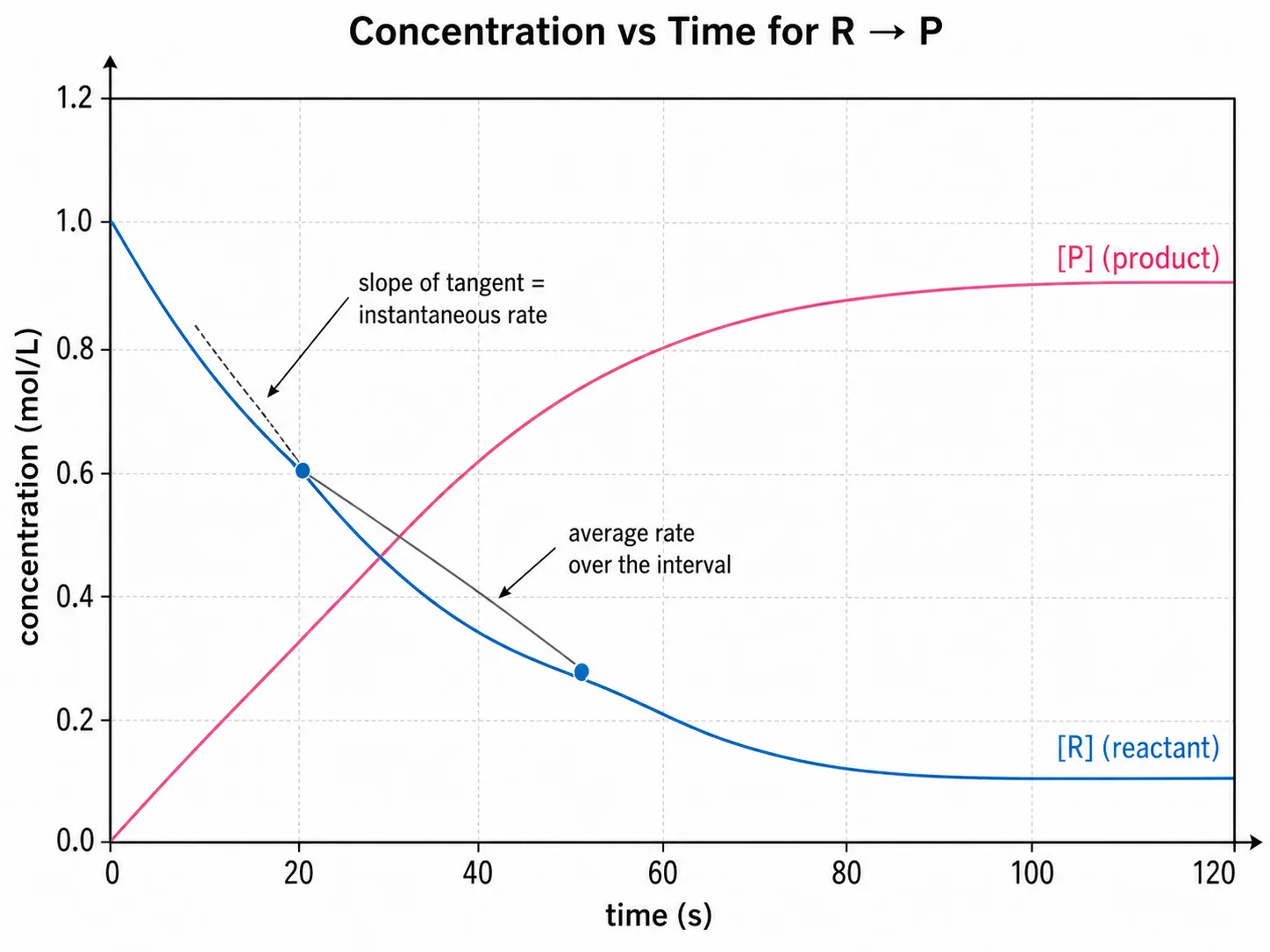
For a reaction , we can measure the rate two ways.
Average rate — the change over a finite time interval:
The minus sign for the reactant makes the rate positive (since decreases, is negative).
Instantaneous rate — the rate at a particular instant, obtained as :
Graphically, the instantaneous rate is the slope of the tangent to the concentration-time curve at that point.
Rate in Terms of Different Species
When the stoichiometric coefficients are not all 1, the rate measured from each species differs by those coefficients. For a general reaction:
the unique rate of reaction is defined by dividing each term by its coefficient:
This gives a single value no matter which species you track.
Worked relation: For , .
[JEE Tip] If a question gives the rate of disappearance of one species and asks for another, just use the coefficient ratios. For the above, .
Solved Examples
Example 1: Average rate
For , the concentration of falls from 0.03 M to 0.02 M in 25 minutes. Find the average rate in (a) mol L min and (b) mol L s.
Solution: (a) mol L min. (b) mol L s.
Example 2: Rate in terms of species
For Products, the concentration of A decreases from 0.5 M to 0.4 M in 10 minutes. Find the rate of reaction.
Solution: mol L min.
Example 3: Relating rates of two species
For , if forms at mol L s, find the rate of formation of .
Solution: , so mol L s.
Example 4: Rate of disappearance
For , if is consumed at mol L s, find the rate of formation of .
Solution: . So mol L s.
Example 5: Units of rate
What are the SI-style units of reaction rate when concentration is in mol L and time in seconds?
Solution: mol L s.
Example 6: Instantaneous rate from a graph
How is the instantaneous rate of a reaction obtained from a concentration-time graph?
Solution: It is the slope of the tangent drawn to the curve at that particular instant. For a reactant the slope is negative, so the instantaneous rate is taken as the negative of that slope.
Example 7: Average rate of product
In a reaction, the concentration of product rises from 0 to 0.10 M in 5 seconds. Find the average rate of formation of product.
Solution: mol L s.
Example 8: Rate relation in ammonia synthesis
For , express the single rate of reaction in terms of all three species.
Solution: .
Example 9: Why divide by coefficients?
Why do we divide each concentration-change term by the stoichiometric coefficient when defining the rate of reaction?
Solution: Different species are consumed or formed at different numerical speeds set by the stoichiometry. Dividing by the coefficient gives a single, unique rate for the reaction that is the same whichever species is monitored.
Example 10: Converting per-minute to per-second
A rate is mol L min. Convert to mol L s.
Solution: Divide by 60: mol L s.