
What Changes a Reaction's Rate?
Why does milk spoil faster in summer, and food last longer in a fridge? Why does powdered sugar dissolve faster than a cube? Several factors control how fast a reaction goes:
- Concentration of reactants — more reactant usually means a faster rate (more collisions).
- Temperature — raising temperature sharply increases rate (Section 7).
- Catalyst — speeds a reaction without being consumed (Section 9).
- Surface area — a finely divided solid reacts faster than a lump.
- Nature of reactants — ionic reactions are fast; covalent-bond-breaking reactions are usually slower.
- Radiation/light — some reactions (e.g. photosynthesis, ) need light.
This section focuses on the quantitative effect of concentration, captured by the rate law.
The Rate Law (Rate Expression)
Experiments show that the rate depends on reactant concentrations raised to certain powers. For products:
This is the rate law (or rate expression). Here:
- is the rate constant (specific reaction rate),
- is the order with respect to A, the order with respect to B,
- and are found experimentally — they are not necessarily the stoichiometric coefficients and .
Crucial point: You cannot read the powers off the balanced equation (unless the reaction is a single elementary step). They must be measured. For example, for formation the rate law is found by experiment, not from coefficients.
[NEET Important] This is the most common misconception in the chapter: students assume order = coefficient. For the reaction , the experimental rate law is — a fractional order, impossible to guess from the equation.
The Rate Constant k
The rate constant is the rate when all reactant concentrations are unity (1 M). It is a measure of how intrinsically fast a reaction is at a given temperature.
Key properties of :
- It is independent of concentration (it's a constant for a given reaction at a given temperature).
- It depends strongly on temperature (via the Arrhenius equation).
- Its units depend on the overall order of the reaction.
Units of k by order
From , the units of are :
| Order | Units of |
|---|---|
| 0 | mol L s |
| 1 | s |
| 2 | mol L s |
| 3 | mol L s |
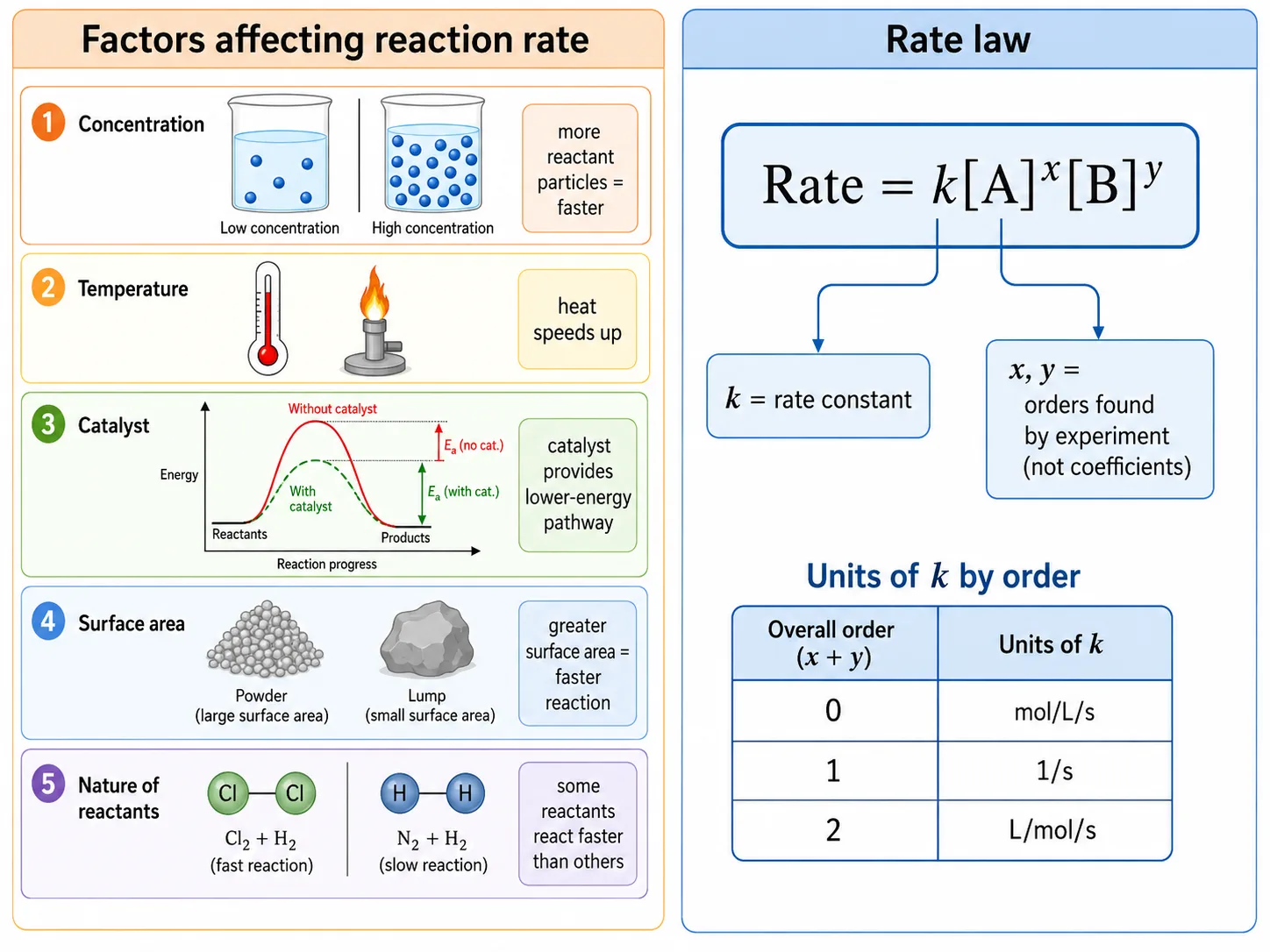
[JEE Tip] A fast way to find an unknown order from units: if has units s, the reaction is first order; mol L s means zero order; L mol s means second order.
Solved Examples
Example 1: Identify the order from the rate law
For the rate law , state the order with respect to A, to B, and overall.
Solution: Order in A = 1; order in B = 2; overall order = 1 + 2 = 3.
Example 2: Units of k for a first-order reaction
A reaction has rate law . What are the units of ?
Solution: Rate (mol L s) (mol L), so has units s.
Example 3: Units of k for a second-order reaction
For , find the units of .
Solution: mol L s , so mol L s.
Example 4: Order from the units of k
The rate constant of a reaction has units mol L s. What is its order?
Solution: Units mol L s correspond to , so the reaction is zero order.
Example 5: Effect of doubling concentration
For , what happens to the rate if is doubled?
Solution: Rate , so doubling multiplies the rate by . The rate becomes 4 times as fast.
Example 6: Rate law cannot come from stoichiometry
For , the experimental rate law is . What is the overall order, and why couldn't it be predicted from the equation?
Solution: Overall order (1.5). It cannot be predicted from the balanced equation because the powers are determined by the reaction mechanism (experiment), not the coefficients.
Example 7: Effect of tripling one concentration
For , the rate when is tripled (B unchanged) becomes:
Solution: Rate , so tripling triples the rate (3 times).
Example 8: Mixed order effect
For , if both and are doubled, by what factor does the rate change?
Solution: New rate . The rate increases 8-fold.
Example 9: Units of k for third order
Find the units of for a third-order reaction.
Solution: mol L s , so mol L s.
Example 10: Identify factor
Powdered calcium carbonate reacts with acid much faster than a marble chip of the same mass. Which factor explains this?
Solution: Surface area. The powder exposes far more surface for collisions, increasing the rate, even though the chemical amounts are identical.