
Half-Life of a Reaction
The half-life () of a reaction is the time taken for the concentration of a reactant to fall to half its initial value. It is one of the most useful and most tested quantities in kinetics.
The form of depends on the order:
First order: from , put :
Strikingly, this is independent of the initial concentration — a defining feature of first-order reactions.
Zero order: — directly proportional to .
Key contrast: First-order half-life does not depend on how much you start with; zero-order half-life does. This single difference is a favourite exam discriminator.
Half-Life and Radioactive Decay
All radioactive decays are first order, so they have a constant half-life independent of the amount present. This is the basis of radiocarbon dating and nuclear-fallout calculations.
After half-lives, the fraction remaining is :
| Half-lives elapsed | Fraction remaining |
|---|---|
| 1 | 1/2 = 50% |
| 2 | 1/4 = 25% |
| 3 | 1/8 = 12.5% |
| 4 | 1/16 = 6.25% |
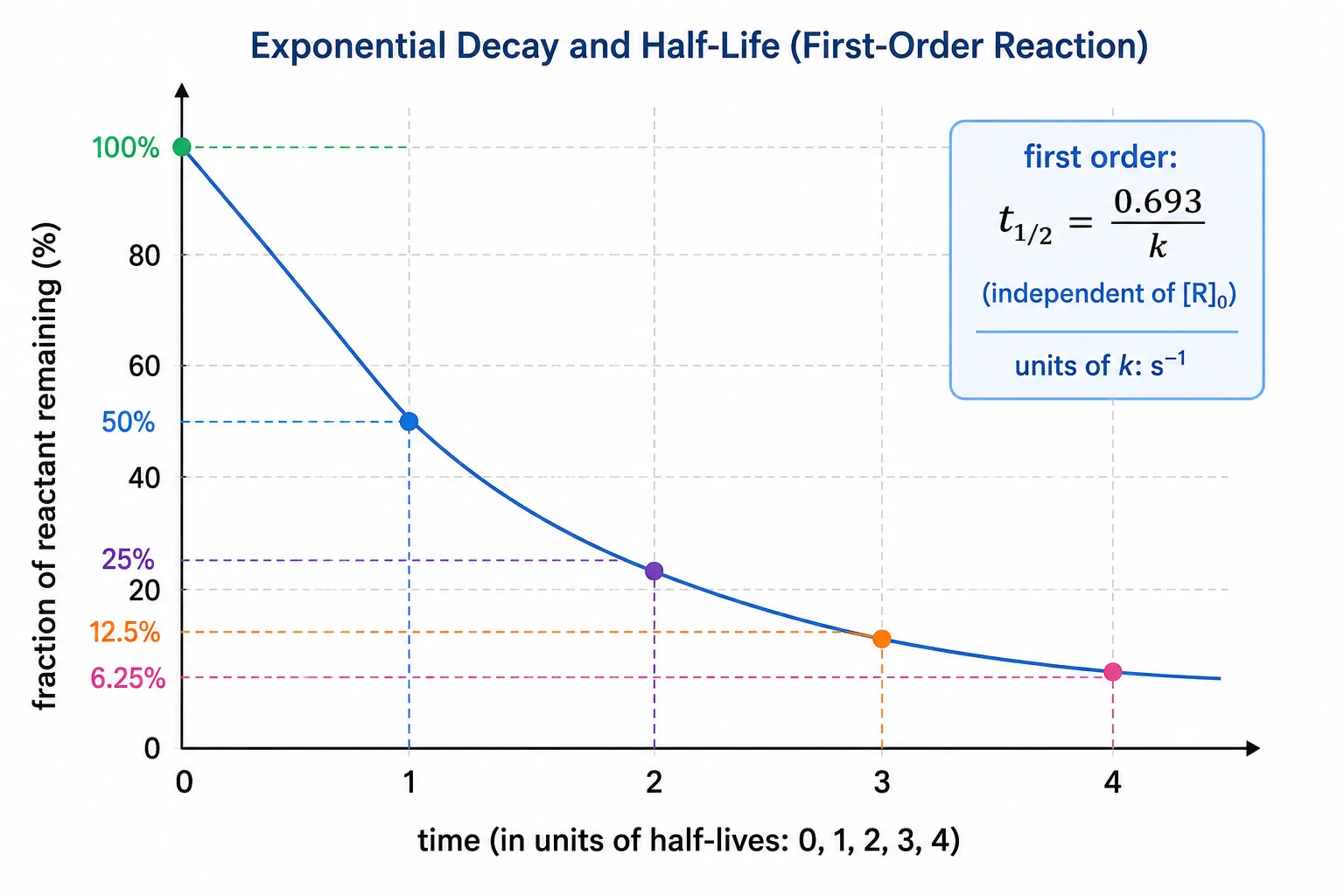
[NEET Important] is one of the most-used formulas in the chapter. Note . The rate constant and half-life of a first-order reaction are inversely related.
Solved Examples
Example 1: Half-life from rate constant
A first-order reaction has s. Find its half-life.
Solution: s.
Example 2: Rate constant from half-life
A first-order reaction has a half-life of 69.3 s. Find .
Solution: s.
Example 3: Carbon-14 dating
The half-life of C is 5730 years. An archaeological sample has 25% of the original C. How old is it?
Solution: 25% remaining , so 2 half-lives have elapsed. Age years.
Example 4: Fraction left after time
For a first-order reaction with min, what fraction remains after 30 min?
Solution: Number of half-lives . Fraction (12.5%).
Example 5: Zero-order half-life
A zero-order reaction has M and mol L s. Find its half-life.
Solution: s.
Example 6: Independence of concentration (first order)
For a first-order reaction, if the initial concentration is tripled, how does the half-life change?
Solution: does not depend on initial concentration, so the half-life is unchanged.
Example 7: Sr-90 fallout
Sr has a half-life of about 28.1 years. What fraction of a sample remains after 84.3 years?
Solution: Number of half-lives . Fraction remaining (12.5%).
Example 8: Time for 75% completion (first order)
For a first-order reaction, how many half-lives are needed for 75% completion?
Solution: 75% complete means 25% remains , so 2 half-lives.
Example 9: k and t-half together
A first-order reaction is 75% complete in 60 minutes. Find its half-life.
Solution: 75% complete = 25% remaining = 2 half-lives in 60 min, so min. (Check: min.)
Example 10: Comparing zero and first order
Two reactions have the same numerically. One is zero order ( M), the other first order. Which has the longer half-life, given (in appropriate units)?
Solution: Zero order: s. First order: s. The first-order reaction has the longer half-life here.