
Zero Order Reactions
A zero-order reaction is one whose rate is independent of the concentration of the reactant — it stays constant as the reaction proceeds. For :
Integrating from (at ) to (at time ):
This is the equation of a straight line ( form) when is plotted against : the line starts at and has slope .
The units of for a zero-order reaction are mol L s (same as rate, since rate ).
Graph and Half-Life of a Zero-Order Reaction
A plot of against time is a descending straight line:
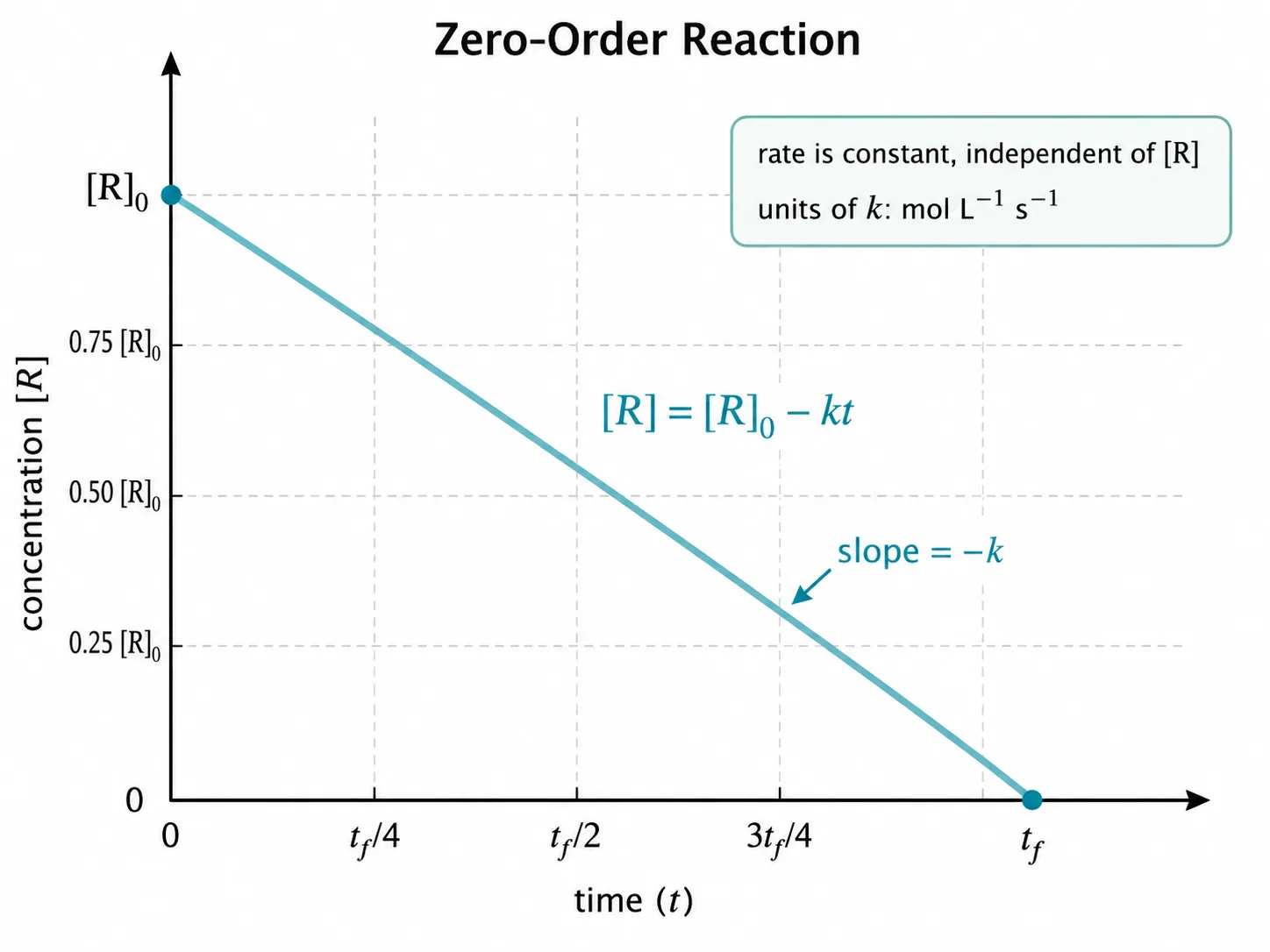
Half-life () is the time for to fall to half of . Putting :
So for a zero-order reaction, half-life is directly proportional to the initial concentration.
Real examples: the decomposition of gaseous ammonia on a hot platinum surface, and the decomposition of on a gold surface, are zero order — the metal surface is saturated, so adding more reactant doesn't speed things up. Many enzyme-catalysed reactions are zero order at high substrate concentration.
Solved Examples
Example 1: Rate constant of a zero-order reaction
In a zero-order reaction, falls from 0.10 M to 0.075 M in 50 s. Find .
Solution: mol L s.
Example 2: Concentration after a given time
For a zero-order reaction with mol L s and M, find after 100 s.
Solution: M.
Example 3: Half-life of a zero-order reaction
A zero-order reaction has mol L s and M. Find its half-life.
Solution: s.
Example 4: Time for complete reaction
For the reaction in Example 3, how long until the reactant is completely consumed ()?
Solution: s. (Note this is exactly for zero order.)
Example 5: Identify zero order from units
A reaction's rate constant is mol L s. What is its order, and how do you know?
Solution: Units mol L s are the units of for a zero-order reaction (they equal the units of rate). So the reaction is zero order.
Example 6: Slope of the graph
For a zero-order reaction, a plot of vs has slope mol L s. What is ?
Solution: slope , so mol L s.
Example 7: Half-life proportional to concentration
If the initial concentration of a zero-order reaction is doubled, how does its half-life change?
Solution: , so . Doubling doubles the half-life.
Example 8: Concentration from data
A zero-order reaction ( mol L min) starts at 0.25 M. What is after 10 minutes?
Solution: M.
Example 9: Finding time to reach a concentration
A zero-order reaction has M and mol L s. How long to reach M?
Solution: s.
Example 10: Why surface reactions are zero order
Explain why the decomposition of ammonia on a hot platinum surface is zero order.
Solution: The platinum surface becomes fully saturated with ammonia molecules. Once saturated, adding more ammonia cannot increase the number reacting, so the rate stays constant — independent of ammonia concentration — i.e. zero order.