
The Whole Chapter in One Glance
Chemical kinetics is about how fast reactions go. We measure rate, write the experimental rate law , classify reactions by order and molecularity, integrate the rate law for zero and first order, compute half-lives, and explain the steep temperature dependence with the Arrhenius equation, collision theory and catalysis.
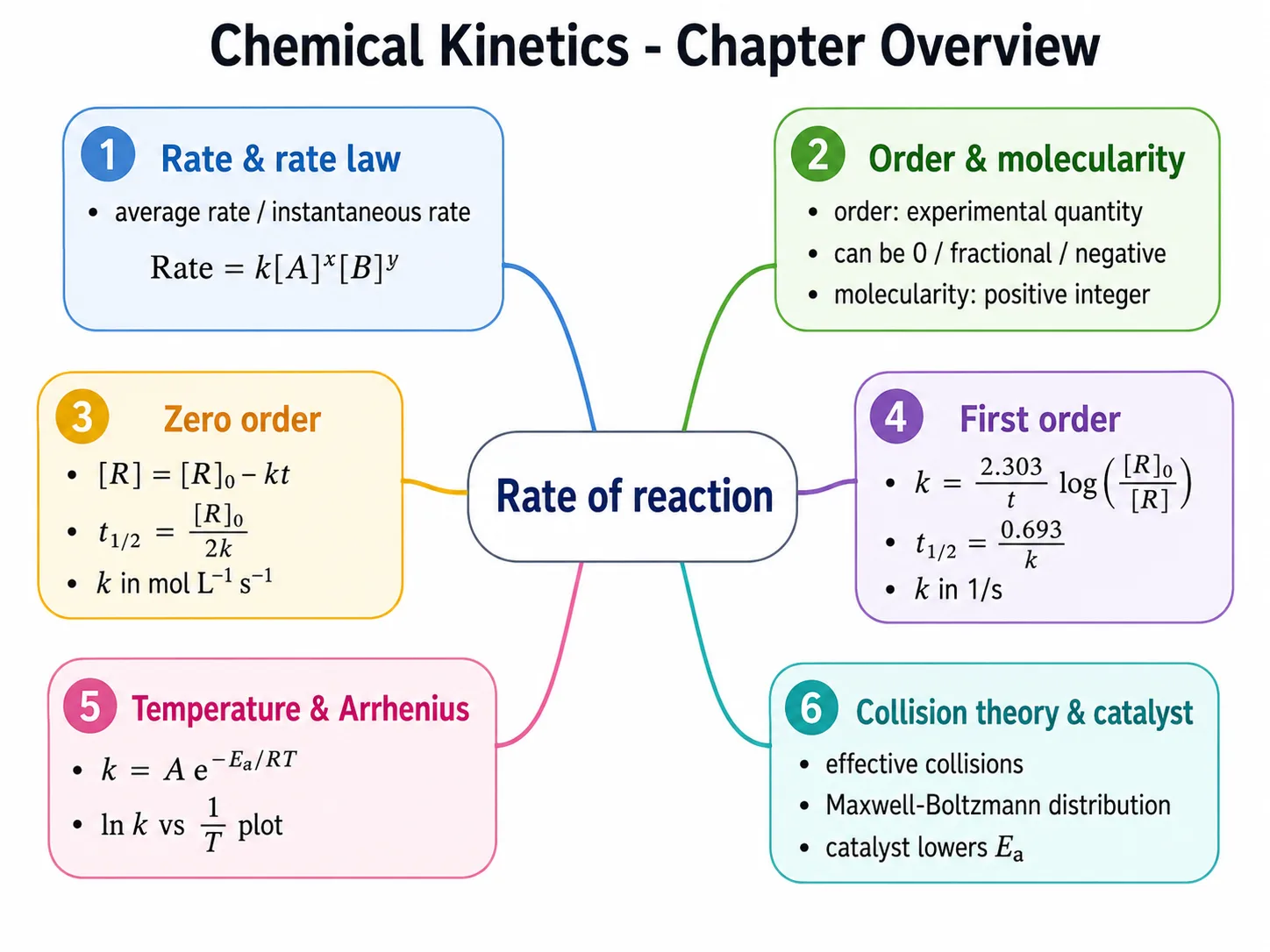
Slot every concept and numerical into one of these six branches.
Master Formula Sheet
Rate: (units mol L s).
Rate law: ; order (experimental).
Zero order: ; ; in mol L s.
First order: ; ; ; in s.
Arrhenius: ; ; .
Units of : order 0 -> mol L s; order 1 -> s; order 2 -> mol L s; order 3 -> mol L s.
Constants: J K mol; ; .
Quick Comparison Tables
Order vs Molecularity
| Feature | Order | Molecularity |
|---|---|---|
| Nature | Experimental | Theoretical |
| Values | 0, fractional, negative allowed | Positive integer (1-3) |
| Applies to | Overall & elementary | Elementary steps only |
Zero vs First Order
| Feature | Zero order | First order |
|---|---|---|
| Rate law | Rate | Rate |
| Integrated | ||
| Units of | mol L s | s |
| (depends on ) | (independent of ) | |
| Straight-line plot | vs | vs |
Last-Minute Memory Hooks
- Order = experimental (read off the rate law, found by experiment); molecularity = mechanistic (integer, elementary steps only). For an elementary step, they are usually the same.
- Units of tell the order: mol L s -> zero; s -> first; L mol s -> second.
- First-order is independent of ; zero-order depends on .
- After half-lives a first-order reactant is down to .
- Pseudo-first-order: look for one reactant in large excess, so its concentration remains effectively constant.
- Arrhenius: plot vs -> slope . Rate roughly doubles per 10 K.
- Catalyst lowers , speeds forward and reverse reactions equally, and does NOT change or .
- Effective collision needs energy AND proper orientation.
One-line revision flow: Rate -> rate law -> order/molecularity -> zero/first order integrated -> half-life -> Arrhenius/temperature -> collision theory & catalyst.