Integrated Rate Equation — First Order & Pseudo First Order
First Order Reactions
A first-order reaction has a rate proportional to the first power of the reactant concentration. For R→P:
Rate=−dtd[R]=k[R]
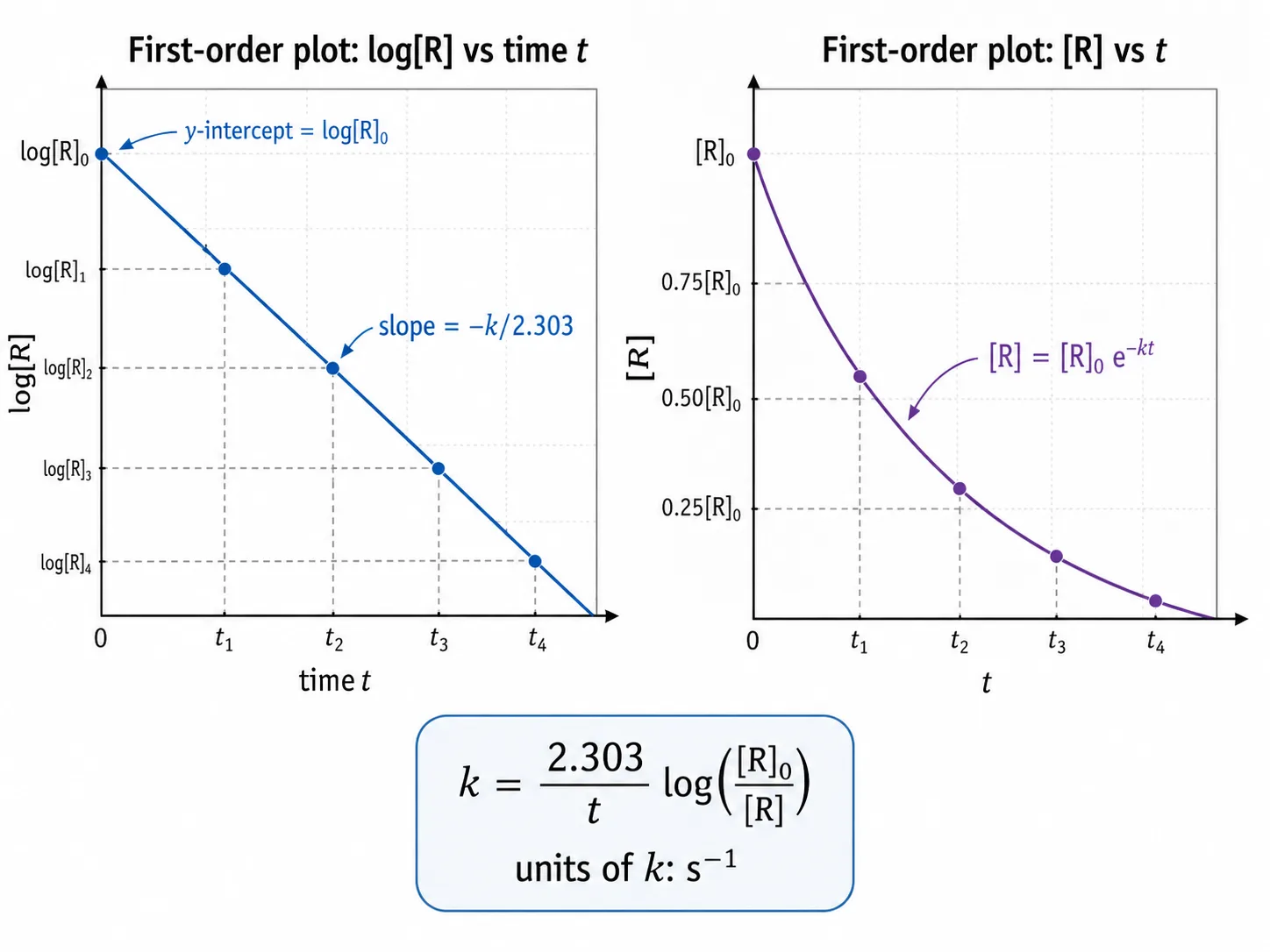
Integrating gives the natural-log form ln[R][R]0=kt, or in the base-10 form used in most numericals:
k=t2.303log[R][R]0
Equivalently, [R]=[R]0e−kt. The units of k are s−1 (or min−1) — independent of concentration, a hallmark of first order.
Graph of a First-Order Reaction
Rearranging the integrated law:
log[R]=log[R]0−2.303kt
So a plot of log[R] against t is a straight line with slope =−2.303k and intercept log[R]0. (Equivalently, ln[R] vs t has slope −k.)
Examples of first-order reactions: radioactive decay, decomposition of N2O5, decomposition of SO2Cl2, and several unimolecular decompositions studied in kinetics.
Pseudo First Order Reactions
Some reactions that are truly second order behave as first order because one reactant is present in such large excess that its concentration hardly changes. These are pseudo-first-order reactions.
Two classic examples:
1. Acid hydrolysis of an ester:CH3COOC2H5+H2OH+CH3COOH+C2H5OH
True rate =k[ester][H2O], but water is in vast excess, so [H2O] is essentially constant. The rate then appears as Rate=k′[ester] with k′=k[H2O] — pseudo first order.
2. Inversion of cane sugar:C12H22O11+H2OH+glucose+fructose
Again water is in large excess, so it is pseudo first order.
[JEE Tip] A reaction's true order can be higher than its observed order when a reactant is in large excess. Spotting "water in excess" or "one reactant in large excess" is the cue for pseudo first order.
Solved Examples
Example 1: First-order rate constant
A first-order reaction is 50% complete in 20 minutes. Find k.
Solution: 50% complete means [R]=[R]0/2, so [R][R]0=2.
k=t2.303log2=202.303×0.301=0.0347 min−1.
Example 2: Concentration after time
A first-order reaction has k=2.303×10⁻³ s−1. What fraction of reactant remains after 1000 s?
Solution:log[R][R]0=2.303kt=2.303(2.303×10⁻³)(1000)=1. So [R][R]0=10, i.e. [R]0[R]=0.1. 10% remains.
Example 3: Time for a given completion
A first-order reaction has k=1.15×10⁻³ s−1. How long for the reactant to fall to one-fourth of its initial value?
Solution:[R][R]0=4. t=k2.303log4=1.15×10−32.303×0.602=2003.5×0.602=1206 s.
Example 4: Percentage decomposition and time
A first-order reaction takes 40 min for 30% decomposition. Find k.
Solution: 30% decomposed means [R]=70% of [R]0, so [R][R]0=70100=1.4286.
k=402.303log1.4286=402.303×0.1549=8.92×10⁻³ min−1.
Example 5: Pseudo first order identification
Why is the acid hydrolysis of ethyl acetate called a pseudo-first-order reaction?
Solution: The true rate law is Rate=k[ester][H2O] (second order). But water is in large excess, so [H2O] is effectively constant. The rate reduces to Rate=k′[ester], appearing first order — hence pseudo first order.
Example 6: Fraction remaining after n half-lives
For a first-order reaction, what fraction of reactant remains after 3 half-lives?
Solution: After each half-life the amount halves: after 3, fraction =(21)3=81=0.125. 12.5% remains.
Example 7: Rate constant from concentrations
For a first-order reaction, [R] falls from 0.80 M to 0.20 M in 60 s. Find k.