
Atomic and Ionic Sizes
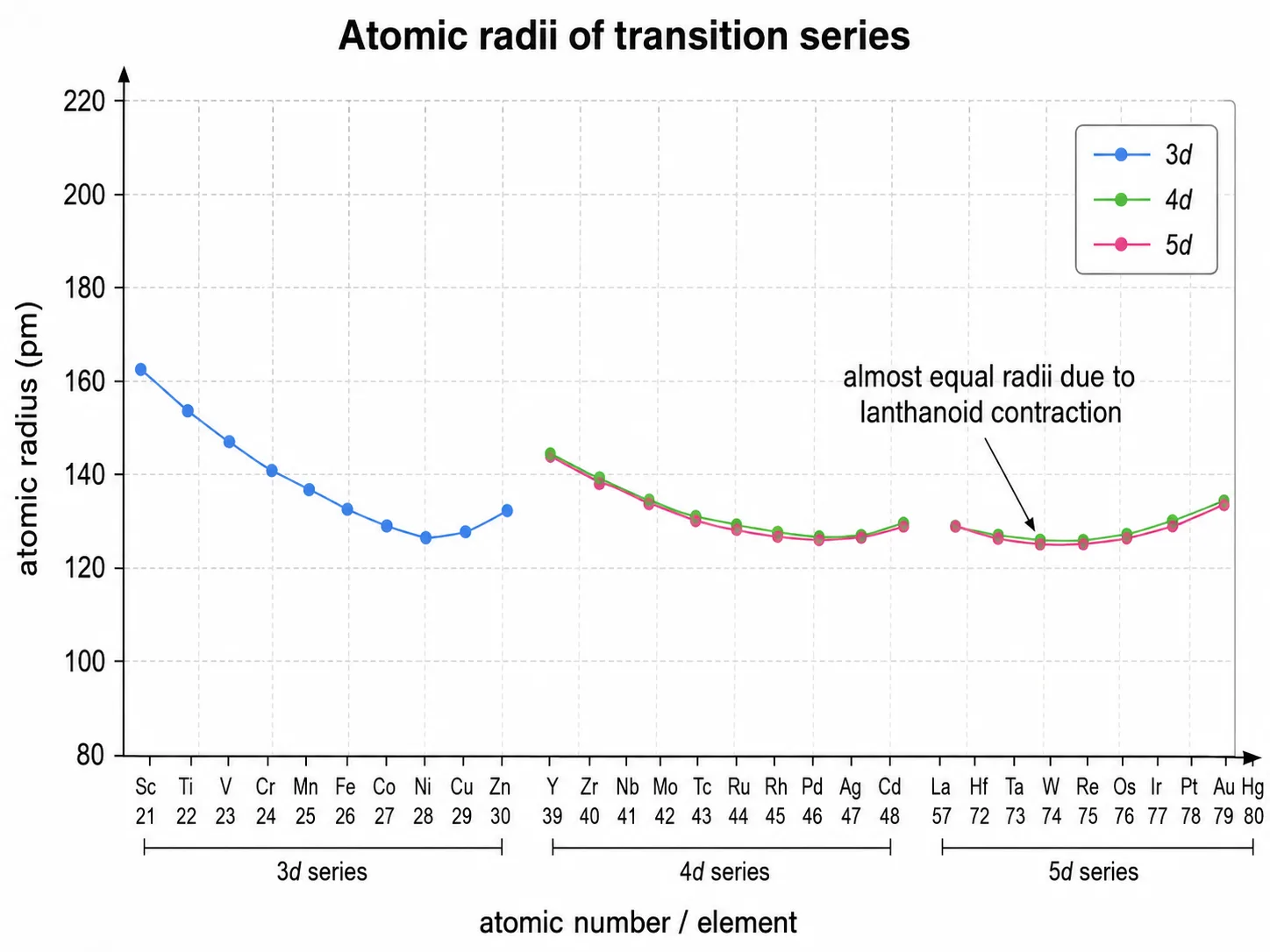
Across a transition series, the atomic radius shows only a small overall decrease (much smaller than across a typical period of main-group elements). Why?
As we move left to right, each added electron goes into the (n-1)d subshell, which shields the outer ns electrons fairly well from the increasing nuclear charge. The increased nuclear charge (which would shrink the atom) is largely offset by this extra d-electron shielding. The result is a gentle decrease, then a slight rise toward the end (Cu, Zn) as electron-electron repulsion in the filled d subshell grows.
Ionic radii: for ions of the same charge, the radius decreases gradually across the series as nuclear charge increases (e.g. across the M ions).
The Lanthanoid Contraction and Its Echo
Here is one of the chapter's most important ideas. The radii of the second (4d) and third (5d) transition series are almost the same — even though the 5d elements are a whole period lower and should be larger.
The reason is the lanthanoid contraction: the 14 lanthanoids (which come between the 4d and 5d series) cause a steady size decrease because the 4f electrons shield poorly. This contraction nearly compensates for the expected increase in size on going from the 4d to the 5d series.
Consequences (very exam-important):
- Zr and Hf (and Nb/Ta, Mo/W) have nearly identical sizes and very similar chemistry — making them notoriously hard to separate.
- The 5d elements have higher densities than expected.
[NEET Important] The phrase "the second and third transition series have nearly the same atomic radii because of the lanthanoid contraction" is a standard one-mark and reasoning answer. Memorise it.
Enthalpy of Atomisation and Ionisation Enthalpy
Enthalpy of atomisation (the energy to convert the metal to gaseous atoms) is high for transition metals — they have many unpaired d electrons available for strong metallic bonding. This is why they are hard, strong, high-melting metals. The values peak in the middle of each series (most unpaired electrons) and dip where the d subshell is half or fully filled.
Ionisation enthalpies generally increase across a series (rising nuclear charge), but irregularly, because half-filled and fully-filled stability intervenes:
- The first ionisation enthalpies do not rise smoothly.
- Why is the IE of Mn relatively low? Mn is ; removing the 4s electron is easy, leaving stable .
- Why is IE of Zn high? Removing an electron from the stable filled configuration requires more energy.
- (second ionisation) is exceptionally high for Cr and Cu because the second electron must come from a stable (Cr) or (Cu) configuration.
Key Point: Wherever you see an irregular ionisation-enthalpy value in this chapter, the explanation is almost always the extra stability of a half-filled () or fully-filled () subshell.
Solved Examples
Example 1: Lanthanoid contraction
What is the lanthanoid contraction, and name one consequence.
Solution: It is the steady decrease in atomic and ionic radii of the lanthanoids across the 4f series, caused by the poor shielding by 4f electrons. A key consequence: the 4d and 5d transition series have nearly identical radii (e.g. Zr and Hf), making them hard to separate.
Example 2: Why small size change across a series
Why does atomic radius decrease only slightly across a transition series?
Solution: The added d electrons shield the outer electrons from the increasing nuclear charge, so the contracting effect of nuclear charge is largely cancelled — giving only a small net decrease.
Example 3: High melting points
Why do transition metals have high melting points and enthalpies of atomisation?
Solution: They have many unpaired d electrons that participate in strong metallic (and some covalent) bonding between atoms, requiring large energy to separate — hence high enthalpies of atomisation and melting points.
Example 4: IE of Mn+ vs Cr+
Why is the ionisation enthalpy of Mn lower than that of Cr?
Solution: Mn is ; losing the 4s electron leaves a stable half-filled . Cr is already , so its next electron must come from the stable — requiring more energy. Hence IE of Mn < Cr.
Example 5: Zr and Hf similarity
Why do zirconium (4d) and hafnium (5d) have almost the same atomic radius?
Solution: Because of the lanthanoid contraction — the 14 lanthanoids between them cause a size reduction that offsets the expected increase from 4d to 5d. So Zr and Hf are nearly the same size and chemically very similar.
Example 6: Trend in M2+ ionic radii
How does the ionic radius of M ions change across the 3d series?
Solution: It decreases gradually from Sc to Zn (for the same +2 charge) as the increasing nuclear charge pulls the electrons in more tightly.
Example 7: High IE2 of copper
Why is the second ionisation enthalpy of copper unusually high?
Solution: Cu is — a stable fully-filled subshell. Removing a second electron disrupts this stable , requiring a large amount of energy, so IE(Cu) is high.
Example 8: Density of 5d metals
Why are third (5d) transition series metals very dense?
Solution: The lanthanoid contraction keeps their atomic sizes small while their atomic masses are large, so the same small volume packs much more mass — giving very high densities (e.g. Os, Ir, Pt).
Example 9: Atomisation enthalpy trend within a series
Where in a transition series is the enthalpy of atomisation greatest, and why?
Solution: Near the middle of the series, where the number of unpaired d electrons (available for metallic bonding) is maximum. It dips at the ends (e.g. Zn) where the d subshell is filled and fewer electrons bond.
Example 10: Why Zn has low atomisation enthalpy
Why does zinc have a low enthalpy of atomisation?
Solution: Zn has a completely filled subshell; these d electrons do not participate in metallic bonding, so only the 4s electrons bond weakly — giving a low enthalpy of atomisation and a low melting point.