
The Whole Chapter in One Glance
The d- and f-block elements owe their family of properties to partially filled d (or f) subshells: variable oxidation states, colour (d-d transitions), paramagnetism (unpaired electrons), catalysis, and complex/interstitial/alloy formation. Two compounds (KCrO and KMnO) are studied in depth, and the f-block is dominated by the lanthanoid contraction and the +3 state.
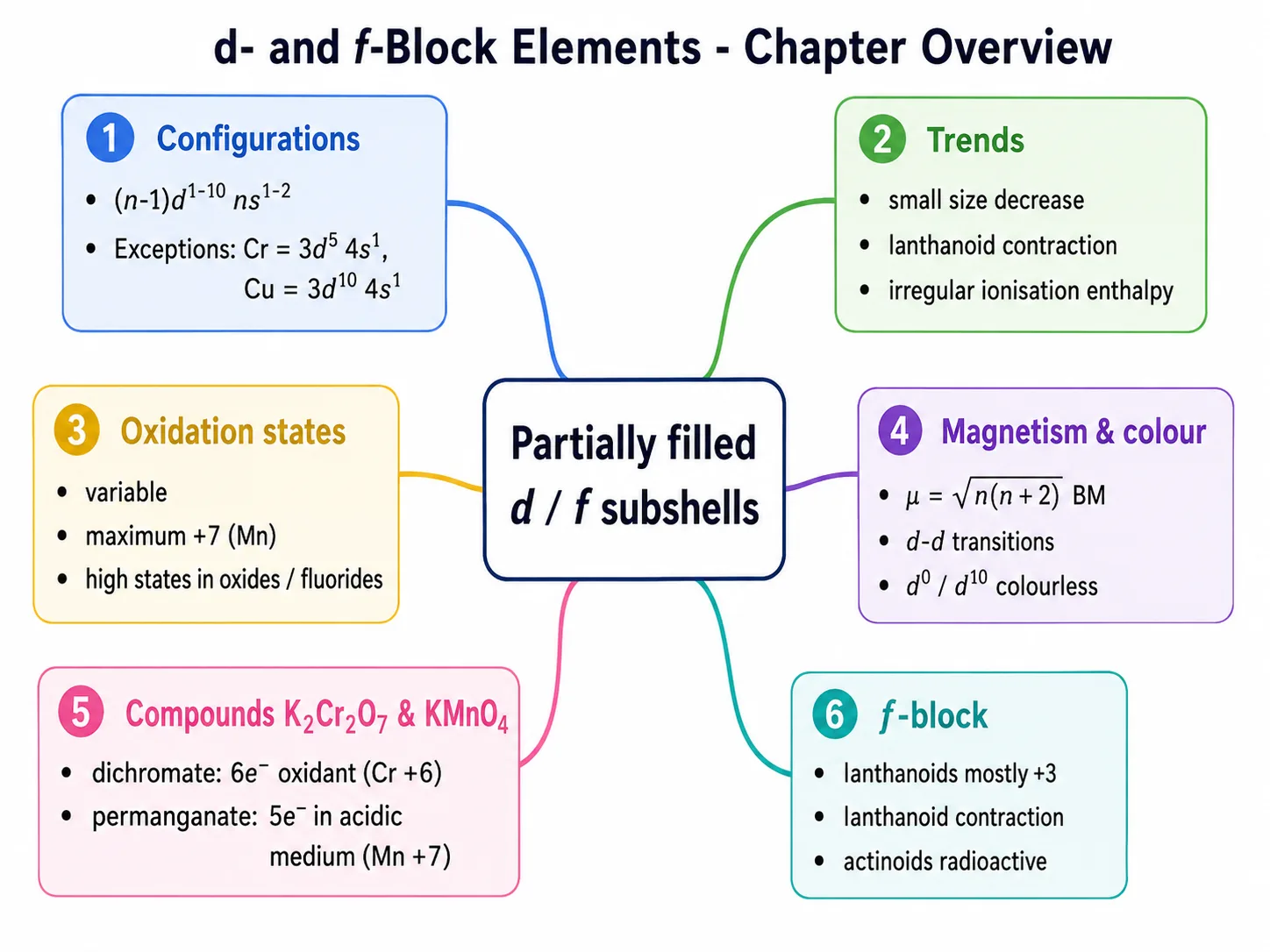
Slot every fact into one of these branches.
Master Facts Sheet
General config (d-block): . Exceptions: Cr = , Cu = .
Ions: lose ns before (n-1)d. e.g. Fe, Mn, Zn.
Spin-only moment: BM (1.73, 2.83, 3.87, 4.90, 5.92 for to 5).
Colour: from d-d transitions; and ions are colourless.
Highest oxidation state: up to +7 (Mn); high states appear in oxides/fluorides; +2 grows more stable across the series.
Dichromate (Cr +6): (6 e, equiv mass 49). Acid → orange, base → yellow.
Permanganate (Mn +7): (acid 5 e; neutral 3 e → MnO; alkaline 1 e → MnO).
Lanthanoid contraction: steady size decrease (poor 4f shielding) → similar 4d/5d radii; lanthanoids mostly +3; actinoids radioactive with more oxidation states.
Quick Comparison Tables
d-block vs f-block
| Feature | d-block | f-block |
|---|---|---|
| Subshell filled | (n-1)d | (n-2)f |
| Oxidation states | Many (variable) | Lanthanoids mostly +3 |
| Colour/magnetism | Common | Common (lanthanoids) |
| Position | Main table groups 3-12 | Below the table |
Lanthanoids vs Actinoids
| Feature | Lanthanoids | Actinoids |
|---|---|---|
| Subshell | 4f | 5f |
| Common state | +3 | Many (up to +6/+7) |
| Radioactivity | Mostly no | All radioactive |
| Contraction | Lanthanoid | Actinoid (greater per step) |
Last-Minute Memory Hooks
- Cr and Cu exceptions: half-filled and fully-filled — the most-tested fact in the chapter.
- Lose ns first when ionising; then count d electrons for unpaired-electron and colour questions.
- : memorise 1.73, 2.83, 3.87, 4.90, 5.92.
- / = colourless and diamagnetic (Sc, Ti, Zn, Cu).
- Mn = +7 max; high states in oxides/fluorides; +2 grows stable rightward.
- Cu is the odd one out: positive , no H from acids.
- Dichromate = 6 e (equiv 49); permanganate = 5 e in acid (equiv 31.6); KMnO electrons by medium: 5 / 3 / 1.
- Lanthanoid contraction (poor 4f shielding) → similar 4d/5d sizes; +3 dominates; all actinoids radioactive.
One-line revision flow: configurations (Cr, Cu) → sizes & lanthanoid contraction → oxidation states → E values → magnetism & colour → complexes/catalysis/interstitials → dichromate → permanganate → lanthanoids & actinoids.