
Formation of Complex Compounds
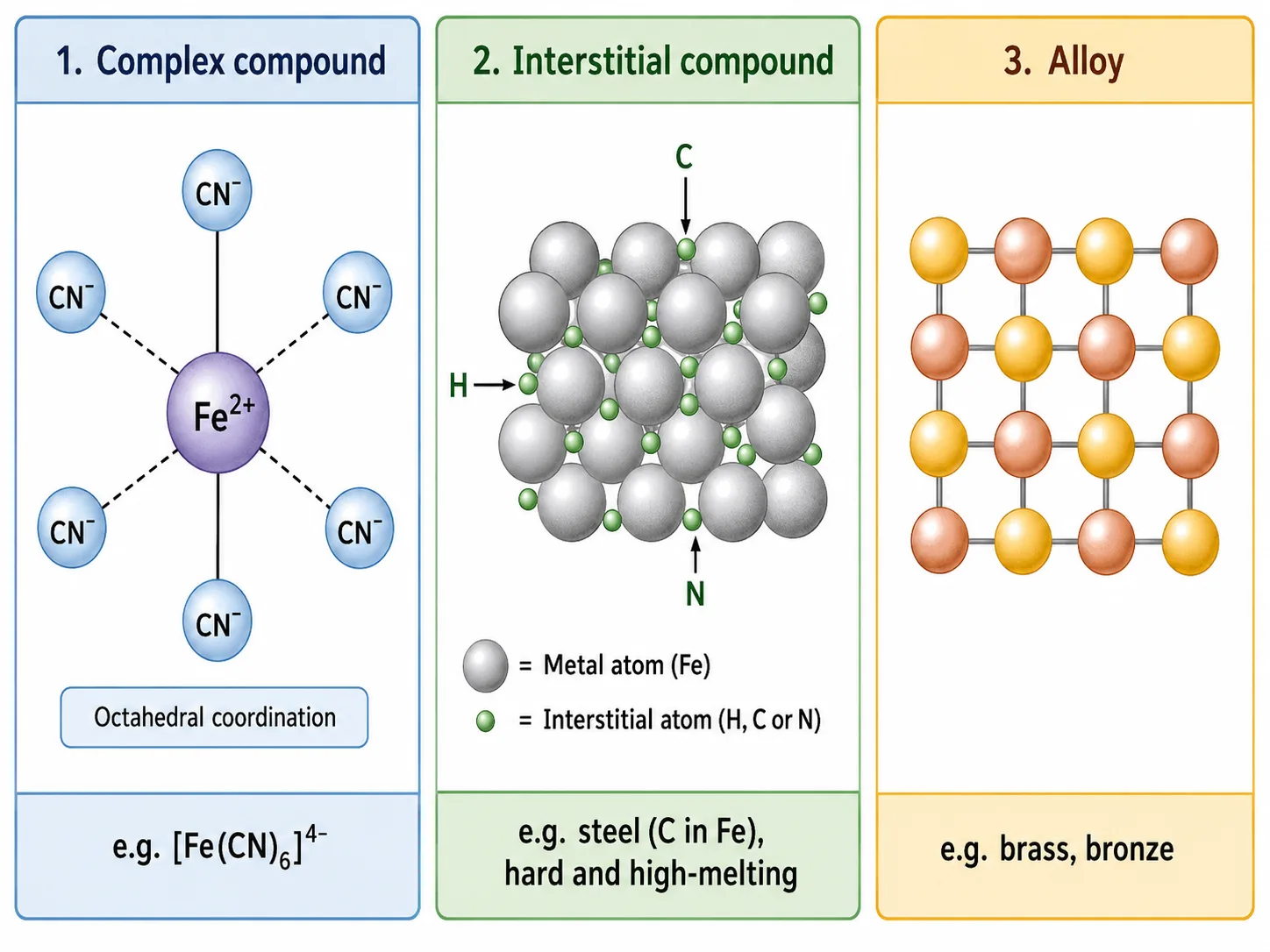
Transition metals are famous for forming complex (coordination) compounds, in which the metal ion binds several ligands (ions or molecules with lone pairs) — e.g. , , .
Why are transition metals so good at this?
- Small, highly charged ions with a strong tendency to attract electron pairs.
- Vacant d orbitals of suitable energy to accept lone pairs from ligands.
These two features let the metal accept several coordinate bonds, forming stable complexes — the basis of the whole of coordination chemistry (the next chapter).
Catalytic Properties
Transition metals and their compounds are widely used as catalysts. Two features make them excellent catalysts:
- Variable oxidation states — they can readily gain or lose electrons, providing alternative reaction pathways (e.g. forming intermediate compounds).
- Surface adsorption — finely divided metals adsorb reactant molecules on their surface, weakening bonds and bringing reactants together.
Standard examples:
- Iron (Fe) in the Haber process (synthesis of NH).
- Vanadium(V) oxide (VO) in the Contact process (manufacture of HSO).
- Nickel (Ni) in the hydrogenation of oils.
- MnO in the decomposition of KClO.
Why variable oxidation states help: a catalyst like Fe/Fe can shuttle between states, accepting and donating electrons to the reactants, providing a lower-energy route.
Interstitial Compounds and Alloys
Interstitial compounds form when small atoms — H, C, N, B — lodge in the holes (interstices) of a transition-metal lattice. Examples include steel (carbon in iron) and various metal hydrides, carbides and nitrides.
Their characteristic properties:
- Hard and high-melting (often higher than the pure metal).
- Retain metallic conductivity.
- Chemically inert (the small atoms fill gaps without much chemical change).
- Often non-stoichiometric (e.g. TiH, VH).
Alloy formation: because transition metals have similar atomic radii, one metal can replace another in the crystal lattice, forming substitutional alloys (e.g. brass, bronze, steel, stainless steel). Alloys are usually harder and more corrosion-resistant than the pure metals.
Key Point: Five "extra" properties define transition metals beyond colour and magnetism: complex formation, catalysis, interstitial compounds, alloys, and variable oxidation states — all flowing from partially filled d orbitals and similar atomic sizes.
Solved Examples
Example 1: Why complexes form readily
Why do transition metals readily form complex compounds?
Solution: Because their ions are small and highly charged (strongly attract ligand lone pairs) and have vacant d orbitals of suitable energy to accept those lone pairs — enabling several coordinate bonds.
Example 2: Catalysis and oxidation states
How do variable oxidation states make transition metals good catalysts?
Solution: A metal that can switch between oxidation states (e.g. Fe/Fe) can accept and donate electrons to reactants, forming intermediates and providing a lower-energy alternative pathway, speeding the reaction.
Example 3: Name the catalyst
Name the transition-metal catalyst used in (a) the Haber process and (b) the Contact process.
Solution: (a) Iron (Fe) with a molybdenum promoter, for NH synthesis. (b) Vanadium(V) oxide (VO), for oxidising SO to SO in HSO manufacture.
Example 4: Interstitial compounds
What are interstitial compounds, and give one property and one example.
Solution: They form when small atoms (H, C, N, B) occupy the interstices of a metal lattice. Property: very hard and high-melting. Example: steel (carbon in iron).
Example 5: Why interstitial compounds are hard
Why are interstitial compounds harder than the parent metal?
Solution: The small interstitial atoms fill the holes in the lattice and restrict the movement of metal layers over one another. This makes the solid harder and less malleable (and raises the melting point).
Example 6: Alloys and atomic size
Why do transition metals readily form alloys with one another?
Solution: Transition metals have similar atomic radii, so one metal atom can substitute for another in the lattice without much distortion, forming substitutional alloys (e.g. brass, steel).
Example 7: Non-stoichiometry
Why are many interstitial compounds non-stoichiometric?
Solution: The small atoms occupy only some of the available interstitial holes, and the number filled is variable, so the formula is not a simple whole-number ratio (e.g. TiH, FeH).
Example 8: A catalyst that changes oxidation state
In a reaction catalysed by Fe/Fe, what is the role of the iron?
Solution: Iron cycles between Fe and Fe, alternately accepting and donating electrons to the reacting species, regenerating itself each cycle while providing a faster electron-transfer route.
Example 9: Properties of interstitial compounds
List three properties of interstitial compounds.
Solution: (1) Hard and high-melting; (2) retain metallic conductivity; (3) chemically inert (and often non-stoichiometric).
Example 10: Surface catalysis
How does surface adsorption contribute to the catalytic activity of a transition metal?
Solution: Finely divided metal surfaces adsorb reactant molecules, increasing their local concentration and weakening their bonds, so the reactants combine more easily — lowering the activation energy.