
Potassium Dichromate — Preparation
Potassium dichromate () is a bright orange crystalline solid, a very important industrial oxidising agent used in leather tanning, dyeing and analytical chemistry. Chromium is in the +6 oxidation state.
It is prepared from chromite ore, , in three stages:
- Roast chromite with molten alkali and air to get sodium chromate:
- Acidify the yellow sodium chromate solution to get sodium dichromate:
- Treat with KCl — potassium dichromate (less soluble) crystallises out as orange crystals:
Chromate-Dichromate Equilibrium and Structure
In solution, chromate (, yellow) and dichromate (, orange) are interconvertible and the equilibrium depends on pH:
- Acidic solution → dichromate (orange) dominates.
- Alkaline solution → chromate (yellow) dominates.
In both ions chromium is in the +6 state. Their structures:
- Chromate : a single tetrahedral unit.
- Dichromate : two tetrahedra sharing one oxygen corner (a Cr-O-Cr bridge).
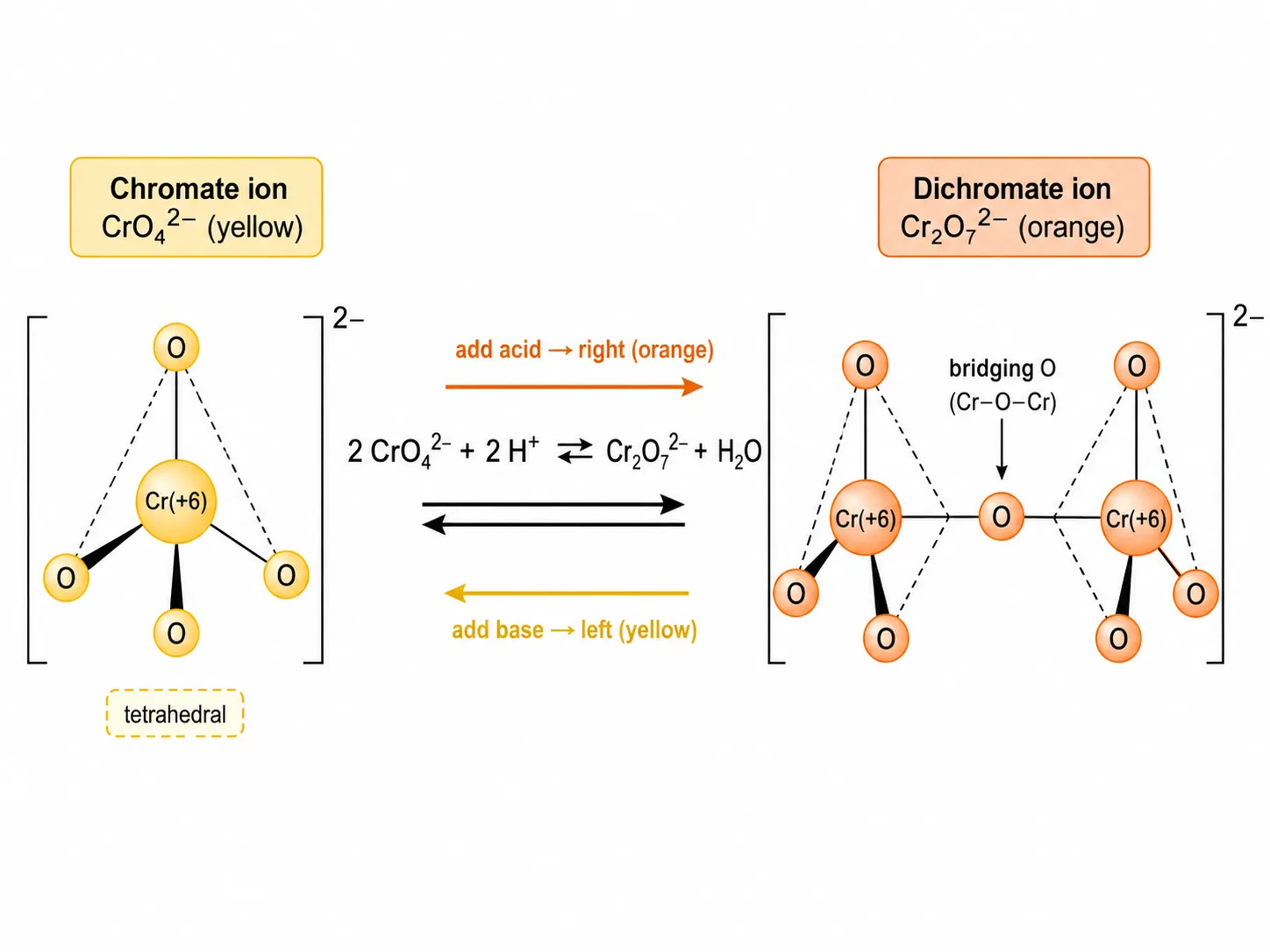
[NEET Important] Remember: acid → orange dichromate; base → yellow chromate. The Cr oxidation state stays +6 throughout; only the structure (and colour) changes.
Oxidising Action of Acidified Dichromate
In acidic solution, dichromate is a powerful oxidising agent. Its half-reaction (with V) is:
Note: 6 electrons are gained, and Cr goes from +6 to +3 (orange → green).
Important oxidations by acidified :
- Oxidises iron(II) to iron(III):
- Oxidises iodide to iodine:
- Oxidises HS to sulphur:
Key Point: Acidified dichromate gains 6 electrons per ion (Cr → Cr). This is why its equivalent mass is (molar mass)/6 — important for volumetric analysis.
Solved Examples
Example 1: Oxidation state of Cr in dichromate
What is the oxidation state of chromium in ?
Solution: Let it be . . Chromium is in the +6 state.
Example 2: Effect of pH
What happens to a dichromate solution when made alkaline?
Solution: It turns yellow as dichromate converts to chromate: . (Adding acid reverses it to orange dichromate.)
Example 3: Electrons gained
How many electrons does one dichromate ion gain when it acts as an oxidising agent in acid?
Solution: From , it gains 6 electrons (each of the two Cr goes +6 → +3).
Example 4: Colour change
What colour change accompanies the reduction of acidified dichromate?
Solution: Orange to green — orange (Cr +6) is reduced to green ions.
Example 5: Equivalent mass of K2Cr2O7
The molar mass of is 294 g mol. Find its equivalent mass as an oxidising agent in acid.
Solution: It gains 6 electrons per formula unit, so equivalent mass g equiv.
Example 6: Reaction with Fe2+
Write the ionic equation for the oxidation of Fe by acidified dichromate.
Solution: .
Example 7: Structure of dichromate
Describe the structure of the dichromate ion.
Solution: Two CrO tetrahedra joined by sharing one oxygen corner (a Cr-O-Cr bridge). Each chromium is tetrahedrally surrounded by oxygen, in the +6 state.
Example 8: Why dichromate is used as a primary standard
Why is preferred as a primary standard in titrations?
Solution: It can be obtained pure, is stable (non-hygroscopic), has a definite composition, and its solution does not change concentration on standing — making it an excellent primary standard for redox titrations.
Example 9: Oxidation of iodide
Write the equation for the oxidation of iodide ions by acidified dichromate.
Solution: .
Example 10: Acidifying chromate
What is observed when dilute sulphuric acid is added to a yellow potassium chromate solution?
Solution: The solution turns orange as chromate converts to dichromate: .