
Standard Electrode Potentials of the 3d Metals
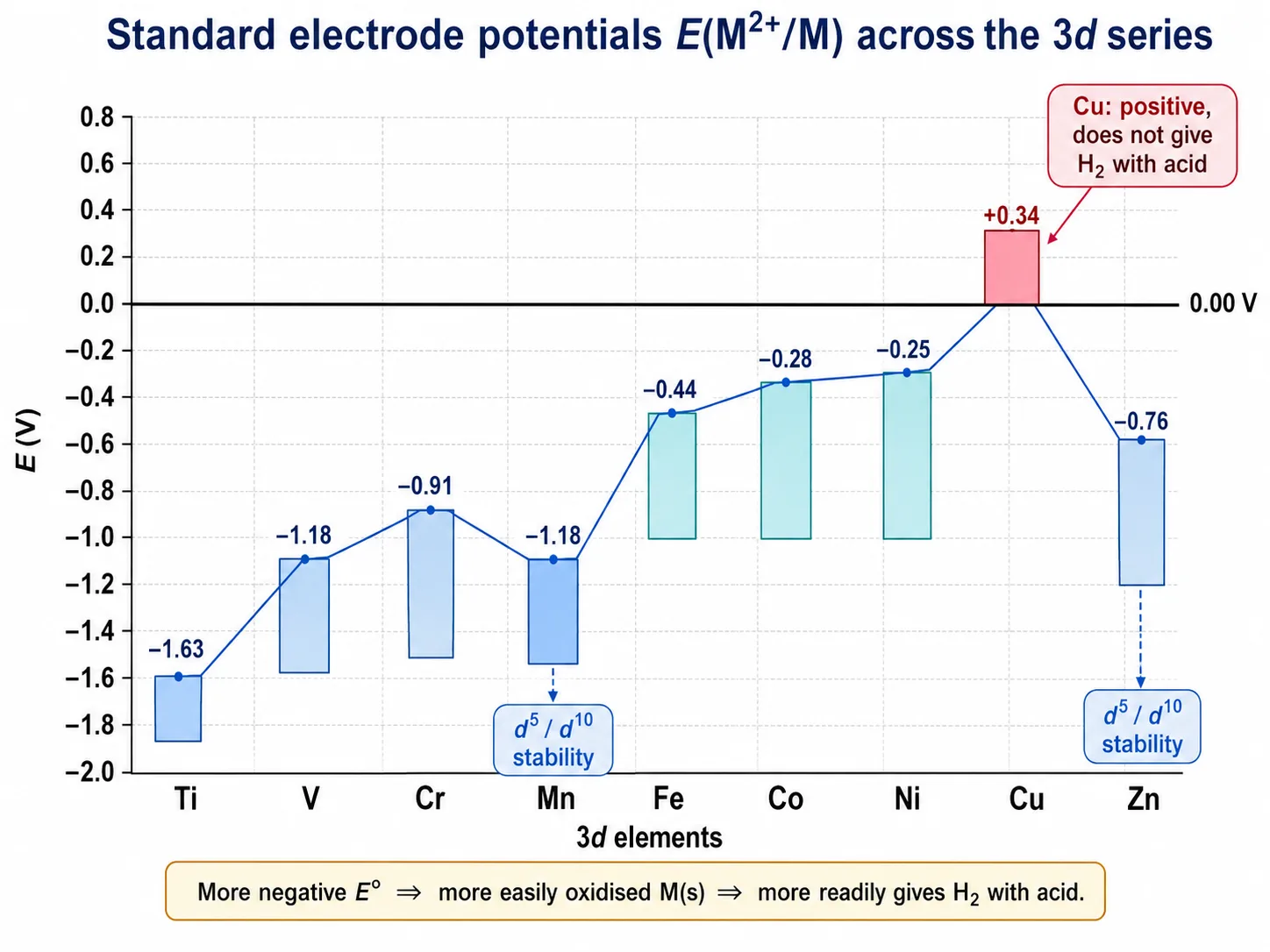
The standard electrode potential tells us how readily a metal is oxidised to its ion in water. Across the 3d series these values are mostly negative (the metals tend to be oxidised) but show irregularities rather than a smooth trend.
depends on three energy terms: the enthalpy of atomisation, the ionisation enthalpy (to form M), and the hydration enthalpy of M. The balance of these explains the bumps.
The copper anomaly: V is positive — unique in the series. This means copper is not oxidised by H (it does not dissolve in dilute non-oxidising acids to give H). The reason: copper's high enthalpy of atomisation and high ionisation enthalpies are not balanced by its hydration enthalpy.
The Mn and Zn Bumps; M3+/M2+ Trends
Two more anomalies in :
- Manganese has an unexpectedly low (more negative) value — because forming Mn (, stable half-filled) from the metal is favourable.
- Zinc also has a low value — linked to the stability of the filled in Zn.
The values tell us how easily the ion is oxidised to :
- Sc has no stable , so this couple starts the series.
- is highly positive — Mn () strongly resists oxidation to Mn, confirming Mn's stability.
- is small and positive — Fe is fairly easily oxidised to the stable Fe ().
[JEE Tip] When asked to explain an anomaly, cite the stability of or configurations and the balance of atomisation, ionisation and hydration enthalpies.
Stability of Higher Oxidation States and Reactivity
The stability of higher oxidation states is greatest with the most electronegative ligands:
- The highest states (e.g. for Mn, for Cr) appear in fluorides and oxides.
- The state of Mn is not found in simple halides other than indirectly; fluorine best stabilises high states.
- Lower halides (iodides) tend to stabilise lower oxidation states (iodide is a reducing ligand, so e.g. Cu + I does not give CuI but CuI + I).
General chemical reactivity:
- Most 3d metals (except Cu) have negative , so they liberate H from dilute acids.
- They are fairly electropositive and reactive, though a protective oxide layer can passivate some (e.g. Cr, Ti).
Key Point: Two ideas explain almost every redox/stability question in this chapter: (1) the special stability of half-filled () and filled () subshells, and (2) the role of small electronegative ligands (O, F) in stabilising high oxidation states.
Solved Examples
Example 1: The copper anomaly
The is +0.34 V (positive). What does this imply?
Solution: A positive value means copper is not oxidised by H — it does not liberate H from dilute HCl or HSO. Copper's high atomisation and ionisation enthalpies are not offset by its hydration enthalpy, making the oxidation unfavourable.
Example 2: Why Mn2+/Mn is low
Why is more negative than expected?
Solution: Forming Mn gives the stable half-filled configuration, which is energetically favourable — making manganese easier to oxidise to and giving a more negative electrode potential.
Example 3: High E(Mn3+/Mn2+)
Why is strongly positive?
Solution: Mn (, stable half-filled) strongly resists oxidation to Mn (). A large positive for the M/M couple means Mn is a strong oxidising agent and Mn is very stable.
Example 4: Fe3+/Fe2+ couple
What does the small positive tell us?
Solution: Fe () is fairly easily oxidised to Fe (, stable half-filled). The small positive value indicates Fe is only a mild oxidising agent and Fe is moderately stable.
Example 5: Metals liberating hydrogen
Which 3d metals can liberate H from dilute acids, and which cannot?
Solution: Metals with negative (most of the series — Sc to Ni, plus Zn) liberate H from dilute acids. Copper cannot because its is positive (+0.34 V).
Example 6: Stabilising the highest state
In which compounds does manganese show its state?
Solution: In oxoanions and oxides with electronegative oxygen, such as (permanganate) and . Oxygen (small, highly electronegative) stabilises the high state.
Example 7: Why CuI2 does not exist
Why does copper(II) not form a stable iodide, CuI?
Solution: Iodide is a reducing ligand. Cu oxidises I: . So copper(II) iodide is unstable and decomposes to copper(I) iodide and iodine.
Example 8: Passivation
Why does chromium resist corrosion despite a fairly negative electrode potential?
Solution: Chromium forms a thin, adherent oxide layer on its surface that passivates it, preventing further reaction. This is why chromium is used for protective plating.
Example 9: Which is a better oxidising agent
Using configurations, decide which is the stronger oxidising agent: Mn or Fe.
Solution: Mn is the stronger oxidising agent. It is reduced to the very stable half-filled Mn (). Fe is already the stable , so it has little tendency to be reduced further — making it a weaker oxidising agent.
Example 10: Reactivity vs hydrogen
A metal has V. Will it displace hydrogen from dilute acid?
Solution: Yes. A negative means the metal is oxidised more readily than H, so it displaces H from dilute acid (this is iron).