
Meet the Transition Elements
Look at the middle block of the periodic table — groups 3 to 12. These are the d-block elements, and most of them are the familiar transition metals: iron, copper, chromium, zinc, silver, gold. Below the main table sit the f-block elements (lanthanoids and actinoids), the inner-transition metals.
What unites them is one structural feature: partially filled d (or f) subshells. This single fact explains nearly every property in this chapter — variable oxidation states, colour, magnetism, catalytic activity and complex formation.
Definition: A transition element is one which has a partially filled d subshell in its elemental form or in one or more of its common oxidation states.
This definition matters: it's why Zn, Cd and Hg are not regarded as typical transition metals — they have a completely filled configuration in their elemental and common states.
The Four Transition Series
The d-block has four horizontal series, each filling a different d subshell:
- 3d series (First): Sc (21) to Zn (30) — filling 3d.
- 4d series (Second): Y (39) to Cd (48) — filling 4d.
- 5d series (Third): La, Hf (72) to Hg (80) — filling 5d.
- 6d series (Fourth): Ac, Rf (104) onward — filling 6d (incomplete).
The general electronic configuration is:
where is the penultimate shell being filled and is the outermost shell.
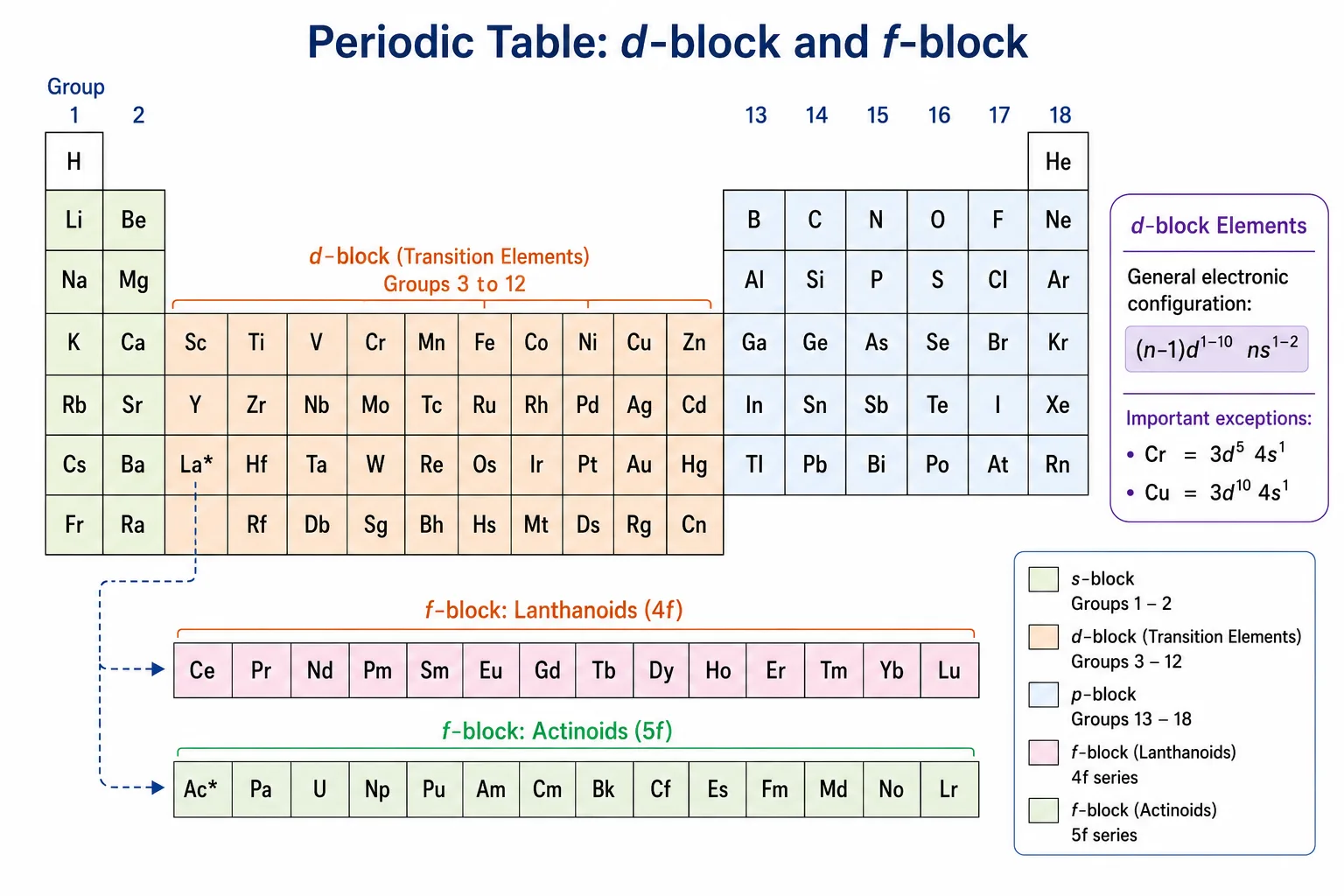
[JEE Tip] The general configuration is worth memorising — but watch for the two big exceptions (Cr and Cu) covered next, which examiners test relentlessly.
Writing the Configurations (and the Cr, Cu Exceptions)
For the 3d series, electrons fill 4s before 3d, giving configurations like:
- Sc:
- Ti:
- V:
- Mn:
- Fe:
But two elements break the pattern because half-filled and fully-filled d subshells are extra stable:
- Chromium: — not . The (half-filled) configuration is more stable.
- Copper: — not . The (fully-filled) configuration is more stable.
Key Point: The exceptional stability of half-filled () and fully-filled () subshells comes from their symmetrical distribution and large exchange energy. This explains the Cr and Cu anomalies — and recurs throughout the chapter (e.g. why Mn and Zn are stable).
Configurations of ions
When a transition metal ionises, it loses ns electrons first, then . So Fe () gives Fe () and Fe ().
Solved Examples
Example 1: Configuration of chromium
Write the ground-state electronic configuration of chromium (Z = 24) and explain the anomaly.
Solution: Expected: . Actual: . One 4s electron shifts to 3d to give a half-filled subshell, which is extra stable (symmetry + exchange energy).
Example 2: Configuration of copper
Write the configuration of copper (Z = 29).
Solution: (not ) — the fully-filled subshell is more stable.
Example 3: Configuration of an ion
Write the configuration of Fe (Fe, Z = 26).
Solution: Fe is . Removing electrons ( first, then ): Fe loses both electrons and one electron, giving . (The stable half-filled is why Fe is common.)
Example 4: Why Zn is not a typical transition metal
Explain why zinc (Z = 30) is not regarded as a typical transition element.
Solution: Zn is , and its common ion Zn is — a completely filled d subshell. Since neither the atom nor its common ion has a partially filled d subshell, Zn is not a typical transition metal.
Example 5: Mn configuration
Write the configuration of Mn (Mn, Z = 25).
Solution: Mn is ; Mn loses the two electrons to give — a stable half-filled subshell.
Example 6: General configuration
Write the general outer electronic configuration of a d-block element.
Solution: — the subshell fills while the subshell holds one or two electrons.
Example 7: Order of electron removal
When a transition metal forms a cation, which electrons are removed first?
Solution: The electrons are removed before the electrons. For example, Ti () gives Ti (), losing the pair first.
Example 8: Sc configuration
Write the configuration of Sc (Sc, Z = 21) and comment.
Solution: Sc is ; Sc loses all three outer electrons to give (a noble-gas core, ). This is why Sc is colourless and diamagnetic.
Example 9: Cu vs Cu configurations
Write the configurations of Cu and Cu (Cu, Z = 29).
Solution: Cu is . Cu = (fully filled); Cu = (one unpaired electron, hence coloured and paramagnetic).
Example 10: Identify the series
The element with configuration belongs to which series and which group?
Solution: It is in the 3d (first transition) series. With 3 + 2 = 5 outer electrons it is vanadium (V, group 5).