
The f-Block: Lanthanoids and Actinoids
Below the main periodic table sit the f-block (inner-transition) elements, in which the f orbitals are progressively filled:
- Lanthanoids: the 14 elements Ce (58) to Lu (71) following lanthanum — filling the 4f subshell.
- Actinoids: the 14 elements Th (90) to Lr (103) following actinium — filling the 5f subshell.
Electronic configurations:
- Lanthanoids: general .
- Actinoids: general .
The lanthanoids are chemically very similar to one another (which makes them hard to separate), all dominated by the +3 oxidation state.
The Lanthanoid Contraction
The defining feature of the lanthanoids is the lanthanoid contraction — the steady decrease in atomic and ionic radii from La to Lu across the series.
Cause: as we move along, each added electron enters a 4f orbital, which shields very poorly. So the effective nuclear charge felt by the outer electrons rises steadily, pulling them inward — a small but cumulative contraction over 14 elements.
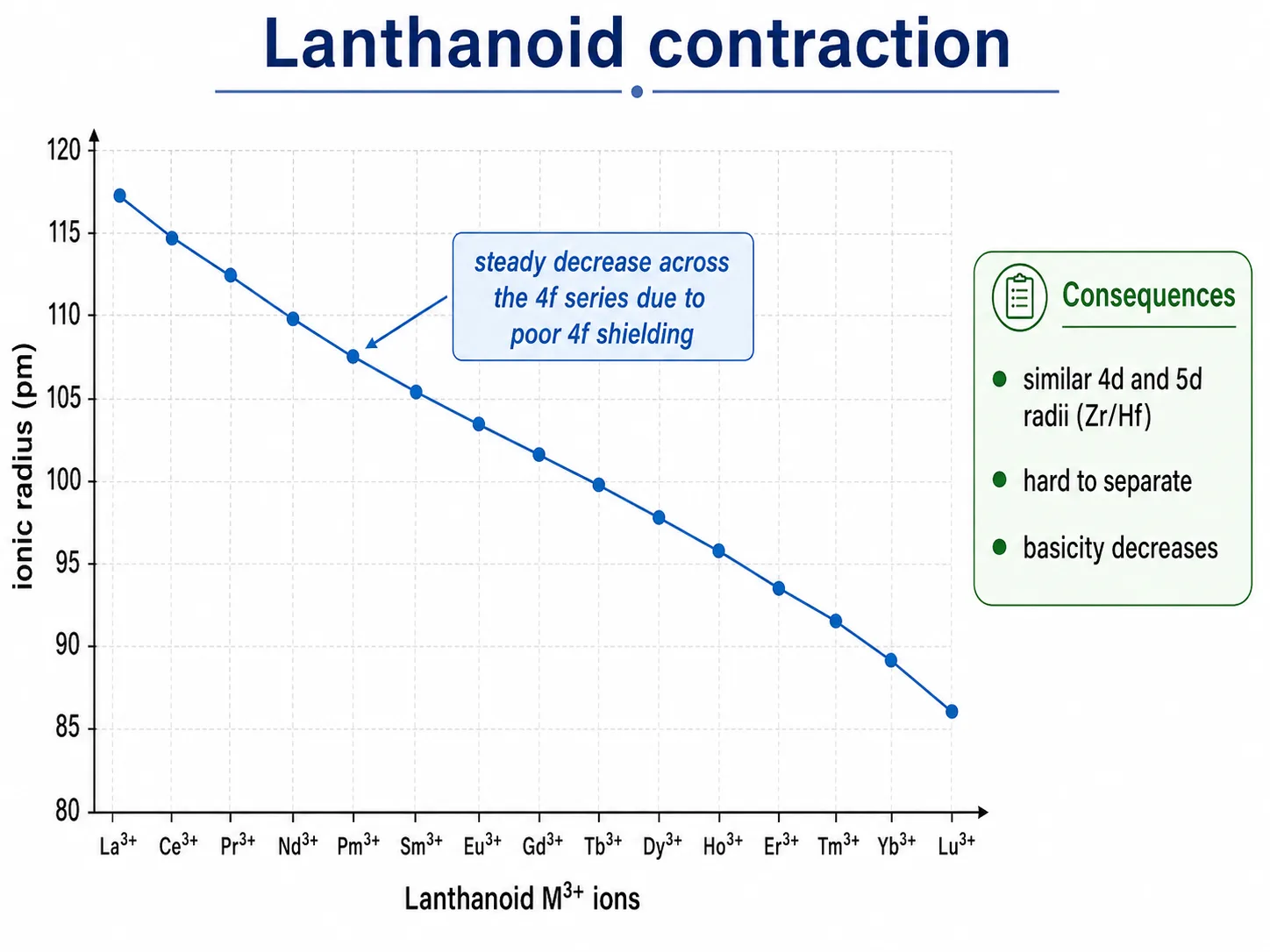
Consequences (highly exam-important):
- The 4d and 5d transition series have almost the same radii (e.g. Zr/Hf, Nb/Ta), making those pairs hard to separate.
- The basicity of the hydroxides decreases from La(OH) to Lu(OH) (smaller ions, more covalent).
- The lanthanoids themselves are difficult to separate because their sizes (and so chemistry) are so similar.
[NEET Important] "Lanthanoid contraction" and its consequences (especially the near-identical 4d/5d radii) appear almost every year. Know the cause (poor 4f shielding) and at least two consequences.
Oxidation States and the Lanthanoid-Actinoid Comparison
Lanthanoid oxidation states:
- +3 is the characteristic and most stable state for all lanthanoids.
- A few show +2 or +4 as well (e.g. Ce — a good oxidising agent; Eu — a reducing agent), where these give a stable empty/half/full 4f.
Actinoids differ from lanthanoids in several ways:
- They show a much greater range of oxidation states (e.g. up to +6 or +7 for U, Np, Pu) because the 5f, 6d and 7s orbitals are close in energy.
- They show actinoid contraction, which is even greater per element than the lanthanoid contraction (because 5f electrons shield even more poorly).
- All actinoids are radioactive; the elements beyond uranium are synthetic (man-made).
Key Point: Lanthanoids = mostly +3, non-radioactive, 4f. Actinoids = many oxidation states, all radioactive, 5f. Both show a contraction, but the actinoid contraction is larger per step.
Solved Examples
Example 1: Define lanthanoid contraction
What is the lanthanoid contraction?
Solution: It is the steady decrease in atomic and ionic radii of the lanthanoids from La to Lu, caused by the poor shielding of the nucleus by the 4f electrons, which lets the effective nuclear charge increase across the series.
Example 2: A consequence
State one important consequence of the lanthanoid contraction.
Solution: The second (4d) and third (5d) transition series have nearly the same atomic radii (e.g. Zr and Hf), so those element pairs are very similar and hard to separate.
Example 3: Common oxidation state of lanthanoids
What is the most stable oxidation state of the lanthanoids?
Solution: +3 — it is the characteristic and most stable oxidation state for essentially all the lanthanoids.
Example 4: Ce4+ and Eu2+
Why do cerium and europium show +4 and +2 states respectively?
Solution: Ce attains the stable empty configuration, so it forms readily (and is a strong oxidising agent). Eu attains the stable half-filled , so it forms (and is a reducing agent).
Example 5: Why actinoids show more oxidation states
Why do actinoids exhibit a greater range of oxidation states than lanthanoids?
Solution: In the actinoids the 5f, 6d and 7s orbitals are close in energy, so more electrons can participate in bonding, giving a wider variety of oxidation states (up to +6/+7) than the lanthanoids (mostly +3).
Example 6: Radioactivity
State two differences between lanthanoids and actinoids.
Solution: (1) All actinoids are radioactive, whereas most lanthanoids are not. (2) Actinoids show a much greater range of oxidation states than the +3-dominated lanthanoids.
Example 7: Basicity trend
How does the basicity of lanthanoid hydroxides change across the series?
Solution: Basicity decreases from La(OH) to Lu(OH). As ionic size decreases (lanthanoid contraction), the M-OH bond becomes more covalent, so the hydroxide becomes less basic.
Example 8: Actinoid contraction
How does the actinoid contraction compare with the lanthanoid contraction?
Solution: The actinoid contraction is greater per element than the lanthanoid contraction, because the 5f electrons shield even more poorly than 4f electrons.
Example 9: Configuration of a lanthanoid
Write the general electronic configuration of the lanthanoids.
Solution: — the 4f subshell is progressively filled.
Example 10: Why lanthanoids are hard to separate
Why is it difficult to separate individual lanthanoids?
Solution: Because of the lanthanoid contraction, their ionic sizes and chemical properties are very similar, so they behave almost identically in reactions — making chemical separation very hard (modern methods use ion-exchange/solvent extraction).