
Magnetic Properties
Place a substance in a magnetic field. Diamagnetic substances (all electrons paired) are weakly repelled; paramagnetic substances (one or more unpaired electrons) are attracted. Most transition-metal ions are paramagnetic because they have unpaired d electrons.
The strength of paramagnetism is measured by the magnetic moment. For transition-metal ions, the orbital contribution is usually quenched, so we use the spin-only formula:
where is the number of unpaired electrons and BM is the Bohr magneton. A single unpaired electron gives BM.
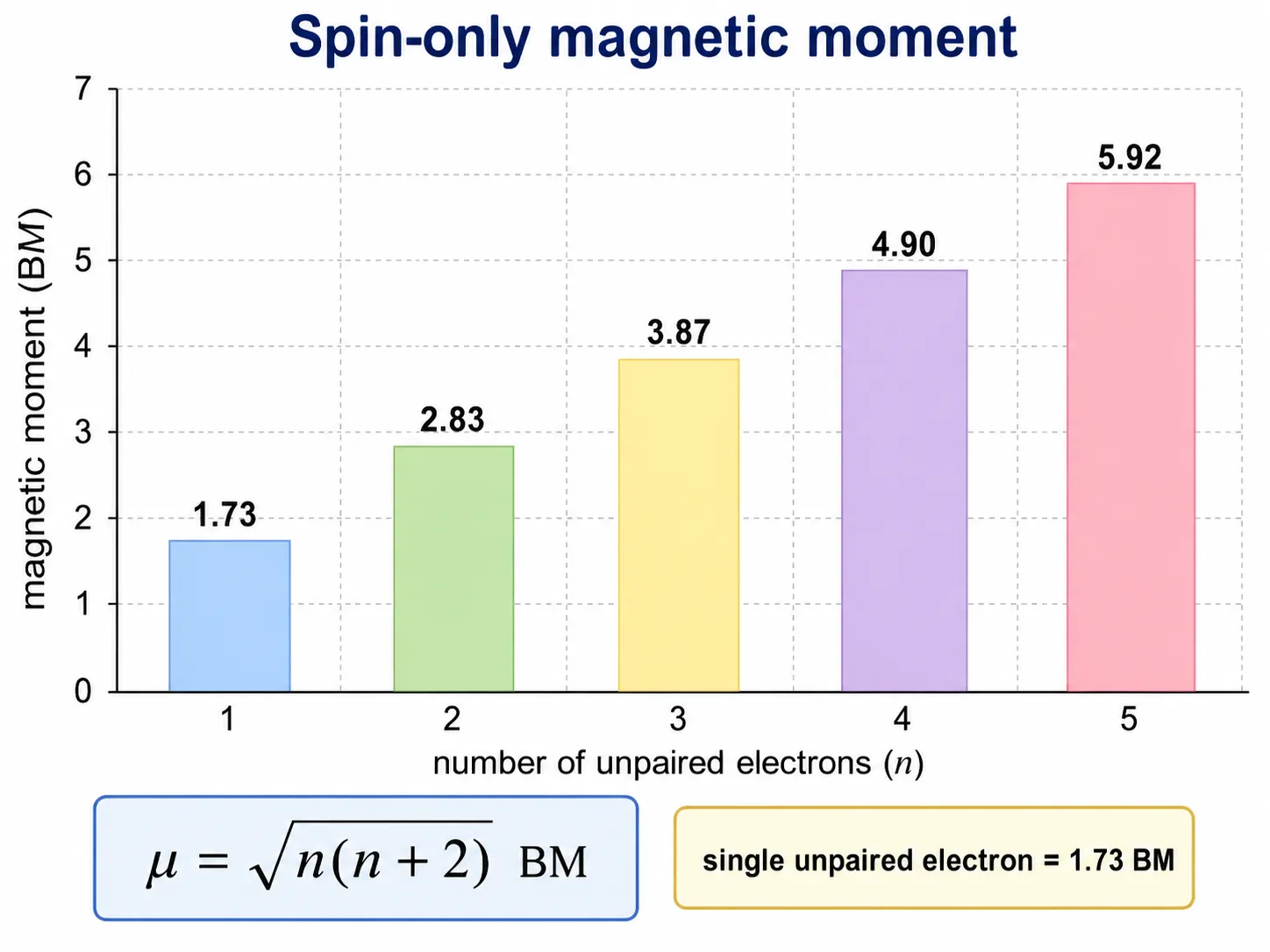
| Unpaired electrons | BM |
|---|---|
| 1 | 1.73 |
| 2 | 2.83 |
| 3 | 3.87 |
| 4 | 4.90 |
| 5 | 5.92 |
Using the Spin-Only Formula
The formula works both ways:
- Given the configuration, count unpaired electrons , then compute .
- Given the measured , solve for to deduce the number of unpaired electrons (and hence the oxidation state).
Worked example: for Mn (), all five d electrons are unpaired, so and BM.
Key Point: To count unpaired electrons, write the d-configuration of the ion (not the atom) and fill the five d orbitals following Hund's rule. For Fe (): 5 unpaired; for Ni (): 2 unpaired; for Zn (): 0 unpaired (diamagnetic).
[NEET Important] Spin-only magnetic moment is the single most common numerical in this chapter. Always: (1) find the ion's d-configuration, (2) count , (3) apply .
Why Transition-Metal Compounds Are Coloured
Most transition-metal ions are coloured — and the reason is their partially filled d subshell.
When a transition-metal ion is surrounded by ligands, the five d orbitals split into two energy levels. A d electron can absorb a photon of visible light and jump from the lower to the higher set — a d-d transition. The light absorbed is removed from white light, and we see the complementary colour.
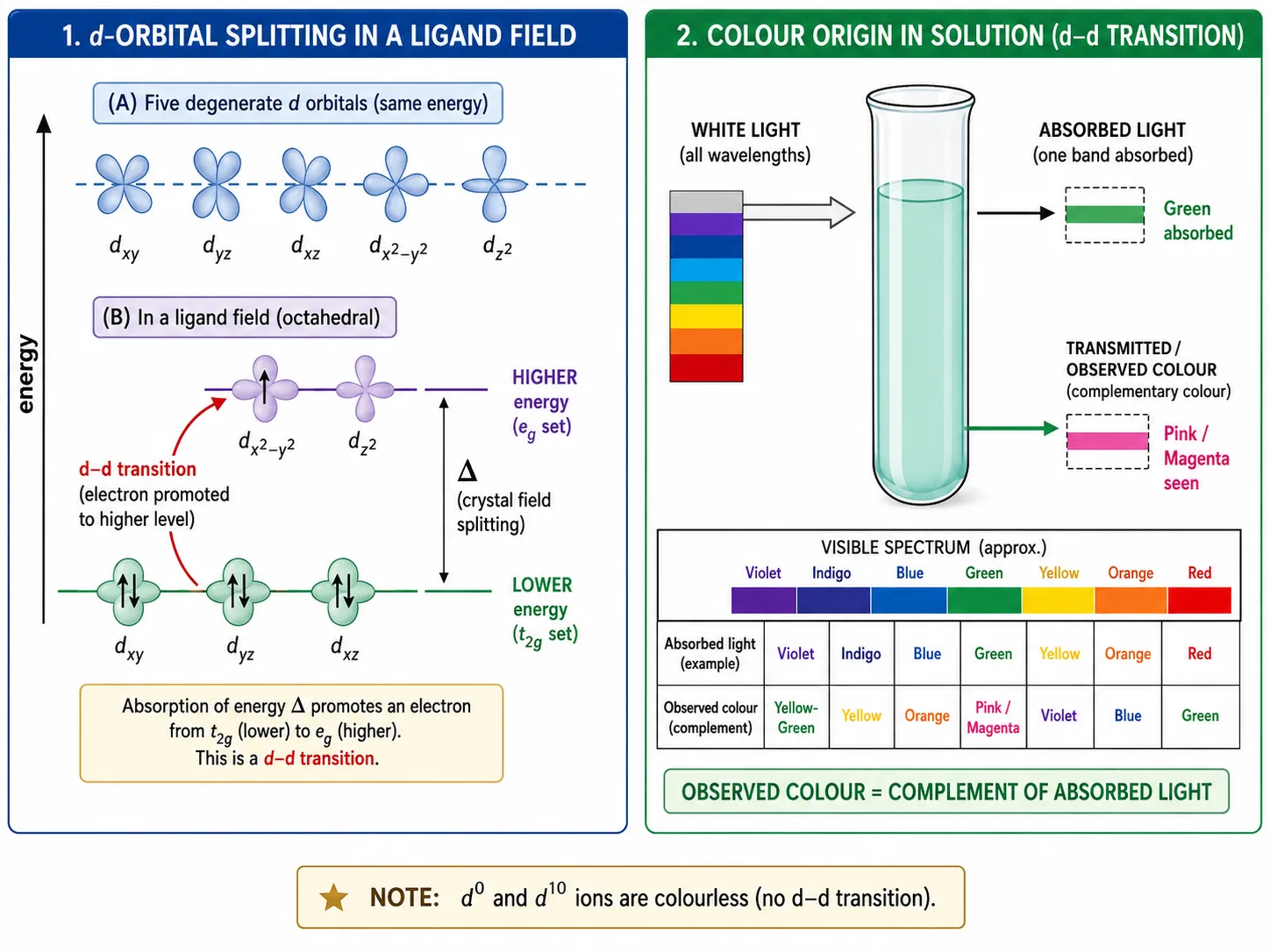
- Ions with (e.g. Sc, Ti) or (e.g. Zn, Cu) are colourless — there is no partially filled d set for a d-d transition.
- The colour depends on the metal, its oxidation state, and the ligands (which set the size of the d-orbital splitting).
Examples: is blue; () is purple; Mn salts are pale pink. Sc and Zn salts are white.
[JEE Tip] "Why is Zn (or Sc) colourless?" — because it has a (or ) configuration with no possible d-d transition. This is a guaranteed exam question.
Solved Examples
Example 1: Spin-only moment of Mn2+
Calculate the spin-only magnetic moment of Mn ().
Solution: Mn is with 5 unpaired electrons. BM.
Example 2: Moment of a d2 ion
Calculate the spin-only moment of an ion with configuration.
Solution: has 2 unpaired electrons. BM.
Example 3: Number of unpaired electrons from moment
A transition-metal ion has a spin-only moment of 3.87 BM. How many unpaired electrons does it have?
Solution: , so , giving . Three unpaired electrons (a ion such as Cr).
Example 4: Moment of M2+ with Z = 27
Calculate the spin-only magnetic moment of the M ion with (cobalt).
Solution: Co is ; Co is with 3 unpaired electrons. BM.
Example 5: Diamagnetic ion
Which of Zn, Cu, Fe is diamagnetic, and why?
Solution: Zn () is diamagnetic — all d electrons are paired (, ). Cu (, 1 unpaired) and Fe (, 5 unpaired) are paramagnetic.
Example 6: Why Sc3+ is colourless
Why are Sc salts colourless?
Solution: Sc has a configuration — no d electrons for a d-d transition — so it cannot absorb visible light and appears colourless.
Example 7: Colour of Cu+ vs Cu2+
Why is Cu colourless but Cu coloured?
Solution: Cu is (fully filled) — no d-d transition possible, so colourless. Cu is with a vacancy in the d set, allowing a d-d transition that absorbs visible light — so it is coloured (blue).
Example 8: Moment of Ni2+
Calculate the spin-only moment of Ni ().
Solution: Ni is ; Ni is with 2 unpaired electrons. BM.
Example 9: Origin of colour
What causes the colour of transition-metal compounds?
Solution: d-d electronic transitions. In a ligand field the d orbitals split; a d electron absorbs visible light to jump between the split levels. The colour seen is the complement of the light absorbed.
Example 10: Identify maximum paramagnetism
Among Ti (), V (), Cr () and Mn (), which has the largest spin-only moment?
Solution: Mn () has the most unpaired electrons (5), giving the largest moment, BM.